World Models Shift from Prediction to Planning: HWM and the Challenge of Long-Horizon Control

marsbit2026-04-17 tarihinde yayınlandı2026-04-17 tarihinde güncellendi

Özet

World models have evolved from focusing on representation learning and future prediction to addressing long-horizon planning challenges. While models like V-JEPA 2 demonstrate strong predictive capabilities using large-scale video pre-training, they struggle with multi-stage control tasks due to error accumulation and exponential growth in action search space. HWM (Hierarchical World Model) introduces a two-level planning structure: a high-level planner outlines coarse subgoals over longer time horizons, while a low-level executor handles short-term actions. This decomposition reduces planning complexity and error propagation. In experiments, HWM achieved 70% success in real-world robotic tasks where flat models failed entirely. Complementary efforts include V-JEPA (focused on representation), HWM (on hierarchical planning), and WAV (World Action Verifier, on self-correction). Together, they mark a shift from pure world modeling to integrated systems capable of prediction, planning, and verification—key to deploying world models in real-world agents and long-term tasks.

Over the past year, the research focus of world models has initially centered on representation learning and future prediction. Models first understand the world and then internally simulate future states. This approach has already produced a number of representative results. V-JEPA 2 (Video Joint Embedding Predictive Architecture 2—a video world model suite released by Meta in 2025) used over 1 million hours of internet video for pre-training, combined with a small amount of robot interaction data, demonstrating the potential of world models in understanding, prediction, and zero-shot robot planning.

However, a model's ability to predict does not equate to its ability to handle long-horizon tasks. When faced with multi-stage control, systems typically encounter two challenges. One is that prediction errors accumulate over long rollouts (multi-step simulations), causing the entire path to increasingly deviate from the goal. The other is that the action search space expands rapidly as the planning horizon increases, leading to continuously rising planning costs. HWM does not rewrite the underlying learning approach of world models but instead adds a hierarchical planning structure on top of existing action-conditioned world models, enabling the system to first organize stage paths and then handle local actions.

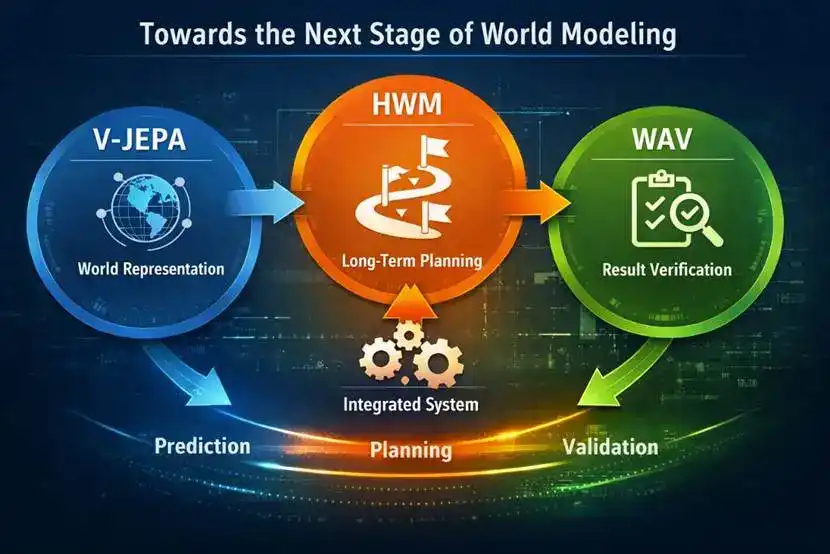
From a technical perspective, V-JEPA 2 (https://ai.meta.com/research/vjepa/) leans more toward world representation and basic prediction, HWM leans more toward long-horizon planning, and WAV (World Action Verifier: Self-Improving World Models via Forward-Inverse Asymmetry, https://arxiv.org/abs/2604.01985) leans more toward the model's ability to identify and correct its own prediction distortions. These three lines of research are gradually converging. The focus of world model research has shifted from merely predicting the future to transforming predictive capabilities into executable, correctable, and verifiable system capabilities.

I. Why Long-Horizon Control Remains a Bottleneck for World Models

The difficulties of long-horizon control become clearer when applied to robotic tasks. Take robotic arm manipulation as an example: picking up a cup and placing it in a drawer is not a single action but a sequence of continuous steps. The system must approach the object, adjust its posture, complete the grasp, move to the target location, and then handle the drawer and placement. As the chain lengthens, two problems arise simultaneously. One is that prediction errors accumulate along the rollout, and the other is that the action search space expands rapidly.
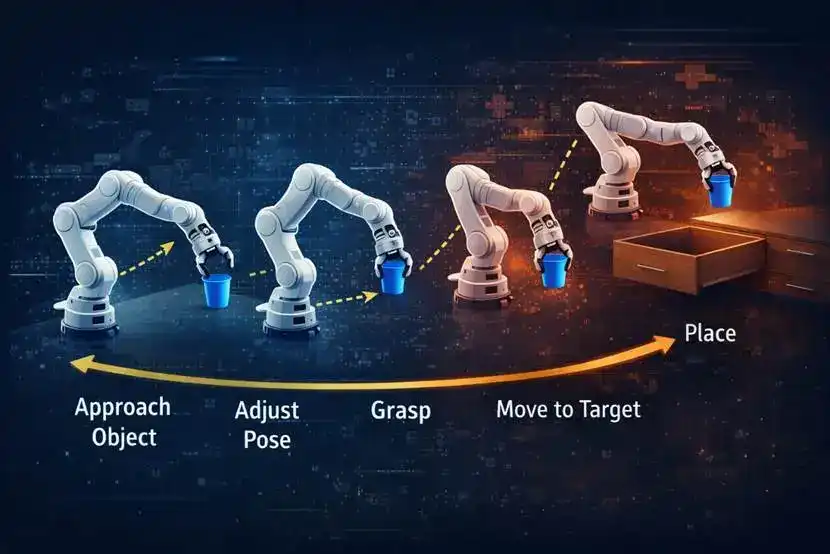
What the system often lacks is not local predictive ability but the capacity to organize distant goals into stage paths. Many actions may appear to deviate from the goal locally but are actually intermediate steps required to achieve it. For example, raising the arm before grasping or moving back slightly and adjusting the angle before opening a drawer.

In demonstration tasks, world models can already provide coherent predictions. However, when entering real control scenarios, performance begins to decline, and problems emerge. The pressure comes not only from the representation itself but also from the immaturity of the planning layer.

II. How HWM Restructures the Planning Process

HWM splits the originally single-layer planning process into two layers. The upper layer is responsible for stage direction at a longer time scale, while the lower layer handles local execution at a shorter time scale. The model plans at two different temporal rhythms simultaneously, rather than at a single pace.

When handling long tasks, single-layer methods typically need to search the entire action chain directly in the underlying action space. The longer the task, the higher the search cost, and the more likely prediction errors are to diffuse along multi-step rollouts. After HWM's decomposition, the high layer only handles route selection at a longer time scale, and the low layer only handles the execution of the current segment. The entire long task is broken into multiple shorter segments, reducing planning complexity.

Another key design is that high-level actions are not simply the difference between two states but use an encoder to compress a sequence of low-level actions into a higher-level action representation. For long tasks, the key is not just the difference between the start and end points but also how the intermediate steps are organized. If the high layer only looks at displacement differences, it may lose path information in the action chain.

HWM embodies a hierarchical task organization approach. Faced with a multi-stage task, the system no longer unfolds all actions at once but first forms a coarse stage path and then executes and corrects it segment by segment. Once this hierarchical relationship is incorporated into the world model, predictive capabilities begin to transform more stably into planning capabilities.

III. From 0% to 70%: What the Experimental Results Indicate

In the real-world grasp-and-place task set up in the paper, the system was given only the final goal condition without manually decomposed intermediate goals. Under these conditions, HWM achieved a success rate of 70%, while the single-layer world model had a 0% success rate. A long task that was nearly impossible to complete originally became highly achievable after introducing hierarchical planning.
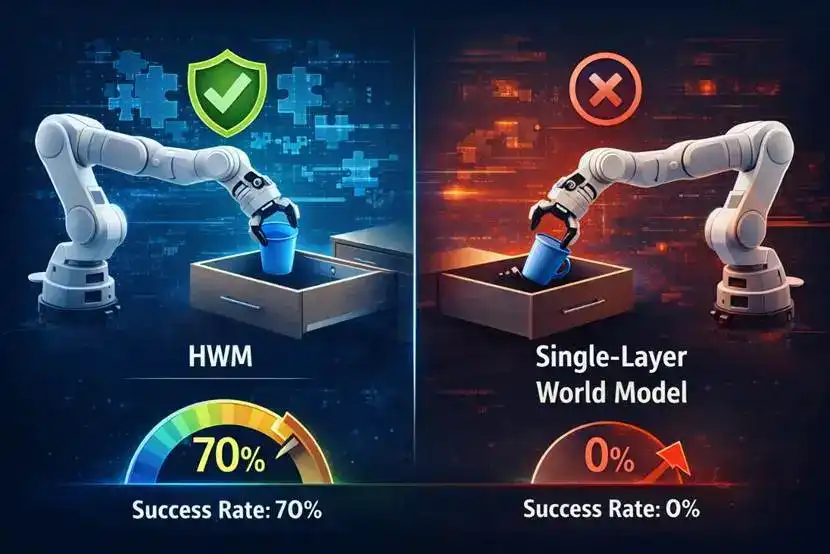
The paper also tested simulation tasks such as object pushing and maze navigation. The results showed that hierarchical planning not only improved success rates but also reduced the computational cost of the planning phase. In some environments, the computational cost of the planning phase could be reduced to about a quarter of the original while maintaining higher or comparable success rates.

IV. From V-JEPA to HWM to WAV

V-JEPA 2 represents the world representation approach. V-JEPA 2 used over 1 million hours of internet video for pre-training, combined with less than 62 hours of robot video for post-training (targeted training after pre-training), resulting in a latent action-conditioned world model (a world model that predicts in an abstract representation space incorporating action information) usable for understanding, predicting, and planning in the physical world. It demonstrates that models can acquire world representations through large-scale observation and transfer these representations to robot planning.

HWM is the next step. The model already possesses world representation and basic predictive capabilities, but once multi-stage control is involved, the problems of error accumulation and search space expansion erupt. HWM does not change the underlying representation learning approach but adds a multi-timescale planning structure on top of existing action-conditioned world models. It addresses how the model organizes distant goals into a set of intermediate steps and then advances segment by segment.

WAV further focuses on verification capabilities. For world models to enter policy optimization and deployment scenarios, they cannot just predict; they must also identify areas where they are prone to distortion and make corrections accordingly. It focuses on how the model checks itself.

V-JEPA leans toward world representation, HWM toward task planning, and WAV toward result verification. Although their focuses differ, their overall direction is consistent. The next phase of world models is no longer just internal prediction but the gradual integration of prediction, planning, and verification into a system capability.
V. From Internal Prediction to Executable Systems

Many past world model efforts were closer to improving the continuity of future state predictions or the stability of internal world representations. However, the current research focus is beginning to change. Systems must not only form judgments about the environment but also translate those judgments into actions and continue to adjust the next steps after results are obtained. To get closer to real deployment, it is necessary to control error propagation in long-horizon tasks, compress the search space, and reduce inference costs.

Such changes will also affect AI agents. Many agent systems can already handle short-chain tasks, such as calling tools, reading files, and executing multi-step commands. However, once tasks become long-chain, multi-stage, and require mid-course re-planning, performance declines. This is not fundamentally different from the difficulties in robotic control; both stem from insufficient high-level path organization capabilities, leading to a disconnect between local execution and overall goals.

The hierarchical approach provided by HWM—where the high level is responsible for paths and stage goals, the low level handles local actions and feedback processing, and result verification is layered on top—will continue to appear in more systems in the future. The next phase of world models will focus not only on predicting the future but on organizing prediction, execution, and correction into a viable path.


İlgili Sorular

QWhat are the main challenges in long-horizon control for world models, as discussed in the article?

AThe main challenges are the accumulation of prediction errors during long rollout sequences, which causes the system to increasingly deviate from the goal, and the exponential expansion of the action search space as the planning horizon grows, leading to rising computational costs.

QHow does HWM (Hierarchical World Model) address the problem of long-term task planning?

AHWM restructures the planning process into two layers: a high-level layer that plans stage directions over longer time scales, and a low-level layer that handles local execution over shorter time scales. This hierarchical approach breaks long tasks into shorter segments, reducing planning complexity and error propagation.

QWhat key improvement did HWM demonstrate in experimental results for real-world tasks?

AIn a real-world grasping and placement task where only the final target was provided without intermediate goals, HWM achieved a 70% success rate, compared to a 0% success rate for a single-layer world model. It also reduced computational costs by up to a quarter in some environments while maintaining high success rates.

QWhat are the distinct focuses of V-JEPA 2, HWM, and WAV in world model research?

AV-JEPA 2 focuses on world representation and foundational prediction using large-scale video pre-training. HWM emphasizes hierarchical task planning for long-horizon control. WAV (World Action Verifier) concentrates on self-verification, identifying and correcting prediction distortions to improve model reliability.

QHow is the research focus of world models evolving beyond mere prediction?

AThe research is shifting from internal future prediction to building executable systems that integrate prediction, planning, and verification. This involves controlling error propagation, compressing search spaces, reducing inference costs, and organizing hierarchical structures for reliable long-term task execution.

İlgili Okumalar

Can DeepSeek Save China One Trillion Dollars?

"DeepSeek and the $1 Trillion Infrastructure Question" The article examines whether DeepSeek's AI optimization breakthroughs could potentially save China $1 trillion in future AI infrastructure costs. The analysis begins with Nvidia's upcoming Vera Rubin AI platform, costing ~$7.8 million, where memory (HBM4/LPDDR5X) constitutes $2 million—a 435% cost increase in one year, highlighting how AI hardware spending is shifting toward expensive memory components. DeepSeek's approach works in the opposite direction. Through three key technical innovations showcased in DeepSeek V4, the company dramatically improves hardware efficiency: 1. **Memory Compression (MLA)**: Re-engineers the attention mechanism to compress long-context memory (KV Cache) by over 90%, drastically reducing expensive HBM usage. 2. **Selective Activation (MoE)**: Employs Mixture-of-Experts architecture where only a small fraction of parameters (e.g., 49B out of 1.6T in V4-Pro) are activated per token, allowing most parameters to reside in cheaper memory/SSD. 3. **Computation Caching**: Reuses previously computed results via cache hits, replacing expensive GPU computations with cheap memory reads. Combined, these optimizations allow the same hardware to produce approximately 4x more tokens, effectively reducing required hardware investment by 75%. DeepSeek's pricing reflects this: a 10-billion token workload costs ~$522 monthly versus ~$9,000-$10,000 for competitors. The $1 trillion savings projection stems from McKinsey's estimate that global AI infrastructure will require ~$5.2 trillion investment by 2030. As China's daily token consumption grows toward quadrillions, even marginal efficiency gains scale massively. With a conservative 4x throughput improvement, China could avoid building tens of thousands of AI data centers equivalent to ~7 trillion RMB ($1 trillion) in saved investment. Critically, this strategy shifts dependency from scarce, expensive GPU/HBM—where China lags—toward more accessible storage, caching, and systems engineering where domestic suppliers like CXMT are gaining strength. Rather than "replacing Nvidia," DeepSeek rebalances AI's value chain away from monolithic hardware dependency. Ultimately, DeepSeek's technical breakthroughs could lower the barrier to AI adoption across Chinese industries by making advanced capabilities affordable at scale—transforming who can access next-generation AI.

marsbit47 dk önce

Can DeepSeek Save China One Trillion Dollars?

marsbit47 dk önce

Overturning the Mainstream Approach to Hallucinations: Metacognition is the New Solution for Large Models to Break the Hallucination Barrier

This paper, "Hallucinations Undermine Trust; Metacognition is a Way Forward," proposes a paradigm shift in combating AI hallucination. It argues that the current mainstream approaches—striving for omniscience by scaling data/models or having AI abstain from uncertain answers—are fundamentally flawed. The former has inevitable knowledge gaps, while the latter imposes a crippling "utility tax," requiring the rejection of many correct answers to achieve high accuracy, due to models' poor "discrimination" (the ability to distinguish correct from incorrect answers internally). The core contribution is redefining hallucination not as "being wrong," but as "expressing false information with unwarranted certainty." The proposed solution is **Faithful Uncertainty** or **Metacognition**: enabling AI to accurately perceive its internal uncertainty and honestly express it in its language (e.g., using hedging phrases when unsure). This creates a more reliable assistant that provides useful information while signaling its confidence, minimizing harm from errors. The paper emphasizes that metacognition is critical for the era of AI Agents. Without it, Agents cannot intelligently decide when to use tools like search engines, leading to inefficiency and misuse. Key implementation challenges are highlighted: the "bootstrapping paradox" of training with static uncertainty data, the "alignment distortion signal" where human preference training suppresses internal uncertainty cues, and the difficulty of causally evaluating true metacognition vs. its superficial imitation. The paper concludes that the goal should not be an infallible AI, but one that is honest about the limits of its knowledge, thereby building user trust through transparent communication of its certainty.

marsbit51 dk önce

Overturning the Mainstream Approach to Hallucinations: Metacognition is the New Solution for Large Models to Break the Hallucination Barrier

marsbit51 dk önce

Hedge by Buying Gold and Oil, Chase Soaring Returns with AI. ‘Dated’ Bitcoin Enters a Bear Market

Bitcoin has recently declined, hitting a two-month low near $66,123, while Ethereum fell to a three-month low around $1,837. Analysts suggest the drop is not merely due to factors like ETF outflows or MicroStrategy's selling but reflects a deeper issue: Bitcoin is losing a broader asset competition. In a near-zero interest rate environment, Bitcoin previously thrived as an outlet for investor dissatisfaction with inflation and limited options. However, the market landscape has shifted. Bitcoin now occupies an "awkward middle ground," facing competition on three fronts. For inflation hedging, investors prefer gold, energy stocks, and commodity producers—assets with tangible backing and clearer pricing power. For growth exposure, AI-related companies with actual revenues and profits are more attractive. Even within crypto, investors can choose stablecoins, exchanges, or infrastructure firms tied directly to adoption, offering clearer business models and leverage. Thus, Bitcoin is no longer the top choice for hedging, growth, or crypto exposure. This shift is evident in market reactions: despite recent warnings about persistent inflation from a Fed official, Bitcoin did not rally as it might have in the past. Instead, capital flowed to assets with direct commodity or energy exposure. The recent ETF outflows and MicroStrategy sales are symptoms, not causes, of this new reality. Investors are becoming more selective, demanding clearer value propositions beyond mere scarcity. The emerging bear case for Bitcoin is not about it being a bubble or failed technology, but that scarcity alone is no longer sufficient.

华尔街日报54 dk önce

Hedge by Buying Gold and Oil, Chase Soaring Returns with AI. ‘Dated’ Bitcoin Enters a Bear Market

华尔街日报54 dk önce

İşlemler

Spot
Futures
活动图片




