‘Withdraw Insurance to Buy Stocks’: South Koreans Over 60 Are Borrowing to Bet on Samsung

marsbit2026-05-21 tarihinde yayınlandı2026-05-21 tarihinde güncellendi

Özet

South Korea's stock market has seen a frenzy, with the KOSPI nearly doubling in six months. This boom is fueled by a surge in retail investors borrowing to buy stocks, with outstanding margin loans hitting a record high. A significant portion of this debt is held by people over 50, with the 60+ age group seeing the fastest growth. Many are reportedly cashing out savings-type life insurance policies—even at a loss—to fund their stock investments. They are heavily concentrated in major semiconductor stocks like Samsung Electronics and SK Hynix, which have driven most of the market's gains. This trend is particularly risky for older investors, who are leveraging their limited retirement savings. While a market correction in March caused significant losses for leveraged accounts, the swift recovery and continued rally have reinforced risky behavior. Stories of quick profits on platforms like Blind further fuel the speculative rush. The phenomenon is partly driven by economic anxiety. With South Korea having a high elderly poverty rate and a low public pension replacement rate, some seniors see the booming market as a last chance to improve their finances. This "FOMO" (fear of missing out) sentiment is palpable, even in public parks where retirees gather and now discuss stock tips alongside their usual activities. Despite regulatory warnings and the inherent risks of leverage—especially for those with little time to recover from losses—the borrowing binge continues. The market...

Author: Curry, Deep Tide TechFlow

How frenzied has the South Korean stock market become recently?

The KOSPI rose from around 4,000 points to nearly 8,000 points in six months. According to a report in the "JoongAng Ilbo," the employee restrooms in a department store in Seoul's Gangnam District are completely full every day at 3:30 p.m., the market close time, with employees hiding inside to check stock prices.

By mid-May, the balance of loans taken by Korean retail investors from securities firms for stock trading had surged to a historic high of 36.47 trillion won (approximately 170 billion yuan), doubling within a year.

But in this carnival, the source of the money is a bit odd.

According to a report in the "Korea Herald," the three major life insurance companies in South Korea saw policy surrenders totaling 4.9 trillion won (approximately 230 billion yuan) in the first quarter, a year-on-year increase of 16.3%. Savings-type life insurance policies were surrendered the most aggressively, up 23.2%.

Savings-type life insurance is inherently a product for leaving money to family. Surrendering a policy guarantees a loss, as the surrender value is lower than the premiums paid. Yet, more and more people are choosing to take a loss and surrender their policies.

Where does the withdrawn money go? Most likely, into another stock trading account.

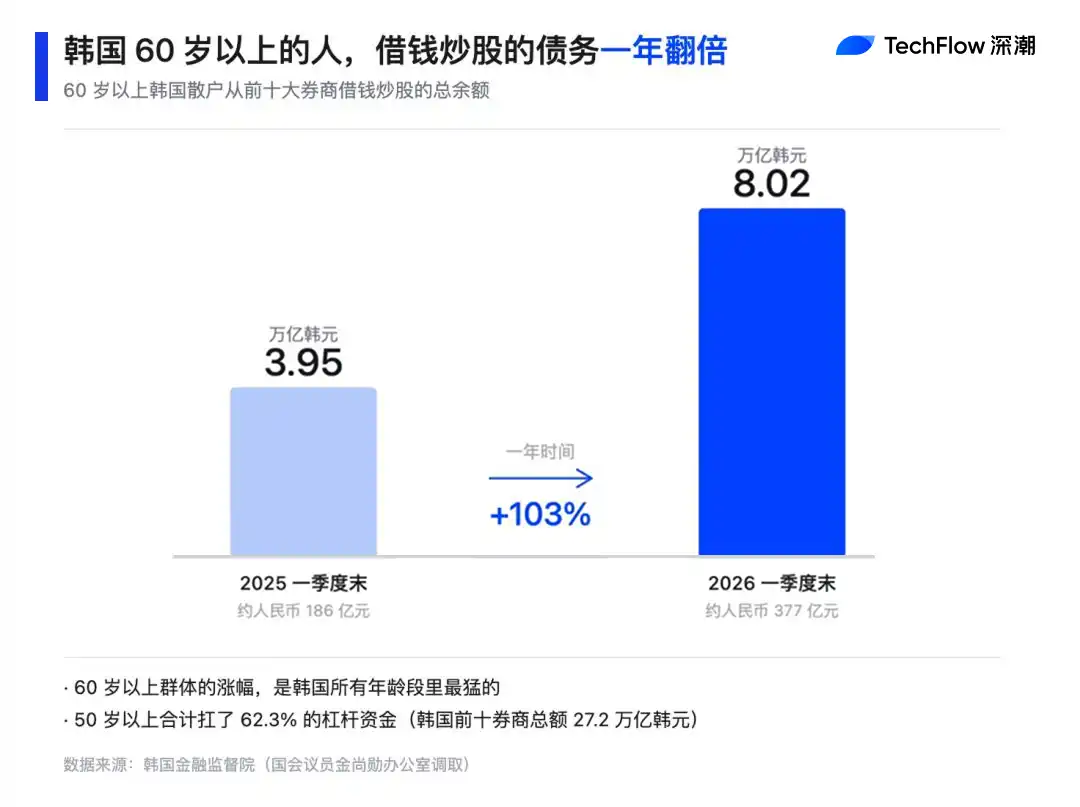
Data obtained by a South Korean lawmaker from the Financial Supervisory Service shows that as of the end of the first quarter, retail investors borrowed 27 trillion won from the top ten securities firms for stock trading. Of this amount, over sixty percent (62.3%) was borrowed by people aged 50 and above.

The debt of the group aged 60 and above doubled in one year, from 3.95 trillion won to 8.02 trillion won, the sharpest increase among all age groups.

Withdrawing insurance to buy stocks—an entire generation of South Koreans is using future money to chase the current bottom.
Borrowing Because of the Crazy Bull Market?

Adding leverage in a bull market is called "amplifying returns"; adding leverage in a bear market is called "accelerating to zero." Korean seniors have already experienced this roller coaster once.

In early March of this year, joint U.S.-Israel airstrikes on Iran caused panic in global capital markets. The South Korean stock market triggered circuit breakers for two consecutive trading days, with the KOSPI plunging nearly 13%.

According to a late March report by the Financial Supervisory Service of South Korea, during that downturn, among the nation's 4.6 million retail investor accounts, those who used margin loans lost an average of 19%, while those who didn't lost 8.2%. Those who borrowed to trade stocks lost 2.3 times more than those who didn't borrow.

Breaking it down by age group, the leveraged account holders aged 60 and above suffered the worst, with an average return rate of -19.8%, the lowest among all age groups.

What's even harsher is what comes next: forced liquidation.

Leveraged accounts have a liquidation line. If the market value of the stocks in the account falls below this line, the securities firm won't consult with you; they will directly sell your positions. The Financial Supervisory Service received numerous complaints from retail investors at the time, such as "My stocks were sold without my knowledge" and "I was charged exorbitant interest rates."

A significant portion of these complaints came from the elderly, who were already unfamiliar with trading rules. However, it must be said, the retail investors who held on during the March circuit breakers ultimately won.

The Korean stock market recovered all those losses in just over two months and has been rising ever since. Those who held on through March have seen their accounts fully recover, with some possibly even making money.

There was volatility, there was room for an uptrend, so this became a successful experience of "getting on board," even if it meant getting on board with borrowed money.

Thus, this success story becomes the excuse for the next, bolder move. After the March circuit breakers, margin lending to South Korean retail investors not only didn't shrink but kept rising. Public data shows that the total margin loan balance hit a record high of 25 trillion won by the end of April; by mid-May, it had surged further to 36.47 trillion won.

In just a month and a half, South Korean retail investors collectively borrowed an additional 11 trillion won (approximately 52 billion yuan).

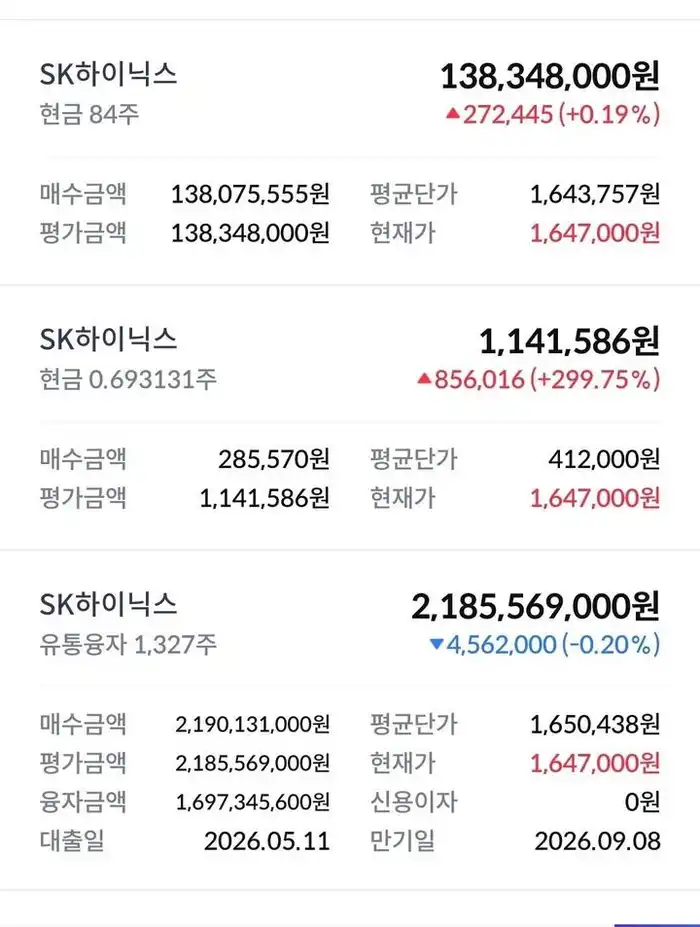
Looking at individual cases. In early May, a South Korean civil servant posted a screenshot on the Korean workplace community Blind:

Their account showed 2.3 billion won (approximately $1.7 million) all-in on SK Hynix, with 1.7 billion of that borrowed from a securities firm. In other words, their own capital was 600 million won, leveraged by 1.7 billion in borrowed funds.

Four days later, they updated that they had already made 267 million won.
On the same day, another post from a woman in her 20s working for Seoul Metro said she would rather "go completely bust" than miss this wave, going all-in on SK Hynix with 150% margin financing. Borrowed money was used as principal to borrow yet again.

Such posts are discussed daily on the Korean Blind community.

The regulators are not unaware of this FOMO frenzy. At the end of March, the Financial Supervisory Service summoned major securities firms to strengthen risk controls, and some brokerages temporarily restricted new margin loans for overheated stocks. But the money already lent out remains there, accruing interest daily at annual rates ranging from 7% to 9%.

Calculating at an 8% interest rate, South Korean retail investors collectively pay nearly 3 trillion won (approximately 14 billion yuan) in interest to securities firms annually.

However, leveraging at 60 is a different matter from leveraging at 30. A 30-year-old who gets wiped out still has decades of salary to slowly recover. A 60-year-old who gets wiped out potentially loses their entire pension, with only exhausted physical strength and the reality of being unable to earn more left.

If another circuit breaker hits, the outcome might not be "a full recovery in just over two months."

In Tapgol Park, the Flowing Intelligence Among the Elderly

Like all Korean retail investors, the elderly in Korea are borrowing and betting on Samsung Electronics and SK Hynix.

Samsung Electronics is up 138% year-to-date, SK Hynix is up 189%. The KOSPI as a whole is up about 80%, but excluding these two companies, the remaining stocks have gained only about 30%.

These two companies together account for over 43% of the weighting in the KOSPI index. This means that as long as these two rise, the entire Korean stock market rises.

Most of the money borrowed by the elderly flows here. A quarter of the net purchases by Korean retail investors this year went into these two companies. The remaining three-quarters are scattered across other stocks, but the overall gain for those other stocks this year is only 30%.

There's Tapgol Park in Jongno District, Seoul, one of the city's oldest public parks. Young people rarely visit. Its regulars are a group of retired seniors who come to the park every morning, drink free coffee, chat, play board games—time seems to flow as slowly as if it were standing still.

According to a report by the "Kyunghyang Shinmun," the topics of conversation in Tapgol Park have changed this year.

Amidst coffee drinking, someone might say, "My Samsung stocks went up again." During a board game, someone might ask, "Did you buy Hynix?" A 77-year-old gentleman told his middle school classmates that Samsung and Hynix have been performing well lately and that he had made a bit in his account.

A corner of Tapgol Park, gathering many elderly people playing board games

Source: Seoul News

However, he didn't mention whether he borrowed money or how much he borrowed.

Topics popular among seniors in the park don't come out of thin air; they resemble intelligence exchanged at the village entrance station. For instance, an elderly person hears another senior made money in the park and checks their own account the next day. Then they start trying to borrow a little. And then potentially borrow more and more.

But if you ask why South Korean seniors are appearing in leveraged stock trading accounts, this is actually related to their retirement security.

According to OECD data, the relative poverty rate among South Korea's population aged 65 and above is about 40%, the highest among OECD member countries. The replacement rate of the National Pension (South Korea's version of a pension) has long been low. The OECD average is around 50%, while South Korea's is only about 31%.

Conversely, the labor force participation rate of those aged 65 and above is the highest among OECD countries, meaning a significant portion of South Korean seniors have to continue working after retirement.

Therefore, the availability of free coffee in places like Tapgol Park is essentially a form of social relief in South Korea. A cup of coffee costs less than 500 won. For seniors with a monthly pension of less than a thousand dollars, this is part of daily life.

But the elderly in Tapgol Park are no longer just there for free coffee and board games. They might also have the KOSPI行情 open on their phones.

After taking office, South Korean President Lee Jae-myung has been vigorously promoting全民炒股 (全民炒股 - mass participation in stock trading). He has publicly called himself the "Great Ant," where "ant" is a common nickname for retail investors in Korea. He set a KOSPI突破 5000点 as an administrative goal.

In other words, to some extent, the elderly borrowing to buy stocks is officially encouraged in South Korea.

What the elderly are truly betting on is an anxiety. If they don't get on board now, they will miss out.

This is their last chance before retirement. The South Korean semiconductor industry is cyclical, having experienced more than one boom-to-bust roller coaster over the past three decades.

SK Hynix reported a loss of 4.26 trillion won in 2023, its worst performance in a decade. Switching from massive losses one year to an operating profit margin of 72% in a single quarter two years later (surpassing Nvidia)—the speed of this cyclical shift itself serves as a reminder that the cycle might switch back again.

And time, perhaps, is the most precious thing for these elderly individuals borrowing to trade stocks.

The elderly in Tapgol Park are striving to seize the红利 of this era. The coffee is still free. The行情 on their phones hasn't stopped for a moment.


İlgili Sorular

QAccording to the article, what drastic financial action are some elderly Koreans taking to invest in the stock market?

ASome elderly Koreans are surrendering their savings-type life insurance policies, even at a loss (as the surrender value is often lower than the premiums paid), and using the proceeds, along with borrowed money from brokerages (margin loans), to invest in stocks like Samsung and SK Hynix.

QWhat was the performance of leveraged versus non-leveraged散户 investors during the market crash in March mentioned in the article?

ADuring the market crash in March,散户 investors who used margin loans (leveraged) experienced an average loss of 19%, which was 2.3 times the average 8.2% loss suffered by those who did not use borrowed money.

QWhy are Korean senior citizens particularly vulnerable when using leverage to invest in the stock market?

AKorean senior citizens are particularly vulnerable because if they experience a significant loss or a margin call, they risk losing their entire pension savings. Unlike younger individuals who have decades of earning potential to recover, older individuals may lack the physical capacity and opportunity to earn back the money.

QHow does the article describe the role of Samsung and SK Hynix in the current Korean stock market rally?

AThe article describes Samsung and SK Hynix as the primary drivers of the KOSPI rally. Together, they account for over 43% of the KOSPI index's weight. While KOSPI rose 80% overall, removing these two companies reduces the remaining market's gain to only about 30%. A significant portion of散户 investment, including from seniors, has flowed into these two stocks.

QWhat underlying socio-economic factors, according to the article, are driving elderly Koreans to take on risky investments?

AKey factors include a high relative poverty rate among those over 65 (around 40%, the highest in the OECD), a low pension replacement rate (about 31%, compared to the OECD average of 50%), and a high labor participation rate among seniors, indicating financial pressure. This creates anxiety and a sense that investing in the current stock market rally is a 'last chance' to improve their financial security before it's too late.

İlgili Okumalar

Musk Posted a Recruitment Ad for SpaceX, and After Reading the Comments Section, I Understood

On May 20th, SpaceX filed for a landmark IPO with a $1.75 trillion valuation. Shortly after, Elon Musk posted a recruitment call on X, seeking "world-class engineers and physicists" for SpaceX. The application process was starkly simple: email with three bullet points proving "exceptional ability," with real, complex projects as a plus. Musk promised to review qualifying emails himself. The post garnered millions of views and thousands of replies, revealing a spectrum of responses. Most comments, including a highly-upvoted humorous one listing absurd "skills," merely listed credentials or experiences in a conventional, non-differentiating way. This highlighted a key insight: a traditional resume listing degrees and skills often fails to demonstrate true exceptionalism. Effective self-presentation requires "performance efficiency." A standout reply came from an OpenAI engineering lead, who simply stated "codex." This demonstrated that for those who have built significant, recognized products, the product itself becomes the ultimate resume. The article argues that in the AI era, any tangible, shareable output—a tool, research, or online project—serves as a living, self-evident credential more powerful than a list of attributes. However, a twist emerged when applicants found the provided email address non-functional, leading to speculation that the post might also serve as an IPO publicity stunt, projecting an image of aggressive talent acquisition to investors. Ultimately, the episode served as a microcosm: some participate through performance, others through proof of work, while some question the reality of the stage itself. It underscores the enduring challenge of defining and demonstrating value in an age of abundant, yet often superficial, content.

marsbit8 dk önce

Musk Posted a Recruitment Ad for SpaceX, and After Reading the Comments Section, I Understood

marsbit8 dk önce

Cutting Off OpenAI, Anthropic Acquires the Tool Provider Used by a Quarter of Global Developers

Anthropic has acquired Stainless, a developer tool company that automatically generated official SDKs (Software Development Kits) for AI giants including OpenAI, Anthropic, Meta, and Cloudflare. The deal, reportedly valued at around $300 million, marks a strategic shift for Anthropic as it builds its "AI agent" infrastructure. Stainless acted as a "translator," converting complex API specifications into ready-to-use code libraries for developers. Its tools indirectly reached about a quarter of professional software developers globally. Following the acquisition, Stainless will shut down its public products and its team will join Anthropic to focus on internal platform development, notably for the Claude Platform. Existing SDKs remain with their respective client companies but will no longer receive updates from Stainless. This move is part of Anthropic's broader 18-month strategy to assemble a complete "agent stack." The stack consists of the Claude model at its core, the newly acquired Stainless for standardized API interfaces, and the Model Context Protocol (MCP), an open standard for connecting agents to external tools and data. This contrasts with OpenAI's focus on model generations and consumer-scale compute. Anthropic believes an agent's ultimate utility depends on its ability to connect to external systems. By internalizing the SDK layer and promoting MCP as a connection standard, Anthropic aims to lock in long-term ecosystem advantages and create path dependency, moving beyond the transient lead provided by any single model generation.

marsbit9 dk önce

Cutting Off OpenAI, Anthropic Acquires the Tool Provider Used by a Quarter of Global Developers

marsbit9 dk önce

Bankless Founder Sells Off ETH, Collective Collapse of Ethereum Faith

Ethereum faces a "crisis of faith" as David Hoffman, co-founder of the prominent pro-Ethereum media outlet Bankless, announces he has sold all his ETH. This move, coupled with reports of major layoffs at Bankless, signals a potential retreat of Ethereum's staunchest supporters. Hoffman and co-founder Ryan Sean Adams confirm Bankless is entering a "second era," with Adams stepping back and Hoffman exploring new frontiers. Hoffman sharply criticizes the Ethereum Foundation, stating that ETH's poor price performance cannot be separated from its leadership. He has a history of public dissatisfaction, citing the Foundation's failure to drive market growth and its "endless manifestos." His frustration coincides with ETH/BTC hitting multi-month lows and a significant exodus of senior researchers and executives from the Ethereum Foundation, partly attributed to controversial "loyalty oaths." The article contrasts Ethereum's current predicament—with its Layer-2 narrative discredited and ecosystem stagnant—against what should have been a highlight year in 2026 amid tokenization trends. While a previous surge to near $5,000 was driven by corporate buybacks (DAT热潮), ETH has since fallen over 50%. The core question remains: with fading faith and intense competition, what is Ethereum's next solution? Hoffman's divestment symbolizes a growing disconnect between the community and the ecosystem's direction.

Odaily星球日报33 dk önce

Bankless Founder Sells Off ETH, Collective Collapse of Ethereum Faith

Odaily星球日报33 dk önce

a16z Invests Heavily with $356 Million in HYPE, Surpassing Paradigm to Become the Largest External Holder

On May 21st, HYPE surged past $59, reaching a new high since September 2025, with a market cap nearing $150 billion. Analysts attribute the rally to a short squeeze and significant ETF inflows. The launch of two U.S. spot ETFs for Hyperliquid has driven substantial capital, with their inflows at times surpassing those of Bitcoin and Ethereum ETFs. Major institutions are actively accumulating HYPE. Venture firm a16z has become the largest external holder with a $356 million position, surpassing Paradigm. Other firms like Goldman Sachs, Grayscale, and Galaxy Digital have also made large purchases, with Goldman reportedly selling portions of its XRP, ETH, and BTC holdings to buy HYPE. Bitwise CIO Matt Hougan calls HYPE one of the most "mispriced" assets, arguing its valuation should reflect Hyperliquid's broader platform beyond just a perpetual DEX token. The protocol generates substantial real revenue, using 97% of fees to buy back and burn HYPE. Its expansion into RWA commodities and prediction markets has driven user growth and transaction volume, now commanding about 70% of the on-chain perpetual DEX market. However, this rapid growth faces challenges. Traditional exchanges CME and ICE are pressuring the CFTC to regulate Hyperliquid, citing concerns over its impact on global commodity benchmarks. Concurrently, some major market makers have withdrawn significant liquidity from the platform. With HYPE up over 125% year-to-date, operational risks are rising. Large holders are reportedly hedging with sizable short positions. The regulatory outlook from the CFTC remains a key uncertainty, adding another layer to the ongoing battle over the future of on-chain finance.

链捕手34 dk önce

a16z Invests Heavily with $356 Million in HYPE, Surpassing Paradigm to Become the Largest External Holder

链捕手34 dk önce

İşlemler

Spot
Futures
活动图片