With Roadshow Data in Hand, How Does Wall Street View SpaceX Now

marsbit2026-06-05 tarihinde yayınlandı2026-06-05 tarihinde güncellendi

Özet

SpaceX’s recent IPO filings outline a $135 per share price, offering 5.556 billion Class A shares, targeting a valuation around $1.77 trillion. The company positions itself not merely as a launch provider but as an integrated infrastructure play spanning space transport, connectivity (Starlink), and AI (xAI/Grok). Financially, connectivity drives profitability with $114B revenue and $72B adjusted EBITDA in 2025, while space services and AI show lower earnings or losses. Capital expenditures have surged, reaching $207B in 2025. Wall Street reactions are divided. Bulls argue SpaceX is building unique, hard‑to‑replicate infrastructure, justifying a premium akin to AI‑infrastructure firms. Bears point to high multiples—90–103x trailing sales—and question the AI segment’s unproven scale and a $26.5T AI market claim. Notable valuations range from Morningstar’s $780B fair value to Damodaran’s $1.22–1.29T model and Scottish Mortgage’s $1.25T mark, all below the IPO target. Governance concerns arise as Musk would retain ~82.4% voting power via super‑voting shares. Ultimately, the debate centers on how much of the price reflects tangible cash flows versus future technology promises and Musk’s leadership premium.

$135 per share, 555.6 million shares, $1.77 trillion.

SpaceX has pinned its IPO price here. According to the S-1/A filed with the SEC on June 3 and the FWP roadshow materials filed on June 4, the company plans to issue 555.6 million shares of Class A common stock at an offering price of $135 per share. The stock is expected to list on Nasdaq and Nasdaq Texas under the ticker symbol SPCX. After deducting underwriting discounts and offering expenses, the company expects net proceeds of approximately $74.4 billion, or about $85.7 billion if the underwriters fully exercise their additional purchase option.

The real question posed to the market by the roadshow is not "How much should a rocket company be worth?" What SpaceX repeatedly emphasizes in its materials is something else: space transportation, satellite connectivity, and AI computing power are being consolidated into a single balance sheet.

According to the same FWP roadshow materials, SpaceX claims to be the only company simultaneously building the three-layer hardware and software infrastructure for space, connectivity, and AI. The Space business is responsible for lowering the cost of reaching orbit, Starlink is responsible for extending connectivity on land, at sea, in the air, and beyond mobile networks, and the AI business integrates xAI, Grok, X, and the Colossus computing cluster into the same narrative.
The figures it provides are substantial enough. According to the roadshow materials, SpaceX has carried over 80% of global mass to orbit since 2023, with approximately 650 cumulative launches, operates over 9,600 Starlink satellites, has about 10.3 million Starlink users, and covers 164 countries and regions. Grok and X have approximately 550 million monthly active users, X sees about 350 million daily posts, and the nominal power consumption of its AI computing infrastructure exceeds 1GW.

This is precisely where the greatest divergence lies on Wall Street today.

SpaceX says it's selling infrastructure. Skeptics say it's packaging infrastructure, AI, and Musk's personal premium together for sale.

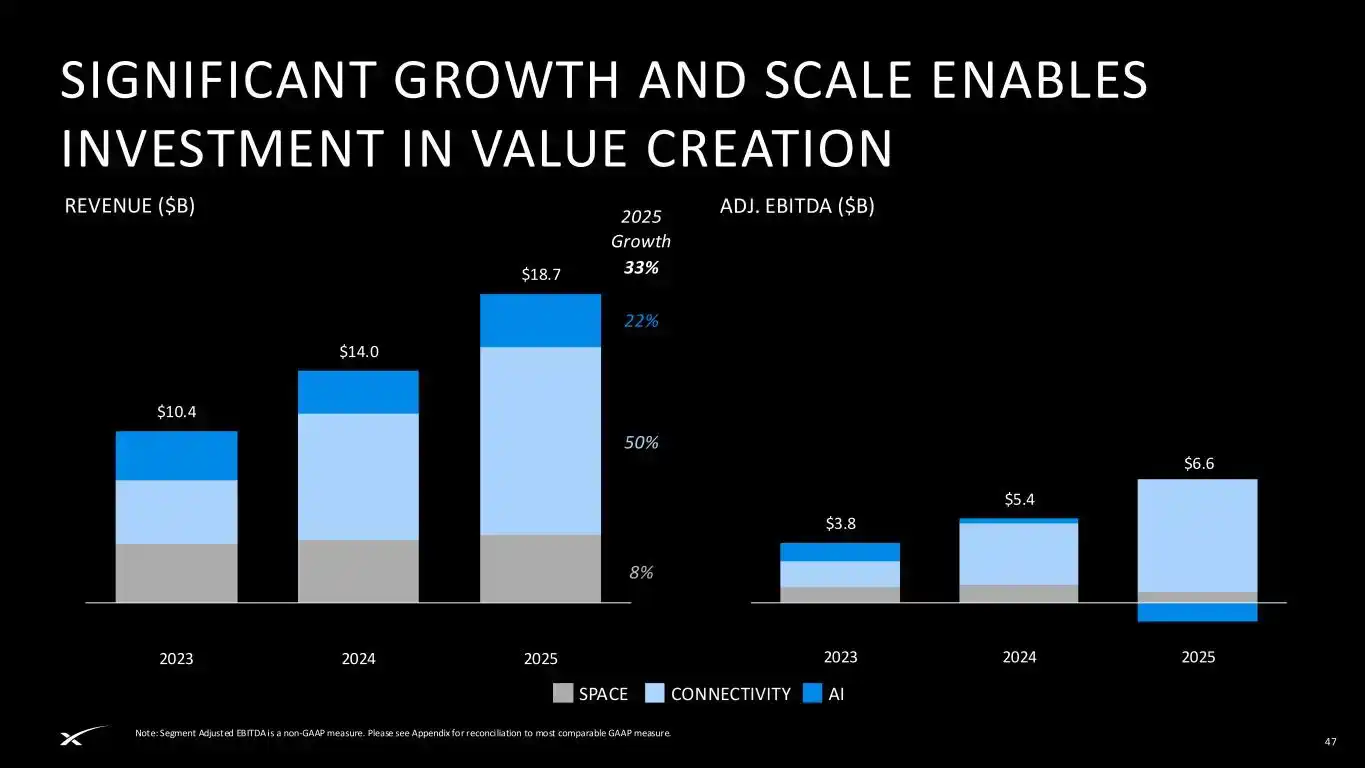
First, look at the hardest piece in the roadshow. Connectivity is currently the part that most resembles a 'public company business.' According to the roadshow materials, the Connectivity segment generated $11.4 billion in revenue and $7.2 billion in adjusted EBITDA in 2025, up from $7.6 billion in revenue and $3.8 billion in adjusted EBITDA in 2024. The Space segment reported $4.1 billion in revenue and $0.7 billion in adjusted EBITDA in 2025. The AI segment reported $3.2 billion in revenue and an adjusted EBITDA loss of $1.2 billion in 2025.

Combined, these three bills present a highly uneven SpaceX. Starlink is profitable, rockets provide deployment capability, and AI is burning cash while contributing valuation optionality.

According to the roadshow materials, SpaceX's total revenue for 2025 was $18.7 billion with adjusted EBITDA of $6.6 billion, but it recorded a GAAP net loss of $4.9 billion. Capital expenditures rose from $4.4 billion in 2023 to $11.2 billion in 2024, and further to $20.7 billion in 2025. For the first quarter of 2026, the company still recorded a GAAP net loss of $4.3 billion.

Translated into stock market language, this is not a mature earnings stock. It's a stock selling the future control of infrastructure to the public market ahead of time.
Wall Street's initial set of reactions is to acknowledge that the story has changed.

In an article by fund manager Mike Alves, he stated that investors should not just look at the headline valuation of $1.75 to $2 trillion; the real question is whether SpaceX is building the infrastructure layer for the next generation of the economy. Shaun Davies, Associate Professor of Finance at the University of Colorado Boulder, also described SpaceX as a hybrid of aerospace, communication infrastructure, defense technology, and AI. Scott Pace, Director of the Space Policy Institute at George Washington University, offered a judgment closer to the roadshow's pitch, suggesting that growth drivers come from communications, data, and AI combining through space in new ways.

This is the core logic of one bullish camp. Don't try to fit SpaceX into the mold of Boeing, AT&T, or traditional aerospace companies. It's selling access to a difficult-to-replicate infrastructure platform.

Reuters noted that at least one large institutional investor in SpaceX privately is not comparing it to Boeing or AT&T, but rather to companies like Palantir, GE Vernova, Vertiv—firms that have been revalued by AI infrastructure. PitchBook analyst Franco Granda's statement in the same report was blunt: investors today are paying a platform premium, betting on tomorrow's monopoly economy of infrastructure.

But this valuation framework has its own awkwardness. At a $1.75 trillion valuation, SpaceX would trade at roughly 110 times its estimated 2025 revenue, making even Palantir appear cheaper on some metrics. Calculations based on S&P Capital IQ data show that if using the $1.75 to $2 trillion market cap range and revenue for the trailing twelve months ended March 31, 2026, SpaceX's price-to-sales ratio would be about 90x to 103x, exceeding all of the 'Magnificent Seven' companies and significantly higher than Tesla's roughly 16x P/S ratio at the time.

Bulls can accept this price because they don't see SpaceX as a rocket company. Bears cannot accept this price precisely because SpaceX is no longer just a rocket company.

Valuation divergence becomes clear from here.

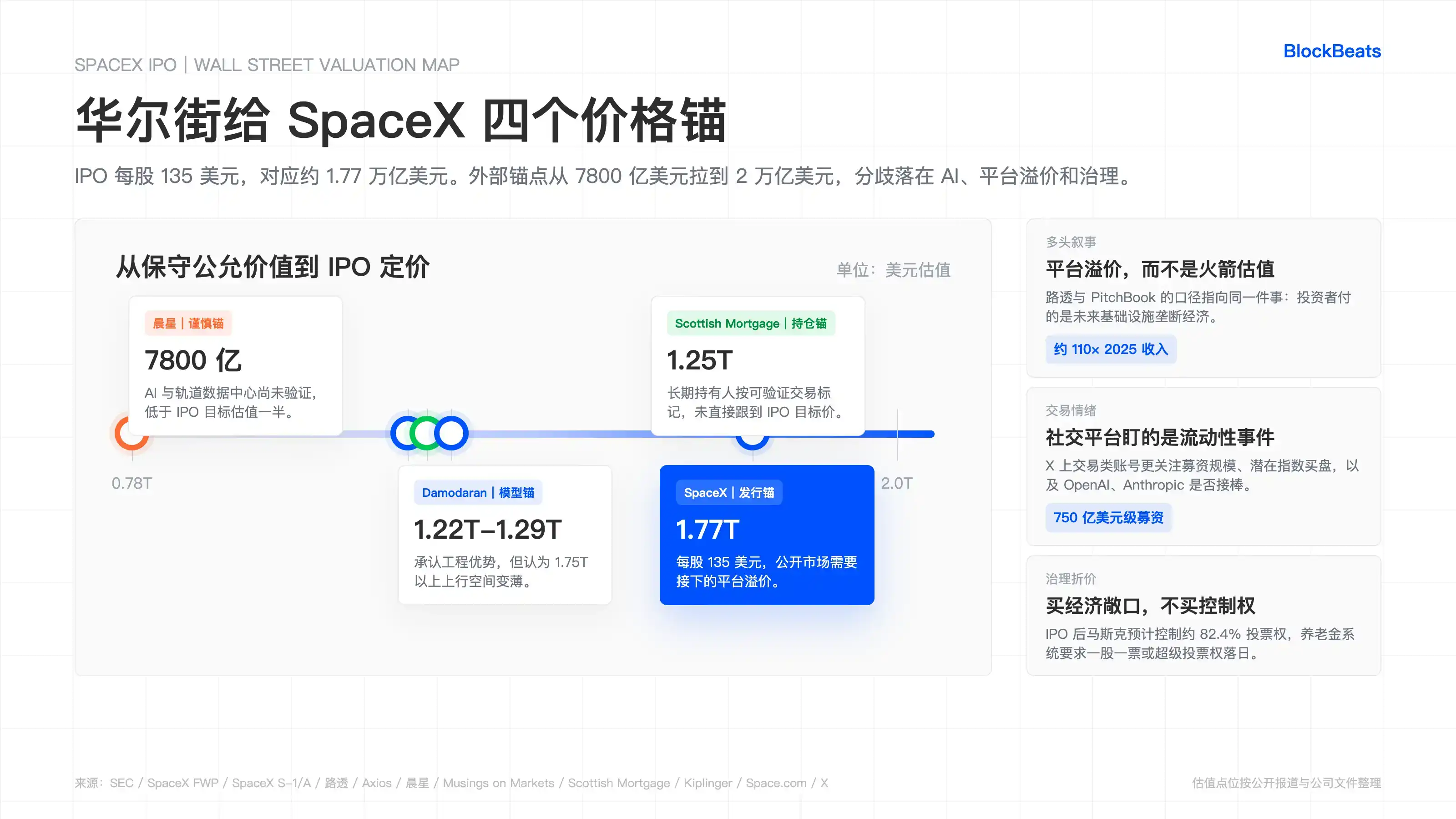
The first line is $780 billion. Morningstar analyst Nicolas Owens, initiating coverage on SpaceX, assigned a fair value estimate of $780 billion, less than half the IPO's target valuation. Owens' concerns center on the AI business, noting that Grok is currently not a leading AI lab, technologies like orbital data centers are unproven, and investors might find a more risk-adjusted entry point post-IPO.

The second line is $1.22 trillion to $1.29 trillion. A valuation model by New York University Stern School of Business professor Aswath Damodaran, based on the limited financial data available at the time, gave a baseline valuation of $1.22 trillion, with a median of $1.29 trillion after 10,000 simulations. He acknowledges SpaceX is an engineering marvel and has tremendous competitive advantages, but his bottom line is clear: at a pricing of $1.75 trillion or even $2 trillion, buyers have very little upside potential.

The third line is $1.25 trillion. Baillie Gifford-managed Scottish Mortgage Investment Trust valued its SpaceX holding at $1.25 trillion as of March 31, 2026, emphasizing the valuation is based on verifiable transactions, not media speculation. This number is interesting. Scottish Mortgage is a long-term holder; it's not bearish on SpaceX, but it also hasn't directly marked it up to $1.75 trillion.

Beyond that lies the $1.77 trillion that SpaceX itself is presenting to the public market.

These four numbers placed together represent the real SpaceX on Wall Street today.

It's not a simple case of some shouting 'buy' while others shout 'sell.' It's more like a price band: $780 billion is the conservative anchor set by fundamentals-focused analysts, $1.22 to $1.29 trillion is Damodaran's compromise between narrative and discounted cash flow, $1.25 trillion is the marking by existing institutional holders, and $1.77 trillion is the price SpaceX is preparing for the public market to accept.

Trading sentiment on social platforms is more direct. On X, accounts like Ticker Wire, Surmount, and VirtualBacon, focused on trading, discuss not discounted cash flow, but the $75 billion fundraising, $1.75 trillion valuation, potential index buying pressure, and the trading rhythm where SpaceX's IPO could be followed by potential listings from OpenAI and Anthropic. They treat SpaceX as a liquidity event, not a company that needs to be slowly dissected in Excel.

This is also the warning given by Scott Sacknoff. SPADE Defense Index manager Scott Sacknoff believes the SpaceX IPO has pushed mainstream investor enthusiasm to near irrational exuberance levels, with publicly traded space company stocks already up 60% to 100% year-to-date. At a $1.75 trillion valuation, those likely to make real money may be traders, not buy-and-hold long-term investors.

Traders look at supply and demand; long-term investors look at the path to valuation realization.

There are three checkpoints on this path.

The first checkpoint is Starlink. It must continue to convert user growth, ARPU, mobile connectivity, and enterprise/government customers into cash flow. SpaceX's roadshow places Connectivity within a $1.6 trillion total addressable market (TAM), with Starlink Broadband representing $870 billion and Starlink Mobile representing $740 billion. This market is not small, but the public market will first scrutinize revenue quality, not TAM.

The second checkpoint is AI. SpaceX's roadshow writes the long-term AI opportunity at $26.5 trillion and proposes a roadmap to begin deploying AI computing satellites starting in 2028. Reuters Breakingviews on April 24 called this market proclamation "planetary-grade absurdity," with a simple reason: a $28.5 trillion total addressable market already exceeds one-fifth of global GDP. This isn't to say AI lacks value, but that SpaceX has anchored its valuation optionality on the hardest-to-validate piece.

The third checkpoint is the governance discount. According to SpaceX's S-1/A, based on the post-offering ownership structure, Elon Musk will control approximately 82.4% of the voting power of common stock. Class B common stock carries 10 votes per share, Class A carries 1 vote per share. In an open letter dated May 13, the New York City Comptroller, New York State Comptroller, and CalPERS CEO, representing combined assets under management exceeding $1 trillion, called on SpaceX to adopt one-share-one-vote or impose a sunset clause of no more than 7 years on supervoting rights.

Kiplinger's Mike Alves offered a bullish interpretation of this issue. He argues that in an ordinary company, such control might be a deal-breaker, but SpaceX's market might consider 'getting exposure' more important than governance. The implication here is that investors are not buying governance rights, but an option on Musk continuing to steer the ship.

This roadshow has rewritten SpaceX from a rocket company into an infrastructure conglomerate. What Wall Street must now do is decide how much of this conglomerate consists of real cash flows, how much is future technology roadmaps, and how much is the Musk premium.

If you only look at the roadshow, SpaceX has told an exceptionally complete story. Rockets drive down costs, Starlink connects users, AI brings in computing demand, and orbital computing further raises the ceiling.

If you look at Wall Street's reactions, another story is also complete.

Morningstar is waiting for a lower price, Damodaran is waiting for a major pullback, Scottish Mortgage hasn't marked its holding up to the IPO target price, PitchBook and some institutions are willing to rationalize the platform premium, trading accounts are watching for potential index buying and short-term liquidity, and the pension system is watching control.

SpaceX's rockets are not in dispute. The dispute lies in how much investors are willing to pay for the entire sky that lies beyond those rockets.


İlgili Sorular

QAccording to the article, what are the main reasons for the valuation discrepancy on Wall Street regarding SpaceX's IPO?

AThe main reasons are: 1) Uncertainty over how to value SpaceX as a combined infrastructure, AI, and connectivity platform versus a traditional aerospace company. 2) The high valuation metrics (e.g., ~90-103x P/S ratio based on 1.75-2 trillion valuation) that significantly exceed those of other major tech firms. 3) Differing opinions on the viability and value of its AI business segment, which is currently loss-making. 4) The premium assigned to Elon Musk's leadership and vision versus governance concerns from institutional investors.

QWhat are the three business segments outlined in SpaceX's roadshow materials, and what were their 2025 financial performances?

AThe three segments are: 1) Connectivity (primarily Starlink): $11.4 billion revenue, $7.2 billion Adj. EBITDA. 2) Space: $4.1 billion revenue, $0.7 billion Adj. EBITDA. 3) AI: $3.2 billion revenue, -$1.2 billion Adj. EBITDA loss. Combined, this resulted in total revenue of $18.7 billion, Adj. EBITDA of $6.6 billion, but a GAAP net loss of $4.9 billion for 2025.

QWhat are the different valuation estimates for SpaceX mentioned by various analysts and institutions in the article?

AThe valuation estimates are: 1) Morningstar analyst Nicolas Owens: ~$780 billion (fair value estimate). 2) NYU Professor Aswath Damodaran's model: $1.22 trillion baseline, $1.29 trillion median from simulations. 3) Baillie Gifford's Scottish Mortgage Investment Trust: Marking its holding at $1.25 trillion. 4) SpaceX's own IPO target valuation: $1.77 trillion.

QWhat are the three key checkpoints or challenges identified for SpaceX's future valuation path after the IPO?

AThe three key checkpoints are: 1) Starlink's (Connectivity segment) ability to convert user growth into high-quality, sustained cash flow. 2) The AI segment's ability to validate its ambitious technological roadmap (like orbital data centers) and justify its projected $26.5 trillion market opportunity. 3) Addressing corporate governance concerns, particularly the significant voting control held by Elon Musk through a dual-class share structure, which has drawn criticism from major pension funds.

QHow does the article describe the contrasting perspectives between long-term investors and traders regarding the SpaceX IPO?

ALong-term investors focus on the valuation and the path to future cash flow realization, scrutinizing financial metrics, business model sustainability, and governance. Traders, particularly on social platforms, view it more as a major liquidity event, focusing on factors like the $75-85 billion fundraising size, potential index fund buying pressure, and the trading momentum it could create for the broader AI/space sector, with less emphasis on detailed financial analysis.

İlgili Okumalar

7 Months After the Collapse of Huiwang, Southeast Asia's Escrow Platforms Undergo a Major Reshuffle

Following the collapse of Huione Pay—dubbed the "Alipay of Southeast Asia"—seven months ago, the region's underground financial guarantee platform sector is undergoing a significant reshuffle. This power vacuum has been swiftly filled by emerging platforms such as XinBi, Tiger/Navigator, JinBei (renamed JinBo), Dali/Tiancheng, and FullyLight. These platforms, operating largely via Telegram and offering services like escrow for illicit transactions, have absorbed the vast user base and markets left behind by Huione. While positioning themselves as "trust intermediaries," their primary clientele consists of networks involved in online scams, money laundering, illegal gambling, and even human trafficking. For instance, the Tiger/Navigator platform explicitly provides "escrow" services for kidnapping-for-ransom operations ("强押车交易"). Data underscores the immense scale: Huione alone processed over $103 billion in cryptocurrency payments and facilitated over $31 billion through its escrow market before its downfall, linking it to Cambodia's notorious Prince Group. Since its collapse, competitors have seen explosive growth. For example, the XinBi platform has accumulated over $1.6 billion in total USDT revenue, while platforms like NewPay, OkPay (under Dali), and FullyLight Wallet collectively processed over $4.8 billion in USDT in a single year. This ecosystem thrives in regions like Cambodia and Myanmar, where regulatory gaps allow these platforms to act as critical financial infrastructure for sprawling cybercrime industries, from scam compounds to online casinos. The article concludes that the moniker "Southeast Asian Alipay" is a misnomer, obscuring the platforms' fundamental role in enabling serious criminal enterprises rather than representing legitimate financial innovation.

Odaily星球日报55 dk önce

7 Months After the Collapse of Huiwang, Southeast Asia's Escrow Platforms Undergo a Major Reshuffle

Odaily星球日报55 dk önce

The Changing Landscape: What Are Crypto VCs Experiencing?

Title: The Shifting Landscape of Crypto Venture Capital The era of dedicated crypto venture capital funds is undergoing a significant transformation. Once essential for navigating the sector's complexity and high risk, these specialized funds are now facing an identity crisis as the market matures. This shift mirrors historical patterns in other specialized investment classes like cleantech and SPACs, where initial information advantages dissipate as technologies become mainstream and integrated into existing industry frameworks. The article argues that crypto is reaching a critical inflection point, transitioning from a "building phase" to an "integration phase." Major players like Stripe, BlackRock, and Visa now engage with crypto not for its novel mechanics but as a foundational financial infrastructure. Their needs—regulatory compliance, banking partnerships, distribution channels—align with traditional fintech, a domain easily understood by large, generalist funds like Sequoia and Founders Fund. This evolution creates a "barbell effect" within the VC landscape. On one end are massive, diversified platforms that can incorporate crypto as one vertical among many. On the other are small, nimble funds focused on niche, experimental projects. The middle ground—medium-sized dedicated crypto funds—is being squeezed out. Their typical fund size makes it impossible to generate sufficient returns solely from early-stage crypto bets, yet they cannot compete with giants for later-stage deals. Consequently, leading crypto-native firms like Paradigm and Framework Ventures are expanding into AI, robotics, and other sectors, driven partly by LP pressure for better returns amid a broader VC DPI crisis. Others, like Dragonfly and a16z, have narrowed their crypto focus predominantly to financial infrastructure like stablecoins, reframing the sector's core narrative. For crypto entrepreneurs, this consolidation presents challenges. While generalist funds offer larger checks and broader resources, crypto projects now compete fiercely with AI for attention and capital within these firms. Furthermore, the long-term, non-commercial foundational work that built the ecosystem—funded by dedicated crypto VCs—is less likely to attract generalist capital focused on direct returns. The conclusion is that "crypto investor" as a standalone category is becoming obsolete, akin to "internet investor." Crypto is becoming a baseline infrastructure layer. The future will see a barbell structure: large-scale growth financing handled by generalist funds, while pioneering, speculative projects are funded by small, specialized vehicles. The dedicated crypto funds of the 2017-2021 boom, which incubated core infrastructure, are giving way to this new, bifurcated reality.

Foresight News1 saat önce

The Changing Landscape: What Are Crypto VCs Experiencing?

Foresight News1 saat önce

As Consensus Accelerates, What Are Young Investors Betting On?

Title: As Consensus Forms Faster, What Are Young Investors Betting On? In the rapid evolution of tech investment, a new generation of young investors is navigating a landscape where AI, robotics, commercial aerospace, and quantum computing are advancing simultaneously. Traditional investment logic based on financial models is giving way to a need for deep technical understanding and the ability to act before industry consensus forms. An analysis of trends from the "WAIC FUTURE TECH" list of young investment leaders reveals key shifts in focus. The first major trend is the movement of AI from the digital screen into the physical world. Investment is shifting from large language models and chatbots towards embodied AI, robotics, AI hardware, and edge computing. While demonstrations generate excitement, the real challenge lies in achieving scalable, reliable, and cost-effective delivery in complex real-world environments like factories and logistics. Success depends not just on algorithms but on the integration of sensors, actuators, and control systems. Second, the competitive focus for large models is moving beyond raw capability toward building an "intelligence flywheel." The goal is to create self-reinforcing systems where user interaction generates data, improving the model, which in turn enhances the user experience and attracts more engagement. Companies that successfully embed AI into workflows to create these closed-loop systems can build lasting value that isn't easily erased by the next model upgrade. Third, facing a potential bottleneck in high-quality human-generated data, investors are looking at new underlying technologies. Reinforcement learning and self-play, as demonstrated by AlphaGo Zero, offer paths for AI to generate its own experience. Scientific foundation models, which aim to build general AI capabilities for fields like life sciences and materials discovery, represent a non-consensus direction that could unlock new frontiers of knowledge and data. Finally, in deep-tech areas like quantum computing, commercial aerospace, and space-based infrastructure, patient capital is essential. These fields have long, uncertain development and validation cycles involving complex engineering, supply chains, and regulations. Investment here requires a long-term view, focusing on foundational team capabilities and the eventual emergence of market demand, even if commercial returns are distant. Collectively, these trends illustrate how young investors are adapting to a new era. They are learning to make earlier, technically-informed judgments, balance hype with real-world viability, and provide the patient capital needed to build the deep-tech foundations of the future.

marsbit1 saat önce

As Consensus Accelerates, What Are Young Investors Betting On?

marsbit1 saat önce

İşlemler

Spot
活动图片




