With Labour Changing Leaders, Is the Long-Suppressed UK Crypto Market About to Turn Around?

Foresight News2026-06-23 tarihinde yayınlandı2026-06-23 tarihinde güncellendi

Özet

Labour leader change: Hope for UK crypto market? With Keir Starmer's resignation as Prime Minister and Labour leader, a leadership contest has begun. Andy Burnham, the former Mayor of Greater Manchester and now the overwhelming favourite to succeed, has sparked cautious optimism within the UK cryptocurrency industry. Industry figures hope Burnham, seen as more receptive to digital assets than much of the Labour establishment, could shift the party's traditionally harder line. The leadership transition is expected to be swift, with prediction markets like Polymarket assigning a 97% probability to Burnham becoming the next Prime Minister. However, this political shift comes as a comprehensive regulatory framework for crypto, established by law earlier this year, is in its final implementation phase. The Financial Conduct Authority (FCA) is finalizing detailed rules covering trading, custody, stablecoins, and market abuse, with the full regime set to go live in October 2027. While a new Prime Minister can reshuffle ministers and adjust policy priorities, the core regulatory architecture is now law and unlikely to be fundamentally overturned without significant, deliberate government intervention. The main industry hope is that a Burnham government, focusing on economic growth, will ensure the FCA's implementation is pragmatic and growth-oriented. Industry advocates seek proportionate capital requirements, a streamlined licensing process, and clear rules for staking and stable...


By: Liam 'Akiba' Wright

Compiled by: Saoirse, Foresight News


Key Takeaways


  • Keir Starmer announces resignation, triggering Labour leadership contest; Andy Burnham quickly emerges as the frontrunner.
  • Crypto industry executives hope Burnham will soften Labour's hardline stance on digital assets, but the UK Financial Conduct Authority's (FCA) work on the full set of 2027 regulations continues unabated.
  • A Burnham premiership could change cabinet ministers and policy priorities, but only strong, proactive government intervention could potentially alter the overall direction of the new regulatory framework.


Keir Starmer's announcement that he is stepping down as UK Prime Minister has triggered a contest for his successor at 10 Downing Street. At the same time, a far-reaching new financial regulatory framework is entering its final stages of implementation.

(Note: The UK operates under a parliamentary system. When the Labour Party is in government, the Labour leader automatically becomes Prime Minister; changing the party leader also changes the Prime Minister.)


Starmer stated on June 22nd that he will remain as Prime Minister until Labour elects a new leader, marking the end of his tenure of less than two years. He conceded that Labour needs a new leadership team before the next general election, which must be held by 2029, and that he wants to spend more time with his family.


Andy Burnham, who just returned to Parliament via a by-election in the Marketfield constituency, immediately became the overwhelming favorite to replace Starmer.


His rise offers a glimmer of cautious optimism for crypto industry professionals. Insiders believe the former Mayor of Greater Manchester has a higher acceptance of digital assets and blockchain technology than most senior Labour figures.


Burnham's Firm Support Within Party, Prediction Markets Bet on Smooth Transition


Last week, Burnham won the Marketfield by-election, clearing the procedural hurdle to run for Labour leader. Following Starmer's announcement, Burnham immediately confirmed his candidacy and urged the party to continue focusing on economic growth, housing, public services, and the cost of living during the transition period.


Wes Streeting, previously seen as one of Burnham's strongest rivals, dropped out of the race and publicly endorsed the former Manchester mayor. Streeting called on Labour members to unite behind Burnham and avoid internal disputes over largely non-divisive policies this summer.


Labour will open nominations for leader on July 9th. If no one challenges Burnham, the election process could conclude by mid-July; a multi-candidate contest could prolong the transition until September.


Predictions market Polymarket has already seen traders betting on a swift Burnham succession. Data on Monday showed the market assigned him a 97% implied probability of becoming the UK's next Prime Minister, with a total of about $12.5 million wagered on the contract.
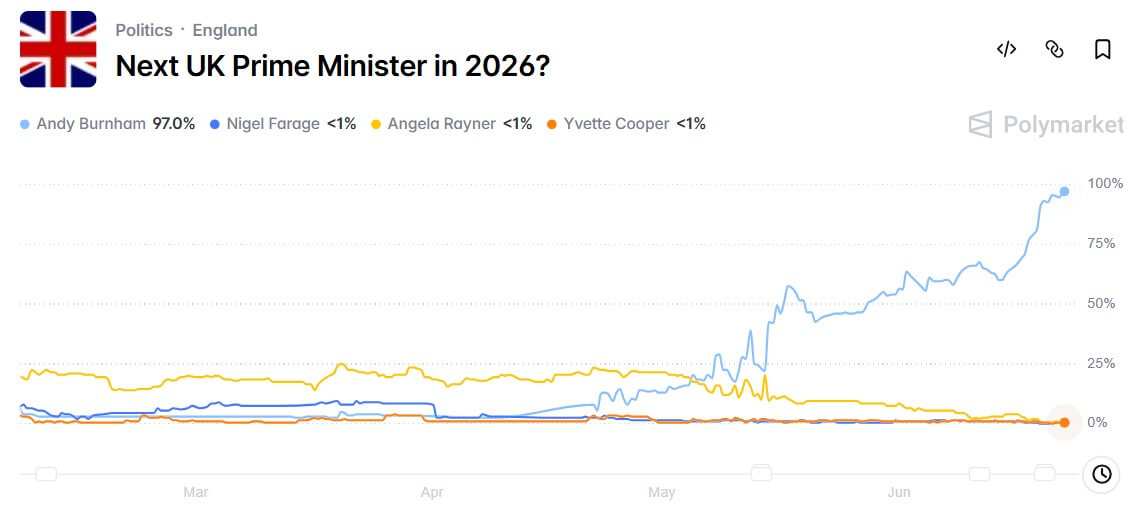

UK Next Prime Minister (Source: Polymarket)


This probability represents a market judgment backed by real money, not a rigorous poll, but it reflects how the market has swung decisively towards Burnham since Streeting's withdrawal.


Traditional financial markets saw little immediate volatility: movement in the pound and UK government bonds was minimal, indicating investors had already priced in Starmer's departure. Market focus has shifted to Burnham's stance on fiscal policy and the identity of the next Chancellor of the Exchequer.


If Burnham assumes office smoothly, he will be the UK's seventh Prime Minister in a decade. The country has seen frequent leadership changes since the 2016 Brexit referendum.


UK Cryptocurrency Regulatory Framework Already Set, Formal Implementation in 2027


The regulatory system the new Prime Minister will inherit has already moved beyond mere policy slogans.


Legislation passed in February formally brought crypto-related activities under the UK's formal financial regulatory umbrella, covering all operations such as crypto trading platform operations, compliant stablecoin issuance, user asset custody, and digital asset transactions.


The UK Financial Conduct Authority (FCA) is still refining the supporting rules, having conducted multiple public consultations on areas including asset custody, stablecoins, prudential requirements, market abuse controls, consumer protection, and business authorization processes. The regulator plans for the full set of new rules to take effect on October 25, 2027.


Once implemented, any firm conducting the specified crypto activities, even if already holding other financial licenses or having completed basic FCA registration, must obtain separate crypto-specific authorization.


While a new Prime Minister can adjust government policy priorities, replace Treasury officials, or push for amendments to legislation, a mere leadership change cannot repeal existing laws or force the FCA to restart its comprehensive rule-making process from scratch.


However, risks exist in the implementation process: a cabinet reshuffle could replace officials familiar with the crypto regulatory framework, just as regulators and industry firms are intensively preparing for authorization applications. Meanwhile, government attention could be diverted by more pressing issues like public spending, economic growth, or Labour's electoral prospects.


Such shifts in policy focus could affect the pace of implementing secondary legislation and resolving contentious details. However, the core architecture of the regulatory system is largely fixed, and without strong, proactive intervention from a new government, a complete reversal of the overall regulatory direction is highly unlikely.


This is fundamentally different from the earlier policy debate phase. The industry now most needs detailed implementation rules and clear compliance guidance, not another round of vague slogans about making the UK a digital assets hub.


Industry Hopes New Government Embraces Growth-Oriented Path


Burnham has spoken little publicly about cryptocurrency, but past comments have given many industry insiders cause for optimism. Freddie New, CEO of BHODL and co-founder of UK Bitcoin Policy, told CryptoSlate that with Burnham's likely ascension, the industry has a chance to reshape its public image, positioning crypto as a potential driver of UK economic growth rather than a risky sector to be suppressed, as previously perceived by mainstream Labour thinking.


He noted that several bitcoin reserve companies are already seeking London listings. The UK stock market has long struggled to attract new IPOs, and digital asset firms could bring fresh capital and global attention to London. "We should welcome and support emerging companies listing in London, not impose restrictions everywhere. I hope Burnham sees this," he said.


Industry executives plan to lobby the new government for several key priorities: proportionate capital requirements, a streamlined and practical authorization process, and clear regulatory definitions for staking, lending, and stablecoin payments. They also hope the FCA will more tangibly implement the government's previously stated mandate for growth-oriented regulation when finalizing the rules.


Despite market optimism about Burnham, the digital assets industry remains wary of certain factions within Labour. Freddie New mentioned that domestic financial regulators have not yet fully implemented the growth-first regulatory approach previously advocated by Rachel Reeves.


He added: "The UK has deep strengths in finance and computing technology and should be leading globally in crypto. The sooner politicians and regulators truly understand and accept this industry, the more the country will benefit."

İlgili Sorular

QWho is the leading candidate to replace Keir Starmer as the UK Prime Minister according to the article?

AAndy Burnham is the leading candidate to replace Keir Starmer as the UK Prime Minister, as indicated by his rapid rise to frontrunner status in the Labour Party leadership race.

QWhat is the expected timeline for the UK's comprehensive cryptocurrency regulatory framework to come fully into effect?

AThe UK's comprehensive cryptocurrency regulatory framework is planned to fully come into effect on October 25, 2027.

QWhy does the cryptocurrency industry view Andy Burnham's potential premiership with 'cautious optimism'?

AThe cryptocurrency industry views Andy Burnham's potential premiership with 'cautious optimism' because industry insiders perceive him as more receptive to digital assets and blockchain technology compared to most senior Labour Party figures.

QWhat impact did Wes Streeting's withdrawal from the Labour leadership race have on market predictions for the next Prime Minister?

AWes Streeting's withdrawal from the Labour leadership race and his endorsement of Andy Burnham solidified market predictions, with platforms like Polymarket showing an implied probability of 97% for Burnham becoming the next Prime Minister.

QWhat specific regulatory adjustments does the cryptocurrency industry hope the new government might pursue according to the article?

AAccording to the article, the cryptocurrency industry hopes the new government might pursue adjustments such as proportionate capital requirements, a streamlined licensing regime, clear regulatory definitions for staking, lending, and stablecoin payments, and clearer implementation of a growth-oriented regulatory mandate by the FCA.

İlgili Okumalar

When Billions Begin to Operate Everything by Voice, How Far is ‘All Assets on Chain’?

In June 2026, WeChat began a limited rollout of "Xiaowei," its native AI assistant. This move is more than an upgrade to a smarter chatbot; it signals a crucial step from "universal internet access" toward the broader vision of "full asset tokenization." Xiaowei, powered primarily by WeChat's in-house WeLM model, demonstrates four key capabilities: 1) direct voice/web chat control of app functions, 2) automated access to mini-programs for services, 3) instant comprehension and summarization of complex documents like PDFs, and 4) generating functional mini-program prototypes from simple natural language requests. This represents a fundamental shift from GUI (Graphical User Interface) to LUI (Language User Interface), eliminating friction in human-digital interaction. The rollout is pivotal because it brings AI Agents to China's massive user base with zero friction—no new app downloads or accounts needed. This "seamless access" mirrors past platform revolutions like the App Store or WeChat Mini-Programs, potentially unlocking a global AI Agent market projected to grow from $7.92 billion in 2025 to nearly $295 billion by 2035. The article argues that China's internet evolution has moved from "connecting everyone" to "putting all services online." The next phase is "tokenizing all assets"—a concept broader than just Real World Assets (RWA) like real estate. It encompasses tokenizing personal assets like social influence, attention, and credit history. RWA tokenization itself is forecast to explode from $35 billion in 2025 to over $500 billion in 2026. The convergence of ubiquitous AI Agents and rapidly tokenizing assets points to a future paradigm for wealth management. Your AI Agent could autonomously manage a globally diversified, tokenized portfolio based on your preferences. Initiatives like EXIO Group's full-stack RWA services aim to lower investment barriers, paralleling WeChat's democratization of AI access. In conclusion, the launch of Xiaowei is not merely a technical upgrade but a historic inflection point. It marks AI Agents' transition from niche tools to essential utilities and accelerates the movement toward a future where voice commands seamlessly interact with tokenized value, redefining humanity's relationship with the digital and financial worlds.

marsbit13 dk önce

When Billions Begin to Operate Everything by Voice, How Far is ‘All Assets on Chain’?

marsbit13 dk önce

SoftBank CEO Masayoshi Son's New Trillion-Dollar "Gamble"

SoftBank founder Masayoshi Son is embroiled in a new trillion-dollar "bet" on Physical AI and humanoid robotics, even as his massive wager on OpenAI faces uncertainty ahead of its potential IPO. Recent reports reveal OpenAI's steep losses—$85 billion net loss by Q1 2026 and a $38.5 billion loss in 2025—casting doubt on its path to a trillion-dollar valuation. SoftBank, OpenAI's second-largest external shareholder with a planned 13% stake, stands to gain hugely if OpenAI succeeds. Undeterred, Son is already pushing forward with his next ambitious venture: consolidating SoftBank's AI and robotics assets into a new U.S.-based company named "Roze," targeting a $100 billion IPO as early as late 2026. This move aligns with his belief that Physical AI, merging AI cognition with robotic physical execution, is the next trillion-dollar frontier. Son's confidence stems from recent AI wins; SoftBank's stock surged and he briefly regained the title of Asia's richest person, largely due to OpenAI's soaring valuation. However, his aggressive strategy has raised internal concerns about over-reliance on OpenAI and strained finances. With competitors like Anthropic advancing rapidly and OpenAI's IPO timing uncertain, Son is racing to capitalize on the AI boom. His long-term vision for Physical AI includes a decade of investments in robotics, from Boston Dynamics to recent acquisitions like ABB's robotics unit, and a planned $1 trillion investment in U.S.-based AI robotics industrial parks. Yet, challenges remain: humanoid robotics firms like Figure AI lack the clear revenue paths of AI software companies, and Roze's lofty valuation faces skepticism. For Son, these bets are also driven by an unfulfilled promise of massive returns to key investors like Saudi Arabia's PIF. Despite risks, he continues to double down, betting that the fusion of AI and physical machines will define the next technological era.

marsbit20 dk önce

SoftBank CEO Masayoshi Son's New Trillion-Dollar "Gamble"

marsbit20 dk önce

İşlemler

Spot
Futures
活动图片