With 100 Days Until Midterm Elections, Crypto Community Voters Track CLARITY Act Amid Senate Time Crunch

cryptonews.ru2026-07-27 tarihinde yayınlandı2026-07-27 tarihinde güncellendi

Özet

With the 2026 midterm elections 100 days away, cryptocurrency voters are closely monitoring the progress of the CLARITY Act in the Senate as the legislative window narrows. The advocacy group Stand With Crypto reports that crypto policy is a priority for voters, with nearly 70% of crypto owners saying a candidate's stance will influence their vote. At the core of the debate is the Digital Asset Market Clarity Act of 2025, which aims to establish clearer rules by defining regulatory authority between the SEC and CFTC. Proponents argue it provides needed regulatory certainty, while critics emphasize the need for robust consumer protections. Supporters have made over one million contacts with Congress, highlighting the industry's political push. The impending elections create pressure, as legislative priorities may shift post-election. The outcome of the bill is seen as a test of Washington's strategy on digital assets, with its fate in the next 100 days potentially shaping the future of crypto regulation and influencing voter decisions.

Ahead of the 2026 midterm elections, crypto voters are closely watching lawmakers' positions on digital assets as the CLARITY Act emerges as a key legislative issue for the industry.

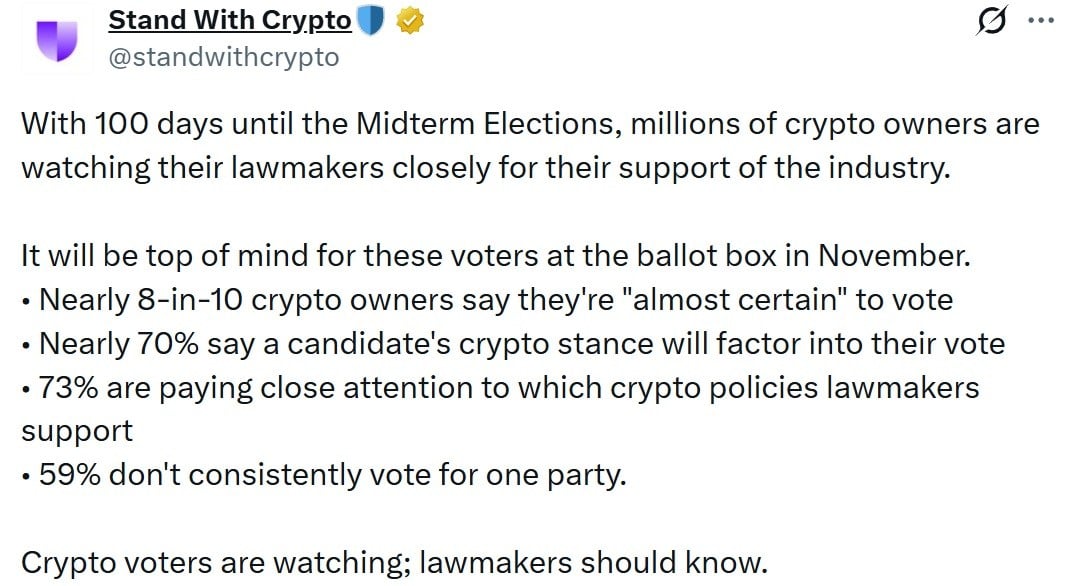
The cryptocurrency advocacy group Stand With Crypto stated in an X post on July 26th that digital asset policy is becoming a priority for many crypto holders leading up to the elections. According to the group, nearly 70% of crypto owners believe a candidate's position on crypto will influence their voting choice, and nearly 8 in 10 said they are almost certain to vote.

Stand With Crypto also reported that 73% of crypto owners are paying close attention to which crypto policies lawmakers support, while 59% do not consistently vote for one political party. The group's poll suggests that crypto policy could sway voters regardless of party affiliation.
CLARITY Act Faces Pressure Amid Heightened Pre-Midterm Political Jockeying

At the center of attention is the CLARITY Act, formally known as the Digital Asset Market Clarity Act of 2025. This bill aims to establish clearer rules for digital assets by defining regulatory authority between the U.S. Securities and Exchange Commission (SEC) and the Commodity Futures Trading Commission (CFTC). This regulatory framework could help determine whether certain digital assets are treated as securities or as commodities under federal oversight.

For crypto investors, companies, and consumers, the bill could define how digital assets are classified, which federal agency will oversee market activity, and what requirements exchanges must meet.

Timing adds urgency to the matter. Supporters of the bill argue that lawmakers have limited time to advance it before the political climate in an election year makes major policy changes more difficult.

The approaching midterm elections could create hurdles for the bill's passage, as lawmakers will devote more time to campaigning and Congressional leaders will reassess legislative priorities. If consideration of the CLARITY Act extends into the elections, its backers will face a more complicated path, as a new Congress could have different priorities and negotiating terms.

Crypto Industry Ramps Up Pressure Amid Senate Time Crunch

The push for the CLARITY Act has extended beyond traditional lobbying, with crypto advocates urging users to contact legislators directly.

Crypto proponents say they have contacted Congress more than 1 million times in an effort to gain support for the bill. These efforts underscore the growing political focus on digital asset regulatory issues.

Advocates argue the bill could provide regulatory clarity for the industry after years of uncertainty over whether certain cryptocurrencies should be considered securities or commodities. They believe clearer rules could encourage companies to grow their business in the U.S. and give consumers more predictable protection.

Critics argue that any new regulatory framework must include strong safeguards against fraud, market manipulation, and investor losses. This debate reflects the complexity of balancing financial innovation with consumer protection.

CLARITY Act Becomes a Test for Washington's Crypto Strategy

The debate over the CLARITY Act has become part of a broader pre-election struggle over how Washington should approach cryptocurrency: supporters frame the bill as a path to regulatory certainty, while opponents highlight oversight and consumer protection concerns.

The next 100 days could prove decisive in determining whether the CLARITY Act moves forward before the midterm elections or becomes stuck in the general election cycle calendar.

For lawmakers, the bill presents a choice: how decisively the United States should define the future of digital asset markets. Supporters see the bill as a path to clearer oversight, while opponents continue to debate whether the regulatory framework provides sufficient consumer protection.

For voters, the outcome of this issue could influence concerns extending beyond crypto markets, including access to exchanges, investment products, taxation, and the future role of federal regulators in digital finance.

As the election campaign intensifies, lawmakers' stances on the CLARITY Act could become a factor for some voters assessing the future of crypto regulation in the U.S.


İlgili Sorular

QWhat is the CLARITY Act and why is it a key legislative issue for the crypto industry ahead of the 2026 midterm elections?

AThe CLARITY Act, officially known as the 'Digital Asset Market Clarity Act of 2025', aims to establish clearer rules for digital assets by defining regulatory authority between the U.S. SEC and CFTC. It is a key issue as it could determine whether certain digital assets are treated as securities or commodities, providing much-needed regulatory certainty for crypto investors, companies, and consumers.

QAccording to the Stand With Crypto survey, how do cryptocurrency owners view the importance of a candidate's crypto stance for their vote?

AAccording to the Stand With Crypto survey, nearly 70% of cryptocurrency owners believe a candidate's position on cryptocurrency will influence their voting choice, and nearly 8 out of 10 stated they are almost certain to vote in the upcoming elections.

QWhy does the approaching midterm election create a potential obstacle for the passage of the CLARITY Act?

AThe approaching midterm elections create an obstacle because legislators will spend more time campaigning, and Congressional leaders will reassess legislative priorities. If the CLARITY Act's consideration is delayed until after the elections, its supporters face a more complicated path as a new Congress may have different priorities and negotiating dynamics.

QHow have cryptocurrency advocates demonstrated political pressure in support of the CLARITY Act, according to the article?

ACryptocurrency advocates have reportedly contacted Congress over 1 million times to gain support for the bill. This effort goes beyond traditional lobbying by urging users to directly contact their legislators, highlighting the growing political engagement on digital asset regulation.

QWhat are the main points of contention between supporters and critics of the CLARITY Act regarding regulatory framework?

ASupporters argue the bill provides the regulatory clarity needed for businesses to operate in the U.S. and offers predictable consumer protection. Critics contend that any new framework must include robust safeguards against fraud, market manipulation, and investor losses, reflecting the complex balance between financial innovation and consumer protection.

İlgili Okumalar

Now the Greatest Regret Is to My Family: Crypto Experts Took a Stumble in the Stock Market

Summary: This article examines the significant losses recently suffered by cryptocurrency traders and influencers who ventured into the stock market, specifically by heavily investing in AI-related and semiconductor storage stocks. The narrative centers on the dramatic reversal in the Korean and US equity markets in late July, with stocks like SK Hynix and related leveraged ETFs experiencing historic plunges, erasing massive gains. The analysis highlights several key factors behind the "flip." Traders, accustomed to crypto's high volatility and frustrated by a stagnant market, chased the apparent momentum in AI-themed equities. Many made fatal mistakes: applying high-leverage strategies common in crypto (e.g., 2x ETFs, on-chain perpetual contracts) to stocks, and failing to understand the distinct rules of different stock markets (like Korean pre-market trading). This led to widespread liquidations, especially when a thin Korean pre-market trade triggered a cascading flash crash on a decentralized exchange. Post-crash reflections from prominent figures reveal deep regret and self-criticism. They acknowledge misjudging their expertise, overestimating their edge against sophisticated institutional players, and the dangers of leverage. The article concludes that while such setbacks are part of trading, surviving long-term requires recognizing one's limitations and the inherent risks of cross-market strategies.

marsbit9 dk önce

Now the Greatest Regret Is to My Family: Crypto Experts Took a Stumble in the Stock Market

marsbit9 dk önce

US Senate Makes Important Amendments to "Conflict of Interest" Section of Cryptocurrency Bill

The U.S. Senate has taken a key step regarding the CLARITY Act, which could shape the future of the U.S. crypto market. On July 29, Senators Tom Tillis and Ruben Gallego finalized amendments to the bill's "conflict of interest" rules, one of its most contentious aspects. The bipartisan bill aims to tighten restrictions on high-level federal officials' ties to digital assets. The new text, crafted as an alternative to a White House-endorsed ethics code, is expected to impose stricter rules limiting officials' ability to issue or directly participate in digital asset projects. However, with Congress entering an August recess and the revised text not yet reviewed by much of the Senate, the bill's timeline is uncertain. Senate Majority Leader John Thune indicated a procedural vote could occur between July 29 and August 1 but expressed doubt the full bill could pass before the break. The House-approved CLARITY Act, passed in July 2025, has been under Senate negotiation for over a year. Key goals of the CLARITY Act include clarifying jurisdictional boundaries between the SEC and CFTC, setting rules for digital commodity spot markets, and addressing topics like stablecoin yields, DeFi, and illicit financing. The stablecoin yield provisions could significantly impact U.S.-based DeFi protocols, exchanges, and issuers, affecting their global competitiveness. The outcome is being closely watched by both the U.S. and global digital asset markets.

cryptonews.ru1 saat önce

US Senate Makes Important Amendments to "Conflict of Interest" Section of Cryptocurrency Bill

cryptonews.ru1 saat önce

Pavel Durov Designated as a Terrorist in Russia. What Does This Mean for Telegram Users?

Pavel Durov, the founder of Telegram, has been added to Russia's list of terrorists and extremists by Rosfinmonitoring, as published on July 30. The entry includes his name and date of birth. The designation follows an announcement by the Russian Federal Security Service (FSB) on July 29, which charged Durov with aiding terrorist activity. The FSB alleges that a Telegram dating bot named "DaiVinchik" was used to recruit 46 individuals for attacks on police and arson, orchestrated by Ukrainian special services. The FSB also accuses Telegram's administration of failing to remove channels and bots used by Ukrainian intelligence and extremist groups. Durov is reportedly subject to an international arrest warrant. Inclusion on the Rosfinmonitoring list leads to significant restrictions: the freezing of Durov's bank accounts and assets, severe limitations on financial transactions, and a ban on election participation, media interaction, and event organization. Transfers to his accounts may be considered terrorism financing. For ordinary Russian Telegram users, purchasing Telegram Premium is not classified as financing terrorism, according to an IT expert. General use of the messenger—messaging, managing channels—does not automatically make a user a participant in extremist activity. There has been no official decision to ban Telegram itself. It is noted that French authorities are also investigating Durov over allegations of inadequate measures against criminal activity on the platform and insufficient cooperation with law enforcement. Durov denies all charges.

cryptonews.ru1 saat önce

Pavel Durov Designated as a Terrorist in Russia. What Does This Mean for Telegram Users?

cryptonews.ru1 saat önce

İşlemler

Spot
活动图片