Wisdom Tree + Glassnode: Reframing Blockchains as Economic Systems

insights.glassnode2026-03-17 tarihinde yayınlandı2026-03-17 tarihinde güncellendi

Özet

The digital asset ecosystem is increasingly viewed as an emerging financial system with its own infrastructure and economic structure. This report, a collaboration between Wisdom Tree and Glassnode, reframes blockchain networks as multi-layered economic systems that mirror traditional markets in function and incentives. Key insights include the use of transaction fees as a direct measure of blockchain health, the economic models of security (energy-backed for Bitcoin, capital-backed for Ethereum), and the industrialization of mining. Systemically important crypto exchanges and custodians now link on-chain activity to traditional capital markets, facilitating institutional adoption. Stablecoins serve as the core settlement and liquidity layer, while DeFi and tokenization extend financial functions on-chain with growing integration into traditional finance. The full analysis provides a data-driven framework for evaluating digital assets beyond price, using observable on-chain metrics and macroeconomic benchmarks.

The digital asset ecosystem is increasingly being evaluated not as a collection of speculative assets, but as an emerging financial system with its own infrastructure, economic inputs, and market structure.

In our joint analysis with Wisdom Tree, we reframe blockchain networks and digital assets as a multi-layered economic system that increasingly mirrors traditional markets in structure, incentives, and economic function.

For financial professionals, this framing demonstrates how digital assets can be analyzed through observable data and compared against traditional macroeconomic benchmarks, offering a more robust foundation for valuation and risk assessment than a price-centric analysis alone.

Key Takeaways

  • Transaction fees provide a direct, price-independent measure of a blockchain's growth, health and maturity. The transparency of blockchain data allows analysts to quantify economic activity with a level of fidelity that is difficult to achieve in other financial systems.
  • In blockchain systems, transaction security and settlement finality are enforced through economic incentives built into the protocol. Bitcoin represents an energy-backed security model, while Ethereum is an example of a capital-backed security model.
  • Mining has evolved into an industrialized commodity business: Cost structures, margin dispersion, and consolidation dynamics increasingly resemble traditional energy and extractive industries.
  • Crypto exchanges and custodians have become systemically relevant: they function as the primary financial gateways, linking on-chain activity to traditional capital markets, and driving the transition from retail-dominated ownership to institutional participation through regulated channels.
  • Stablecoins underpin settlement and liquidity across the ecosystem. Acting as the primary unit of account, stablecoins enable real-time clearing and continuous capital mobility across global markets.
  • DeFi and tokenization extend financial functionality on-chain. Trading, lending, and capital deployment are increasingly executed via rules-based systems, with growing integration into traditional finance.

The full report is freely available for download in PDF format.

Download report PDF

Quantifying Network Demand

At the foundation of the blockchain economy is blockspace, a scarce digital resource consumed by every transaction, smart contract execution, and settlement event, and priced dynamically through transaction fees.

Transaction fees, in this context, are not incidental costs but market-based pricing for network usage, offering a direct lens into network demand. Unlike traditional economic data, this activity is observable in near real time, enabling a high-fidelity view of system utilization.

While fee levels remain cyclical and sensitive to market conditions, the longer-term trend in the data points toward sustained growth in infrastructure-level demand. This dynamic positions blockspace as a core economic primitive for evaluating the ecosystem.

Security as an Economic Input

Blockchain networks replace institutional trust with explicitly funded security models, where participants are economically incentivized to validate transactions and maintain system integrity.

In Bitcoin’s Proof-of-Work model, this relationship is observable through hashrate, or the total computational power securing the network, which reflects the aggregate energy and capital deployed to maintain transaction finality. As the economic value of the network grows, so too does the incentive to invest in this security layer.

In practice, this has given rise to increasingly industrialised operations (most notably in Bitcoin mining), where cost efficiency, scale, and capital access shape competitive positioning.
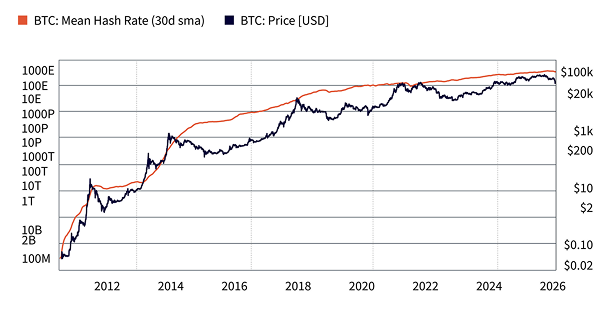
Bitcoin Hashrate vs. BTC Price

Financial Gateways and Institutional Integration

If blockchain networks form the economic substrate, then exchanges and custodians operate as the primary and systemically important financial gateways to traditional capital markets.

As infrastructure has matured, so too has the investor base. Ownership is increasingly shifting toward institutional and regulated capital, marking a transition from early adopters toward participants operating within formal mandates, governance frameworks, and risk constraints.
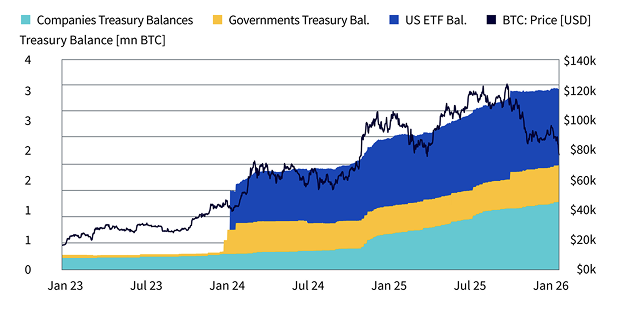
Institutional & Corporate Ownership of Bitcoin (Time Series)

The System’s Monetary Layer

Stablecoins have emerged as the core liquidity and settlement instrument within the blockchain economy. Functionally, they operate as the primary unit of account, medium of exchange, and collateral asset across both centralized and decentralized venues. Their ability to enable instant, final settlement makes them a growing rail for cross-border value transfer.

Growth in stablecoin supply reflects a broader structural shift: capital migrating from traditional banking infrastructure onto blockchain rails to support trading, settlement, and financial activity.
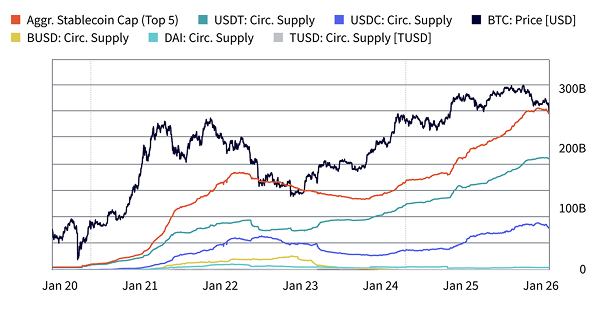
Stablecoin Supply Over Time

Extending Markets Beyond Traditional Rails

DeFi today represents an alternative financial system, where trading, lending, and capital deployment are executed through rules-based protocols rather than intermediaries.

This architecture enables continuous, transparent market activity, with mechanisms such as automated market making and on-chain credit replacing traditional structures.

At the same time, tokenization is extending this system outward: bringing traditional financial assets on-chain and deepening the integration between blockchain infrastructure and global capital markets.
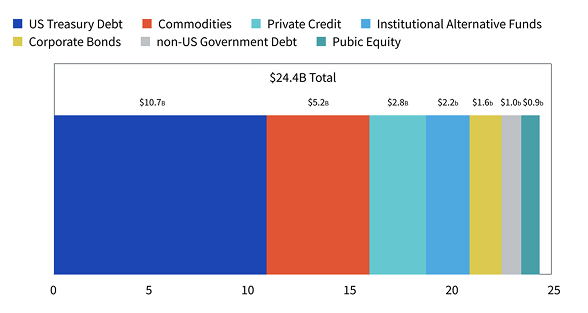
Tokenized Assets by Category

To read the full analysis, download the report in PDF format.

Download report PDF

Disclaimer: This report does not provide any investment advice. All data is provided for information and educational purposes only. No investment decision shall be based on the information provided here and you are solely responsible for your own investment decisions. We urge users to exercise caution and discretion when utilizing these metrics. Glassnode shall not be held responsible for any discrepancies or potential inaccuracies.


  • Follow us on X for timely market updates and analysis
  • Join our Telegram channel
  • For on-chain metrics, dashboards, and alerts, visit Glassnode Studio

İlgili Sorular

QWhat is the primary measure of a blockchain's growth, health, and maturity that is independent of price?

ATransaction fees provide a direct, price-independent measure of a blockchain's growth, health, and maturity.

QHow do the security models of Bitcoin and Ethereum differ according to the report?

ABitcoin represents an energy-backed security model, while Ethereum is an example of a capital-backed security model.

QWhat role do stablecoins play in the blockchain ecosystem?

AStablecoins underpin settlement and liquidity across the ecosystem, acting as the primary unit of account and enabling real-time clearing and continuous capital mobility across global markets.

QWhat is the function of crypto exchanges and custodians in the blockchain economy?

ACrypto exchanges and custodians function as the primary financial gateways, linking on-chain activity to traditional capital markets and driving the transition from retail-dominated ownership to institutional participation.

QWhat is the core economic primitive for evaluating the blockchain ecosystem, as described in the 'Quantifying Network Demand' section?

ABlockspace is the core economic primitive for evaluating the ecosystem, as it is a scarce digital resource consumed by every transaction and priced dynamically through transaction fees.

İlgili Okumalar

Stuck Polymarket: The Real Test After Riding the Traffic Boom Has Arrived

Polymarket, a leading prediction market platform, is facing significant technical challenges as its growth outpaces its current infrastructure on Polygon. Users are experiencing laggy transactions, unresponsive orders, and delayed confirmations, severely impacting the trading experience. In response, DeFi Engineering VP Josh Stevens outlined a comprehensive engineering overhaul. The plan includes reducing on-chain data delays, fixing order cancellation issues, rebuilding the central limit order book (CLOB), improving website performance, and developing a unified SDK and API. A major revelation was the ongoing "chain migration," indicating a potential move away from Polygon. The core issue is that Polymarket has evolved from a simple prediction market into a high-frequency trading platform, making Polygon's limitations—such as block space, gas fees, and block time—a ceiling for further growth. The migration is not just a simple chain switch but a fundamental rebuild of its trading system to support more complex products like perpetual contracts (Perps). This announcement has sparked competition among chains like Solana, Sui, and Algorand, all vying to host Polymarket. For Polygon, losing this key application, which contributes significantly to its gas fee revenue, would be a major setback. The real test for Polymarket is no longer attracting users but proving it can provide a stable, reliable trading environment that retains them.

Odaily星球日报12 dk önce

Stuck Polymarket: The Real Test After Riding the Traffic Boom Has Arrived

Odaily星球日报12 dk önce

Lowering Expectations for BTC's Next Bull Market

The author, Alex Xu, explains his decision to significantly reduce his Bitcoin holdings (from full to ~30% of his portfolio) during the current bull cycle, citing a lowered long-term outlook for BTC's price appreciation in the next cycle. He outlines six key reasons for this reduced expectation: 1. **Diminished Growth Drivers:** The narrative of exponential user adoption has largely played out with institutional ETF adoption. The next major growth phase—adoption by sovereign national reserves or central banks—seems unlikely in the near future. 2. **Personal Opportunity Cost:** More attractive investment opportunities have emerged in other assets, such as undervalued companies. 3. **Industry-Wide Contraction:** The broader crypto industry is struggling, with most Web3 business models (SocialFi, GameFi, DePIN) failing. This overall萧条 (depression) reduces the fundamental demand and consensus for Bitcoin. 4. **Strain on Major Buyer:** MicroStrategy, a major corporate buyer of BTC, faces rising financing expenses for its debt, which could slow its purchasing rate and create significant marginal pressure on the market. 5. **Increased Competition from Gold:** The emergence of "tokenized gold" has closed the functional gap (portability, divisibility) between physical gold and Bitcoin, offering a strong competitor in the non-sovereign store-of-value space. 6. **Security Budget Concerns:** The block reward halving continues to exacerbate the long-standing issue of funding Bitcoin's network security, with new fee source explorations like Ordinals and L2s largely failing. The author's decision to hold a significant (though reduced) position reflects a cautious, not bearish, outlook. He remains open to increasing his exposure if the fundamental reasons for his skepticism change or if new positive catalysts emerge.

marsbit50 dk önce

Lowering Expectations for BTC's Next Bull Market

marsbit50 dk önce

Can Iran 'Control' the Strait of Hormuz?

Iran has announced a comprehensive plan to assert control over the strategic Strait of Hormuz, a critical global oil shipping chokepoint. The proposed measures include requiring all vessels to obtain Iranian permission for passage, imposing fees for security, environmental protection, and navigation management—preferably paid in Iranian rials—and absolutely banning Israeli ships. Vessels from countries deemed hostile by Iran’s top security bodies may also be barred. Analysts suggest Iran’s motives are multifaceted: increasing pressure on the U.S. and Israel by leveraging control over oil transit to influence global prices and inflation; creating a new revenue stream, potentially exceeding $7.7 billion annually, to counter Western sanctions and support postwar reconstruction; and using transit permissions as bargaining chips in future negotiations, notably with the U.S. However, the plan faces significant practical and diplomatic challenges. Enforcing comprehensive interception and fee collection in the busy waterway, patrolled by international military forces, would be difficult. The U.S. has already countering with a blockade of Iranian ports and threats to intercept any ship paying fees, potentially strangling Iran’s oil exports and fee revenue. Broad international opposition, led by European and Gulf states, and legal controversies further complicate implementation. The proposal may ultimately serve more as a negotiating tactic than a feasible policy, with its execution remaining highly uncertain.

marsbit2 saat önce

Can Iran 'Control' the Strait of Hormuz?

marsbit2 saat önce

İşlemler

Spot
Futures
活动图片