Wintermute: The Four-Year Cycle is Dead, How Will Crypto Break Through in 2026?

marsbit2026-01-20 tarihinde yayınlandı2026-01-20 tarihinde güncellendi

Özet

The traditional four-year crypto cycle, once considered a market "iron law," is now obsolete, according to a 2025 annual report from market maker Wintermute. The market logic has shifted from "seasonal rotation" to "liquidity lock-up." 2025 did not bring the anticipated broad rally but instead showed extreme polarization: BTC and ETH gained institutional legitimacy through ETFs, while altcoins saw significantly reduced momentum and shorter lifespans. OTC data indicates that the historical wealth flow—from Bitcoin to Ethereum, then to blue chips, and finally to altcoins—has weakened substantially. ETFs and Digital Asset Trusts (DATs) act as "walled gardens," providing sustained demand for large-cap assets but failing to naturally circulate liquidity to the broader market. Altcoin rallies in 2025 lasted an average of just 20 days, down from 60 days in 2024, reflecting a highly concentrated market. Wintermute outlines three potential catalysts to break this stagnation in 2026: 1. **Expanding Institutional Mandates**: Broader institutional adoption beyond current large-cap assets, as seen with early ETF filings for Solana (SOL) and XRP. 2. **The Wealth Effect**: A strong rally in BTC or ETH could generate spillover demand for altcoins, similar to 2024. 3. **Rotation from Equities**: Retail attention shifting back from equity markets (e.g., AI, rare earths, quantum computing) to crypto, though this is the least likely scenario. The future of the market depends on...

The once-considered "iron law" of the four-year halving cycle in the crypto market is facing unprecedented challenges. Top market maker Wintermute pointed out in its latest 2025 annual report that the traditional cycle narrative has become obsolete, and market logic has shifted from "seasonal rotation" to "liquidity lock-up."

2025 did not bring the widespread euphoria as expected; instead, it exhibited extreme emotional polarization: on one hand, BTC and ETH entered the institutional hall of fame with the support of ETFs, while on the other hand, the explosive power of altcoins significantly diminished, and their lifecycles shortened.

Facing 2026, can the crypto market break the current存量困局 (stock dilemma)? Wintermute has outlined three core variables to打破现状 (break the status quo).

Main Text:

2025 did not bring the anticipated broad-based rally, but this may be regarded by future generations as the beginning of cryptocurrency's transition from a speculative tool to a mature asset class.

The traditional four-year cycle is becoming outdated. Market performance is no longer dominated by self-fulfilling timed narratives but depends on the flow of liquidity and the concentration of investor attention.

What Changed in 2025?

Historically, crypto-native wealth manifested as a fungible pool of capital. Profits from Bitcoin would spill over into Ethereum (ETH), then flow to blue-chip assets, and finally reach altcoins.

Wintermute's over-the-counter (OTC) flow data indicates that this传导机制 (transmission mechanism) significantly weakened in 2025.

Spot exchange-traded funds (ETFs) and digital asset trusts (DATs) evolved into "walled gardens." They provided sustained demand for large-cap assets but did not naturally rotate funds into the broader market.

With retail interest being drawn to the stock market, 2025 became a year of extreme polarization.
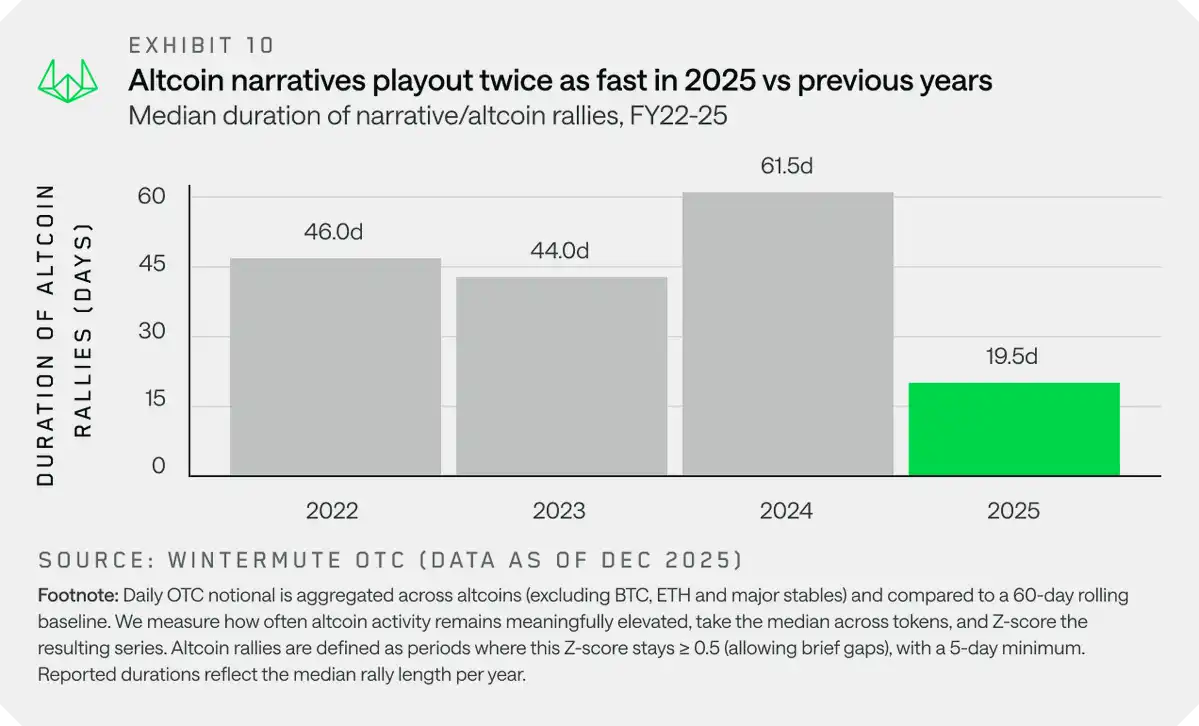
The average duration of altcoin rallies in 2025 was 20 days, far below the 60 days seen in 2024.

A handful of mainstream assets absorbed the vast majority of new funds, while the broader market struggled.

Three Paths for 2026

For market participation to extend beyond mainstream assets and expand further, at least one of the following three things needs to happen:

1. Expanding Institutional Mandates

Currently, most of the new liquidity remains confined to institutional channels. A full market recovery requires institutional investors to broaden the range of assets they can invest in.

Early signs have already emerged through ETF applications for Solana (SOL) and XRP.

2. The Wealth Effect from Mainstream Assets

A strong rebound in Bitcoin or Ethereum could generate a wealth effect, spilling over into the broader market, similar to what happened in 2024.

However, there remains uncertainty about how much capital will ultimately flow back into digital assets.

3. Rotation from Equities

Retail investor attention could rotate back from the stock market (such as AI, rare earths, quantum computing, etc.) to cryptocurrencies, bringing fresh capital inflows and stablecoin minting.

Although this is the least likely scenario, it would significantly expand market participation.

The future outcome will depend on whether the aforementioned catalysts can effectively diffuse liquidity beyond a few large-cap assets or whether this concentration trend will persist.

Understanding where capital flows and what structural changes are needed will determine which strategies will work in 2026.


İlgili Sorular

QAccording to Wintermute's 2025 report, what is replacing the traditional four-year cycle narrative in the crypto market?

AThe market logic has shifted from 'seasonal rotation' to 'liquidity lock-up', where performance is now dictated by the flow of liquidity and the concentration of investor attention rather than self-fulfilling, timed narratives.

QWhat does Wintermute identify as a key factor causing the extreme polarization in the crypto market in 2025?

AThe introduction of spot ETFs and Digital Asset Trusts (DATs) acted as 'walled gardens', providing sustained demand for large-cap assets like BTC and ETH but not naturally rotating capital into the broader market, while retail interest was drawn to the stock market.

QWhat was the average duration of an altcoin rally in 2025, as cited by Wintermute?

AThe average duration of an altcoin rally in 2025 was 20 days, which is significantly lower than the 60-day average seen in 2024.

QWhat are the three potential catalysts Wintermute outlines for breaking the current market stagnation and expanding participation beyond large-cap assets in 2026?

AThe three catalysts are: 1. Expanding Institutional Mandates, where institutions invest in a wider range of assets. 2. The Wealth Effect from a strong Bitcoin or Ethereum rally spilling over. 3. A Rotation from Equities, where retail attention shifts back from the stock market to crypto.

QWhat early sign does Wintermute point to regarding the potential expansion of institutional investment mandates?

AWintermute points to the ETF applications for Solana (SOL) and XRP as early signs that institutional investors might be expanding the range of assets they are willing to invest in.

İlgili Okumalar

Within Strategy's Framework, STRC's Dividend Yield Remains at 12% as Share Price Stays Below Par Value

Michael Saylor, Executive Chairman of Strategy (MSTR), confirmed that the dividend rate for its STRC perpetual preferred shares will remain at 12.00% through August 2026. The rate has increased from 9% at its July 2025 launch to the current high via a "ratchet" mechanism, which permanently raises the rate by 0.5% whenever the share price falls below $95. This mechanism is intended to push the price back toward its $100 par value and support Strategy's "at-the-market" (ATM) program for issuing new shares to fund Bitcoin purchases. However, the mechanism has not worked as intended. STRC shares closed at $89.46 on July 31, remaining about 10-11% below par value despite the record-high dividend. Competition from rival Strive's higher-yielding SATA securities has pressured demand. The persistent discount has forced Strategy to suspend new STRC issuances via its ATM program, limiting this funding channel for Bitcoin acquisitions. STRC's struggles reflect Bitcoin's own volatility, as the preferred shares historically move in tandem. Analysts have warned the ratchet structure carries long-term, one-way risk. A law firm is investigating Strategy's ability to maintain dividend payments if Bitcoin's price stays low. Retail investors own roughly 83% of outstanding STRC shares, a group seen as prone to panic selling during downturns. In response, Strategy has established financial reserves, including a liquidity cushion covering about 26 months of dividend/interest obligations, and a $2 billion share buyback program alongside a Bitcoin monetization framework, though the company emphasized it is not obligated to sell any Bitcoin.

cryptonews.ru19 dk önce

Within Strategy's Framework, STRC's Dividend Yield Remains at 12% as Share Price Stays Below Par Value

cryptonews.ru19 dk önce

Analyst: Bitcoin's Price Will Drop to $60k in August, Then Rebound to $70k

Financial analyst Andrey Poroshin has provided a new forecast for Bitcoin's price dynamics in August. Poroshin, an analyst at the Bitbanker exchange, expects the cryptocurrency market to experience a downturn this month, with prices retesting the $60,000 level due to a lack of supportive macroeconomic catalysts. He noted that the recent US Federal Reserve decision to hold interest rates did not significantly impact the market, while inflation remains above the 2% target. Poroshin stated that Bitcoin is ending July under pressure from moderate volatility and a lack of new macroeconomic stimuli, leading to continued market caution. According to his base scenario, Bitcoin will drop to a range of $60,000 to $62,000 before recovering to $70,000. He pointed out that even $70,000 remains below the cost of mining in the US, which has prompted some miners to shift towards AI data center operations. Poroshin cited the winding down of BitMEX's operations as a potential catalyst for a price rebound, suggesting the exit of weaker players often coincides with market reversals and reduced short-term selling pressure. He believes Bitcoin is currently less susceptible to geopolitical shocks, such as the Iran-US conflict, and does not expect significant market changes in August related to the pending CLARITY Act. Looking ahead, Poroshin forecasts that September will bring more active price fluctuations driven by potential Fed rate decisions and possible discussions or approval of the CLARITY Act.

cryptonews.ru19 dk önce

Analyst: Bitcoin's Price Will Drop to $60k in August, Then Rebound to $70k

cryptonews.ru19 dk önce

İşlemler

Spot
活动图片




