Will Trump Announce the New Fed Chair on the Night of the Fed Decision?

比推2026-01-28 tarihinde yayınlandı2026-01-28 tarihinde güncellendi

Özet

On January 29, 2026, the Federal Reserve is expected to announce its decision to keep interest rates unchanged, with market consensus nearly 100%. While this outcome is widely anticipated, the focus will be on Chair Jerome Powell’s post-announcement press conference for signals on future monetary policy. Investors are divided over whether the Fed will continue its rate-cutting cycle later in the year or adopt a more hawkish stance due to persistent inflation, which remains at 2.8%, above the 2% target. A key uncertainty is the potential announcement of a new Fed Chair nominee by former President Donald Trump, who has hinted at a January reveal. The shortlist includes Rick Rieder (currently the most probable candidate at 47%), Kevin Warsh, Christopher Waller, and Kevin Hassett. Trump may use the FOMC meeting timing to divert market attention from any hawkish signals from Powell, instead promoting a dovish nominee to reassure markets. The new composition of the voting members on the Fed’s rate-setting committee also leans more hawkish this year, which could influence future decisions regardless of the new Chair’s stance. The outcome of Powell’s remarks and a possible Trump announcement could significantly impact market sentiment.

Author: Golem

Original Title: On the Eve of the Storm: Powell Holds Rates, Trump Announces New Fed Chair?


At 3:00 AM Beijing time on January 29 (this Thursday), the Federal Reserve is set to announce its first interest rate decision of 2026; half an hour later, current Fed Chair Jerome Powell will hold a monetary policy press conference. However, there is little suspense around this Fed rate decision, as the market widely expects the Fed to keep rates unchanged. Polymarket data shows the probability of holding rates steady is close to 100%.
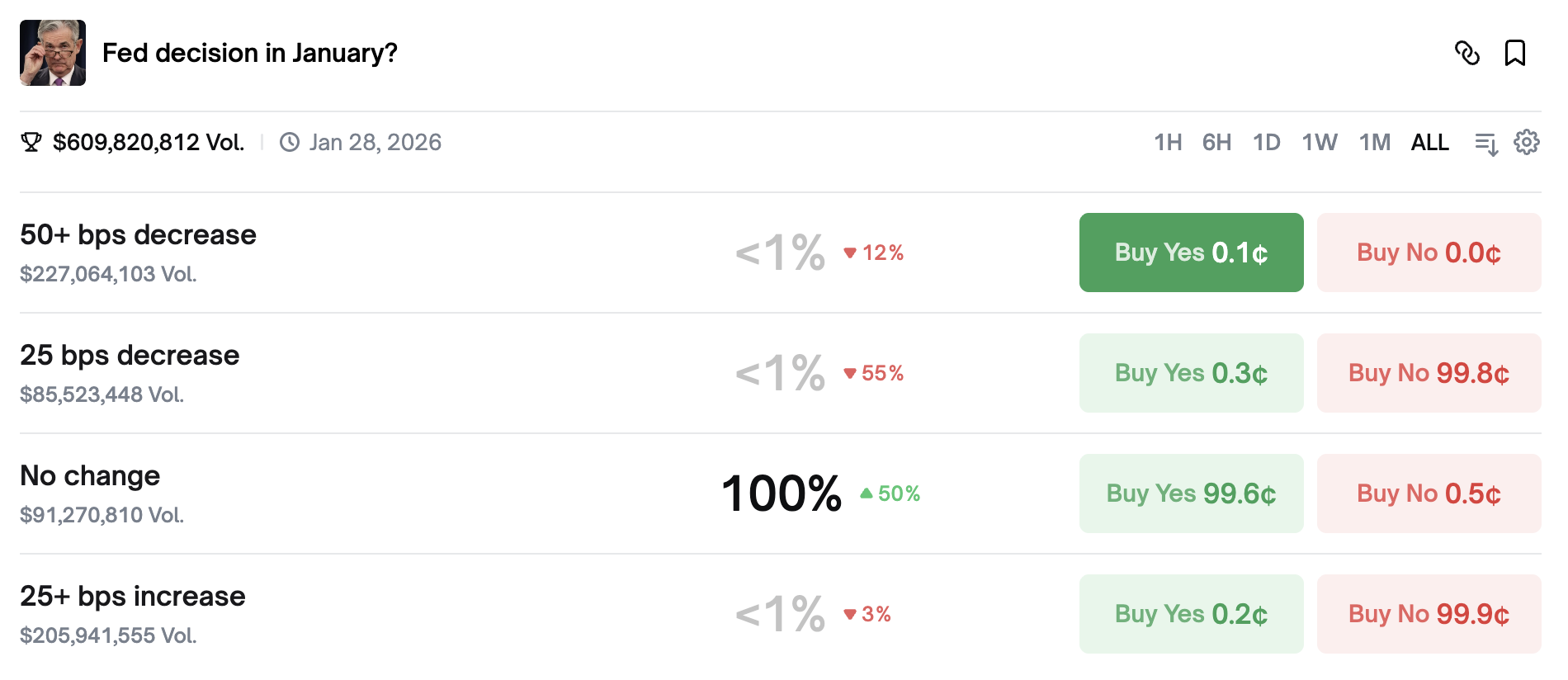
Such a high probability has allowed the market to提前消化 (price in) the negative impact of the Fed's "no rate cut" announcement this time. OKX data shows that BTC has fallen only 0.39% in the past 7 days, basically hovering sideways, but this period of market "silence" might be broken tonight.

On one hand, although the market almost unanimously believes the Fed will hold rates this week, there is significant divergence regarding the fiscal path for the remainder of 2026, making this still an important meeting to watch. The Fed's future key policy tendencies—whether it will continue cutting rates in 2026, the frequency of cuts, etc.—will affect the market. If Powell makes hawkish remarks during his speech, such as "need to continue observing," the market might "fall in response."

On the other hand, the announcement of the successor to the Fed Chair will also have a long-term impact on the market. The shortlist has been narrowed down to four people. Trump previously stated he has a preferred candidate but is waiting for the right time to announce, and this suitable time could very well be tonight.

2026 Rate Cut Direction Still Uncertain

Since last September, the Fed initiated a new rate-cutting cycle, conducting three consecutive rate cuts. If rates are held unchanged this week, it would be the first pause since the cycle began. At this point, the market is concerned not with the reason for holding rates, but whether this is a brief pause to observe or the start of a prolonged pause in rate cuts, or even the beginning of a rate hike cycle?

Previously, the prevailing market view was that 2026 would be a year of further quantitative easing by the Fed.

Reason one, from a data perspective, the US labor market indeed shows signs of weakness. Non-farm payrolls increased by only 50,000 in December 2025, with an unemployment rate of 4.4%. While there hasn't been "massive layoffs," it remains in a state of "low hiring, cooling demand." Reason two, the Fed might still believe Trump's tariff policies won't have a long-term impact on inflation (Odaily: Powell cited this factor for a rate cut in September 2025). Reason three, Trump has publicly stated he will choose a "dovish" figure as the next Fed Chair.

However, some in the market believe there is uncertainty about the Fed continuing rate cuts in 2026. Some analysts think that unless the job market deteriorates significantly, it will be difficult to see rate cuts before mid-year, as the pace of inflation decline is not sufficient to convince hawkish members.

The Fed's mandate, simply put, is to curb inflation and promote employment. However, in 2025, the US experienced a phenomenon of a weak labor market coexisting with high inflation. The Fed ultimately chose to prioritize the employment issue, hence initiating the rate-cutting cycle. Yet, the reality is that the US inflation rate remains stuck at 2.8%, far above the Fed's 2% target, forcing the Fed to reconsider the impact of tariffs on inflation. Holding rates this week would also indicate the Fed is starting to "observe."

Furthermore, although the next Fed Chair chosen by Trump is destined to be "dovish," the new rotating chairs of the Fed's interest rate-setting committee are predominantly "hawkish." At the beginning of each year, four of the 12 regional Fed presidents rotate onto the interest rate-setting committee and gain voting rights for the next eight policy meetings. This year's rotating list includes Dallas Fed President Lorie Logan, Cleveland Fed President Loretta Mester (referred to as Hamack in the text, likely a transliteration for Mester), Philadelphia Fed President Patrick Harker (referred to as Paulson in the text, likely a transliteration for Harker), and Minneapolis Fed President Neel Kashkari.

Among them, Logan and Mester are seen as "hawkish" figures, both having previously publicly stated the Fed should focus on inflation. Harker is seen as "dovish," having expressed "cautious optimism" about inflation. Kashkari's stance is relatively neutral. The addition of new "hawkish" members might disrupt the previous balance of policy倾向 within the Fed. Even if Trump chooses a "dovish" Chair, they cannot single-handedly sway the entire interest rate-setting committee.

Moreover, the Fed Chair might not completely follow Trump's wishes in主导降息 (leading rate cuts). Years ago, Trump personally appointed Powell as Fed Chair, but last year, even though Trump promoted Powell, Powell did not "repay" Trump with sustained, significant rate cuts. Under US law, the Fed is independent and can make interest rate decisions based on the economic situation, not government wishes. Therefore, even if the new Fed Chair verbally promises Trump to cut rates, they might "go their own way" after taking office.

This kind of meaningless "political promise" is also a concern for Trump. Last week, Trump said in a speech at the World Economic Forum in Davos, Switzerland, "It's amazing how people change once they get that job," meaning candidates "say nice things during the interview" but emphasize their independence once confirmed.

Considering these factors, Powell's speech after tonight's FOMC meeting will also be closely watched by investors for hints on how long the Fed might pause rate cuts.

This Week's FOMC Meeting Could Be One of the Best Times for Trump to Announce the Fed Chair Successor

Besides this week's FOMC meeting, the Fed Chair successor is another macro event that can influence the market. The candidates have been narrowed down to Kevin Hassett, Kevin Warsh, Rick Rieder, and Christopher Waller. According to Polymarket data, Rick Rieder currently has the highest probability of being nominated by Trump at 47%; Kevin Hassett has the lowest probability at 6%.
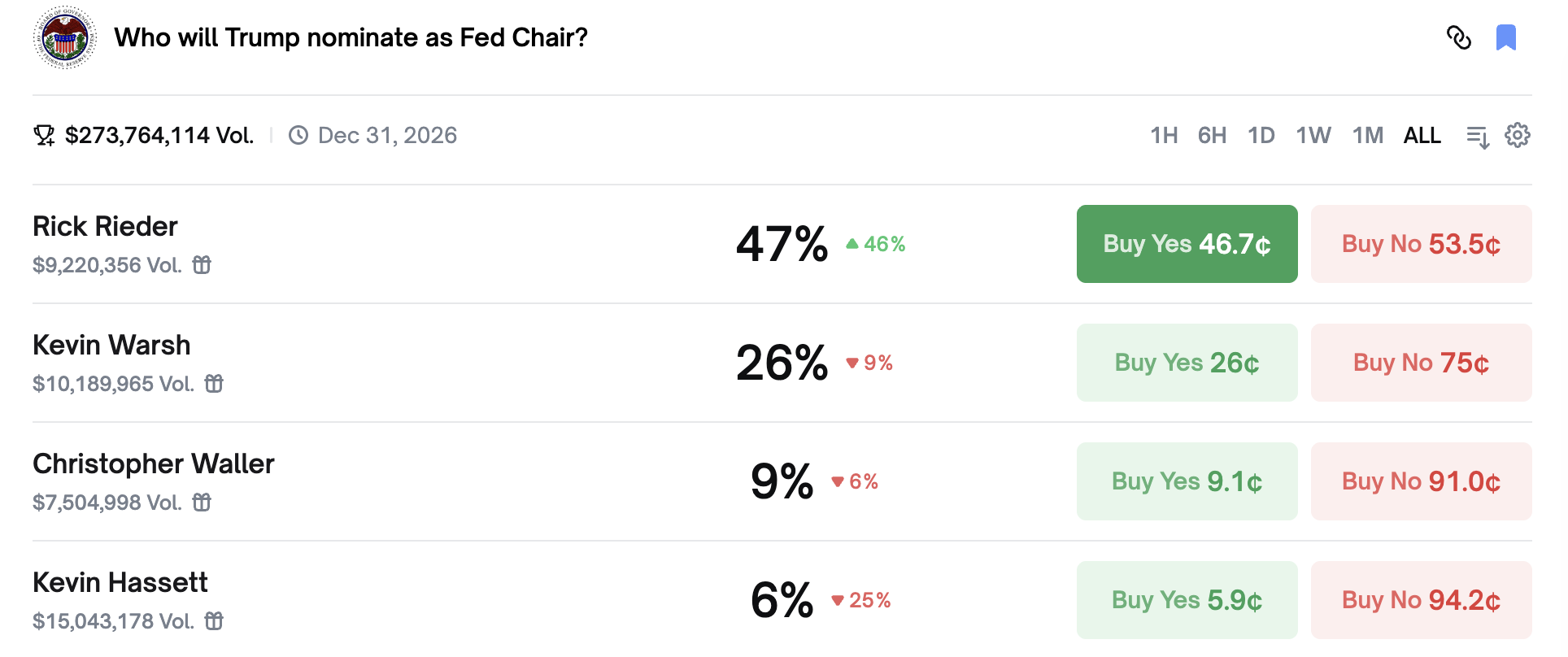
Rick Rieder is BlackRock's Chief Investment Officer of Global Fixed Income. Although he doesn't have much government experience, he has consistently advocated for supporting low interest rates based on his understanding of the market rather than politics. This resume might attract Trump, who is worried about the new Fed Chair becoming "disobedient" upon taking office. Economists at Evercore ISI, including Krishna Guha, even believe "if Rick Rieder becomes the new Fed Chair, he might advocate for three rate cuts this year." (Odaily Note: For more information on Rick Rieder, read 《The Last Seat on the Fed Chair Candidate List, What is Rick Rieder's Attitude Towards Crypto?》)

Hassett was once considered the most likely candidate for the new Fed Chair, with probability一度 (once) exceeding 80%. But Hassett is Trump's economic advisor. Previously,外界质疑 (outside doubts emerged) that if Trump nominated Hassett, it would damage the Fed's independence. Additionally, Trump publicly stated he didn't want to lose Hassett within his administration. Therefore, Hassett's probability of selection declined, though some still believe his nomination probability is higher than 6%.

Trump has repeatedly publicly stated he would announce his nominee in January. In late December 2025, Trump told reporters in Florida he would announce the next Fed Chair人选 (candidate) sometime in January; On January 14, 2026, Trump said in an interview with Reuters he would announce the candidate within the next few weeks; Two weeks later, on January 27, Trump said in Iowa he would announce the new Fed Chair candidate soon, but has not done so yet.

Although Trump's answers are vague each time, it's certain that the probability of an announcement in January is very high. It's even highly possible that the best time to announce is during this week's FOMC meeting.

As mentioned earlier, Powell's speech tonight will be a key focus for investors. If Powell does not make dovish-leaning remarks, financial markets might suffer a blow, a scenario Trump显然不愿见到 (obviously does not want to see). Therefore, if Trump wants to shift market attention away from the uncertain Powell, he might announce his nominee for the next Fed Chair during tonight's FOMC meeting. This would release the positive news of a "dovish chair" to the market, reducing attention on Powell's speech or mitigating potential negative market impacts.

Tonight, let's wait and see!


Twitter:https://twitter.com/BitpushNewsCN

BitPush TG Discussion Group:https://t.me/BitPushCommunity

BitPush TG Subscription: https://t.me/bitpush

Original article link:https://www.bitpush.news/articles/7606677

Trend Kriptolar

İlgili Sorular

QWhat is the market's expectation for the Federal Reserve's interest rate decision on January 29, 2026?

AThe market widely expects the Federal Reserve to maintain the current interest rate, with the probability of no change being close to 100% according to Polymarket data.

QWhy might the Federal Reserve's decision to pause rate cuts in January 2026 be significant despite the high expectation of no change?

AIt is significant because there is considerable divergence in the market's expectations for the Fed's monetary policy path for the rest of 2026, including the frequency of potential future rate cuts. This makes it an important meeting for gauging future policy direction.

QWho are the four candidates reportedly shortlisted by Trump for the next Federal Reserve Chair, and who is the current favorite according to prediction markets?

AThe four candidates are Kevin Hassett, Kevin Warsh, Rick Rieder, and Christopher Waller. According to Polymarket data, Rick Rieder currently has the highest probability of being nominated at 47%.

QWhat reason does the article suggest for why Trump might announce his Fed Chair nominee during the FOMC meeting?

AThe article suggests Trump might announce the nominee during the FOMC meeting to shift market attention away from potentially hawkish comments by Chair Powell. This could help mitigate any negative market reaction by instead highlighting the promise of a future dovish Chair.

QWhat are the two main factors cited that create uncertainty about the Fed's ability to continue its rate-cutting cycle in 2026?

AThe two main factors are: 1) Stubbornly high inflation, which remains at 2.8%, well above the Fed's 2% target, causing the Fed to reassess the impact of tariffs. 2) The annual rotation of voting members on the rate-setting committee, which has introduced new hawkish members who may disrupt the previous policy balance.

İlgili Okumalar

Annual Salary of Millions Competing for Electricians, Meta Rushes to Open Its Own Technical School

The AI boom is facing an unexpected bottleneck: a severe shortage of skilled construction workers and electricians. As tech giants like Meta, OpenAI, and Alphabet race to build massive data centers—such as OpenAI's $16 billion "Stargate" project—they are hitting a critical labor wall. The U.S. needs an estimated 130,000 more electricians, 240,000 construction workers, and 150,000 supervisors by 2030 for AI infrastructure alone, but tens of thousands of electrician jobs go unfilled each year. While AI companies offer high premiums, with electricians earning up to $280,000 annually, worker scarcity still causes massive losses—delays on a single project can cost $14.2 million per month. The complexity of building AI data centers, which require immense power (equivalent to powering hundreds of thousands of homes), sophisticated electrical systems, and advanced liquid cooling solutions, demands highly skilled technicians who are in short supply. To combat this, companies are investing heavily in training. Meta has committed $115 million to a free training school offering tuition, housing, and stipends, targeting 5,000 new workers. OpenAI is partnering with unions to secure skilled labor. These efforts are paying off, with a significant rise in Gen Z interest in trade schools over college. However, the power demands are staggering. AI data centers are driving a rapid surge in electricity consumption, projected to account for up to 12% of U.S. power use by 2028 and raising costs for consumers. Furthermore, the construction boom is project-based, leading to a potential future glut of trained workers once building peaks, which could depress wages industry-wide. The race for AI supremacy now depends as much on skilled hands as on advanced chips.

marsbit30 dk önce

Annual Salary of Millions Competing for Electricians, Meta Rushes to Open Its Own Technical School

marsbit30 dk önce

OpenAI No Longer Sells Its Most Expensive Model for Profit

OpenAI is shifting its business strategy away from promoting its most expensive, flagship models for every task. Recent price cuts—80% for GPT-5.6 Luna and 20% for Terra—signal a deeper change: the company now actively advises users that many tasks don't require the most powerful model. Instead, OpenAI recommends a tiered approach: use the high-end GPT-5.6 Sol for complex planning and analysis, then delegate execution to cheaper models like Luna. This mirrors moves by Anthropic, which recently launched Claude Opus 5 at half the price of its top model, Fable 5. Both companies are de-emphasizing flagship models as primary revenue drivers, using them instead for brand prestige and technological showcases. The industry is entering a "mass-market" phase, similar to automotive, where high-volume, cost-effective models handle daily operations and drive scale. OpenAI's price reductions are partly enabled by AI models themselves optimizing underlying code and infrastructure, creating a self-reinforcing cycle of efficiency gains and cost reduction. Competition is shifting from "who is smartest" to "who offers the best value." The goal is no longer selling individual models but fostering widespread API adoption and ecosystem lock-in. By making AI calls cheap and ubiquitous, companies like OpenAI aim to become the indispensable, utility-like infrastructure powering automated workflows—the "water and electricity" of software, quietly embedded everywhere.

marsbit30 dk önce

OpenAI No Longer Sells Its Most Expensive Model for Profit

marsbit30 dk önce

Will the Fed Definitely Raise Interest Rates in September? How Will Crypto and U.S. Stocks Withstand the Pressure?

The market's expectation for a September Fed rate hike surged dramatically in early August, jumping from under 50% to over 80% within a week. This shift followed a contentious July FOMC meeting, where a 9-3 vote to hold rates revealed growing dissent from hawkish members advocating for an immediate hike to combat persistent inflation. The primary catalyst for this repricing is rising oil prices, driven by renewed geopolitical tensions around the Strait of Hormuz, which threaten global supply. Energy costs directly influence inflation metrics, making the upcoming July CPI report (due August 12th) a critical data point. If it shows inflation reaccelerating, the probability of a September hike will solidify. For Bitcoin and crypto assets, this is typically bearish news. Bitcoin continues to behave as a high-beta, liquidity-sensitive risk asset. A rate hike raises the opportunity cost of holding non-yielding assets and could drive capital toward money markets, pressuring crypto prices in the short term. However, historical patterns suggest that if a hike is perceived as the end of a tightening cycle rather than the start, any negative price impact may be brief. U.S. stocks, particularly crypto-linked equities like Coinbase and growth-oriented tech stocks, are also vulnerable. Higher rates increase discount rates in valuation models, putting pressure on high-multiple companies. This coincides with a pivotal tech earnings season where investor focus has shifted from massive AI capital expenditure to tangible revenue and cash flow generation. Companies with negative cash flow and weak growth narratives could face heightened volatility if borrowing costs rise in September. In summary, a September Fed hike has evolved into a mainstream market scenario. Key factors to watch are oil prices, the July CPI report, and Fed communications, which will determine the final decision and its impact on volatile crypto and equity markets.

marsbit40 dk önce

Will the Fed Definitely Raise Interest Rates in September? How Will Crypto and U.S. Stocks Withstand the Pressure?

marsbit40 dk önce

İşlemler

Spot

Popüler Makaleler

NIGHT Nasıl Satın Alınır

HTX.com’a hoş geldiniz! Midnight (NIGHT) satın alma işlemlerini basit ve kullanışlı bir hâle getirdik. Adım adım açıkladığımız rehberimizi takip ederek kripto yolculuğunuza başlayın. 1. Adım: HTX Hesabınızı OluşturunHTX'te ücretsiz bir hesap açmak için e-posta adresinizi veya telefon numaranızı kullanın. Sorunsuzca kaydolun ve tüm özelliklerin kilidini açın. Hesabımı Aç2. Adım: Kripto Satın Al Bölümüne Gidin ve Ödeme Yönteminizi SeçinKredi/Banka Kartı: Visa veya Mastercard'ınızı kullanarak anında Midnight (NIGHT) satın alın.Bakiye: Sorunsuz bir şekilde işlem yapmak için HTX hesap bakiyenizdeki fonları kullanın.Üçüncü Taraflar: Kullanımı kolaylaştırmak için Google Pay ve Apple Pay gibi popüler ödeme yöntemlerini ekledik.P2P: HTX'teki diğer kullanıcılarla doğrudan işlem yapın.Borsa Dışı (OTC): Yatırımcılar için kişiye özel hizmetler ve rekabetçi döviz kurları sunuyoruz.3. Adım: Midnight (NIGHT) Varlıklarınızı SaklayınMidnight (NIGHT) satın aldıktan sonra HTX hesabınızda saklayın. Alternatif olarak, blok zinciri transferi yoluyla başka bir yere gönderebilir veya diğer kripto para birimlerini takas etmek için kullanabilirsiniz.4. Adım: Midnight (NIGHT) Varlıklarınızla İşlem YapınHTX'in spot piyasasında Midnight (NIGHT) ile kolayca işlemler yapın.Hesabınıza erişin, işlem çiftinizi seçin, işlemlerinizi gerçekleştirin ve gerçek zamanlı olarak izleyin. Hem yeni başlayanlar hem de deneyimli yatırımcılar için kullanıcı dostu bir deneyim sunuyoruz.

362 Toplam GörüntülenmeYayınlanma 2025.12.08Güncellenme 2026.06.02

NIGHT Nasıl Satın Alınır

Tartışmalar

HTX Topluluğuna hoş geldiniz. Burada, en son platform gelişmeleri hakkında bilgi sahibi olabilir ve profesyonel piyasa görüşlerine erişebilirsiniz. Kullanıcıların NIGHT (NIGHT) fiyatı hakkındaki görüşleri aşağıda sunulmaktadır.

活动图片













