Will the Continued Shutdown of the Strait of Hormuz Trigger an Oil and Gas Supply Crisis?

marsbit2026-05-08 tarihinde yayınlandı2026-05-08 tarihinde güncellendi

Özet

The prolonged closure of the Strait of Hormuz, a critical global energy chokepoint, is evolving from a military conflict into a severe stress test for worldwide energy trade. Despite a ceasefire, transit remains minimal due to persistent threats from Iran, which uses drones, small boats, mines, and a new transit permit/fee system to effectively control the strait. Daily vessel traffic has plummeted from about 135 to under 10 ships, trapping over 1500 commercial vessels. The U.S. has initiated "Project Freedom" to escort ships, but Iran condemns it as a violation. The crisis is forcing a fundamental re-pricing of risk and cost for using this route, which normally carries about one-fifth of global oil and LNG supplies. Even if a political deal is reached, restoring full, trusted transit will be slow due to mine clearance needs, security concerns, and eroded market confidence. Major oil producers like Saudi Arabia are using alternative pipelines, but capacities are limited and routes are also vulnerable. Iran has signaled its intent to institutionalize control over the strait post-conflict, leveraging it as a geopolitical tool. The standoff underscores how Iran can paralyze this vital passage without a traditional navy, creating a lasting impact on global energy security and trade logistics.

Editor's Note: The crisis in the Strait of Hormuz is evolving from a military conflict into a stress test for global energy trade.

The key recent shift is that the ceasefire has not led to a genuine resumption of navigation. In early May, the United States announced the launch of "Project Freedom," attempting to guide stranded vessels away from the Persian Gulf; Iran, in turn, warned external warships not to enter the strait. Subsequently, the U.S. and Iran engaged in another round of clashes near the Strait of Hormuz, with the U.S. claiming it intercepted an Iranian attack on three U.S. naval vessels, and Iran accusing the U.S. of violating the ceasefire and attacking vessels and coastal areas. While former President Trump stated the ceasefire remained in effect, the market has already begun repricing the risks, with Brent crude prices briefly rising to around $101 per barrel.

Iran has demonstrated that, even without a traditionally strong navy, it can bring the world's most important energy artery to a near-standstill through the use of drones, small boats, the threat of mines, and mechanisms for passage permits and fees. For shipowners, insurers, and oil-producing nations, the question is no longer just "can we pass through," but "how much risk do we bear for each passage."

This means the cost of using the Strait of Hormuz is being repriced. Once considered an implicitly available piece of global energy infrastructure, it is now turning into a geopolitical bargaining chip in Iran's hands. Even if a future agreement is reached between the U.S. and Iran, a full restoration of shipping to pre-conflict levels is unlikely to happen immediately, because what has truly been damaged is not the waterway itself, but the market's trust in its safety.

Below is the original article:

No region in the world produces more oil and natural gas than the countries spanning the coast of the Persian Gulf. Most of that energy is exported by tankers navigating through the Strait of Hormuz—and that waterway has effectively been blocked for more than two months.

Since being attacked by the U.S. and Israel in late February, Iran has been restricting vessel transit through the strait. Iran refuses to reopen this vital shipping lane unless the U.S. lifts its maritime blockade on Iranian ports. Tensions escalated again in early May, nearly threatening the maintenance of the ceasefire agreement. Prior to this, former U.S. President Donald Trump announced that the U.S. would launch an operation called "Project Freedom" to guide stranded ships away from the Persian Gulf.

The economic impact of the Strait of Hormuz obstruction is accumulating worldwide. As prices for oil, natural gas, and other commodities rise, supplies are also tightening. Even if the U.S. and Iran eventually break the deadlock in peace talks and reach an agreement to lift the strait blockade, free navigation may not fully resume. Iran has already signaled its intent to use its de facto control over the Strait of Hormuz as a weapon it can wield against adversaries in the future.
How Did the War Affect the Strait of Hormuz?

How did the Iran war affect shipping in the Strait of Hormuz?

Following the outbreak of war on February 28, Iran intermittently attacked ships in and around the Persian Gulf, leading most shipowners to be unwilling to risk casualties, cargo loss, and vessel destruction by attempting to cross the Strait of Hormuz. The average number of vessels passing through the strait daily dropped from around 135 during peacetime to fewer than 10.

Meanwhile, Iran has continued to transport its own oil through the strait. It has also allowed some other vessels to pass, often via a corridor hugging the Iranian coastline; sometimes, Iran has demanded fees of up to $2 million from these vessels.
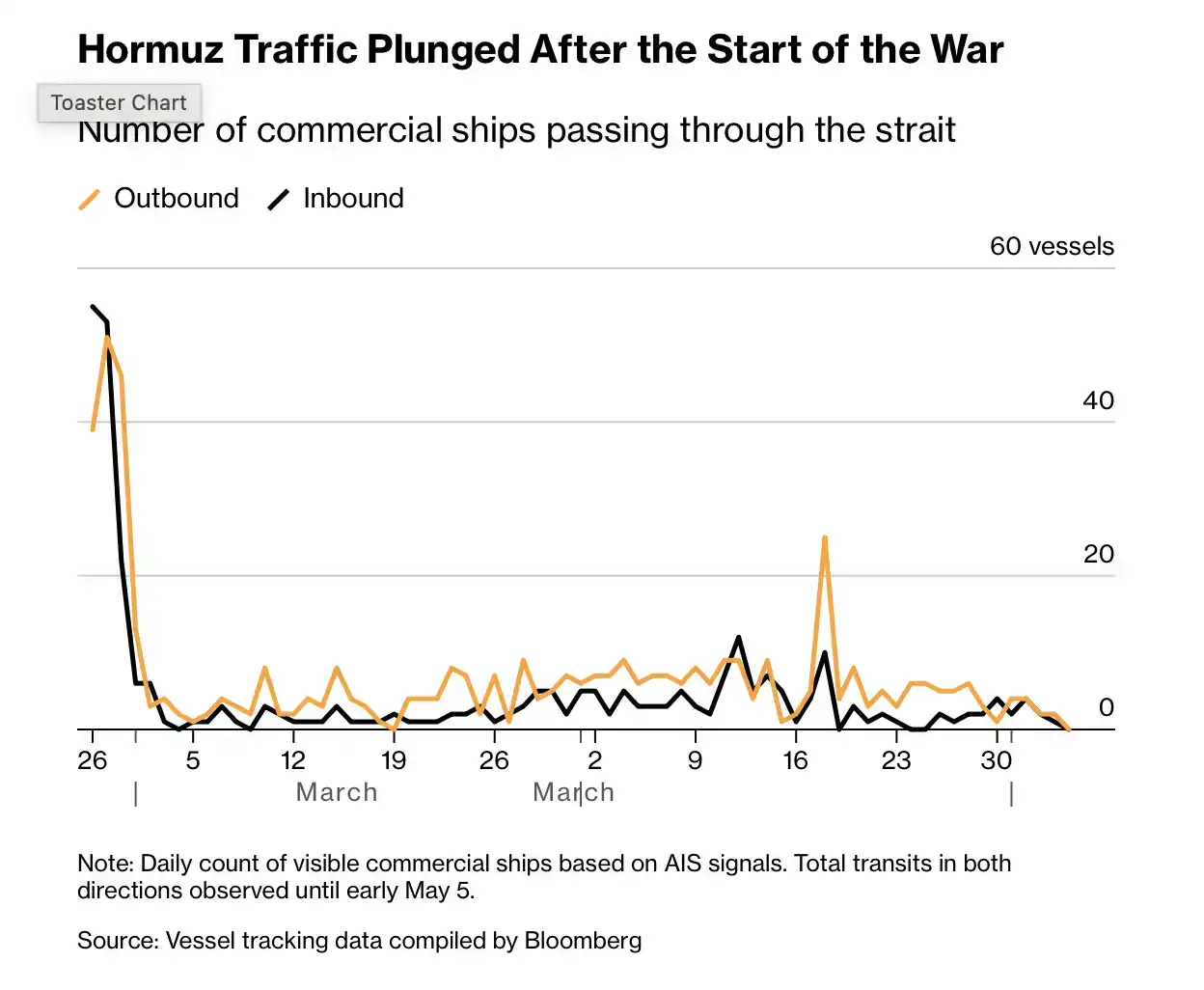
Even after the warring parties agreed to a ceasefire in early April, strait traffic remained nearly stagnant. Starting April 13, the U.S. began imposing a blockade on vessels that had called at Iranian ports or were bound for them, aiming to pressure Iranian oil exports and force the Iranian regime to restore the Strait of Hormuz to a "toll-free zone."

So far, Iran has successfully resisted the blockade pressure. According to Iran's semi-official Tasnim news agency, in early May, Iran even expanded the area over which it claims control in the Strait of Hormuz. As the stalemate persists, the U.S. military states that over 1,500 merchant vessels are now trapped in the Persian Gulf. With crude storage space exhausted, oil producers in the region have been forced to suspend most of their production.

What is needed to reopen the Strait of Hormuz?

Even if a peace agreement is reached, it is unlikely to immediately restore normal navigation through the Strait of Hormuz. Shipowners need assurance that the reopening is lasting and that passage is safe. One issue is the potential threat of mines. Iran has stated it has laid mines along the most commonly used routes within this narrow strait. Sweeping and clearing these explosives could take weeks.

Some vessel operators may be reluctant to sail through the Strait of Hormuz without military escorts. The U.S. Navy does not have enough ships to protect the more than 100 vessels that typically pass through the waterway daily, and the Trump administration has struggled to convince allies to immediately deploy their naval forces. The UK and France are leading consultations to form a multinational coalition to help restore shipping in the Strait of Hormuz once the conflict ceasefire holds.

Even if escort arrangements are finalized, clearing the backlog of vessels on both sides of the strait could take weeks. The narrowness of the Strait of Hormuz limits the number of ships that can be escorted at once and also makes convoyed vessels more vulnerable to attack.

Trump announced that, starting May 4, the U.S. would launch "Project Freedom" to guide neutral vessels out of the Persian Gulf. He did not elaborate on the operation's details, though U.S. Central Command stated it would provide military support, including deploying missile destroyers, aircraft, and drones. Iran labeled this move "Project Deadlock" and accused it of violating the ceasefire.

What does the Iran war mean for the long-term future of the Strait of Hormuz?

Shipowners, insurers, and clients have seen that for Iran, with minimal traditional naval power, rapidly bringing Strait of Hormuz transit to a halt was not difficult; restoring normal operations, however, is proving much harder.

If a U.S.-Iran peace agreement fails to eliminate the threat Iran poses to Hormuz shipping, the economic logic of this critical trade artery could change for years. The most cautious vessel operators may decide that transiting the strait under any circumstance is not worth the risk. Higher insurance premiums could also weaken the competitiveness of Gulf trade compared to other regions.

Iran has signaled its intent to continue exerting control over Strait of Hormuz transit and monetize its influence over this waterway, even after the war ends. Iran's parliament is advancing a bill to enshrine its sovereignty over the strait in domestic law and formally establish a fee system for vessel passage.
Energy Artery Being Repriced

Why is the Strait of Hormuz so important?

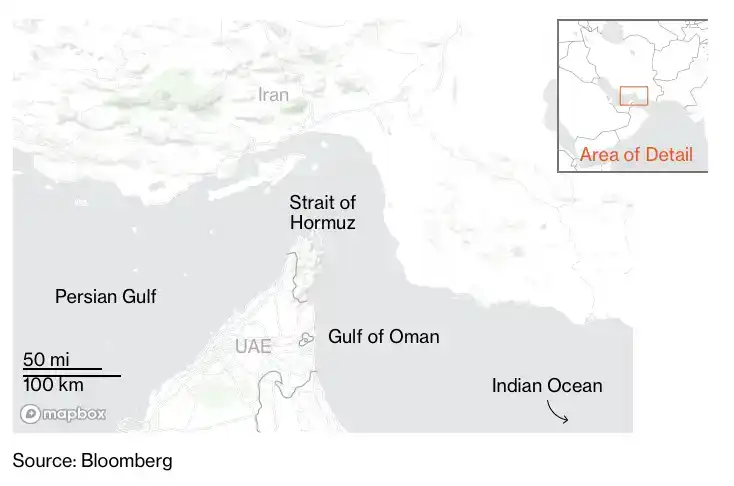
The Strait of Hormuz borders Iran to the north and the UAE and Oman to the south, connecting the Persian Gulf with the Indian Ocean. It stretches about 100 miles (161 km) long and is about 24 miles wide at its narrowest point. The two-way shipping lanes are each just 2 miles wide.

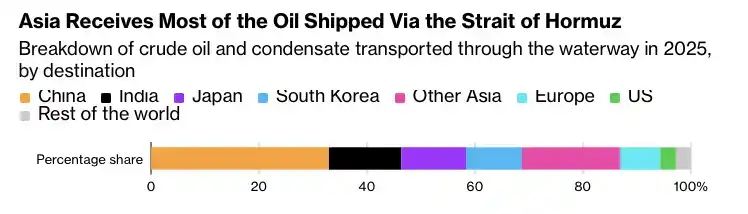
For energy markets, this strait is a vital artery, carrying about one-fifth of the world's oil and liquefied natural gas supply. Under normal circumstances, Saudi Arabia, Iraq, Iran, Kuwait, Bahrain, Qatar, and the UAE all export crude oil via the Strait of Hormuz, with the majority of cargoes destined for Asia.
Gulf countries also have numerous refineries producing significant volumes of diesel, jet fuel, naphtha—used in making plastics and gasoline—and other petroleum products, which are exported via the strait to global markets.

Beyond energy, the Strait of Hormuz is also a chokepoint for transporting products like aluminum, fertilizers, and even helium, which is used in semiconductor manufacturing.

Can oil-producing nations bypass the Strait of Hormuz?

Kuwait, Qatar, and Bahrain have no alternative maritime export routes.

Saudi Arabia, the largest shipper of oil through the Strait of Hormuz, has already diverted some crude via a pipeline extending west to the Red Sea port of Yanbu. Saudi Aramco plans to utilize the pipeline's full capacity of 7 million barrels per day, though only about 5 million barrels per day is available for export, with the remainder for domestic use.

But the Red Sea route is not without risk. Iran has already attacked a refinery in Yanbu and struck a pumping station on the East-West Pipeline; furthermore, the Iran-backed Houthi rebels in Yemen have threatened to resume attacks on vessels in the Red Sea.

The UAE can also bypass the Strait of Hormuz to some extent. However, its alternative capacity is limited, and the port of Fujairah has also been attacked by Iran. This port lies at the end of a pipeline linking UAE oilfields with the Gulf of Oman. Additionally, while Iraq is attempting to resume exports via Jordanian and Syrian ports, the transport volumes under consideration represent only a small fraction of its typical exports via the Strait of Hormuz.

Does Iran have the right to control the Strait of Hormuz?

Under the United Nations Convention on the Law of the Sea (UNCLOS), coastal states can exercise sovereignty over waters extending 12 nautical miles (about 14 miles) from their coastline, an area known as the territorial sea.

The Strait of Hormuz passes through the territorial seas of Iran and Oman. However, states must allow foreign vessels "innocent passage" within their territorial seas and must not hamper "innocent passage" or "transit passage" of foreign vessels through straits used for international navigation. The convention also stipulates that states may not levy charges on foreign vessels merely for passing through their territorial seas.

Although the Iranian government signed UNCLOS in 1982, the Iranian parliament has never ratified the treaty.


İlgili Sorular

QWhat is the core change in the geopolitical situation regarding the Strait of Hormuz, according to the article?

AThe core change is that the Strait of Hormuz is being re-priced from a piece of default, usable global infrastructure into a geopolitical lever under Iran's de facto control. It's no longer just a question of physical passage, but of risk and cost.

QAccording to the article, why would normal traffic not resume immediately even after a peace deal between the US and Iran?

ANormal traffic wouldn't resume immediately because the main issue is not just the physical blockade but the shattered market trust in the safety of the passage. Ship operators need assurances of lasting safety, and concerns like uncleared mines, lack of military escort, and high insurance costs would persist.

QHow did the daily traffic through the Strait of Hormuz change after the outbreak of war and during the ceasefire?

AAfter the war outbreak, daily traffic dropped from an average of about 135 vessels in peacetime to less than 10. During the subsequent ceasefire, maritime traffic remained almost at a standstill, with over 1,500 commercial ships reportedly trapped.

QWhat alternative route does Saudi Arabia primarily use to bypass the Strait of Hormuz, and what are its limitations?

ASaudi Arabia primarily reroutes oil through the Petroline pipeline to the Red Sea port of Yanbu. Its limitations include the pipeline's total capacity of 7 million barrels per day, with only about 5 million barrels available for export, and the route's exposure to risks from Iran and Houthi attacks.

QWhat is the legal basis, according to the article, that challenges Iran's right to control or charge fees for passage through the Strait of Hormuz?

AAccording to the United Nations Convention on the Law of the Sea (UNCLOS), which Iran signed in 1982 but never ratified, coastal states must allow 'innocent passage' or 'transit passage' in straits used for international navigation. The convention also states that countries cannot levy charges solely for the passage of foreign ships through their territorial waters.

İlgili Okumalar

Blocked Its Own Treasure, WeChat AI Steps Up

Tencent's stock surged over 10% on June 2nd amid reports that WeChat, with 1.43 billion monthly users, is finalizing tests for a native AI Agent. The reported feature, accessible by swiping right from the main interface, allows users to issue commands in natural language. The AI then decomposes tasks and automatically calls upon relevant Mini Programs within WeChat to complete actions like ordering food, booking tickets, or making payments, creating a closed-loop service execution system. This strategic shift follows the internal conflict and subsequent "blocking" of Tencent's standalone AI app, Yuanbao, by WeChat for violating sharing rules during a 2026 Spring Festival promotion. The incident highlighted a lack of internal consensus and exposed the weakness of competing in the standalone AI assistant arena against rivals like ByteDance's Doubao (345M MAU) and Alibaba's Qianwen. The new WeChat AI Agent aims to leverage WeChat's unique assets—its massive user base, standardized Mini Program APIs, WeChat Pay, and identity system—to move from simple content generation to actual task execution. Analysts note this changes the competitive landscape from model benchmarks to which AI can connect to more real-world services. However, success depends on key variables: the capability of Tencent's underlying Hunyuan model, managing massive inference costs, and redesigning incentives for Mini Program developers whose traffic might be bypassed. The move is seen as an attempt to keep user service intent within WeChat's ecosystem as AI begins to redefine how users access services.

marsbit15 dk önce

Blocked Its Own Treasure, WeChat AI Steps Up

marsbit15 dk önce

ByteDance Adopts Arm CPUs, Jensen Huang: So Sad I Didn't Buy Arm

**Summary:** At Computex 2026, Arm CEO Rene Haas announced that ByteDance and Oracle have adopted Arm's self-designed Arm AGI data center CPU. The company expects significant revenue growth from this product, projecting $20 billion in demand for the 2027/2028 fiscal years. Haas noted that restricting AI-capable CPUs from the US to China is nearly impossible due to their widespread applications. Arm's stock has surged dramatically this year, notably rising 16% after NVIDIA's Arm-based Vera CPU and RTX Spark announcements. A highlight was the informal, humorous on-stage conversation between Haas and NVIDIA CEO Jensen Huang. Huang joked about NVIDIA's failed attempt to acquire Arm and playfully lamented selling his Arm shares. Both executives showed a clear sense of camaraderie and shared regret over the missed merger. Key technical topics were discussed: 1. **AI PC Design:** Huang explained NVIDIA's RTX Spark superchip (with a 20-core Arm CPU) is designed for future AI agents that will autonomously run and use tools on PCs, blending local and cloud processing. 2. **Agent vs. OS:** Huang emphasized the operating system remains crucial, as AI agents rely on its APIs and tools to function. 3. **Growth Constraints:** He identified the shift to "useful AI" that generates profitable tokens as a primary driver for immense, almost limitless, computational demand. Haas outlined Arm's strategy across PC and data centers. For PCs, Arm collaborates with partners like NVIDIA and MediaTek, offering its compute subsystem (CSS) for custom SoCs. In data centers, its Arm AGI CPU (built on TSMC's 3nm process) has gained major partners including OpenAI, Meta, and now ByteDance and Oracle. Arm presented a multi-year roadmap for its in-house CPU line. The article concludes that while GPUs dominated the AI training race, the explosion of AI agents is shifting significant focus to CPUs for inference, state management, and tool orchestration. The industry is trending towards vertical integration, with companies like cloud providers designing chips and chip/IP firms offering full solutions, all competing to deliver more efficient computing per watt.

marsbit35 dk önce

ByteDance Adopts Arm CPUs, Jensen Huang: So Sad I Didn't Buy Arm

marsbit35 dk önce

New Wall Street Play: Yen Shorts Still Adding, But Japan Stocks Don't Rely on Carry Trade Unwinding

On June 3rd, USD/JPY hit 160.44, its highest level since July 2024, while the Nikkei 225 surged past 68,000 points. Contrary to popular narratives of an imminent "carry trade unwind" akin to August 2024, data reveals a more complex picture. Speculative net short positions in yen futures have actually increased, reaching -114,667 contracts by late May, suggesting traders are doubling down rather than retreating. Meanwhile, Japan's Finance Ministry conducted its largest-ever single-round FX intervention (11.73 trillion yen) in April-May but failed to hold the 160 yen line. The Nikkei's rally is not driven by carry trade dynamics. Foreign investors are aggressively buying Japanese stocks, with net purchases in 2026 running nearly 16 times higher than 2025 levels. This inflow is concentrated in AI and semiconductor-related stocks like SoftBank and Socionext, fueled by positive sector outlooks, rather than being a flight from unwinding yen shorts. Furthermore, the Nikkei has continued climbing despite the Bank of Japan's (BOJ) rate hikes to 0.75%. This disconnect exists because the current equity boom is fueled by AI-driven foreign investment, not reliant on cheap yen funding. However, this relationship remains fragile. Should the BOJ hike rates further (e.g., to 1.0%) while dollar weakness increases carry trade costs, the trajectories of the yen and Japanese stocks could reconverge, potentially triggering volatility.

marsbit40 dk önce

New Wall Street Play: Yen Shorts Still Adding, But Japan Stocks Don't Rely on Carry Trade Unwinding

marsbit40 dk önce

Broadcom's Q3 Guidance Misses Expectations by $12 Billion, After-Hours Trading Plummets Over 13%, AI Narrative "Cooling"?

On June 3, Broadcom released record Q2 FY26 results with revenue of $22.19B, up 48% YoY, and AI chip sales of $10.8B, up 143%. Adjusted EPS of $2.44 beat estimates. However, its Q3 AI semiconductor revenue guidance of $16B, while up over 200% YoY, fell roughly $1.2B (7%) short of analyst consensus expectations of $17.2B. This miss, coupled with slightly weaker-than-expected software revenue, triggered a severe market reaction. CEO Hock Tan maintained the FY26 AI revenue outlook of over $100B but did not raise it, disappointing investors who had priced in more robust growth. The stock plummeted over 13% in after-hours trading, erasing roughly $270B in market cap. The sell-off extended to peers like Marvell. A key concern for markets, particularly for Chinese optical module suppliers, was Tan's comment that the contribution of AI networking (e.g., Ethernet switches, optical interconnect chips) to AI revenue, currently near 40%, is expected to normalize to around 30% over time, signaling a potential peak in growth for that segment. Despite the guidance shortfall, Tan reiterated that AI demand remains "insatiable" and reaffirmed the long-term target of exceeding $100B in AI revenue by FY27. The reaction highlights the heightened sensitivity and premium valuation placed on AI-exposed stocks, where anything less than stellar guidance can prompt significant profit-taking. The broader question is whether this represents a cooling AI narrative or a correction in overstretched valuations.

marsbit40 dk önce

Broadcom's Q3 Guidance Misses Expectations by $12 Billion, After-Hours Trading Plummets Over 13%, AI Narrative "Cooling"?

marsbit40 dk önce

İşlemler

Spot
Futures

Popüler Makaleler

GAS Nasıl Satın Alınır

HTX.com’a hoş geldiniz! GAS (GAS) satın alma işlemlerini basit ve kullanışlı bir hâle getirdik. Adım adım açıkladığımız rehberimizi takip ederek kripto yolculuğunuza başlayın. 1. Adım: HTX Hesabınızı OluşturunHTX'te ücretsiz bir hesap açmak için e-posta adresinizi veya telefon numaranızı kullanın. Sorunsuzca kaydolun ve tüm özelliklerin kilidini açın. Hesabımı Aç2. Adım: Kripto Satın Al Bölümüne Gidin ve Ödeme Yönteminizi SeçinKredi/Banka Kartı: Visa veya Mastercard'ınızı kullanarak anında GAS (GAS) satın alın.Bakiye: Sorunsuz bir şekilde işlem yapmak için HTX hesap bakiyenizdeki fonları kullanın.Üçüncü Taraflar: Kullanımı kolaylaştırmak için Google Pay ve Apple Pay gibi popüler ödeme yöntemlerini ekledik.P2P: HTX'teki diğer kullanıcılarla doğrudan işlem yapın.Borsa Dışı (OTC): Yatırımcılar için kişiye özel hizmetler ve rekabetçi döviz kurları sunuyoruz.3. Adım: GAS (GAS) Varlıklarınızı SaklayınGAS (GAS) satın aldıktan sonra HTX hesabınızda saklayın. Alternatif olarak, blok zinciri transferi yoluyla başka bir yere gönderebilir veya diğer kripto para birimlerini takas etmek için kullanabilirsiniz.4. Adım: GAS (GAS) Varlıklarınızla İşlem YapınHTX'in spot piyasasında GAS (GAS) ile kolayca işlemler yapın.Hesabınıza erişin, işlem çiftinizi seçin, işlemlerinizi gerçekleştirin ve gerçek zamanlı olarak izleyin. Hem yeni başlayanlar hem de deneyimli yatırımcılar için kullanıcı dostu bir deneyim sunuyoruz.

179 Toplam GörüntülenmeYayınlanma 2024.12.12Güncellenme 2026.06.02

GAS Nasıl Satın Alınır

Tartışmalar

HTX Topluluğuna hoş geldiniz. Burada, en son platform gelişmeleri hakkında bilgi sahibi olabilir ve profesyonel piyasa görüşlerine erişebilirsiniz. Kullanıcıların GAS (GAS) fiyatı hakkındaki görüşleri aşağıda sunulmaktadır.

活动图片












