Will Bitcoin Return to $10,000? The Harsh Hypothesis from a Bloomberg Strategist Amid a Deflationary Cycle

marsbit2025-12-16 tarihinde yayınlandı2025-12-16 tarihinde güncellendi

Özet

Bitcoin faces mounting pressure, breaking below $90,000 and testing lows around $86,000, with most major cryptocurrencies also declining. Bloomberg Intelligence senior commodity strategist Mike McGlone presents a bearish outlook, suggesting Bitcoin could fall to $10,000 by 2026. He attributes this potential decline to a macro shift from inflation to deflation, where risk assets like Bitcoin may undergo significant repricing. McGlone emphasizes that Bitcoin is highly correlated with risk appetite and speculative cycles. He points to three key factors: mean reversion after extreme wealth creation, the Bitcoin/Gold ratio (which has already declined from over 30x to around 21x), and systemic oversupply of speculative crypto assets competing for limited risk capital. Not all analysts agree. Standard Chartered has revised its Bitcoin forecast downward but still expects prices around $100,000 in 2025. Glassnode notes current market stress resembles early 2022 conditions, while 10x Research warns that Bitcoin may be in the early stages of a bear market. The broader macro environment remains critical. Upcoming central bank decisions and economic data from the U.S., Europe, and Japan may determine whether deflationary pressures intensify, influencing risk assets globally. The Fed's recent rate cut and internal dissent highlight deepening policy uncertainty, making macro trends a decisive factor for Bitcoin's trajectory.

Over the past weekend, the crypto market did not see a sentiment recovery. After several days of narrow-range fluctuations, Bitcoin came under significant pressure from Sunday evening into Monday's U.S. trading session, falling below the $90,000 mark, with its price briefly touching around $86,000 at the lowest point. ETH dropped 3.4% to $2,980; BNB fell 2.1%; XRP declined 4%; SOL decreased 1.5%, retreating to around $126. Among the top ten cryptocurrencies by market cap, only TRX recorded a slight increase of less than 1%, while the rest were in a correction phase.
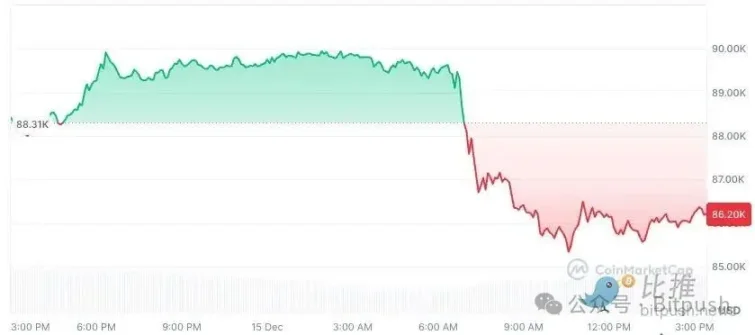
From a time perspective, this is not an isolated adjustment. Since hitting a new all-time high in mid-October, Bitcoin has accumulated a pullback of over 30%, with each rebound appearing brief and hesitant. Although ETF funds have not seen systematic outflows, marginal inflows have significantly slowed, making it difficult to provide the "sentiment foundation" for the market as before. The crypto market is transitioning from one-sided optimism to a more complex and patience-testing phase.

Against this backdrop, Mike McGlone, Senior Commodity Strategist at Bloomberg Intelligence, released a latest report, placing Bitcoin's current trend within a broader macro and cyclical framework and presenting a highly unsettling judgment: Bitcoin is highly likely to return to $10,000 by 2026. This is not alarmist but one of the potential outcomes under a special "deflationary" cycle.

The reason this view has sparked significant controversy is not just because the figure itself is "too low," but because McGlone does not treat Bitcoin as an independent crypto asset. Instead, he reexamines it within the long-term coordinate system of "global risk assets—liquidity—wealth regression."
"Deflation After Inflation"? McGlone Focuses Not on Crypto but on the Cycle Inflection Point

To understand McGlone's judgment, the key does not lie in how he views the crypto industry but in how he interprets the next phase of the macro environment.

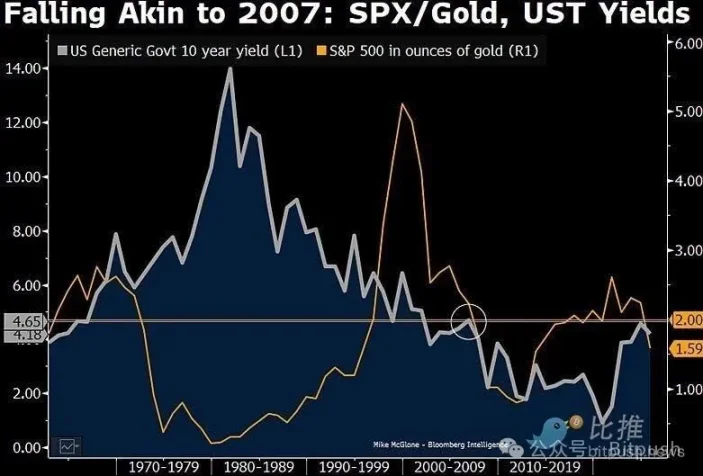
In his latest perspective, McGlone repeatedly emphasizes a concept: Inflation / Deflation Inflection (the turning point from inflation to deflation). In his view, global markets are near such a critical juncture. As inflation peaks in major economies and growth momentum slows, asset pricing logic is shifting from "fighting inflation" to coping with "deflation after inflation"—the phase of comprehensive price declines following the end of the inflation cycle. He writes: "Bitcoin's decline may resemble the stock market's response to Fed policy in 2007."

This is not the first time he has issued a bearish warning. As early as last November, he predicted Bitcoin would fall to the $50,000 mark.
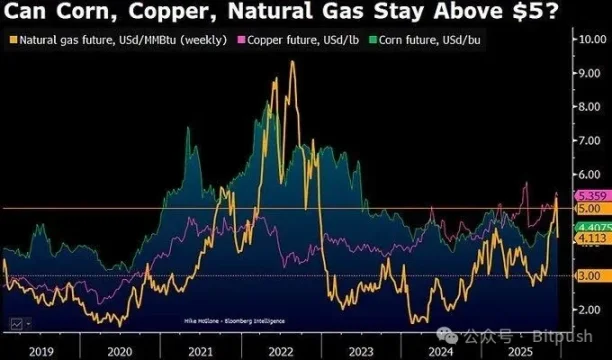
He points out that by around 2026, commodity prices may fluctuate around a key pivot—the "inflation-deflation demarcation line" for core commodities like natural gas, corn, and copper might settle near $5. Among these, only copper, with its genuine industrial demand support, might still stand above this pivot by the end of 2025.

McGlone notes: When liquidity recedes, the market will重新区分 (redistinguish) "real demand" from "financialization premium." In his framework, Bitcoin is not "digital gold" but an asset highly correlated with risk appetite and speculative cycles. When the inflation narrative recedes and macro liquidity tightens, Bitcoin tends to reflect this change earlier and more sharply.

In McGlone's view, his logic is not based on a single technical level but the叠加 (superposition) of three long-term paths.

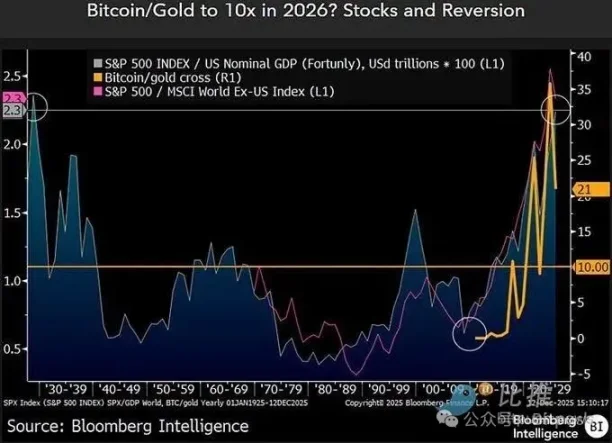
First, mean reversion after extreme wealth creation. McGlone has long emphasized that Bitcoin is one of the most extreme wealth amplifiers under the global宽松货币环境 (loose monetary environment) of the past decade. When asset price growth long outstrips实体经济增长 (real economic growth) and cash flow growth, the regression is not温和 (gentle) but剧烈 (violent). Historically, whether it was U.S. stocks in 1929 or the tech bubble in 2000, the commonality of the top phase was: the market repeatedly sought a "new paradigm" at highs, and the eventual adjustment幅度 (magnitude) often far exceeded the most pessimistic expectations at the time.

Second, the relative pricing relationship between Bitcoin and gold. McGlone特别强调 (particularly emphasizes) the Bitcoin/Gold ratio. This ratio was about 10x at the end of 2022, then expanded rapidly driven by the bull market, reaching over 30x in 2025. But this year, the ratio has fallen about 40%, dropping to around 21x. In his view, if deflationary pressures persist and gold remains firm due to safe-haven demand, a further return of the ratio to its historical range is not an激进假设 (aggressive assumption).
Third, systemic issues in the supply environment of speculative assets. Although Bitcoin itself has a clear supply cap, McGlone has多次指出 (repeatedly pointed out) that what the market is truly trading is not Bitcoin's "uniqueness" but the risk premium of the entire crypto ecosystem. When millions of tokens, projects, and narratives compete for the same risk budget, the entire sector tends to be uniformly discounted in a deflationary cycle, and Bitcoin can hardly完全脱离 (completely detach from) this revaluation process.

It should be noted that Mike McGlone is not a bull/bear spokesperson for the crypto market. As a senior commodity strategist at Bloomberg, he has studied the cyclical relationships between crude oil, precious metals, agricultural products, interest rates, and risk assets for a long time. His predictions are not always precisely timed, but their value lies in: he often raises structural contrarian questions when market sentiment is most consensus-driven.

In his latest remarks, he also主动复盘 (actively reviewed) his "errors," including underestimating the timing of gold breaking through $2,000 and misjudging the节奏 (rhythm) of U.S. Treasury yields and U.S. stocks. But in his view, these deviations反而反复印证 (instead repeatedly confirm) one point: the market is most prone to illusions about trends before cyclical inflection points.

Other Voices: Divergence Is Widening

Of course, McGlone's judgment is not market consensus. In fact, mainstream institutions' attitudes show clear分化 (divergence).

Traditional financial institutions like Standard Chartered have recently significantly lowered their medium-to-long-term target price for Bitcoin, reducing the 2025 expectation from $200,000 to about $100,000, and also adjusting the 2026 imagination space from $300,000 to about $150,000. In other words, institutions no longer assume that ETFs and corporate allocations will持续提供边际买盘 (continuously provide marginal buying) at any price range.

Research from Glassnode points out that Bitcoin's current fluctuation range between $80,000 and $90,000 has already put pressure on the market, with intensity comparable to the trend at the end of January 2022. The current market's relative unrealized loss has approached 10% of the market cap. Analysts further explain that such market dynamics reflect a state of "liquidity constraints, sensitivity to macro shocks," but it has not yet reached the level of typical bear market彻底抛售 (panic selling).
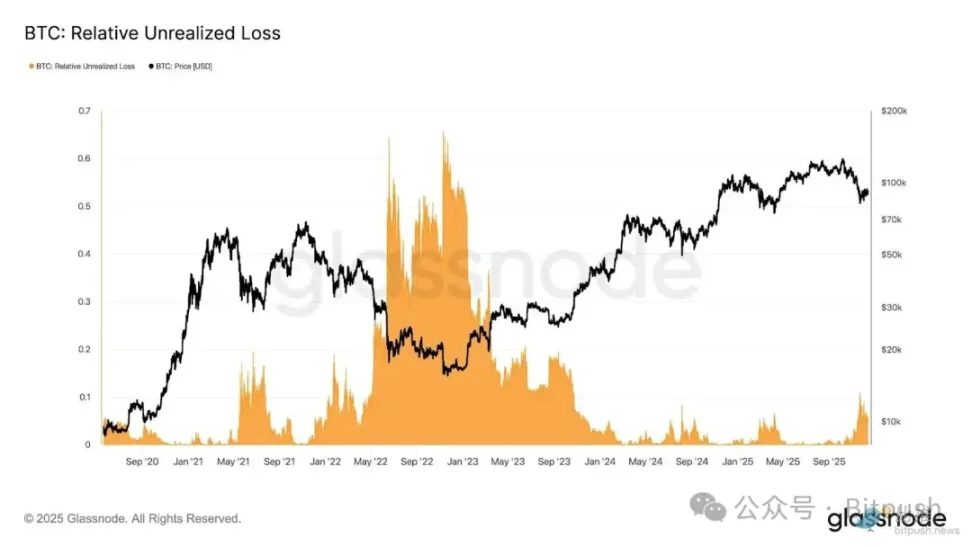
More quantitative and structure-focused 10x Research offers a more direct conclusion: they believe Bitcoin has entered the early stages of a bear market, with on-chain indicators, fund flows, and market structure all indicating that the downward cycle has not yet reached its end.

From a broader time dimension, the current uncertainty surrounding Bitcoin is no longer an issue of the crypto market itself but is firmly embedded in the global macro cycle. The upcoming week is被视为 (seen as) the most critical macro window period of the year-end by multiple strategists—the European Central Bank, the Bank of England, and the Bank of Japan will announce interest rate decisions successively, while the U.S. will迎来 (welcome) a series of delayed employment and inflation data. These data will provide a belated "reality check" for the market.

The Fed's FOMC meeting on December 10 had already released an unusual signal: not only did it cut rates by 25 basis points, but there were also three dissenting votes, and Powell直言 (stated bluntly) that job growth in previous months might have been overestimated. The密集出炉 (intensive release) of macro data this week will重塑 (reshape) the market's core expectations for 2026—whether the Fed can continue to cut rates or will have to press the pause button for a longer period. For risk assets, this answer might be more important than any bull-bear debate on a single asset.


Trend Kriptolar

İlgili Sorular

QWhat is the main argument made by Bloomberg Intelligence senior commodity strategist Mike McGlone regarding Bitcoin's price?

AMike McGlone argues that Bitcoin could potentially fall back to $10,000 by 2026, citing a potential global deflationary cycle following the inflation period as the primary reason. He views Bitcoin not as 'digital gold' but as a risk-on asset highly correlated with speculative cycles and liquidity conditions.

QAccording to the article, what key macroeconomic concept does McGlone emphasize to support his bearish view on Bitcoin?

AMcGlone emphasizes the concept of 'Inflation / Deflation Inflection,' suggesting that global markets are near a turning point where the pricing logic for assets is shifting from fighting inflation to dealing with deflationary pressures after inflation has peaked.

QWhat specific ratio does McGlone use to analyze Bitcoin's relative valuation, and what is its current trend?

AMcGlone uses the Bitcoin/Gold ratio for analysis. The ratio expanded to over 30 times during the bull market but has since declined by approximately 40% and is currently around 21 times. He suggests it could revert further towards its historical range if deflationary pressures persist.

QHow have other major financial institutions, like Standard Chartered, adjusted their Bitcoin price forecasts according to the article?

AStandard Chartered has significantly lowered its Bitcoin price targets, reducing its 2025 forecast from $200,000 to around $100,000 and its 2026 projection from $300,000 to approximately $150,000, reflecting reduced expectations for sustained ETF and corporate buying.

QWhat broader macroeconomic events does the article highlight as critical for risk assets like Bitcoin in the near term?

AThe article highlights upcoming interest rate decisions from the European Central Bank, Bank of England, and Bank of Japan, along with delayed U.S. employment and inflation data, as critical events that will reshape market expectations for 2026 and determine the Federal Reserve's ability to continue cutting rates.

İlgili Okumalar

U.S. Bonds, AI, Inflation: You Can't Have All Three – What's Bitcoin Betting On?

Title: U.S. Treasury Bonds, AI, and Inflation: A Trilemma Facing Washington, and Where BTC Fits In Core Thesis: The U.S. government faces a trilemma: stabilizing the Treasury market, sustaining the AI investment cycle, and controlling inflation. The likely political choice is to prioritize the first two, accepting higher inflation for longer. This creates a sustained tailwind for both gold and Bitcoin by injecting liquidity and shifting duration risk away from the private sector. Key Pressures on Treasuries: * Long-term yields (e.g., 10-year ~4.70%) are near multi-decade highs due to persistent inflation risks, high fiscal supply, weaker demand for long duration, and new competition from AI infrastructure financing. * AI investment, requiring massive capital (estimated ~$300B in investment-grade bond issuance), is now competing directly with the Treasury in long-duration debt markets. * Geopolitical tensions (e.g., Iran conflict) add upward pressure on oil prices and defense spending. Policy Response: The Treasury, under Secretary Besant, is focusing on market stability through measures like supporting the Yen (to prevent forced Japanese Treasury sales), increasing repo operations for long-dated bonds, and potentially shifting issuance toward the short end. This "aggressive Treasury issuance" can function like "stealth QE," easing financial conditions. Impact on Assets: * **Gold** has already benefited (up ~90% from Aug 2024 to Aug 2026), driven by declining trust in the USD, inflation fears, and a "monetary debasement" narrative. * **Bitcoin** is now showing stronger correlation with this theme. Recent outperformance vs. gold (BTC +22.2% vs. Gold +5.9% in late Aug) coincided with Treasury's enhanced repo actions, suggesting the market may be pricing it as a liquidity/ debasement hedge, not just a speculative tech asset. Conclusion: If high inflation, large deficits, and AI capital demands persist, the cost of stabilizing bonds and growth will be shorter debt maturity, constant liquidity support, and tolerance for higher inflation—a favorable environment for gold and BTC. This view would be challenged only by a return to ~2% inflation, credible fiscal consolidation, or AI becoming self-funding.

marsbit20 dk önce

U.S. Bonds, AI, Inflation: You Can't Have All Three – What's Bitcoin Betting On?

marsbit20 dk önce

HBM is Being Redefined

HBM is being redefined as AI-driven demand for computing power shifts the performance bottleneck from processing units to memory bandwidth, making High Bandwidth Memory the critical component for advanced AI hardware. At HotChips 2026, Samsung and SK Hynix unveiled new technical roadmaps for HBM4, moving away from the traditional approach of simply increasing DRAM speed and stacking layers. The focus for HBM4 has shifted from DRAM optimization to a comprehensive system-level redesign of the Base Die. Key innovations include upgrading the Base Die to advanced logic processes (e.g., Samsung's 4nm), adopting hybrid bonding for 3D stacking, and exploring heterogeneous packaging solutions like Intel's EMIB alongside the established CoWoS. This marks HBM's evolution from a simple memory component into an integrated system involving "memory + logic + packaging + IP + EDA." This transition brings benefits like better signal integrity, higher I/O bandwidth (up to 2048-bit), and potential for in-memory computing. However, it also introduces significant complexity. DRAM manufacturers now must deeply collaborate with logic foundries, extending design cycles and increasing supply chain challenges. Furthermore, the industry is moving towards multiple advanced packaging paths, with EMIB emerging as an alternative to CoWoS to alleviate capacity constraints, while hybrid bonding is being developed for future ultra-high (16+ layer) stacks. New core barriers have emerged beyond manufacturing. High-speed PHY/SERDES IP, crucial for HBM4's higher data rates, is concentrated among a few established players, creating an entry barrier for smaller firms. Similarly, the industry lacks mature 3D heterogeneous EDA toolchains capable of co-simulating the coupled electrical, thermal, and mechanical effects across the logic base, memory stacks, and interposer. These "soft" capabilities in IP and EDA are now critical determinants of HBM4's performance and yield. In summary, the HBM industry is entering a new era of systemic competition. The standardized approach is giving way to divergent vendor roadmaps, with multiple technologies coexisting. Success will depend on integrated architecture, packaging, process, and ecosystem capabilities, fundamentally reshaping the competitive landscape for AI memory.

marsbit24 dk önce

HBM is Being Redefined

marsbit24 dk önce

The Era of Earning 200,000 from a 3,000 Investment Is Over; AI Comic Dramas Are Not a Get-Rich-Quick Trend

The era of turning 3,000 yuan into 200,000 yuan is over. AI-generated comic dramas are no longer a low-barrier gold rush. A wave of sudden account suspensions has hit creators in AI comic dramas, AI art, and AI tutorials, primarily triggered by new content and copyright compliance rules implemented by Tomato Novel on August 17. This "last straw" exposed the underlying issues: tightening platform rules, rising copyright requirements, increasing costs, and severe content homogenization. The business model was fundamentally unsustainable for most creators. One creator detailed the math: producing five minutes of content daily cost around 510 yuan in AI computing and editing, while a video with 60,000 views might only earn 45 yuan. While a few early viral hits like "Huo Qubing" and "Zombie Cleaner" achieved high returns with minimal investment, they were exceptions. The reality for most solo creators was barely covering costs or operating at a loss. The new regulations mandate formal authorization from original authors for adaptations, limit video length and the amount of原著 content used, and ban terms like "Episode 1" in titles. This directly dismantled the previous "produce first, authorize later" model. Faced with the inability to afford版权 costs and the threat of penalty, many creators chose to halt updates. While some fans expressed frustration, the rules protect original authors who often faced侵权 with little recourse. The shutdowns signal not the failure of AI technology, but an inevitable industry shift from wild growth to regulated refinement. The previous model prioritized quick cash over quality content, leading to formulaic, "AI-face" saturated dramas that audiences grew tired of. The future belongs to creators who use AI as a tool to serve solid storytelling, not replace it. Some are now seeking formal licenses, a slower but necessary process. Upcoming national regulations further underscore this move towards standardization, weeding out those seeking only fast money and making space for genuine creators.

marsbit25 dk önce

The Era of Earning 200,000 from a 3,000 Investment Is Over; AI Comic Dramas Are Not a Get-Rich-Quick Trend

marsbit25 dk önce

İşlemler

Spot

Popüler Makaleler

PURR Nasıl Satın Alınır

HTX.com’a hoş geldiniz! Hyperliquid Strategies Inc. (PURR) satın alma işlemlerini basit ve kullanışlı bir hâle getirdik. Adım adım açıkladığımız rehberimizi takip ederek kripto yolculuğunuza başlayın. 1. Adım: HTX Hesabınızı OluşturunHTX'te ücretsiz bir hesap açmak için e-posta adresinizi veya telefon numaranızı kullanın. Sorunsuzca kaydolun ve tüm özelliklerin kilidini açın. Hesabımı Aç2. Adım: Kripto Satın Al Bölümüne Gidin ve Ödeme Yönteminizi SeçinKredi/Banka Kartı: Visa veya Mastercard'ınızı kullanarak anında Hyperliquid Strategies Inc. (PURR) satın alın.Bakiye: Sorunsuz bir şekilde işlem yapmak için HTX hesap bakiyenizdeki fonları kullanın.Üçüncü Taraflar: Kullanımı kolaylaştırmak için Google Pay ve Apple Pay gibi popüler ödeme yöntemlerini ekledik.P2P: HTX'teki diğer kullanıcılarla doğrudan işlem yapın.Borsa Dışı (OTC): Yatırımcılar için kişiye özel hizmetler ve rekabetçi döviz kurları sunuyoruz.3. Adım: Hyperliquid Strategies Inc. (PURR) Varlıklarınızı SaklayınHyperliquid Strategies Inc. (PURR) satın aldıktan sonra HTX hesabınızda saklayın. Alternatif olarak, blok zinciri transferi yoluyla başka bir yere gönderebilir veya diğer kripto para birimlerini takas etmek için kullanabilirsiniz.4. Adım: Hyperliquid Strategies Inc. (PURR) Varlıklarınızla İşlem YapınHTX'in spot piyasasında Hyperliquid Strategies Inc. (PURR) ile kolayca işlemler yapın.Hesabınıza erişin, işlem çiftinizi seçin, işlemlerinizi gerçekleştirin ve gerçek zamanlı olarak izleyin. Hem yeni başlayanlar hem de deneyimli yatırımcılar için kullanıcı dostu bir deneyim sunuyoruz.

218 Toplam GörüntülenmeYayınlanma 2026.08.21Güncellenme 2026.08.21

PURR Nasıl Satın Alınır

PDD Nasıl Satın Alınır

HTX.com’a hoş geldiniz! PDD Holdings, Inc. (PDD) satın alma işlemlerini basit ve kullanışlı bir hâle getirdik. Adım adım açıkladığımız rehberimizi takip ederek kripto yolculuğunuza başlayın. 1. Adım: HTX Hesabınızı OluşturunHTX'te ücretsiz bir hesap açmak için e-posta adresinizi veya telefon numaranızı kullanın. Sorunsuzca kaydolun ve tüm özelliklerin kilidini açın. Hesabımı Aç2. Adım: Kripto Satın Al Bölümüne Gidin ve Ödeme Yönteminizi SeçinKredi/Banka Kartı: Visa veya Mastercard'ınızı kullanarak anında PDD Holdings, Inc. (PDD) satın alın.Bakiye: Sorunsuz bir şekilde işlem yapmak için HTX hesap bakiyenizdeki fonları kullanın.Üçüncü Taraflar: Kullanımı kolaylaştırmak için Google Pay ve Apple Pay gibi popüler ödeme yöntemlerini ekledik.P2P: HTX'teki diğer kullanıcılarla doğrudan işlem yapın.Borsa Dışı (OTC): Yatırımcılar için kişiye özel hizmetler ve rekabetçi döviz kurları sunuyoruz.3. Adım: PDD Holdings, Inc. (PDD) Varlıklarınızı SaklayınPDD Holdings, Inc. (PDD) satın aldıktan sonra HTX hesabınızda saklayın. Alternatif olarak, blok zinciri transferi yoluyla başka bir yere gönderebilir veya diğer kripto para birimlerini takas etmek için kullanabilirsiniz.4. Adım: PDD Holdings, Inc. (PDD) Varlıklarınızla İşlem YapınHTX'in spot piyasasında PDD Holdings, Inc. (PDD) ile kolayca işlemler yapın.Hesabınıza erişin, işlem çiftinizi seçin, işlemlerinizi gerçekleştirin ve gerçek zamanlı olarak izleyin. Hem yeni başlayanlar hem de deneyimli yatırımcılar için kullanıcı dostu bir deneyim sunuyoruz.

77 Toplam GörüntülenmeYayınlanma 2026.08.24Güncellenme 2026.08.24

PDD Nasıl Satın Alınır

JP225 Nedir

Japonya'nın en temsilci hisse senedi endeksi, Tokyo Borsası'nda işlem gören 225 mavi çip hisse senedinden oluşmakta olup, imalat, teknoloji ve finans gibi ana sanayileri kapsamaktadır. 1950 yılından beri kesintisiz olarak yayımlanmaktadır ve Japon hisse senedi pazarının genel performansını ölçmek için temel bir kıstas olarak hizmet etmektedir.

24 Toplam GörüntülenmeYayınlanma 2026.08.25Güncellenme 2026.08.25

JP225 Nedir

Tartışmalar

HTX Topluluğuna hoş geldiniz. Burada, en son platform gelişmeleri hakkında bilgi sahibi olabilir ve profesyonel piyasa görüşlerine erişebilirsiniz. Kullanıcıların A (A) fiyatı hakkındaki görüşleri aşağıda sunulmaktadır.

活动图片