Will Bitcoin Return to $10,000? The Harsh Hypothesis from a Bloomberg Strategist Amid a Deflationary Cycle

marsbit2025-12-16 tarihinde yayınlandı2025-12-16 tarihinde güncellendi

Özet

Bitcoin faces mounting pressure, breaking below $90,000 and testing lows around $86,000, with most major cryptocurrencies also declining. Bloomberg Intelligence senior commodity strategist Mike McGlone presents a bearish outlook, suggesting Bitcoin could fall to $10,000 by 2026. He attributes this potential decline to a macro shift from inflation to deflation, where risk assets like Bitcoin may undergo significant repricing. McGlone emphasizes that Bitcoin is highly correlated with risk appetite and speculative cycles. He points to three key factors: mean reversion after extreme wealth creation, the Bitcoin/Gold ratio (which has already declined from over 30x to around 21x), and systemic oversupply of speculative crypto assets competing for limited risk capital. Not all analysts agree. Standard Chartered has revised its Bitcoin forecast downward but still expects prices around $100,000 in 2025. Glassnode notes current market stress resembles early 2022 conditions, while 10x Research warns that Bitcoin may be in the early stages of a bear market. The broader macro environment remains critical. Upcoming central bank decisions and economic data from the U.S., Europe, and Japan may determine whether deflationary pressures intensify, influencing risk assets globally. The Fed's recent rate cut and internal dissent highlight deepening policy uncertainty, making macro trends a decisive factor for Bitcoin's trajectory.

Over the past weekend, the crypto market did not see a sentiment recovery. After several days of narrow-range fluctuations, Bitcoin came under significant pressure from Sunday evening into Monday's U.S. trading session, falling below the $90,000 mark, with its price briefly touching around $86,000 at the lowest point. ETH dropped 3.4% to $2,980; BNB fell 2.1%; XRP declined 4%; SOL decreased 1.5%, retreating to around $126. Among the top ten cryptocurrencies by market cap, only TRX recorded a slight increase of less than 1%, while the rest were in a correction phase.
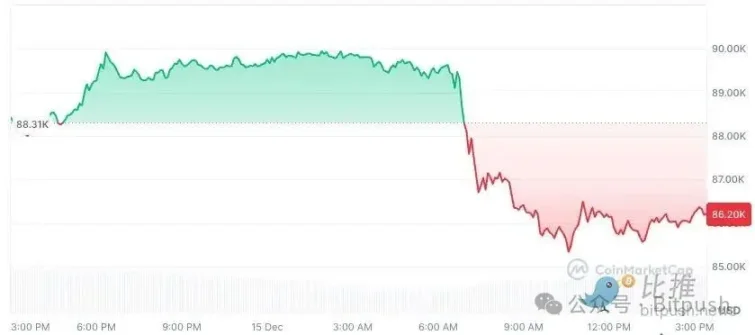
From a time perspective, this is not an isolated adjustment. Since hitting a new all-time high in mid-October, Bitcoin has accumulated a pullback of over 30%, with each rebound appearing brief and hesitant. Although ETF funds have not seen systematic outflows, marginal inflows have significantly slowed, making it difficult to provide the "sentiment foundation" for the market as before. The crypto market is transitioning from one-sided optimism to a more complex and patience-testing phase.

Against this backdrop, Mike McGlone, Senior Commodity Strategist at Bloomberg Intelligence, released a latest report, placing Bitcoin's current trend within a broader macro and cyclical framework and presenting a highly unsettling judgment: Bitcoin is highly likely to return to $10,000 by 2026. This is not alarmist but one of the potential outcomes under a special "deflationary" cycle.

The reason this view has sparked significant controversy is not just because the figure itself is "too low," but because McGlone does not treat Bitcoin as an independent crypto asset. Instead, he reexamines it within the long-term coordinate system of "global risk assets—liquidity—wealth regression."
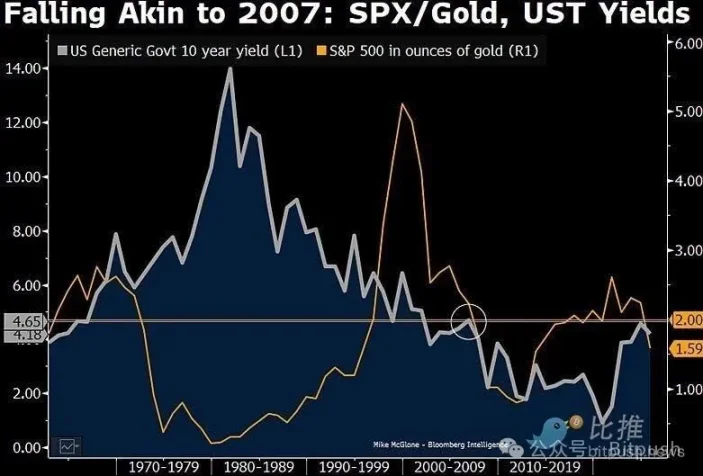
"Deflation After Inflation"? McGlone Focuses Not on Crypto but on the Cycle Inflection Point

To understand McGlone's judgment, the key does not lie in how he views the crypto industry but in how he interprets the next phase of the macro environment.

In his latest perspective, McGlone repeatedly emphasizes a concept: Inflation / Deflation Inflection (the turning point from inflation to deflation). In his view, global markets are near such a critical juncture. As inflation peaks in major economies and growth momentum slows, asset pricing logic is shifting from "fighting inflation" to coping with "deflation after inflation"—the phase of comprehensive price declines following the end of the inflation cycle. He writes: "Bitcoin's decline may resemble the stock market's response to Fed policy in 2007."

This is not the first time he has issued a bearish warning. As early as last November, he predicted Bitcoin would fall to the $50,000 mark.
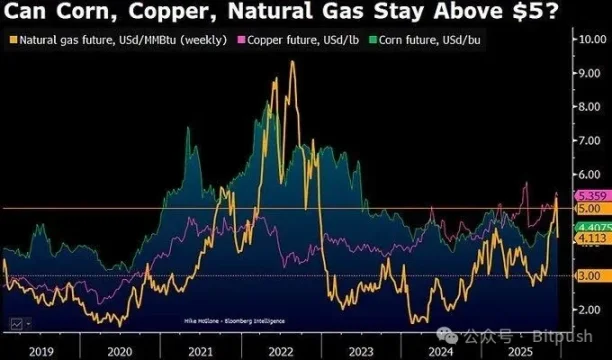
He points out that by around 2026, commodity prices may fluctuate around a key pivot—the "inflation-deflation demarcation line" for core commodities like natural gas, corn, and copper might settle near $5. Among these, only copper, with its genuine industrial demand support, might still stand above this pivot by the end of 2025.

McGlone notes: When liquidity recedes, the market will重新区分 (redistinguish) "real demand" from "financialization premium." In his framework, Bitcoin is not "digital gold" but an asset highly correlated with risk appetite and speculative cycles. When the inflation narrative recedes and macro liquidity tightens, Bitcoin tends to reflect this change earlier and more sharply.

In McGlone's view, his logic is not based on a single technical level but the叠加 (superposition) of three long-term paths.

First, mean reversion after extreme wealth creation. McGlone has long emphasized that Bitcoin is one of the most extreme wealth amplifiers under the global宽松货币环境 (loose monetary environment) of the past decade. When asset price growth long outstrips实体经济增长 (real economic growth) and cash flow growth, the regression is not温和 (gentle) but剧烈 (violent). Historically, whether it was U.S. stocks in 1929 or the tech bubble in 2000, the commonality of the top phase was: the market repeatedly sought a "new paradigm" at highs, and the eventual adjustment幅度 (magnitude) often far exceeded the most pessimistic expectations at the time.

Second, the relative pricing relationship between Bitcoin and gold. McGlone特别强调 (particularly emphasizes) the Bitcoin/Gold ratio. This ratio was about 10x at the end of 2022, then expanded rapidly driven by the bull market, reaching over 30x in 2025. But this year, the ratio has fallen about 40%, dropping to around 21x. In his view, if deflationary pressures persist and gold remains firm due to safe-haven demand, a further return of the ratio to its historical range is not an激进假设 (aggressive assumption).
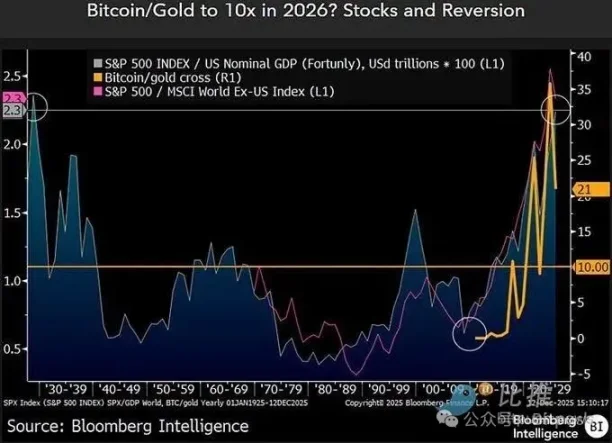
Third, systemic issues in the supply environment of speculative assets. Although Bitcoin itself has a clear supply cap, McGlone has多次指出 (repeatedly pointed out) that what the market is truly trading is not Bitcoin's "uniqueness" but the risk premium of the entire crypto ecosystem. When millions of tokens, projects, and narratives compete for the same risk budget, the entire sector tends to be uniformly discounted in a deflationary cycle, and Bitcoin can hardly完全脱离 (completely detach from) this revaluation process.

It should be noted that Mike McGlone is not a bull/bear spokesperson for the crypto market. As a senior commodity strategist at Bloomberg, he has studied the cyclical relationships between crude oil, precious metals, agricultural products, interest rates, and risk assets for a long time. His predictions are not always precisely timed, but their value lies in: he often raises structural contrarian questions when market sentiment is most consensus-driven.

In his latest remarks, he also主动复盘 (actively reviewed) his "errors," including underestimating the timing of gold breaking through $2,000 and misjudging the节奏 (rhythm) of U.S. Treasury yields and U.S. stocks. But in his view, these deviations反而反复印证 (instead repeatedly confirm) one point: the market is most prone to illusions about trends before cyclical inflection points.

Other Voices: Divergence Is Widening

Of course, McGlone's judgment is not market consensus. In fact, mainstream institutions' attitudes show clear分化 (divergence).

Traditional financial institutions like Standard Chartered have recently significantly lowered their medium-to-long-term target price for Bitcoin, reducing the 2025 expectation from $200,000 to about $100,000, and also adjusting the 2026 imagination space from $300,000 to about $150,000. In other words, institutions no longer assume that ETFs and corporate allocations will持续提供边际买盘 (continuously provide marginal buying) at any price range.

Research from Glassnode points out that Bitcoin's current fluctuation range between $80,000 and $90,000 has already put pressure on the market, with intensity comparable to the trend at the end of January 2022. The current market's relative unrealized loss has approached 10% of the market cap. Analysts further explain that such market dynamics reflect a state of "liquidity constraints, sensitivity to macro shocks," but it has not yet reached the level of typical bear market彻底抛售 (panic selling).
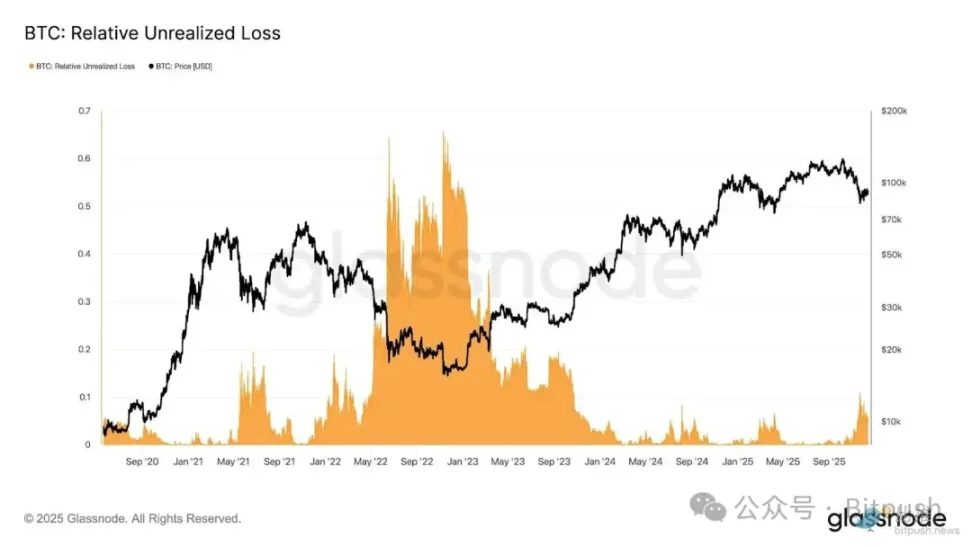
More quantitative and structure-focused 10x Research offers a more direct conclusion: they believe Bitcoin has entered the early stages of a bear market, with on-chain indicators, fund flows, and market structure all indicating that the downward cycle has not yet reached its end.

From a broader time dimension, the current uncertainty surrounding Bitcoin is no longer an issue of the crypto market itself but is firmly embedded in the global macro cycle. The upcoming week is被视为 (seen as) the most critical macro window period of the year-end by multiple strategists—the European Central Bank, the Bank of England, and the Bank of Japan will announce interest rate decisions successively, while the U.S. will迎来 (welcome) a series of delayed employment and inflation data. These data will provide a belated "reality check" for the market.

The Fed's FOMC meeting on December 10 had already released an unusual signal: not only did it cut rates by 25 basis points, but there were also three dissenting votes, and Powell直言 (stated bluntly) that job growth in previous months might have been overestimated. The密集出炉 (intensive release) of macro data this week will重塑 (reshape) the market's core expectations for 2026—whether the Fed can continue to cut rates or will have to press the pause button for a longer period. For risk assets, this answer might be more important than any bull-bear debate on a single asset.


Trend Kriptolar

İlgili Sorular

QWhat is the main argument made by Bloomberg Intelligence senior commodity strategist Mike McGlone regarding Bitcoin's price?

AMike McGlone argues that Bitcoin could potentially fall back to $10,000 by 2026, citing a potential global deflationary cycle following the inflation period as the primary reason. He views Bitcoin not as 'digital gold' but as a risk-on asset highly correlated with speculative cycles and liquidity conditions.

QAccording to the article, what key macroeconomic concept does McGlone emphasize to support his bearish view on Bitcoin?

AMcGlone emphasizes the concept of 'Inflation / Deflation Inflection,' suggesting that global markets are near a turning point where the pricing logic for assets is shifting from fighting inflation to dealing with deflationary pressures after inflation has peaked.

QWhat specific ratio does McGlone use to analyze Bitcoin's relative valuation, and what is its current trend?

AMcGlone uses the Bitcoin/Gold ratio for analysis. The ratio expanded to over 30 times during the bull market but has since declined by approximately 40% and is currently around 21 times. He suggests it could revert further towards its historical range if deflationary pressures persist.

QHow have other major financial institutions, like Standard Chartered, adjusted their Bitcoin price forecasts according to the article?

AStandard Chartered has significantly lowered its Bitcoin price targets, reducing its 2025 forecast from $200,000 to around $100,000 and its 2026 projection from $300,000 to approximately $150,000, reflecting reduced expectations for sustained ETF and corporate buying.

QWhat broader macroeconomic events does the article highlight as critical for risk assets like Bitcoin in the near term?

AThe article highlights upcoming interest rate decisions from the European Central Bank, Bank of England, and Bank of Japan, along with delayed U.S. employment and inflation data, as critical events that will reshape market expectations for 2026 and determine the Federal Reserve's ability to continue cutting rates.

İlgili Okumalar

Within Strategy's Framework, STRC's Dividend Yield Remains at 12% as Share Price Stays Below Par Value

Michael Saylor, Executive Chairman of Strategy (MSTR), confirmed that the dividend rate for its STRC perpetual preferred shares will remain at 12.00% through August 2026. The rate has increased from 9% at its July 2025 launch to the current high via a "ratchet" mechanism, which permanently raises the rate by 0.5% whenever the share price falls below $95. This mechanism is intended to push the price back toward its $100 par value and support Strategy's "at-the-market" (ATM) program for issuing new shares to fund Bitcoin purchases. However, the mechanism has not worked as intended. STRC shares closed at $89.46 on July 31, remaining about 10-11% below par value despite the record-high dividend. Competition from rival Strive's higher-yielding SATA securities has pressured demand. The persistent discount has forced Strategy to suspend new STRC issuances via its ATM program, limiting this funding channel for Bitcoin acquisitions. STRC's struggles reflect Bitcoin's own volatility, as the preferred shares historically move in tandem. Analysts have warned the ratchet structure carries long-term, one-way risk. A law firm is investigating Strategy's ability to maintain dividend payments if Bitcoin's price stays low. Retail investors own roughly 83% of outstanding STRC shares, a group seen as prone to panic selling during downturns. In response, Strategy has established financial reserves, including a liquidity cushion covering about 26 months of dividend/interest obligations, and a $2 billion share buyback program alongside a Bitcoin monetization framework, though the company emphasized it is not obligated to sell any Bitcoin.

cryptonews.ru14 dk önce

Within Strategy's Framework, STRC's Dividend Yield Remains at 12% as Share Price Stays Below Par Value

cryptonews.ru14 dk önce

Analyst: Bitcoin's Price Will Drop to $60k in August, Then Rebound to $70k

Financial analyst Andrey Poroshin has provided a new forecast for Bitcoin's price dynamics in August. Poroshin, an analyst at the Bitbanker exchange, expects the cryptocurrency market to experience a downturn this month, with prices retesting the $60,000 level due to a lack of supportive macroeconomic catalysts. He noted that the recent US Federal Reserve decision to hold interest rates did not significantly impact the market, while inflation remains above the 2% target. Poroshin stated that Bitcoin is ending July under pressure from moderate volatility and a lack of new macroeconomic stimuli, leading to continued market caution. According to his base scenario, Bitcoin will drop to a range of $60,000 to $62,000 before recovering to $70,000. He pointed out that even $70,000 remains below the cost of mining in the US, which has prompted some miners to shift towards AI data center operations. Poroshin cited the winding down of BitMEX's operations as a potential catalyst for a price rebound, suggesting the exit of weaker players often coincides with market reversals and reduced short-term selling pressure. He believes Bitcoin is currently less susceptible to geopolitical shocks, such as the Iran-US conflict, and does not expect significant market changes in August related to the pending CLARITY Act. Looking ahead, Poroshin forecasts that September will bring more active price fluctuations driven by potential Fed rate decisions and possible discussions or approval of the CLARITY Act.

cryptonews.ru14 dk önce

Analyst: Bitcoin's Price Will Drop to $60k in August, Then Rebound to $70k

cryptonews.ru14 dk önce

İşlemler

Spot

Popüler Makaleler

O Nasıl Satın Alınır

HTX.com’a hoş geldiniz! O1 exchange (O) satın alma işlemlerini basit ve kullanışlı bir hâle getirdik. Adım adım açıkladığımız rehberimizi takip ederek kripto yolculuğunuza başlayın. 1. Adım: HTX Hesabınızı OluşturunHTX'te ücretsiz bir hesap açmak için e-posta adresinizi veya telefon numaranızı kullanın. Sorunsuzca kaydolun ve tüm özelliklerin kilidini açın. Hesabımı Aç2. Adım: Kripto Satın Al Bölümüne Gidin ve Ödeme Yönteminizi SeçinKredi/Banka Kartı: Visa veya Mastercard'ınızı kullanarak anında O1 exchange (O) satın alın.Bakiye: Sorunsuz bir şekilde işlem yapmak için HTX hesap bakiyenizdeki fonları kullanın.Üçüncü Taraflar: Kullanımı kolaylaştırmak için Google Pay ve Apple Pay gibi popüler ödeme yöntemlerini ekledik.P2P: HTX'teki diğer kullanıcılarla doğrudan işlem yapın.Borsa Dışı (OTC): Yatırımcılar için kişiye özel hizmetler ve rekabetçi döviz kurları sunuyoruz.3. Adım: O1 exchange (O) Varlıklarınızı SaklayınO1 exchange (O) satın aldıktan sonra HTX hesabınızda saklayın. Alternatif olarak, blok zinciri transferi yoluyla başka bir yere gönderebilir veya diğer kripto para birimlerini takas etmek için kullanabilirsiniz.4. Adım: O1 exchange (O) Varlıklarınızla İşlem YapınHTX'in spot piyasasında O1 exchange (O) ile kolayca işlemler yapın.Hesabınıza erişin, işlem çiftinizi seçin, işlemlerinizi gerçekleştirin ve gerçek zamanlı olarak izleyin. Hem yeni başlayanlar hem de deneyimli yatırımcılar için kullanıcı dostu bir deneyim sunuyoruz.

426 Toplam GörüntülenmeYayınlanma 2026.06.19Güncellenme 2026.06.29

O Nasıl Satın Alınır

PROS Nasıl Satın Alınır

HTX.com’a hoş geldiniz! Pharos (PROS) satın alma işlemlerini basit ve kullanışlı bir hâle getirdik. Adım adım açıkladığımız rehberimizi takip ederek kripto yolculuğunuza başlayın. 1. Adım: HTX Hesabınızı OluşturunHTX'te ücretsiz bir hesap açmak için e-posta adresinizi veya telefon numaranızı kullanın. Sorunsuzca kaydolun ve tüm özelliklerin kilidini açın. Hesabımı Aç2. Adım: Kripto Satın Al Bölümüne Gidin ve Ödeme Yönteminizi SeçinKredi/Banka Kartı: Visa veya Mastercard'ınızı kullanarak anında Pharos (PROS) satın alın.Bakiye: Sorunsuz bir şekilde işlem yapmak için HTX hesap bakiyenizdeki fonları kullanın.Üçüncü Taraflar: Kullanımı kolaylaştırmak için Google Pay ve Apple Pay gibi popüler ödeme yöntemlerini ekledik.P2P: HTX'teki diğer kullanıcılarla doğrudan işlem yapın.Borsa Dışı (OTC): Yatırımcılar için kişiye özel hizmetler ve rekabetçi döviz kurları sunuyoruz.3. Adım: Pharos (PROS) Varlıklarınızı SaklayınPharos (PROS) satın aldıktan sonra HTX hesabınızda saklayın. Alternatif olarak, blok zinciri transferi yoluyla başka bir yere gönderebilir veya diğer kripto para birimlerini takas etmek için kullanabilirsiniz.4. Adım: Pharos (PROS) Varlıklarınızla İşlem YapınHTX'in spot piyasasında Pharos (PROS) ile kolayca işlemler yapın.Hesabınıza erişin, işlem çiftinizi seçin, işlemlerinizi gerçekleştirin ve gerçek zamanlı olarak izleyin. Hem yeni başlayanlar hem de deneyimli yatırımcılar için kullanıcı dostu bir deneyim sunuyoruz.

418 Toplam GörüntülenmeYayınlanma 2026.06.22Güncellenme 2026.06.29

PROS Nasıl Satın Alınır

VERONA Nedir

I. Proje Tanıtımı VERONA, zincir soyutlaması aracılığıyla herkes için, her yerde inşa edilmiş bir blok zinciridir. Genel Soyutlama katmanını kullanarak, VERONA, hesaplar, imzalar ve birlikte çalışabilirlik gibi karmaşık blok zinciri işlevlerini doğrudan protokol seviyesinde entegre ederek kendini ayırt eder. Bu yaklaşım, temel teknolojileri anlamaya gerek kalmadan blok zinciri uygulamalarıyla etkileşimde bulunmayı sağlar.1) Temel Bilgiler İsim: VERONA (VERONA)III. İlgili Bağlantılar Resmi web sitesi bağlantısı: https://xion.burnt.com/ Whitepaper: https://xion.burnt.com/whitepaper.pdf Keşif Araçları: https://explorer.burnt.com/ Sosyal Medya: https://x.com/burnt_xion Not: Proje tanıtımı, resmi proje ekibi tarafından yayımlanan veya sağlanan materyallerden alınmıştır, yalnızca referans içindir ve yatırım tavsiyesi teşkil etmez. HTX, ortaya çıkan doğrudan veya dolaylı kayıplardan sorumluluk kabul etmez.

374 Toplam GörüntülenmeYayınlanma 2026.06.22Güncellenme 2026.06.22

VERONA Nedir

Tartışmalar

HTX Topluluğuna hoş geldiniz. Burada, en son platform gelişmeleri hakkında bilgi sahibi olabilir ve profesyonel piyasa görüşlerine erişebilirsiniz. Kullanıcıların A (A) fiyatı hakkındaki görüşleri aşağıda sunulmaktadır.

活动图片













