Why Robinhood Chain’s memecoin boom has 63% of traders losing money

ambcrypto2026-07-20 tarihinde yayınlandı2026-07-20 tarihinde güncellendi

Özet

Robinhood Chain's memecoin market is experiencing high activity but unequal rewards. An analysis of 164,538 wallets shows 63% are unprofitable, with only a small fraction of traders capturing most gains. The net realized profit across all tracked activity is minimal at $1.87 million. This highlights a concentration of profits where the majority often provides exit liquidity for a few winners. The market's reliance on narratives over fundamentals is evident, as seen with the DADDY token's sharp decline following negative headlines. However, more established memecoins like Pepe (PEPE), Dogecoin (DOGE), and Shiba Inu (SHIB) demonstrate greater resilience due to strong communities, utility, and liquidity. The trend suggests future cycles will favor these enduring qualities over temporary hype.

Robinhood Chain’s memecoin boom is creating plenty of activity. Despite that boom, there are fewer winners than many investors expect. Beneath the trading frenzy, profits remain concentrated, while losses spread across most participants.

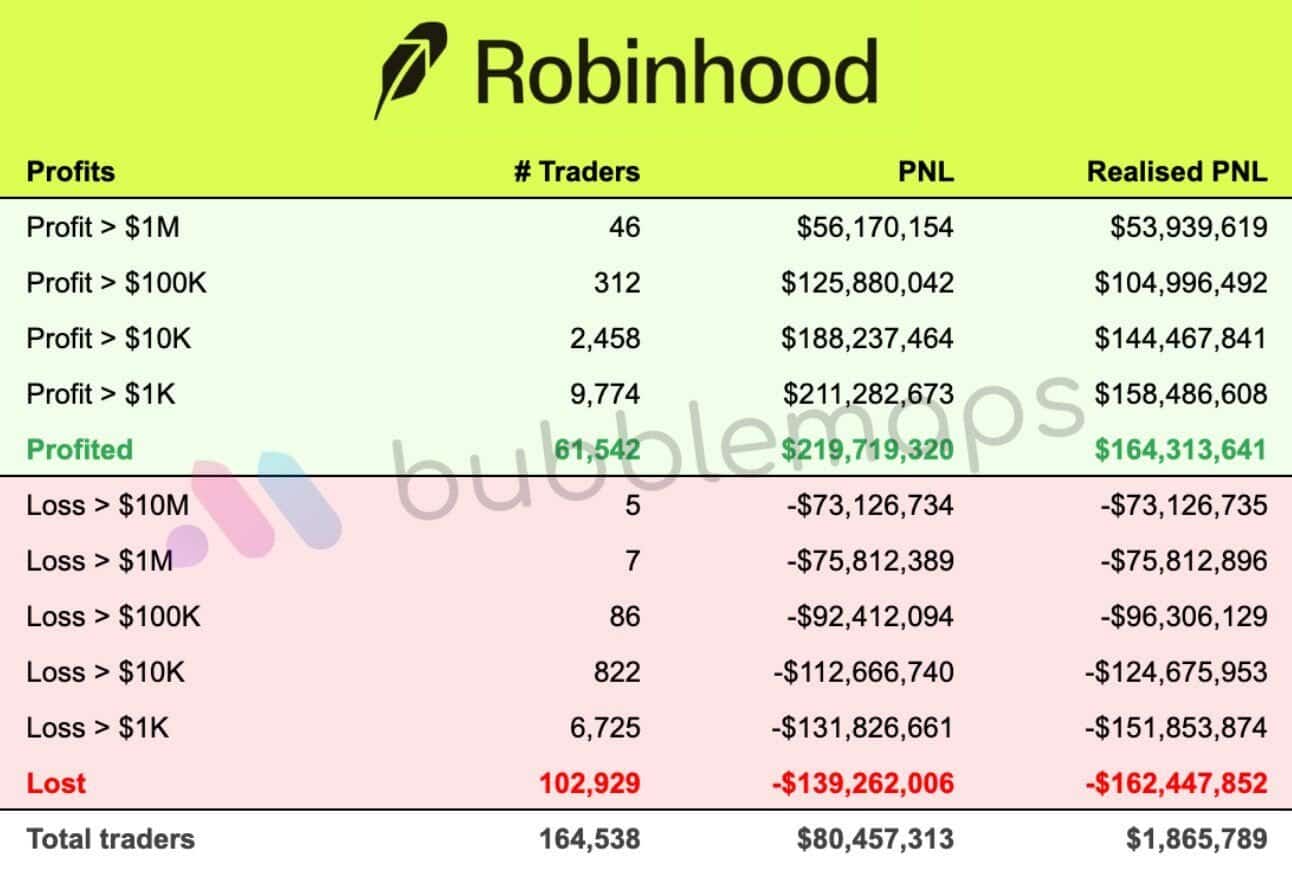
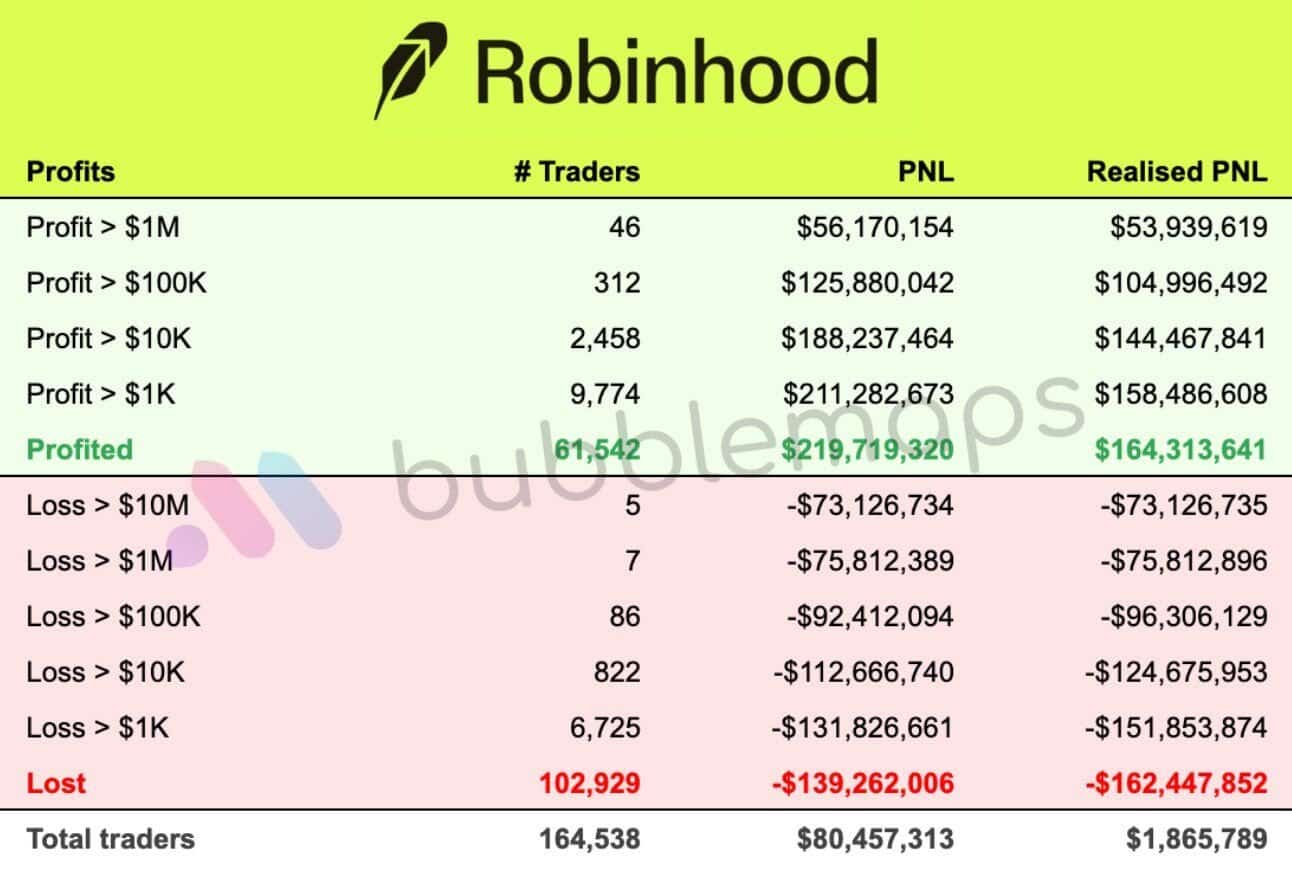
Of the 164,538 wallets tracked, 102,929 remain unprofitable, leaving 63% of traders at a loss. Meanwhile, just 61,542 wallets remain profitable, highlighting the market’s uneven reward structure. As a result, only 46 traders made more than $1 million, whereas five lost over $10 million.
Source: X

Consequently, profitable traders realized $164.3 million in gains, while losing traders realized $162.4 million in losses. That left only $1.87 million in net realized profit despite significant trading activity.

This imbalance suggests a small group continues capturing most returns as the majority provides exit liquidity.

Unless profitability spreads beyond a handful of traders, speculative enthusiasm could fade, weakening participation across Robinhood Chain’s memecoin market.

How narratives drive prices

That imbalance becomes even more apparent when external events suddenly reshape investor sentiment. The DADDY token demonstrated the fragility of narrative-driven tokens under headline risk conditions.

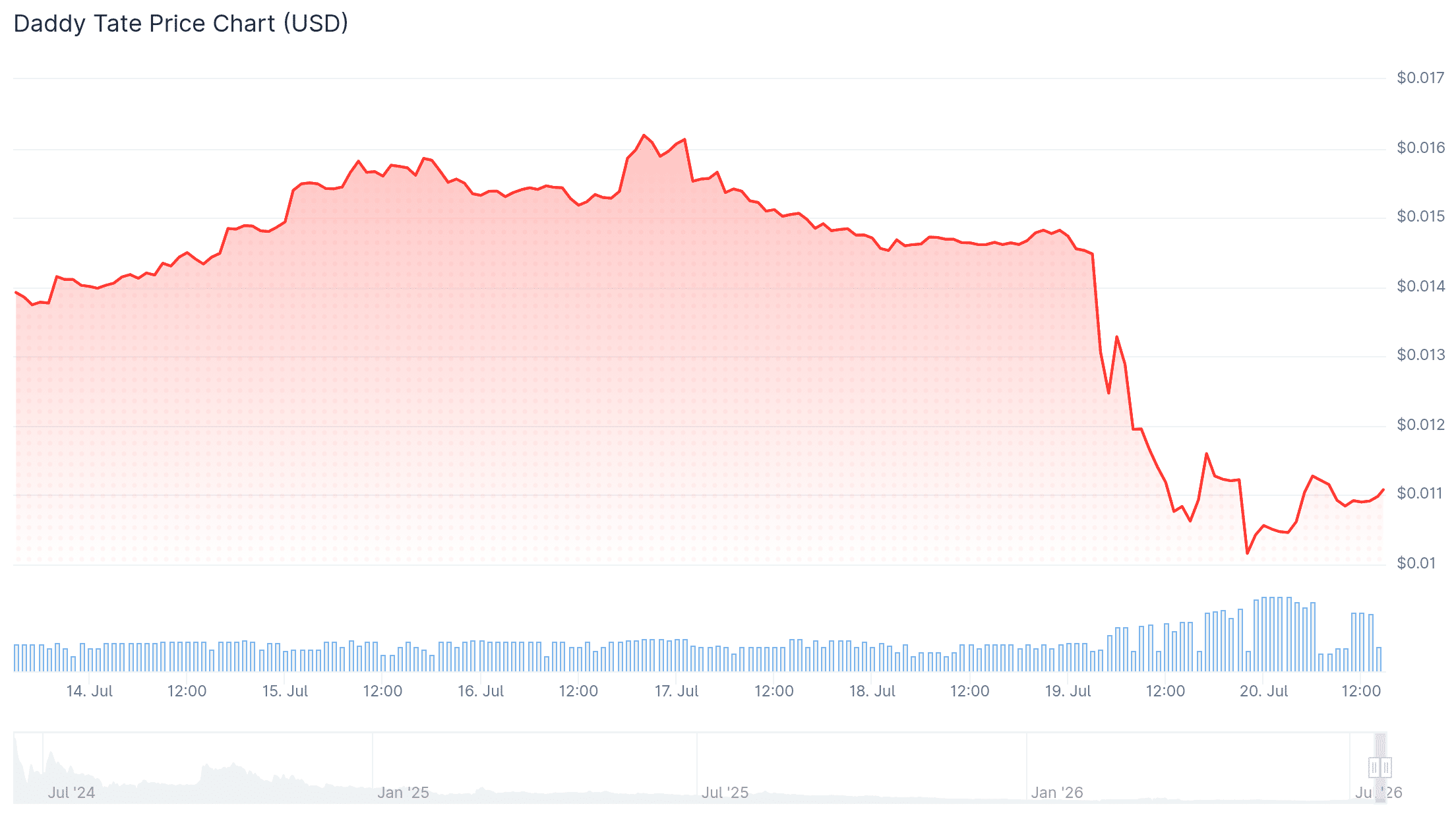
Reports linking Andrew Tate to renewed legal proceedings triggered immediate selling pressure after the token traded near $0.0145 and briefly tested $0.016. However, sentiment reversed sharply as DADDY declined by more than 20%, sliding toward $0.010.
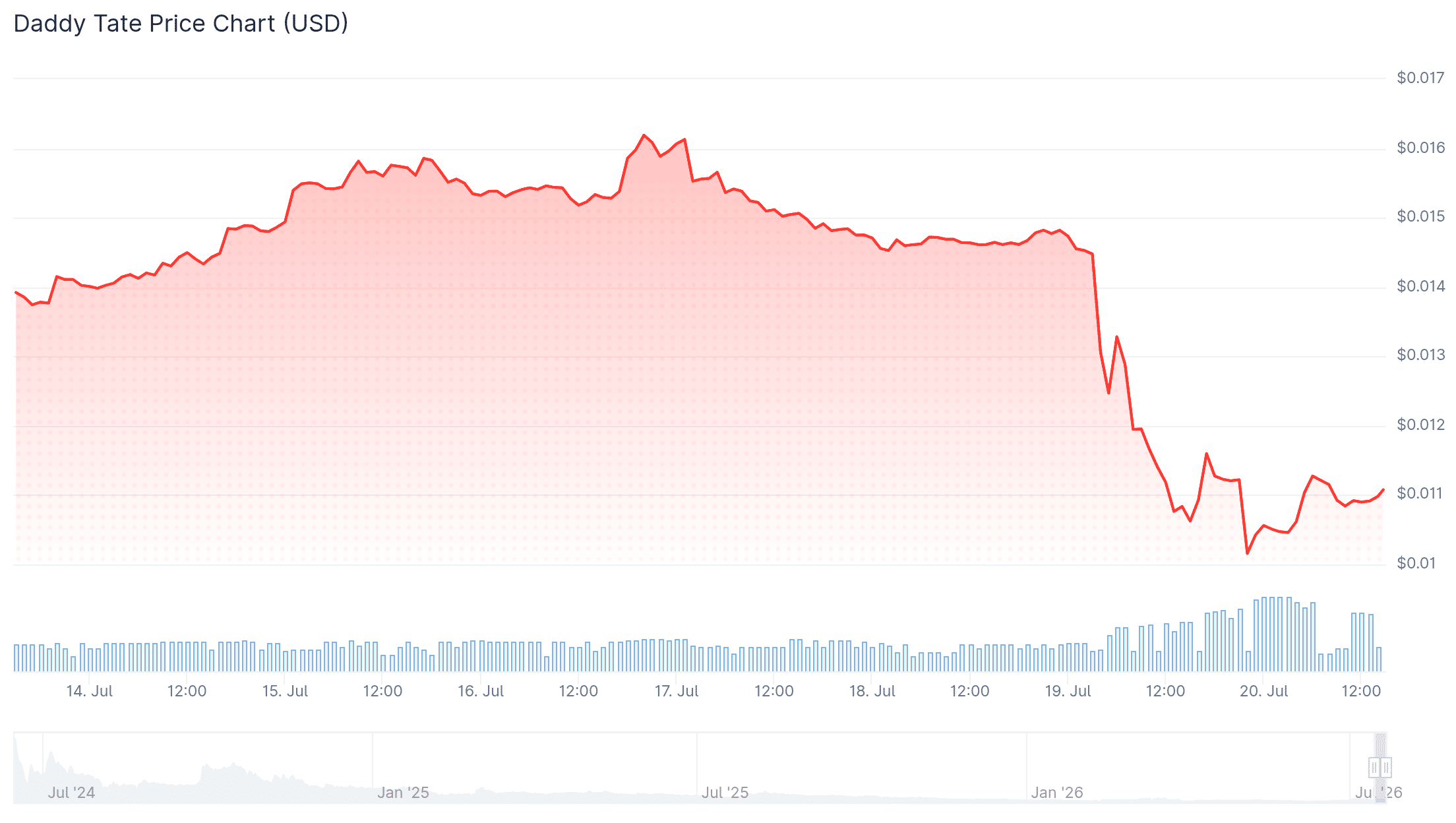
Source: CoinGecko

The sharp increase in selling volume as the price declined indicated a loss of liquidity. After the token stabilized slightly to trade for approximately $0.011, buyers were unable to regain control of the price.

More importantly, DADDY remains down more than 95% from its peak, indicating that confidence in the token will take longer to recover.

This reaction reinforces how memecoin valuations often depend more on narrative than fundamentals. Consequently, headlines continue to generate volatility and influence short-term price discovery and liquidity flow through the entire sector.

As attention shifts, resilient memecoins increasingly outperform short-lived rallies. For instance, Pepe [PEPE] demonstrates resilient holder retention, active addresses, and whale accumulation.

Similarly, Dogecoin [DOGE] is supported by a large base of users who provide significant levels of liquidity. Meanwhile, Shiba Inu [SHIB] leverages Shibarium activity and whale inflows to stabilize demand.

Together, these strengths suggest future memecoin cycles will reward utility, community loyalty, and liquidity depth over temporary viral narratives and hype.


Final Summary

  • Robinhood Chain’s memecoin market remains concentrated, with most traders still unprofitable.
  • PEPE, DOGE, and SHIB show resilience now outweighing hype in memecoin cycles.

İlgili Sorular

QWhat percentage of traders are losing money in Robinhood Chain's memecoin boom according to the tracked wallets?

AAccording to the tracked wallets, 63% of traders (102,929 out of 164,538 wallets) are unprofitable and losing money.

QHow does the article describe the distribution of profits and losses among traders in the Robinhood Chain memecoin market?

AThe article describes the profit distribution as highly uneven and concentrated. While profitable traders realized $164.3 million in gains, losing traders realized $162.4 million in losses, resulting in a net realized profit of only $1.87 million. A very small group captures most returns while the majority provides exit liquidity.

QWhat event caused the DADDY token's price to decline sharply, and what does this demonstrate about memecoins?

AReports linking Andrew Tate to renewed legal proceedings caused the DADDY token's price to decline sharply by more than 20%. This demonstrates how memecoin valuations are often fragile and depend more on narrative and sentiment than fundamentals, making them highly susceptible to headline risk and volatility.

QWhich three memecoins does the article cite as examples of resilience, and what are their key strengths?

AThe article cites Pepe (PEPE), Dogecoin (DOGE), and Shiba Inu (SHIB) as examples of resilience. Their key strengths are: PEPE has resilient holder retention, active addresses, and whale accumulation; DOGE is supported by a large user base providing significant liquidity; SHIB leverages Shibarium activity and whale inflows to stabilize demand.

QWhat does the article suggest future memecoin cycles will reward, according to its conclusion?

AThe article suggests that future memecoin cycles will reward utility, community loyalty, and liquidity depth over temporary viral narratives and hype.

İlgili Okumalar

The Encryption Bill Clarity's Challenge: A Thorny Path of Bipartisan Compromise in the U.S.

U.S. lawmakers are attempting to advance the Clarity Act, a significant crypto market structure bill, but its path is fraught with partisan hurdles. The process has been rocky since January, when a prior bipartisan deal in the Senate Banking Committee was upended. A key compromise in May on "yield" issues allowed the bill to move forward in committee, but only with the conditional support of two Democratic senators, Angela Alsobrooks and Ruben Gallego. They emphasized that their final vote depends on reaching an agreement on ethics provisions for elected officials. Ultimately, the Senate Agriculture Committee passed its version along party lines without Democratic support. As Republicans push for a full Senate vote in July, the demand for strong ethics language has expanded beyond Democrats. Additional controversies surround provisions related to yields (aligning some Republicans with large banks) and developer protections (opposed by enforcement agencies). Core concerns about illicit finance and consumer protection remain central to the debate. Despite consensus on the need for legislation, achieving the necessary bipartisan compromise is proving difficult. While momentum exists—including recent meetings between senators and White House officials—a reconciled bill text faces skepticism. Senator Gallego has stated that without ethics terms acceptable to Democrats, they will not provide the needed votes. The immediate goals for the crypto community in Congress are unclear: a symbolic Senate vote before the August recess, eventual passage into law by 2026, or forging a final compromise framework. The arduous, vote-by-vote effort to build bipartisan support continues, mirroring the traditional legislative grind the industry must now navigate.

Foresight News12 dk önce

The Encryption Bill Clarity's Challenge: A Thorny Path of Bipartisan Compromise in the U.S.

Foresight News12 dk önce

Kalshi and Polymarket Founders at Odds? This Business War Is Far More Brutal Than You Imagine

The New York Times details the fierce, personal rivalry between Kalshi CEO Tarek Mansour and Polymarket founder Shayne Coplan, which has escalated beyond typical business competition into a conflict marked by legal complaints, regulatory battles, and public hostilities. The feud intensified in late 2024 when FBI agents raided Coplan's New York apartment. While Coplan publicly blamed political motives, sources indicate his team privately suspected Mansour, noting that Kalshi's lawyers had previously reported Polymarket's operational model to federal prosecutors, highlighting that U.S. users could still access its offshore platform despite a ban. The animosity extends through their companies' operations. Kalshi positions itself as a compliance-focused, fully licensed U.S. operator, while Polymarket has historically operated its core platform offshore without a U.S. license, offering more anonymity and controversial betting markets. Mansour has publicly called Polymarket's model "illegal and immoral," while Coplan privately dismisses Kalshi as a copycat. Their competition has played out in Washington lobbying, attempts to sabotage each other's major deals (such as Kalshi's efforts to dissuade Intercontinental Exchange from investing in Polymarket), competing sponsorships, and poaching staff. The rivalry continues as both platforms experience massive growth, with Kalshi currently holding a valuation and trading volume edge, but facing ongoing regulatory scrutiny alongside Polymarket.

Foresight News41 dk önce

Kalshi and Polymarket Founders at Odds? This Business War Is Far More Brutal Than You Imagine

Foresight News41 dk önce

İşlemler

Spot
活动图片