Why Japan’s “Takaichi Trade” Could Pressure the Crypto Market Despite Post-Election Rebound

bitcoinist2026-02-10 tarihinde yayınlandı2026-02-10 tarihinde güncellendi

Özet

Japan's snap election victory for Prime Minister Sanae Takaichi initially sparked a market surge, with the Nikkei 225 hitting record highs and Bitcoin briefly exceeding $72,000. However, the "Takaichi trade"—characterized by fiscal expansion, a weaker yen, and loose monetary policy—is now tightening global liquidity. This shift is prompting investors to rebalance portfolios, moving capital into Japanese assets as bond yields rise, which in turn contributed to recent pullbacks in U.S. equities and crypto. Bitcoin's decline is linked to futures unwinding and reduced leverage rather than on-chain weakness. Although long-term regulatory support for digital assets remains possible, short-term downside risks persist due to ongoing global risk reassessment and liquidity adjustments.

Japan’s snap election delivered a decisive mandate for Prime Minister Sanae Takaichi, triggering an immediate rally across equities, foreign exchange, and crypto markets. The Nikkei 225 surged to record highs above 57,000, the yen weakened sharply, and Bitcoin briefly climbed past $72,000 during Asian trading hours.

Related Reading: Arthur Hayes Puts $100K On Hyperliquid (HYPE) Outrunning Every $1B+ Altcoin

At first glance, the reaction looked like a classic risk-on move driven by expectations of fiscal stimulus and policy continuity. But beneath the rebound, a different dynamic is taking shape, one that could tighten global liquidity and pressure risk assets in the near term.

Traders have dubbed the shift the “Takaichi trade,” a combination of aggressive fiscal expansion, tolerance for a weaker yen, and support for loose monetary conditions. While this mix has lifted Japanese stocks and exporters, analysts warn it is also reshaping cross-border capital flows in ways that may weigh on global markets.
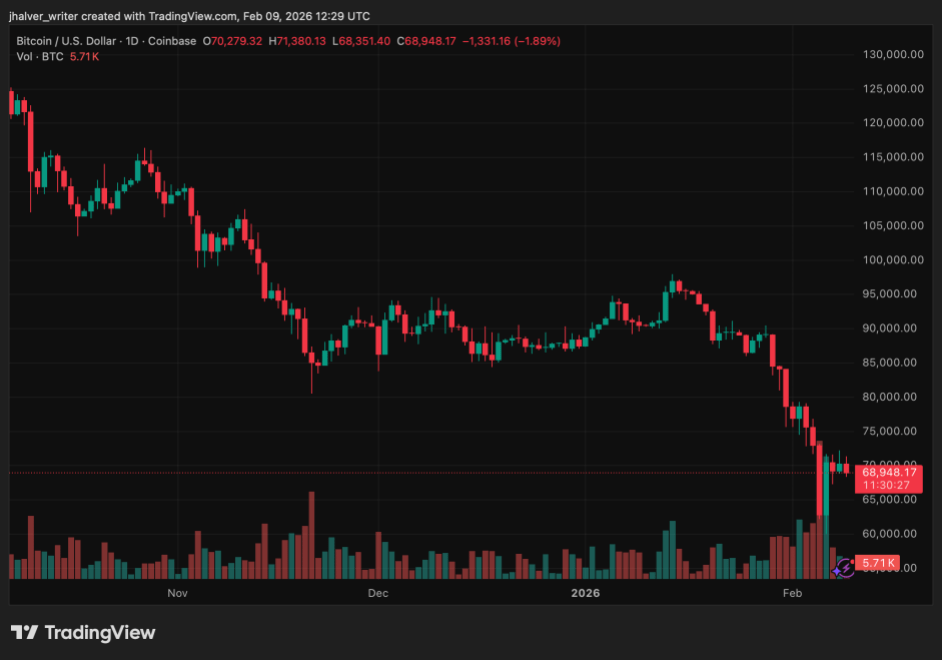
BTC's price trends sideways on low timeframes as seen on the daily chart. Source: BTCUSD on Tradingview

Portfolio Rebalancing and Liquidity Tightening

According to analysis from CryptoQuant contributor XWIN Research Japan, the main risk does not stem from capital fleeing the United States outright. Instead, global investors are rebalancing portfolios as Japanese government bonds regain appeal after years of ultra-low yields.

Expectations of higher spending and reflation have pushed yields up, drawing capital back into domestic Japanese assets. This rotation has coincided with a pullback in U.S. equities.

Over the past week, major indices, including the Nasdaq and S&P 500, slipped into correction territory, reflecting tighter financial conditions and a reassessment of risk. As inflows into U.S. equity ETFs slow, marginal liquidity across global markets has declined, amplifying volatility.

Currency dynamics add another layer of pressure. Yen weakness, persistent U.S.–Japan rate differentials, and steady demand for dollars have increased funding costs for leveraged trades. Historically, such conditions tend to push investors to de-risk across multiple asset classes simultaneously.

Equity Weakness Spills Into Bitcoin

Bitcoin’s recent pullback fits this pattern. Despite briefly reclaiming levels above $70,000 after the election, analysts note that crypto markets remain closely linked to U.S. equities during risk-off phases. When stocks weaken, portfolio managers often trim crypto exposure simultaneously to manage overall volatility.

CryptoQuant data suggests the current softness in Bitcoin prices is driven less by on-chain deterioration and more by futures unwinds and leverage reduction. Open interest has declined, and forced liquidations earlier in the month cleared out crowded long positions, leaving traders more cautious about chasing rebounds.

From a longer-term perspective, Japan’s political stability could still support digital asset adoption. Takaichi’s supermajority gives her administration room to advance tax reforms, stablecoin regulations, and Web3 initiatives later in 2026.

Related Reading: Crypto Alert: 2 Victims Lose Over $60M In Address Poisoning Scam

For now, however, the market remains vulnerable to global risk cycles. As capital continues to adjust to Japan’s fiscal pivot and U.S. equities stay under pressure, short-term downside risks are likely to persist despite the post-election bounce.

Cover image from ChatGPT, BTCUSD chart from Tradingview

İlgili Sorular

QWhat is the 'Takaichi trade' and what are its main components?

AThe 'Takaichi trade' refers to the market shift driven by Prime Minister Sanae Takaichi's policies, characterized by a combination of aggressive fiscal expansion, tolerance for a weaker yen, and support for loose monetary conditions.

QAccording to the analysis, what is the main risk to global markets stemming from Japan's new policies?

AThe main risk is not capital fleeing the U.S. outright, but rather global investors rebalancing their portfolios as Japanese government bonds regain appeal due to rising yields, which draws capital back into domestic Japanese assets and tightens global financial conditions.

QHow did Bitcoin's price react to the Japanese election result, and what is its current correlation?

ABitcoin briefly climbed past $72,000 following the election. However, it has since pulled back and remains closely linked to U.S. equities during risk-off phases, often moving in tandem when portfolio managers trim risk exposure.

QWhat does CryptoQuant data suggest is the primary driver of the current softness in Bitcoin prices?

ACryptoQuant data suggests the current softness is driven less by on-chain deterioration and more by futures unwinds, leverage reduction, and a decline in open interest following forced liquidations of long positions.

QWhat potential long-term positive developments for crypto could come from Takaichi's political victory?

ATakaichi's supermajority provides political stability that could allow her administration to advance supportive policies for digital assets later in 2026, including tax reforms, stablecoin regulations, and Web3 initiatives.

İlgili Okumalar

Bitcoin Withdrawals Continue: 8 Years of Storage in a Coldcard Cold Wallet Ended in Zero

Coldcard Hardware Wallet Hacked: Losses Mount Due to Vulnerable Seed Generation A critical vulnerability in Coldcard hardware wallets has led to a continued wave of fund thefts. According to Galaxy Research, the total stolen has reached 1,367.05 BTC (approx. $88.6 million) from 4,585 addresses, a significant increase from the initial 594.5 BTC reported on July 30, 2026. Most of the stolen funds remain on the attackers' addresses. The issue is not with the current firmware, which Coinkite has updated, but with seed phrases generated on vulnerable devices between March 2021 and the release of fixed firmware versions. Due to a programmer error, devices switched from using a hardware random number generator to the software-based Yasmarang generator, which was initialized with publicly accessible data like the chip's serial number. This made the seed phrases predictable through offline brute-force attacks, meaning wallets remain at risk until funds are moved to a new wallet generated with the patched firmware. Affected devices include Mk2/Mk3 with firmware 4.0.1–4.1.9 (and up to 5.0.3), Mk4/Mk5 up to version 5.6.0, and Q models up to 1.5.0Q. The only exceptions are seeds created with a high-entropy method like at least 50 independent dice rolls or a strong unique BIP-39 passphrase. All other owners must generate a new seed on the fixed firmware and transfer their assets. A case highlighting the human impact involves a 39-year-old long-term investor who lost 2 BTC (approx. $130,000) in minutes. He had accumulated the Bitcoin over eight years through physical labor, viewing it as a financial lifeline and a retirement plan in a country suffering from hyperinflation. His story underscores that even conservative "buy and hold in cold storage" strategies can be compromised by such underlying technical flaws. From a technical perspective, this incident echoes historical failures where weak random number generators undermined cryptographic security, challenging the assumption that offline storage is automatically foolproof.

cryptonews.ru1 saat önce

Bitcoin Withdrawals Continue: 8 Years of Storage in a Coldcard Cold Wallet Ended in Zero

cryptonews.ru1 saat önce

İşlemler

Spot
活动图片





