Why Is Wall Street Collectively Shorting the Crypto Leader Strategy?

marsbit2026-02-27 tarihinde yayınlandı2026-02-27 tarihinde güncellendi

Özet

The Financial Times' Alphaville column highlighted that S&P 500 short interest has reached a multi-year high, with MicroStrategy (referred to as "Strategy" in the text) being the most shorted stock at 14% of its market value, followed by Coinbase at 11%. This indicates significant skepticism toward MicroStrategy, a major crypto-related company. Analysts, including former investment banker Craig Coben, criticize MicroStrategy’s business model, which involves accumulating Bitcoin without generating cash flow, leading to continuous financing and dilution of shareholder equity. The company tends to buy Bitcoin at market peaks, a systemic flaw. While some short positions may hedge Bitcoin exposure, the high short interest reflects broad bearish sentiment. MicroStrategy’s CEO, Michael Saylor, promotes a "digital asset" framework where Bitcoin serves as foundational capital," followed by "digital credit" (perpetual preferred shares) and "digital currency" (stablecoins). This model relies on perpetual debt issuance, similar to U.S. Treasuries, assuming Bitcoin’s long-term appreciation. The company claims it would only face liquidity issues if Bitcoin stays below $8,000 for 4-5 years—a scenario that would likely cripple the broader crypto industry. Despite short-term stability, Wall Street remains skeptical. Hedge funds use MicroStrategy to hedge against Bitcoin’s volatility, and short sellers target it as a proxy for crypto downturns. Saylor’s ambition to build a new monetar...

On February 24, the Financial Times' Alphaville column published an article titled "Mirror mirror on the wall, what is the most shorted stock of them all?" providing some very interesting data.

The article shows that the median short interest in S&P 500 index constituents has climbed to 2.7%, reaching one of the highest levels in nearly a decade. Among all the constituents, Strategy leads with a short interest accounting for 14% of its market value, while Coinbase ranks fourth with 11%. This means that among all U.S. listed companies with a market capitalization exceeding $25 billion, Strategy is the least favored.

Articles published in the Alphaville column do not represent the views of the Financial Times; its characteristic is sharp and unsparing language. Even as cryptocurrency has gradually moved into the mainstream today, articles about cryptocurrency in the Alphaville column still spare no effort in criticizing it. Whether Bitcoin is $10 or $100,000, they consistently believe cryptocurrency is meaningless.

On February 2, Craig Coben, a veteran investment banker and former Vice Chairman of Global Capital Markets and Head of Global Equity Capital Markets at Merrill Lynch, also published an article in the Alphaville column criticizing Strategy's model.

Craig Coben's views are not extreme; he similarly believes that Strategy does not face a short-term "run" risk and currently has no liquidity crisis. However, he pointed out some core issues, such as the fact that the model of hoarding Bitcoin does not generate cash flow, thus requiring constant financing and diluting common shareholders' equity. Additionally, Strategy's tendency to buy when market sentiment is high and Bitcoin prices are elevated is a systemic, unsolvable problem.

Regarding Strategy's high short interest, some analysts believe that not all short positions are "naked shorts" against Strategy; some may be used by hedge funds to hedge their Bitcoin spot holdings. Nevertheless, it still indicates that there are many people bearish on Strategy, at the very least, everyone believes that if Bitcoin falls, Strategy cannot remain unscathed.

In Craig Coben's article, he mentioned that Strategy refers to the five types of perpetual preferred stock it issued as "digital credit," a concept that Michael Saylor has been emphasizing since the end of last year.
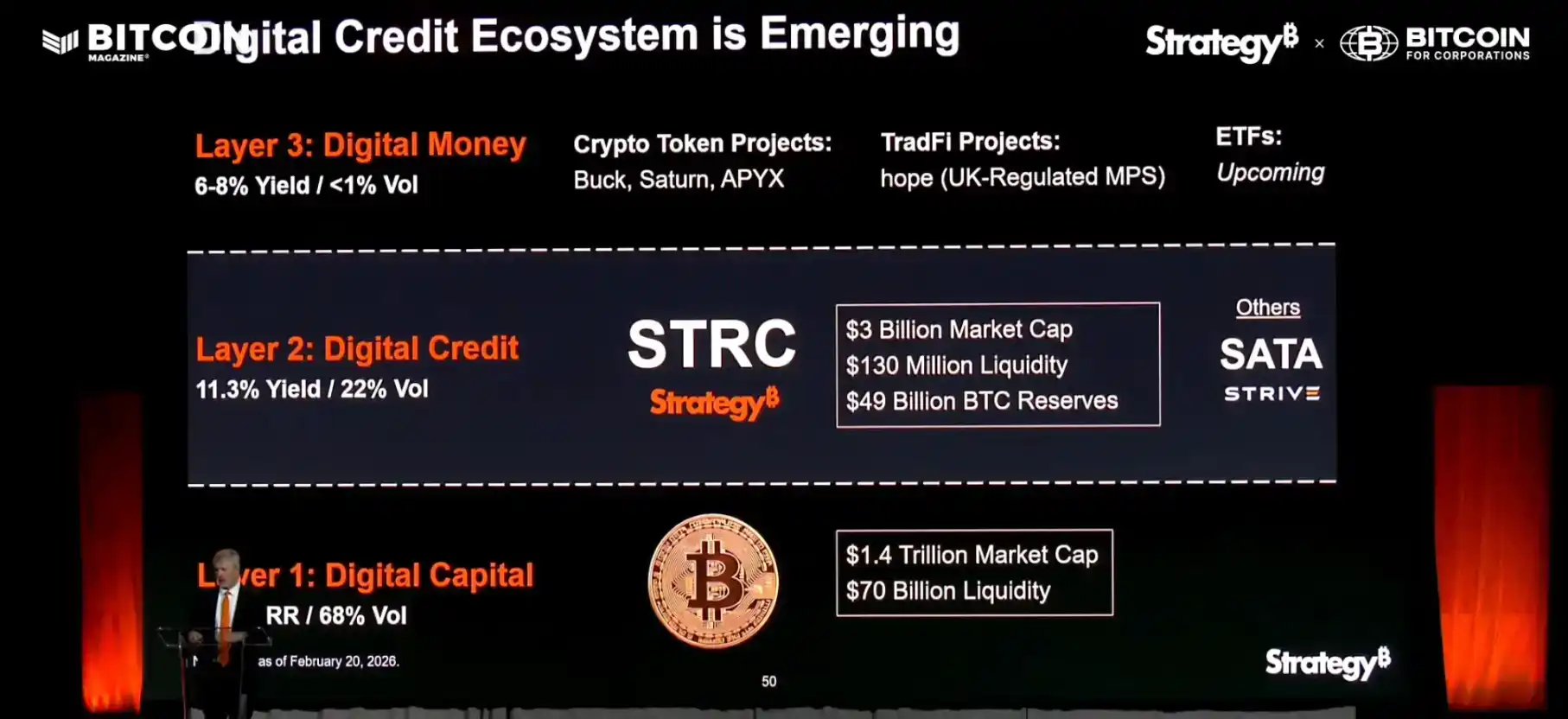
In this conceptual framework, the first layer, "digital capital," is Bitcoin. The second layer, "digital credit (or digital debt)," consists of the various perpetual preferred stocks issued by Strategy. These preferred stocks come with high yields, and Strategy must pay corresponding interest to holders annually.

The third layer is "digital currency," which refers to currencies, including stablecoins, issued based on the financial products in the second layer for trading. For example, Saturn in the diagram above plans to issue the USDat stablecoin based on STRC and U.S. Treasury bonds; this project has also received investment from YZi Labs.

If this logic isn't clear, you can draw an analogy with the United States. The U.S. continuously issues Treasury bonds based on its influence, only needing to pay interest before maturity and using new debt to repay old debt upon maturity. As long as the U.S.'s international influence and the status of the dollar do not weaken, this game can continue indefinitely. For Strategy, Bitcoin is like the U.S. influence, digital credit is like U.S. Treasury bonds, and Strategy also needs to borrow new debt to pay the annual preferred stock interest. However, as long as the price of Bitcoin continues to rise in the long term and drives Strategy's stock price up, the company can continuously issue new shares to finance the purchase of more Bitcoin and pay interest, continuing this cycle.

Michael Saylor is a firm believer that Bitcoin will change everything. In his view, Bitcoin's infinite rise is a more reliable bet than the U.S. winning forever, so he is more willing to issue currency based on an asset that is "destined" to continuously appreciate, just as the U.S. dollar was initially pegged to gold.

Strategy's strategy is not new; it only needs to ensure it has enough cash to pay interest to continuously finance the purchase of Bitcoin. Like U.S. Treasury bonds, this is a game that everyone knows will eventually reach its end one day, but no one can determine how long it can last. Strategy's current financial reserves are also sufficient; its CEO stated that Strategy would only be forced to sell Bitcoin if the price remained below $8,000 for 4 to 5 consecutive years.

If this extreme condition were actually met, not just Strategy, but the entire Web3 industry might disappear.

Even an old-school banker like Craig Coben must admit that Strategy will not face financial problems in the short term. However, for hedge funds, Strategy is a good tool for hedging against a decline in Bitcoin; for short sellers, it is reasonable to short a system that only functions normally when Bitcoin rises during a cryptocurrency downturn. At least for now, there aren't many reasons to be bullish on Strategy.

Michael Saylor's ambition to leverage Bitcoin to launch a new currency is itself interesting. The U.S. dollar is used to buy Bitcoin, and the U.S. dollar is also used to pay interest. The goal of a system built with billions of U.S. dollars is ultimately to destroy the very bricks and mortar that built it. Perhaps the elites on Wall Street are also chuckling; after all, they have no interest in researching whether Strategy can truly become a century-old company. They only care about when your stock price will rise and when it will fall.

Michael Saylor believes Bitcoin will inevitably continue to hit new highs, so he uses it as the cornerstone of everything; holders and users of the U.S. dollar believe the United States will continue to prosper, so they tacitly allow the constant raising of the U.S. debt ceiling. Both are acts of belief—so which is more advanced than the other?


İlgili Sorular

QWhy is MicroStrategy the most shorted stock among S&P 500 companies with a market cap over $25 billion?

AAccording to the Financial Times' Alphaville column, MicroStrategy has the highest short interest at 14% of its market value among S&P 500 companies with a market cap over $25 billion, making it the most heavily shorted stock in that category. This indicates a significant lack of confidence from investors, who are betting that its stock price will decline.

QWhat are the core problems with MicroStrategy's business model as pointed out by Craig Coben?

ACraig Coben pointed out that MicroStrategy's model of hoarding Bitcoin does not generate cash flow, forcing the company to continuously raise capital, which dilutes the equity of common shareholders. He also criticized its strategy of buying Bitcoin when market sentiment is high and prices are elevated, a systemic issue with no easy solution.

QWhat are the three layers in Michael Saylor's concept of 'digital credit'?

AThe three layers are: 1) 'Digital Capital,' which is Bitcoin itself. 2) 'Digital Credit (or Digital Debt),' which refers to the various perpetual preferred shares issued by the company. 3) 'Digital Currency,' which are currencies, including stablecoins, issued based on the financial products from the second layer and intended for transactions.

QHow does MicroStrategy's financial strategy resemble that of the U.S. government's debt system?

AMicroStrategy's strategy is analogous to the U.S. debt system. The company uses Bitcoin (like U.S. influence) as its foundation to issue 'digital credit' (like U.S. Treasury bonds). It plans to pay the interest on these instruments by continuously issuing new debt or equity, similar to how the U.S. refinances its debt, as long as the value of its foundational asset (Bitcoin) is perceived to be rising.

QUnder what extreme condition would MicroStrategy be forced to sell its Bitcoin holdings?

AMicroStrategy's CEO has stated that the company would only be forced to sell its Bitcoin if the price remained below $8,000 for a sustained period of 4 to 5 years. Such an extreme scenario would likely indicate a catastrophic collapse for the entire Web3 and cryptocurrency industry.

İlgili Okumalar

In Conversation with Ray Dalio: We Are Currently in an AI Bubble, with 1% of My Portfolio in Bitcoin

Ray Dalio, founder of Bridgewater Associates, warns in an interview that the current AI boom shows classic bubble characteristics, which could lead to significant economic downturns as seen in past cycles like 1929 or 2000. He explains that speculative enthusiasm, fueled by debt and overvaluation, often precedes a crash when rising rates or taxation force asset sales, causing widespread losses and recession. Dalio also outlines his "Big Cycle" theory, describing an approximate 80-year pattern where widening wealth gaps, massive government deficits, and shifting geopolitical power (like China's rise) create internal conflict and global instability. He emphasizes that we are in a late-cycle, transitional phase where traditional powers like the US and UK face decline. For personal wealth protection, Dalio advises diversification beyond cash into assets like stocks, bonds, real estate, and particularly gold, which he prefers over Bitcoin. While he holds about 1% of his portfolio in Bitcoin as a non-printable hard asset, he views gold as more secure from technological or governmental threats. Regarding AI's impact, Dalio believes it will disproportionately benefit capital owners, worsening inequality by replacing both physical and cognitive labor. He suggests that human intuition and emotional intelligence, combined with AI, will be key for future workers. On taxation, Dalio argues that wealth taxes are impractical and risk triggering asset sell-offs, reducing productive investment. He points to the UK as a cautionary example of debt, low productivity, and political strife. Geopolitically, Dalio foresees a more regionalized world, with the US showing weakness in prolonged conflicts like with Iran, akin to past imperial declines. The ideal outcome, he suggests, is coexisting powerful blocs (e.g., Americas, China-Asia Pacific) without major war.

marsbit2 saat önce

In Conversation with Ray Dalio: We Are Currently in an AI Bubble, with 1% of My Portfolio in Bitcoin

marsbit2 saat önce

Daily 7.2 Trillion KRW: Foreign Capital's Record Net Buying on Friday! Wall Street Says Headwinds for Korean Stock Fund Flows Have Subsided

South Korean stock market sees a dramatic shift in fund flows. On July 31, foreign investors made a record net purchase of approximately KRW 7.2 trillion in KOSPI stocks, marking a fundamental reversal from the persistent large-scale net outflows seen in previous months. This contributed to a significant narrowing of foreign net selling in July to KRW 9.8 trillion, down sharply from KRW 48.4 trillion in June and KRW 44.5 trillion in May. Simultaneously, domestic institutional pressure eased. South Korean pension funds and asset managers turned to a net buying position in July, purchasing KRW 1.0 trillion worth of KOSPI shares, contrasting with net sales in May and June. Market volatility is expected to be dampened by new financial regulations. Effective July 31, the Financial Services Commission tightened access for retail investors to single-stock leveraged ETFs by raising the minimum cash deposit requirement. Trading volumes for these products subsequently dropped to about 50% of their monthly average. Citigroup Research maintains its year-end KOSPI target of 10,000 points. The firm cites several supportive factors: the substantial easing of headwinds from capital outflows, a robust fundamental outlook for the semiconductor sector, historically low market valuations, strong economic fundamentals, and the potential for policy support from financial authorities if needed.

marsbit2 saat önce

Daily 7.2 Trillion KRW: Foreign Capital's Record Net Buying on Friday! Wall Street Says Headwinds for Korean Stock Fund Flows Have Subsided

marsbit2 saat önce

Thanks to Dice Rolls, Bitcoin Keys Are Stored Offline, But Not Everyone Will Do It

The article discusses using dice rolls to generate secure Bitcoin wallet seeds, providing entropy independent of potentially flawed hardware random number generators. It explains that each fair dice roll offers about 2.585 bits of entropy, with around 50 rolls needed for a standard 12-word seed phrase and 99+ recommended for higher security. This method gained attention after a vulnerability was revealed in some Coldcard hardware wallets, where a faulty firmware RNG (dating back to 2021) compromised generated keys. The analysis notes that while a dice-generated main seed was safe from this specific flaw, other Coldcard functions (like creating paper wallets, backup keys, or passwords) could still be vulnerable if they used the defective RNG. The piece argues that while dice-based entropy is technically robust, the manual process is error-prone, tedious, and unrealistic for most new users, who might make mistakes in recording or inputting rolls. It concludes that while manual entropy generation should remain an option for advanced users, the long-term goal is to develop reliable, user-friendly hardware and software that securely generates randomness without requiring specialized knowledge. Coldcard users are advised to check their firmware version and replace any secondary secrets (like paper wallet keys) created with vulnerable devices, while also considering multi-signature setups with devices from different manufacturers for added security.

cryptonews.ru8 saat önce

Thanks to Dice Rolls, Bitcoin Keys Are Stored Offline, But Not Everyone Will Do It

cryptonews.ru8 saat önce

İşlemler

Spot
活动图片




