Why is HYPE Still Surging? Has It Topped Out?

marsbit2026-05-20 tarihinde yayınlandı2026-05-20 tarihinde güncellendi

Özet

The article analyzes the reasons behind the continued surge of the HYPE token, despite the current market conditions. The primary drivers identified are: 1. **ETF Inflows and a New Buyback Mechanism:** The launch of two ETFs (THYP by 21Shares and BHYP by Bitwise) has opened a channel for traditional capital. Crucially, Bitwise announced it will allocate 10% of BHYP's management fee income to acquire and stake HYPE, creating a potential source of recurring buy pressure linked to the ETF's growth. 2. **USDC Integration and New Revenue Stream:** The return of USDC to Hyperliquid, facilitated by Coinbase and Circle, is significant. It establishes a protocol revenue-sharing model from USDC reserve yields. Community estimates suggest this could generate substantial daily income (approx. $440k), which could be used for HYPE buybacks, decoupling token demand from just trading fees and linking it to the platform's stablecoin deposits. 3. **Expansion into New Markets:** Hyperliquid is broadening beyond being just a Perp DEX. Its HIP-4 feature launches it into the prediction market space, already showing high volume. This requires HYPE staking for market creation, directly increasing token utility and staking demand. Furthermore, the platform's Real-World Asset (RWA) trading has seen Open Interest hit a new high of $2.6B, indicating growth in trading traditional assets like stocks and commodities. 4. **Regulatory Tailwinds for RWA:** Potential SEC exemptions for tokenized stock tr...

Author | Asher(@Asher_ 0210)

In the current crypto market, if there's still an altcoin that can excite the market, it's probably HYPE.

Market data shows that the exchange rates of HYPE against BTC and BNB continue to hit new all-time highs, with HYPE/BTC currently at 0.0006249 and HYPE/BNB at 0.075. This indicates that HYPE's strength is not merely following the market rebound but is consistently outperforming major crypto assets like BTC and BNB.
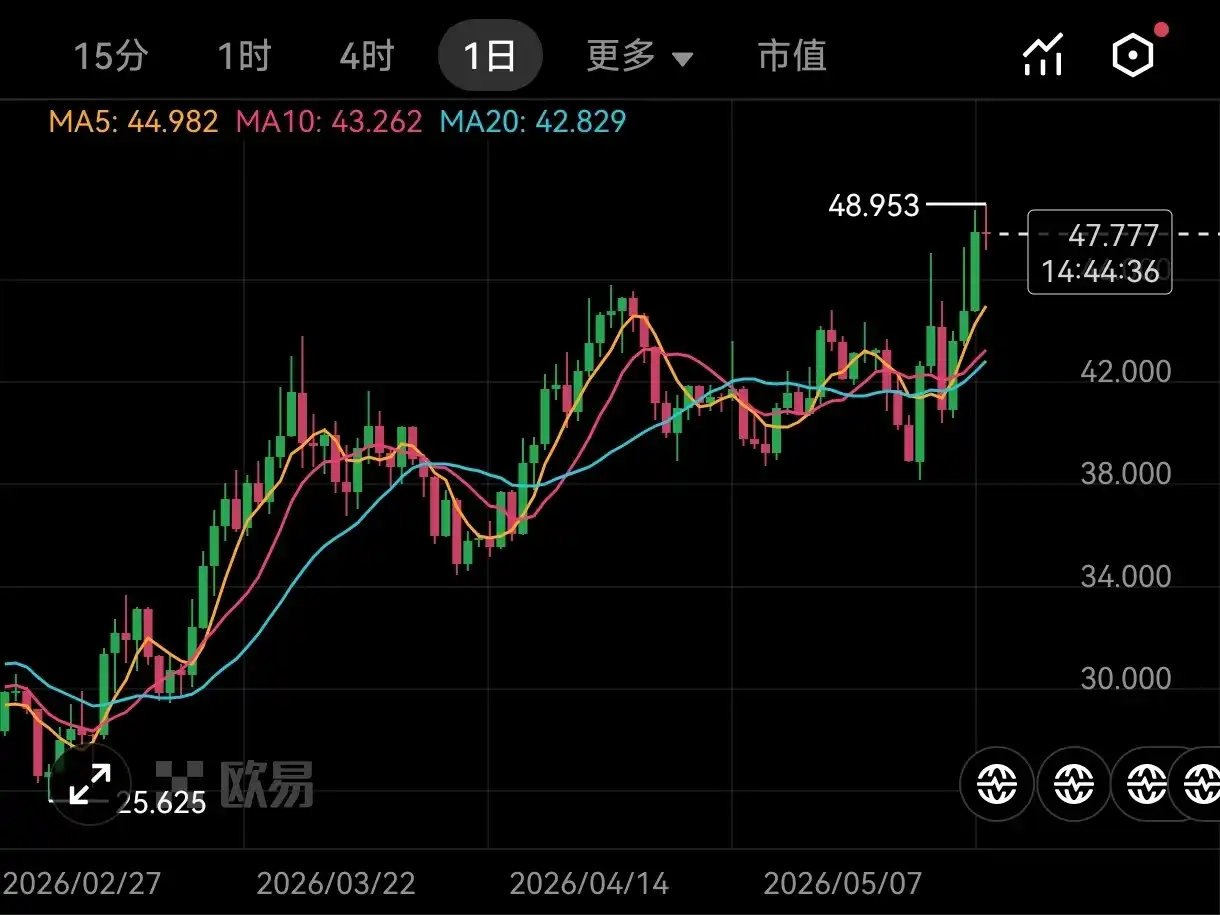
Previously, the outside world's understanding of Hyperliquid was largely confined to a high-performance Perp DEX. However, it's now evident that capital is not just buying the token of a decentralized trading platform; it's betting that Hyperliquid can integrate more asset types, more liquidity, and more trading scenarios into the same on-chain trading system.

HYPE's price performance also reflects the market's ongoing re-evaluation of Hyperliquid's value.

This article from Odaily Planet Daily will dissect its rising logic from several key changes.

From THYP to BHYP: Compliant Buying for HYPE is Opening Up

The first external catalyst for HYPE's recent surge is the opening of ETF channels.

Currently, two asset management firms have begun launching ETF products centered around Hyperliquid. On May 12th, 21Shares listed the Hyperliquid ETF under the ticker THYP; on May 15th, Bitwise listed the Hyperliquid ETF under the ticker BHYP. Data shows that as of May 18th EST, the total historical net inflows for 21Shares Hyperliquid ETF THYP reached $12.901 million; Bitwise Hyperliquid ETF BHYP reached $2.0446 million.

More crucially, Bitwise didn't stop at merely issuing an ETF. Yesterday, Bitwise announced it would allocate 10% of the management fee revenue from its BHYP Hyperliquid ETF to hold HYPE on its corporate balance sheet, with the related HYPE holdings also being staked.

This transforms the ETF narrative from a simple product listing to a potential source of continuous buying pressure. The larger the ETF size and the higher the management fee revenue, the greater the amount Bitwise could theoretically use to accumulate more HYPE. In the short term, this capital might not immediately sway prices; but in the long run, it links ETF growth, asset manager revenue, and HYPE holdings together.

In other words, ETFs are not just a one-time hype for HYPE but a new capital channel. HYPE is beginning to transition from a crypto-native asset to an on-chain trading platform token that traditional capital can also price.

USDC Returns to Hyperliquid, Adding Potential Daily Buy Pressure Exceeding $400k for HYPE

The second reason for HYPE's recent rise is that with USDC's return to Hyperliquid, the market has started to recalculate the protocol's future stable income and whether this income can continue to flow towards HYPE buybacks.

According to Hyperliquid's official announcement, Coinbase will act as the fund deployer, Circle will be responsible for CCTP and native cross-chain infrastructure deployment, and both parties have committed to staking HYPE to activate AQAv2. This means that the return of USDC is not just a simple stablecoin integration but a new mechanism established by Coinbase, Circle, and Hyperliquid around native USDC, cross-chain liquidity, and reserve yield distribution.

The key point is that Coinbase will subsequently share the majority of the USDC reserve yield with the Hyperliquid protocol. Although the specific revenue-sharing ratio has not been officially disclosed, if referencing the previous USDH yield distribution mechanism, Hyperliquid could potentially receive about 90% of the reserve yield. Therefore, the market also interprets AQAv2 as Hyperliquid establishing a protocol revenue-sharing mechanism for USDC reserve yields.

According to community estimates, based on a scale of $4.7 billion and an annualized yield of 3.8%, the USDC reserve yield corresponds to approximately $160 million in annualized revenue, translating to roughly $440,000 in potential daily HYPE buyback pressure. Once the AQAv2 interface is perfected and officially operational, Hyperliquid would no longer rely solely on trading fees to buy back HYPE but could gain an additional source of relatively stable cash flow.

This is where USDC's return truly impacts HYPE's pricing. Previously, the strength of HYPE buybacks depended mainly on trading volume: the more active the trading, the higher the protocol revenue and repurchase capability. However, with the addition of USDC reserve yields, the source of HYPE buying pressure is no longer solely dependent on trading fees but also begins to depend on how much stablecoin capital Hyperliquid can accumulate. In other words, trading fee buybacks represent platform trading activity, while USDC reserve yield buybacks represent the platform's capital accumulation capability. The market's re-pricing of HYPE might be precisely due to observing that HYPE's buyback story is no longer solely reliant on trading hype.

Hyperliquid Integrates HIP-4, Also Entering the Prediction Market Business

Beyond RWA, Hyperliquid is also reaching into one of the hottest crypto sectors this year – prediction markets.

On May 2nd, Hyperliquid launched HIP-4 Outcome Markets on its mainnet, initially introducing BTC intraday binary outcome contracts. Simply put, users can trade whether the BTC price will be above a specified price at a certain point in time. The contract price fluctuates between 0.001 and 0.999, corresponding to the market's pricing of the event's probability; it settles to 1 if the event occurs and 0 if it does not.

Predictefy data shows that on the first day of HIP-4's launch, the trading volume for BTC price-related event contracts reached $6.15 million, meaning Hyperliquid's volume in this niche market alone already far exceeded that of Kalshi, Polymarket, and other similar markets on prediction platforms.

For HYPE, the significance of HIP-4 is not just adding another product feature but connecting prediction markets to HYPE's staking, fee, and buyback mechanisms. According to the design, in the future, for permissionless deployment of prediction events, market creators will need to stake 1 million HYPE tokens, which is higher than the 500,000 HYPE required for deploying perpetual markets under HIP-3. Each staking slot can support rolling and periodic markets and can be reused after settlement; staked assets may also be slashed if issues like oracle manipulation, abnormal market states, or prolonged downtime occur.

Therefore, what HIP-4 brings to HYPE is not just a simple prediction market concept boost but a more direct value capture path. More permissionless deployment of prediction events means more demand for HYPE staking, more trading volume means more fee revenue, and this portion of fees will ultimately feed back into Hyperliquid's original buyback logic.

RWA Open Interest Hits New Highs, Hyperliquid's Ceiling is More Than Just a Perp DEX

Beyond ETF and USDC yield inflows, RWA is further expanding Hyperliquid's trading boundaries.

Data shows that the open interest for RWA trading on the Hyperliquid platform has risen to $2.6 billion, setting a new all-time high and doubling from two months ago. This data indicates that Hyperliquid is no longer just catering to crypto asset trading demand for BTC, ETH, SOL, etc.; real-world assets are also beginning to scale within its on-chain trading system.

This is crucial for HYPE's pricing. If Hyperliquid were merely a Perp DEX, its valuation anchor would primarily be the crypto cycle, trading volume, and fee revenue. But RWA opens up another dimension: stocks, commodities, precious metals, Pre-IPO assets, and more could all become subjects of 24/7 on-chain trading.

The significance of RWA for Hyperliquid isn't about adding a few more trading pairs; it's about pulling the platform out of the internal competition within the crypto market. Perp DEXes compete over who captures more crypto trading volume, but RWA competition is about who can migrate off-chain asset trading demand onto the chain. If Hyperliquid can continue to grow this part of the market, HYPE's pricing will no longer solely follow the crypto trading cycle but begin to tie into the larger demand for real asset trading.

US SEC Plans Tokenized Stock Exemption, Adding More Imagination to RWA Narrative

Potential regulatory easing by the US SEC regarding tokenized stocks is also raising Hyperliquid's long-term ceiling. According to reports, the US SEC is preparing to introduce an innovation exemption for tokenized stock trading, allowing tokens tied to publicly traded company stocks to trade on crypto platforms. In certain circumstances, related platforms might not need to fully register as broker-dealers or exchanges, and tokenized stocks issued by third parties might not even require consent from the listed companies.

For Hyperliquid, the significance of this is not starting tokenized stocks from scratch but adding regulatory imagination to the RWA direction it is already advancing. On the Hyperliquid platform, trading of real assets like stocks and Pre-IPO assets is already scaling, and RWA open interest has also reached new highs. If US regulation indeed opens a testing window for tokenized stocks, this type of on-chain trading demand could be further amplified.

For Hyperliquid, clearer regulatory boundaries could mean less resistance to bringing real asset trading on-chain; and those more likely to capture incremental growth are often not individual asset issuers but platforms capable of handling order books, liquidity, and settlement. If tokenized stocks transition from gray-area experiments to compliant growth, Hyperliquid's already operational RWA business would not just be an early attempt but could become the main battlefield in the next round of on-chain trading competition.

Fundamentals Still Strengthening, But Short-term Enters a Bull-Bear Battle Zone

The logic behind HYPE's rise is becoming clearer. ETFs open compliant capital inlets, USDC's return brings potential buyback increments, and RWA, prediction markets, and tokenized stocks continue to widen Hyperliquid's trading boundaries. These changes all point in the same direction – Hyperliquid is no longer just a Perp DEX but is expanding into a larger on-chain trading system.

However, a valid long-term logic doesn't mean short-term prices will keep rising unilaterally. According to on-chain data, HYPE is currently witnessing a massive standoff between large long and short whales, with the TOP1 and TOP2 whale positions acting as direct counterparties, with a total size exceeding $60 million. The longs are looking at Hyperliquid's subsequent growth space, while the shorts are betting on pullback pressure after rapid short-term gains. As whale position sizes expand, HYPE's short-term price may no longer be dictated solely by fundamentals but will also be influenced by leverage liquidations, funding rates, and market sentiment.

Therefore, HYPE's short-term price action is not easy to predict and depends more on which side between bulls and bears is forced to exit first. But over a longer timeframe, HYPE's fundamentals are still worthy of market optimism. Hyperliquid continues to expand tradable assets, capital inlets, and revenue sources, and HYPE plays a more central role as a value carrier within the buyback, staking, and fee capture mechanisms.

Related Content

First-Day Volume Crushes Polymarket, Hyperliquid Enters Prediction Market with BTC Binary Options

Behind USDH's Acquisition by Coinbase: Hyperliquid's Choice of Interests

İlgili Sorular

QWhat are the two new ETFs that have listed HYPE, and how could they potentially create ongoing buying pressure for the token?

AThe two new ETFs are 21Shares' THYP and Bitwise's BHYP. Specifically, Bitwise has announced that 10% of the management fee income from its BHYP ETF will be used to purchase and stake HYPE on its corporate balance sheet. This creates a scenario where the larger the ETF grows, the more fee income Bitwise generates, and the more ongoing buying pressure for HYPE.

QHow does the return of USDC to Hyperliquid create a new source of potential buy pressure for HYPE, separate from trading fees?

AThe return of USDC, facilitated by Coinbase and Circle through the AQAv2 mechanism, allows Hyperliquid to share in the reserve yield generated from USDC deposits. Community estimates suggest this could generate daily protocol revenue of around $440,000 (based on $4.7B in assets at 3.8% APY). A significant portion of this new revenue stream is expected to be used for HYPE buybacks, providing a source of buy pressure tied to stablecoin deposits rather than just trading activity.

QWhat is HIP-4 on Hyperliquid, and how does it create direct value capture for the HYPE token?

AHIP-4 Outcome Markets is Hyperliquid's new binary options (prediction market) product. It creates direct value capture for HYPE by requiring event creators to stake 1 million HYPE tokens to deploy a market (compared to 500,000 HYPE for perpetual markets). This increases staking demand. Furthermore, the trading fees generated from this new product feed into the protocol's overall revenue, which is used for HYPE buybacks.

QWhy is the growth of RWA (Real World Assets) trading on Hyperliquid significant for HYPE's valuation narrative?

AThe growth of RWA trading (with Open Interest hitting a new high of $2.6B) shifts Hyperliquid's narrative from being just a crypto-native Perp DEX to a broader chain-based trading system. It expands the potential market HYPE is tied to beyond the cyclical crypto trading demand and into the much larger market for trading traditional assets like stocks and commodities. This significantly raises the platform's long-term addressable market and potential revenue, which benefits HYPE's value capture.

QWhat recent US regulatory development could further boost the RWA narrative for Hyperliquid?

AReports suggest the U.S. SEC is preparing an innovative exemption for tokenized stock trading, potentially allowing tokenized versions of publicly traded company stocks to be traded on crypto platforms without full broker-dealer registration. This regulatory clarity could dramatically increase the demand for trading tokenized real-world assets, a market segment where Hyperliquid, with its existing RWA infrastructure and growing OI, is well-positioned to capture significant volume.

İlgili Okumalar

Top 10 Promising Emerging Hyperliquid Native Protocols to Watch

Title: A Review of 10 Emerging Native Protocols on Hyperliquid Hyperliquid is evolving beyond perpetual contracts into a comprehensive on-chain financial stack. This article highlights 10 key native protocols driving this growth: 1. **Monetrix**: A yield-optimizing protocol akin to Ethena, aggregating funding rates, HLP rewards, maker rebates, and HIP-3 into a single stablecoin yield. 2. **ROSETTA**: An automated stablecoin yield router, allocating USDC across top protocols (e.g., Felix, Aave, HLP) for optimal returns, factoring in gas and slippage. 3. **papertrade.xyz**: A fair-launched perpetuals protocol offering up to 1000x leverage, no funding rates, no slippage, and fully on-chain, oracle-based execution. 4. **alt.fun**: A launchpad where tokens are paired with leveraged perpetual positions (2x-5x), linking token price to trading activity and underlying position performance. 5. **Ventuals**: Pre-IPO perpetual contracts (built on HIP-3) allowing up to 10x leveraged speculation on valuations of private companies like SpaceX and Stripe. 6. **Liminal**: A delta-neutral yield protocol that captures funding rates via automated short positions and uses generated xTokens (xBTC, etc.) as DeFi collateral. 7. **Melt**: Brings tokenized stocks, commodities, and RWAs to Hyperliquid spot markets, enabling 24/7 trading alongside crypto assets. 8. **Chainsight**: An oracle and data infrastructure protocol providing low-latency (<3s) price feeds, volatility indices, and risk metrics for novel derivatives. 9. **rip.xyz**: Tokenized vault strategies on HyperEVM; its flagship rHYPURR offers liquidity and fractional exposure to a Hypurr NFT basket, priced hourly via NAV. 10. **Markets**: A perpetuals exchange (by Kinetiq) for trading stocks, forex, commodities, bonds, and crypto with up to 50x leverage, using USDH collateral and Kaiko oracles. These protocols form the foundational layer for generating real yield, liquidity, and innovative financial products natively on Hyperliquid.

marsbit49 dk önce

Top 10 Promising Emerging Hyperliquid Native Protocols to Watch

marsbit49 dk önce

Musk Posted a Recruitment Ad for SpaceX, and After Reading the Comments Section, I Understood

On May 20th, SpaceX filed for a landmark IPO with a $1.75 trillion valuation. Shortly after, Elon Musk posted a recruitment call on X, seeking "world-class engineers and physicists" for SpaceX. The application process was starkly simple: email with three bullet points proving "exceptional ability," with real, complex projects as a plus. Musk promised to review qualifying emails himself. The post garnered millions of views and thousands of replies, revealing a spectrum of responses. Most comments, including a highly-upvoted humorous one listing absurd "skills," merely listed credentials or experiences in a conventional, non-differentiating way. This highlighted a key insight: a traditional resume listing degrees and skills often fails to demonstrate true exceptionalism. Effective self-presentation requires "performance efficiency." A standout reply came from an OpenAI engineering lead, who simply stated "codex." This demonstrated that for those who have built significant, recognized products, the product itself becomes the ultimate resume. The article argues that in the AI era, any tangible, shareable output—a tool, research, or online project—serves as a living, self-evident credential more powerful than a list of attributes. However, a twist emerged when applicants found the provided email address non-functional, leading to speculation that the post might also serve as an IPO publicity stunt, projecting an image of aggressive talent acquisition to investors. Ultimately, the episode served as a microcosm: some participate through performance, others through proof of work, while some question the reality of the stage itself. It underscores the enduring challenge of defining and demonstrating value in an age of abundant, yet often superficial, content.

marsbit1 saat önce

Musk Posted a Recruitment Ad for SpaceX, and After Reading the Comments Section, I Understood

marsbit1 saat önce

Cutting Off OpenAI, Anthropic Acquires the Tool Provider Used by a Quarter of Global Developers

Anthropic has acquired Stainless, a developer tool company that automatically generated official SDKs (Software Development Kits) for AI giants including OpenAI, Anthropic, Meta, and Cloudflare. The deal, reportedly valued at around $300 million, marks a strategic shift for Anthropic as it builds its "AI agent" infrastructure. Stainless acted as a "translator," converting complex API specifications into ready-to-use code libraries for developers. Its tools indirectly reached about a quarter of professional software developers globally. Following the acquisition, Stainless will shut down its public products and its team will join Anthropic to focus on internal platform development, notably for the Claude Platform. Existing SDKs remain with their respective client companies but will no longer receive updates from Stainless. This move is part of Anthropic's broader 18-month strategy to assemble a complete "agent stack." The stack consists of the Claude model at its core, the newly acquired Stainless for standardized API interfaces, and the Model Context Protocol (MCP), an open standard for connecting agents to external tools and data. This contrasts with OpenAI's focus on model generations and consumer-scale compute. Anthropic believes an agent's ultimate utility depends on its ability to connect to external systems. By internalizing the SDK layer and promoting MCP as a connection standard, Anthropic aims to lock in long-term ecosystem advantages and create path dependency, moving beyond the transient lead provided by any single model generation.

marsbit1 saat önce

Cutting Off OpenAI, Anthropic Acquires the Tool Provider Used by a Quarter of Global Developers

marsbit1 saat önce

İşlemler

Spot
Futures

Popüler Makaleler

HYPE Nasıl Satın Alınır

HTX.com’a hoş geldiniz! Hyperliquid (HYPE) satın alma işlemlerini basit ve kullanışlı bir hâle getirdik. Adım adım açıkladığımız rehberimizi takip ederek kripto yolculuğunuza başlayın. 1. Adım: HTX Hesabınızı OluşturunHTX'te ücretsiz bir hesap açmak için e-posta adresinizi veya telefon numaranızı kullanın. Sorunsuzca kaydolun ve tüm özelliklerin kilidini açın. Hesabımı Aç2. Adım: Kripto Satın Al Bölümüne Gidin ve Ödeme Yönteminizi SeçinKredi/Banka Kartı: Visa veya Mastercard'ınızı kullanarak anında Hyperliquid (HYPE) satın alın.Bakiye: Sorunsuz bir şekilde işlem yapmak için HTX hesap bakiyenizdeki fonları kullanın.Üçüncü Taraflar: Kullanımı kolaylaştırmak için Google Pay ve Apple Pay gibi popüler ödeme yöntemlerini ekledik.P2P: HTX'teki diğer kullanıcılarla doğrudan işlem yapın.Borsa Dışı (OTC): Yatırımcılar için kişiye özel hizmetler ve rekabetçi döviz kurları sunuyoruz.3. Adım: Hyperliquid (HYPE) Varlıklarınızı SaklayınHyperliquid (HYPE) satın aldıktan sonra HTX hesabınızda saklayın. Alternatif olarak, blok zinciri transferi yoluyla başka bir yere gönderebilir veya diğer kripto para birimlerini takas etmek için kullanabilirsiniz.4. Adım: Hyperliquid (HYPE) Varlıklarınızla İşlem YapınHTX'in spot piyasasında Hyperliquid (HYPE) ile kolayca işlemler yapın.Hesabınıza erişin, işlem çiftinizi seçin, işlemlerinizi gerçekleştirin ve gerçek zamanlı olarak izleyin. Hem yeni başlayanlar hem de deneyimli yatırımcılar için kullanıcı dostu bir deneyim sunuyoruz.

197 Toplam GörüntülenmeYayınlanma 2024.12.11Güncellenme 2026.04.28

HYPE Nasıl Satın Alınır

Tartışmalar

HTX Topluluğuna hoş geldiniz. Burada, en son platform gelişmeleri hakkında bilgi sahibi olabilir ve profesyonel piyasa görüşlerine erişebilirsiniz. Kullanıcıların HYPE (HYPE) fiyatı hakkındaki görüşleri aşağıda sunulmaktadır.

活动图片