Why is Ethereum Urgently Needing ZK-ification?

marsbit2026-01-13 tarihinde yayınlandı2026-01-13 tarihinde güncellendi

Özet

The article discusses the urgent need for Ethereum to adopt zero-knowledge (ZK) technology as a core narrative for its future development. While Ethereum previously focused on ICOs, DeFi, and being a global financial settlement layer, it now lacks a compelling new narrative. ZK technology is highlighted as a critical solution, with Ethereum being the blockchain most invested in its development. ZK-EVM has reached the Alpha stage, a milestone celebrated by Vitalik Buterin. The primary motivation for ZK integration is to maintain Ethereum’s decentralization while improving scalability. Currently, increasing the Gas limit boosts TPS but raises node operation costs, potentially centralizing the network. ZK proofs allow nodes to verify transactions efficiently without expensive hardware upgrades, similar to automated exam grading versus manual checking. ZK itself doesn’t directly increase TPS but enables future Gas limit hikes with minimal node cost increases. The recent Fusaka upgrade, including PeerDAS, advances this goal. A ZK-powered Ethereum could achieve over 1000 TPS, strengthening its narrative. The article also addresses the role of third-party ZK teams (e.g., Polygon, Scroll, ZKsync, Taiko), which remain crucial for innovation and testing different ZK-EVM types (Type 1 to 4). ZK-VMs, like Brevis, are noted for higher performance and diversity, as they aren’t constrained by EVM compatibility. While ZK L1 may attract some L2 users, it also benefits L2s by reducing costs...

One of the most frequently asked questions recently is, how to view Ethereum's narrative?

Admittedly, Ethereum focused on ICOs and the world computer in 2017, and on DeFi and the financial settlement layer in 2021. However, for the 2025 cycle, there seems to be few new narratives that can match the height of the old ones.

Perhaps ETF and Staking ETF count as half, but this is not within the control of Ethereum developers. If there is another half, it can only be ZK.

Ethereum is undoubtedly the public chain that has bet the most on ZK in the entire Crypto world.

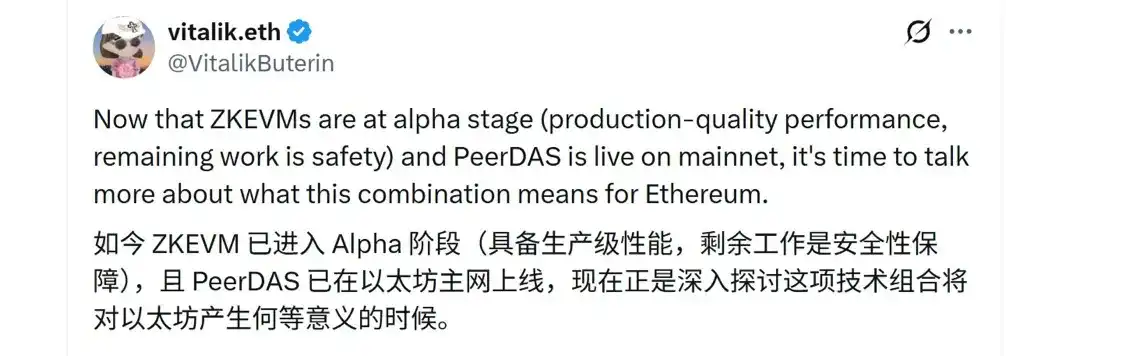
A few days ago, Vitalik was quite excited. He officially announced on Twitter that ZKEVM has now entered the Alpha stage.
Why is Ethereum so persistent about ZK?

Actually, Ethereum's TPS is not low anymore, with the theoretical peak already increased to over 200 TPS. The main reason is that Ethereum has repeatedly raised the Gas limit.
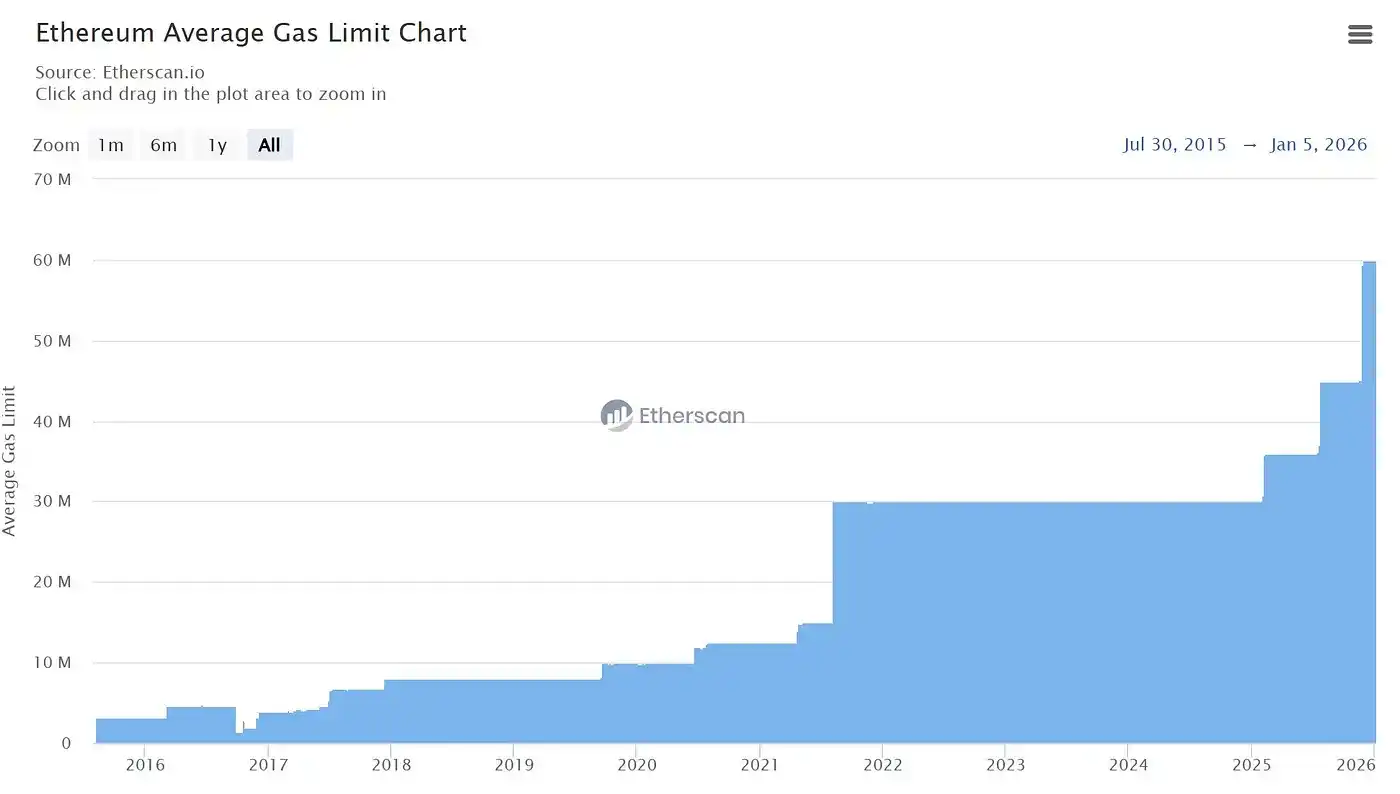
However, raising the Gas limit comes at a cost and cannot be done indefinitely. Its cost is that nodes need more expensive servers to run.

But Ethereum also wants to maintain its proud high degree of decentralization, so it cannot push node server performance too high (refer to Solana, where a single server is about 5–10 times more expensive than an ETH server).

Therefore, the mainnet must be ZK-ified. Note, this is not about creating a few ZK L2s; this is a full ZK-ification of the L1 mainnet.

So what are the benefits after ZK-ification?

Those ETH nodes can simply verify these ZK proofs, without needing to tediously verify transactions one by one as in the past.
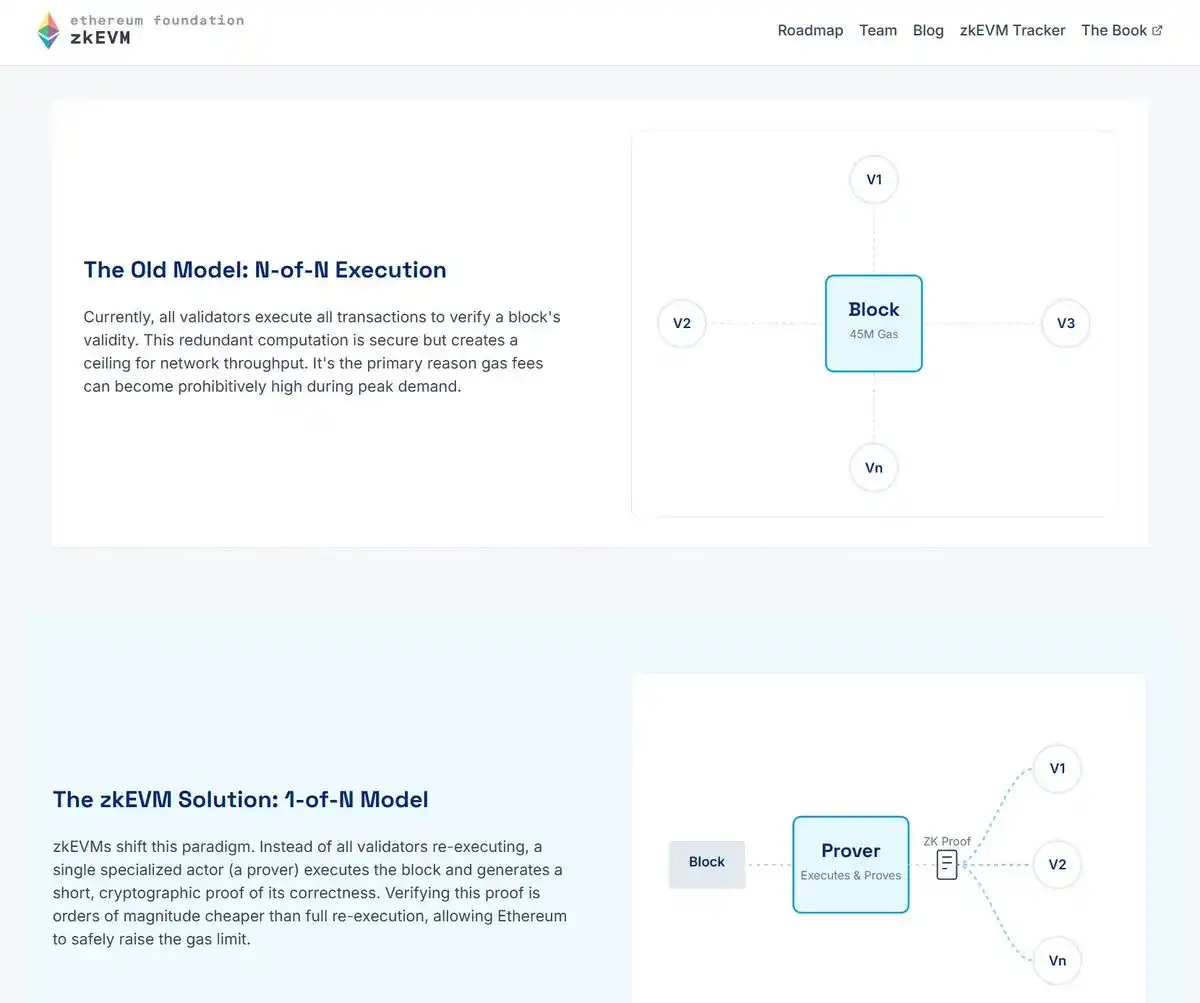
For example, if you are a grading teacher (node), the transactions are the students' exam papers.

In the past, manually grading papers was slow. But since the invention of the answer sheet (ZK-ification)神器, the machine calculates the total score in a second, so as a teacher, aren't you much more relaxed?

You are relaxed; in the past, one person could only grade 50 papers, but now they can grade 1000. The person is the same, but efficiency skyrockets.

Therefore, Ethereum must first ZK-ify the mainnet, and then it can significantly raise the Gas limit again.

ZK-ification itself does not directly increase TPS; it is a prerequisite. Improving performance still relies on raising the Gas limit, but after ZK-ification, nodes do not need to increase server costs much, making the代价很小.

After the recent Fusaka upgrade (especially the PeerDAS upgrade) performed well, Ethereum has taken another step closer to mainnet ZK-ification, which is why Vitalik is so excited.

Imagine a mainnet with TPS breaking thousands; for Ethereum, that indeed counts as a decent narrative.

Someone raised a question:

If Ethereum itself builds a ZK-EVM for the mainnet, are other ZK teams still meaningful?

First, the conclusion is, they are still meaningful.

Why?

First, ZK engineering is one of the most difficult developments in the entire network, sitting at the same table as FHE. It requires a large number of cryptography talents.

It is believed that the ETH Foundation has some reserves in this area, but as an open-source community, Ethereum adheres to the philosophy that many hands make light work. It needs a large number of third-party ZK teams for trial, error, and innovation. In return, Ethereum will give substantial support.

Second, there are four types of ZK-EVM, from type 1 to type 4. Several groups, including Polygon, Scroll, ZKsync, and Taiko, are like each认领任务,分别实现其中一个类型.

Additionally, there is ZK-VM, such as Brevis.

In fact, ZK-VM's position is even more stable compared to ZK-EVM.

The reason is that among the four major ZK-EVM types, it is highly likely that one with the best cost-performance ratio will eventually be chosen to become part of the designated solution for Ethereum's mainnet ZK-EVM, which may affect the other three.

However, for ZK-VM, it is not EVM-compatible by nature, so it will definitely be part of Ethereum's diversity.

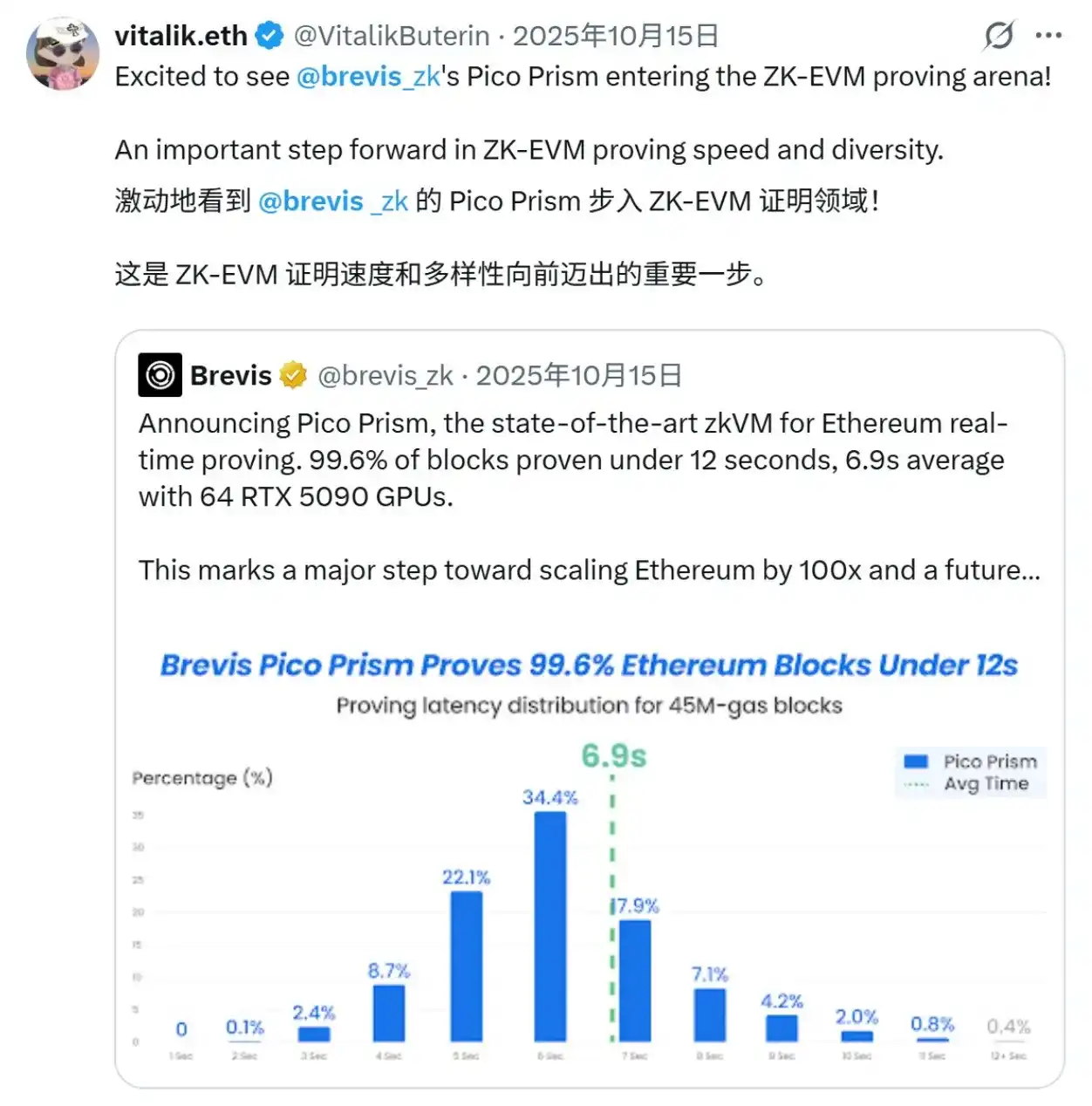
Moreover, since VM is not constrained by EVM limitations, its performance can run very high. Ethereum's ZK-EVM poses no threat to it; instead, the Ethereum official will continue to encourage it.

For example, Vitalik previously specifically mentioned the performance of Brevis's ZK-VM and expressed期待它们进入 ZK-EVM 领域.
What about L2?There might be some impact, but it's still not significant.

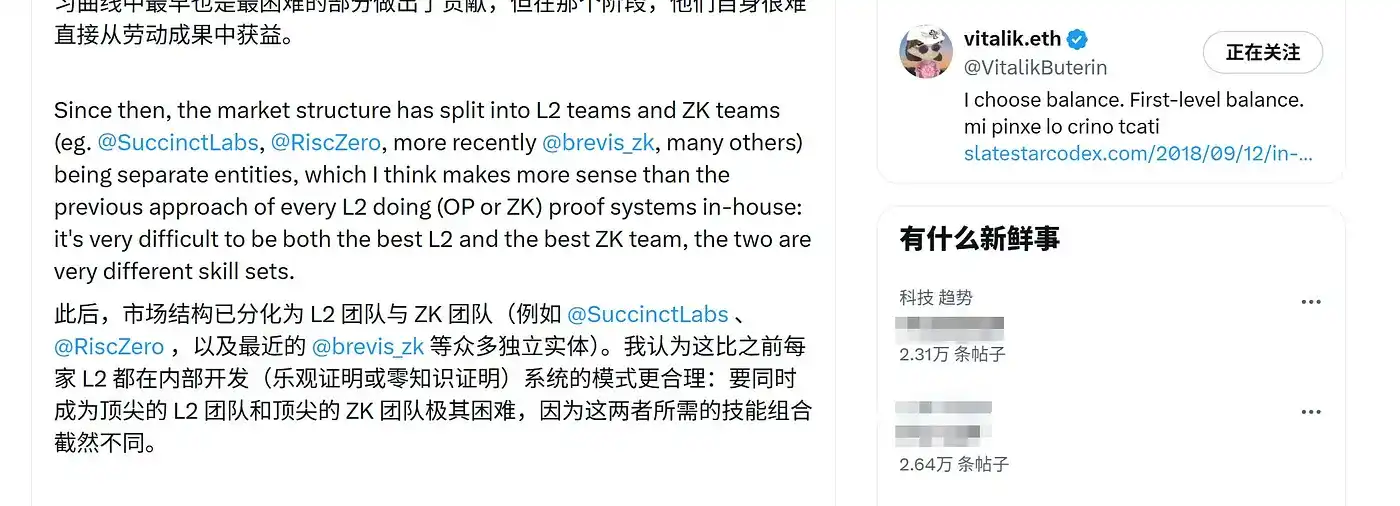
Vitalik once said when discussing Polygon that ZK and L2 should be separated比较好.

The ZK-ified L1 will certainly attract back some users from ZK L2s. After all, if L1 is cheap enough, the number of users on L2 may decrease.

But think about it the other way: if L1 is the foundation and L2 is the skyscraper, the foundation must be as solid as possible. So, if the L1 mainnet is ZK-ified, L2 fees will also decrease, which is beneficial.

Moreover, in that tweet, Vitalik also specifically mentioned Brevis, which works on ZK-VM. The reason is that much of Brevis's ZK work is not limited to L2, meaning "ZK research and L2 research are separated."

For example, they have a ZK computing power market, helping with ZK-ified reward distribution for Uniswap's hooks, which is application-driven.
In summary, Ethereum has been online for 10 years now, and the slogan of ZK-ification has been proposed for five or six years. After continuous cultivation, ZK-ification has finally entered the Alpha stage. This is thanks to the continuous investment from Ethereum and numerous third-party ZK teams including Brevis and Polygon.


Trend Kriptolar

İlgili Sorular

QWhy does Ethereum urgently need to become ZK-based according to the article?

AEthereum needs to become ZK-based to significantly increase its TPS by raising the Gas limit without forcing node operators to use prohibitively expensive servers, thereby preserving its high degree of decentralization while scaling.

QWhat is the role of ZK technology in improving Ethereum's node efficiency?

AZK technology allows nodes to simply verify cryptographic proofs of transaction batches instead of manually verifying each transaction individually, dramatically increasing the number of transactions a node can process without a proportional increase in computational cost.

QHow does the article differentiate between ZK-EVM and ZK-VM, and which one is considered more stable?

AThe article states that ZK-VM is considered more stable because it is not EVM-compatible and exists as part of Ethereum's diversity. It is not threatened by Ethereum's own ZK-EVM development and is performance-optimized without EVM constraints.

QWhat impact might a ZK-based Ethereum L1 have on existing ZK L2s?

AA cheaper and more scalable ZK-based L1 might attract some users back from L2s. However, it also benefits L2s by providing a more robust foundational layer (L1), which can lead to lower fees on L2s as well.

QWhat is the significance of the 'Alpha stage' announcement for ZKEVM mentioned in the article?

AThe announcement that ZKEVM has entered its Alpha stage signifies a major milestone after years of development, indicating that the core technology for Ethereum's full ZK integration is becoming operational and bringing the vision of a high-TPS, decentralized mainnet closer to reality.

İlgili Okumalar

Only 153 Venture Capital Firms Invested in July: Is the Crypto VC Industry Experiencing a 'Mass Extinction'?

In July 2026, only 153 unique venture capital firms participated in disclosed crypto funding rounds, marking the lowest monthly count since November 2020. This figure represents an 87% decline from the peak of 1,177 firms in 2022. Overall, the first seven months of 2026 saw crypto projects raise approximately $11.78 billion across 481 rounds. This crypto VC contraction contrasts sharply with the broader venture capital landscape, where global VC investment reached a record $560.4 billion in H1 2026, heavily fueled by major AI company financings. This shift in capital allocation has drawn funds away from the crypto sector. Within crypto, funding is highly concentrated. Trading platforms, prediction markets, and payment sectors absorbed 53% of the total capital. While early-stage deals remain frequent, the largest sums flow to a few late-stage rounds and mergers & acquisitions, which surged to $7.23 billion in Q2 2026. The market is consolidating around top funds like a16z crypto and Dragonfly, which successfully raised new multi-billion dollar funds, while many smaller firms have retreated. Analysts describe this as a "great extinction" for crypto VCs, where capital is becoming more selective, favoring proven business models and assets over early-stage speculation. This raises the bar for project quality, funding efficiency, and viable exit paths.

marsbit12 dk önce

Only 153 Venture Capital Firms Invested in July: Is the Crypto VC Industry Experiencing a 'Mass Extinction'?

marsbit12 dk önce

Strategy's Loss in the Second Quarter Reaches $8.22 Billion Amid Bitcoin Decline

Strategy, the largest corporate holder of Bitcoin, reported a net loss of $8.22 billion for the second quarter. This loss was primarily driven by an $8.32 billion unrealized loss on its Bitcoin holdings due to a decline in the asset's price during the period. Despite these paper losses, the company increased its Bitcoin holdings to 843,775 BTC, a 25% growth since the start of the year. As part of a new monetization strategy, Strategy sold approximately $218.4 million worth of Bitcoin, mainly to fund dividends for preferred shareholders, with $216 million of that sold after Q2 ended. The company also built a $3.75 billion cash reserve, which it claims is sufficient to cover over two years of dividend and interest payments, aiming to insulate itself from Bitcoin's volatility while meeting obligations. Following the earnings release, Strategy's stock (MSTR) rose 4.7% in regular trading but corrected slightly after-hours. This pattern reflects how the company's accounting results are heavily tied to Bitcoin's price swings, even as its long-term strategy remains unchanged. The report indicates that Strategy is maintaining its core strategy of accumulating Bitcoin while building a financial buffer. This quarterly loss follows a recognizable pattern, with the company posting significant unrealized losses in previous quarters (e.g., $12.4 billion in Q4 2025 and ~$12.5 billion in Q1 2026) due to fair-value accounting. A key technical shift is its new monetization program, which introduces periodic selling pressure on the market, transitioning Strategy from a pure accumulator to a participant that occasionally adds supply. A critical question remains: how long can the cash reserve cover dividend obligations if a Bitcoin price downturn persists beyond two years?

cryptonews.ru32 dk önce

Strategy's Loss in the Second Quarter Reaches $8.22 Billion Amid Bitcoin Decline

cryptonews.ru32 dk önce

Will Terrorist Durov Ban Russian Officials?

Telegram founder Pavel Durov publicly reacted to being labeled a "terrorist" by Russian authorities, stating the designation came after he refused demands for mass surveillance and censorship on the platform. In a Telegram post, he highlighted that this status formally bans him from "publishing information online." Durov concluded with a statement widely circulated: Russian officials "clearly don't understand who can ban whom on the internet." This remark suggests Durov could potentially restrict official Russian government and officials' channels on Telegram, which continue to operate on the platform despite its formal blocking in Russia. The situation parallels previous, slow-moving state directives, like switching officials to domestic cars, contrasted with the current push to migrate all government communication to the Russian-made messenger MAX by 2030. However, reports indicate many officials still use Telegram via workarounds, fearing surveillance on MAX, while alternatives like BiP and KakaoTalk recently became inaccessible in Russia without a VPN. Durov has not specified any immediate actions against state channels. His statement is an initial response, with further developments depending on the authorities' reaction. The dynamic differs from 2020 when Russian regulators lifted a block on Telegram; now, Durov implies control from within the platform itself over the official accounts that persisted through that earlier blockade.

cryptonews.ru32 dk önce

Will Terrorist Durov Ban Russian Officials?

cryptonews.ru32 dk önce

DeepSeek V4 Official Version Arrives, New Capabilities Emerge, Value-for-Money King Enters the Fray

On July 31st, DeepSeek officially launched the public API beta for its DeepSeek-V4-Flash model. A key highlight is its performance on multiple Agent benchmark tests, reportedly nearing or even surpassing the level of the V4-Pro preview version from three months ago. Notably, the Flash model achieves this with significantly smaller scale (130B active parameters vs. Pro's 490B), suggesting that post-training optimization and data quality may be as crucial as raw model size. DeepSeek emphasized that the V4-Flash-0731 uses the same model architecture and size as its preview version, with improvements attributed solely to "re-trained post-training." The update also marks the official debut of DeepSeek's self-developed Agent framework, "Harness." The move signals DeepSeek's strategic push to position its cost-effective Flash model as a competitive base for Agent applications—scenarios requiring autonomous planning, tool usage, and complex task execution—where inference speed and cost are critical. By natively supporting OpenAI's Responses API format and adapting for code-generation scenarios, DeepSeek aims not just to be a cheaper alternative but to establish its own ecosystem in the Agent era. This release follows DeepSeek's record-breaking ~$50 billion fundraising round roughly two months prior, underscoring market confidence in its technology and commercialization prospects. The company is reportedly preparing for another funding round at a valuation of approximately $71 billion. The Flash model's advancement represents a step in fulfilling the high expectations that come with this valuation, setting the stage for the impending release of the V4-Pro official version and intensifying competition in the global Agent landscape.

marsbit36 dk önce

DeepSeek V4 Official Version Arrives, New Capabilities Emerge, Value-for-Money King Enters the Fray

marsbit36 dk önce

İşlemler

Spot

Popüler Makaleler

ZK Nasıl Satın Alınır

HTX.com’a hoş geldiniz! ZKsync (ZK) satın alma işlemlerini basit ve kullanışlı bir hâle getirdik. Adım adım açıkladığımız rehberimizi takip ederek kripto yolculuğunuza başlayın. 1. Adım: HTX Hesabınızı OluşturunHTX'te ücretsiz bir hesap açmak için e-posta adresinizi veya telefon numaranızı kullanın. Sorunsuzca kaydolun ve tüm özelliklerin kilidini açın. Hesabımı Aç2. Adım: Kripto Satın Al Bölümüne Gidin ve Ödeme Yönteminizi SeçinKredi/Banka Kartı: Visa veya Mastercard'ınızı kullanarak anında ZKsync (ZK) satın alın.Bakiye: Sorunsuz bir şekilde işlem yapmak için HTX hesap bakiyenizdeki fonları kullanın.Üçüncü Taraflar: Kullanımı kolaylaştırmak için Google Pay ve Apple Pay gibi popüler ödeme yöntemlerini ekledik.P2P: HTX'teki diğer kullanıcılarla doğrudan işlem yapın.Borsa Dışı (OTC): Yatırımcılar için kişiye özel hizmetler ve rekabetçi döviz kurları sunuyoruz.3. Adım: ZKsync (ZK) Varlıklarınızı SaklayınZKsync (ZK) satın aldıktan sonra HTX hesabınızda saklayın. Alternatif olarak, blok zinciri transferi yoluyla başka bir yere gönderebilir veya diğer kripto para birimlerini takas etmek için kullanabilirsiniz.4. Adım: ZKsync (ZK) Varlıklarınızla İşlem YapınHTX'in spot piyasasında ZKsync (ZK) ile kolayca işlemler yapın.Hesabınıza erişin, işlem çiftinizi seçin, işlemlerinizi gerçekleştirin ve gerçek zamanlı olarak izleyin. Hem yeni başlayanlar hem de deneyimli yatırımcılar için kullanıcı dostu bir deneyim sunuyoruz.

215 Toplam GörüntülenmeYayınlanma 2024.12.13Güncellenme 2026.06.02

ZK Nasıl Satın Alınır

Tartışmalar

HTX Topluluğuna hoş geldiniz. Burada, en son platform gelişmeleri hakkında bilgi sahibi olabilir ve profesyonel piyasa görüşlerine erişebilirsiniz. Kullanıcıların ZK (ZK) fiyatı hakkındaki görüşleri aşağıda sunulmaktadır.

活动图片