Why Hyperliquid’s $48B oil-driven volume could signal a crypto reset

ambcrypto2026-03-20 tarihinde yayınlandı2026-03-20 tarihinde güncellendi

Özet

Middle East tensions are causing a significant oil supply shock, driving traders to seek 24/7 exposure through perpetual contracts on Hyperliquid. This has positioned Hyperliquid as the leading perp DEX by volume, with weekly trades nearing $48 billion. The platform's native token, HYPE, has surged 30% monthly, diverging from most altcoins. However, this rally is fueled by leveraged long positions and geopolitical FOMO. Analysts suggest that an unwind of these crowded oil trades on Hyperliquid could signal easing tensions and potentially trigger a broader crypto market reset towards risk-on sentiment.

A supply shock is a strong catalyst, especially for traders chasing short-term upside.

Currently, the West Asian crisis is driving a real supply-side squeeze in the oil market. As a result, investor sentiment is shifting, with oil flows picking up and traders increasingly positioning for further upside. In short, long positions are becoming more aggressive as the narrative gains momentum.

Against this backdrop, Hyperliquid [HYPE] is starting to stand out as a key beneficiary. According to DeFiLlama data, it’s now leading perp DEX volume, with weekly volume nearing $48 billion, roughly 2x larger than the next platform in line.
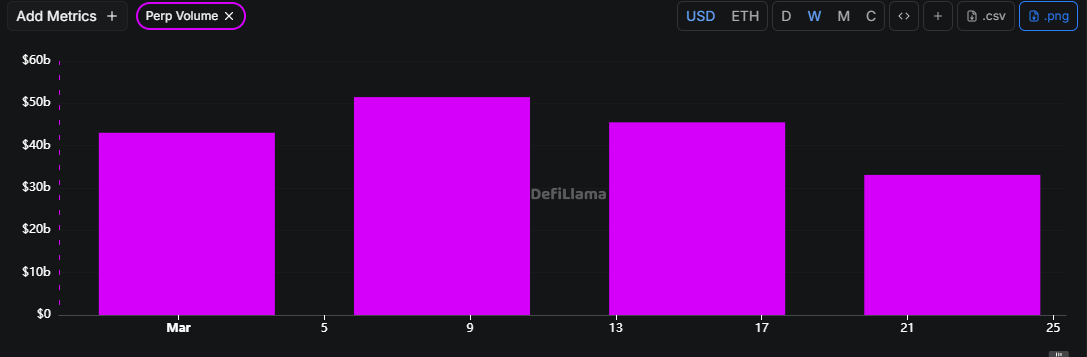
Source: DeFiLlama

Importantly, this shift is also catching the attention of major TradFi players.

JPMorgan analysts, for instance, point to traders chasing 24/7 oil exposure as the main driver behind the spike in Hyperliquid’s perp DEX volume, a gap TradFi markets still don’t cover. As a result, Hyperliquid is gaining an edge in capturing incremental flow and liquidity.

Notably, this on-chain activity is showing up in HYPE’s price action as well. On the monthly chart, HYPE is up roughly 30%, clearly diverging from other high-cap altcoins that are mostly printing single-digit gains. In short, the market is starting to price in this edge.

However, with HYPE now running into resistance around the $2.3k level, a strong case remains that macro FUD and crowded positioning are driving this move rather than a sustained trend. Consequently, if flows cool or positioning gets too crowded, it increases the risk of an unwind.

So the key question is: If we start to see large long squeezes and exits on Hyperliquid, could that flush act as a signal for a market reset and indicate when the broader crypto market flips back to risk-on?

Traders piling into oil on Hyperliquid raise the question of a reset

The conflict in the Middle East has thrown the global oil market into disarray.

According to the Kobeissi Letter, oil prices have jumped sharply since December, and Saudi Arabia’s prediction markets are calling for the war to last through April, with $180 tagged as the “base case” for oil. In short, the market is bracing for continued volatility and supply-driven moves.

In this setup, Lookonchain flagged a trader depositing 4.105 million USDC on Hyperliquid to open a 5x long on $20.19 Brent oil, showing how traders are chasing FOMO and using leverage to capture outsized returns in the oil market. The bigger picture, though? Moves like this underline Hyperliquid’s central role in enabling perp trades and explain why its DEX volume keeps hitting new highs.
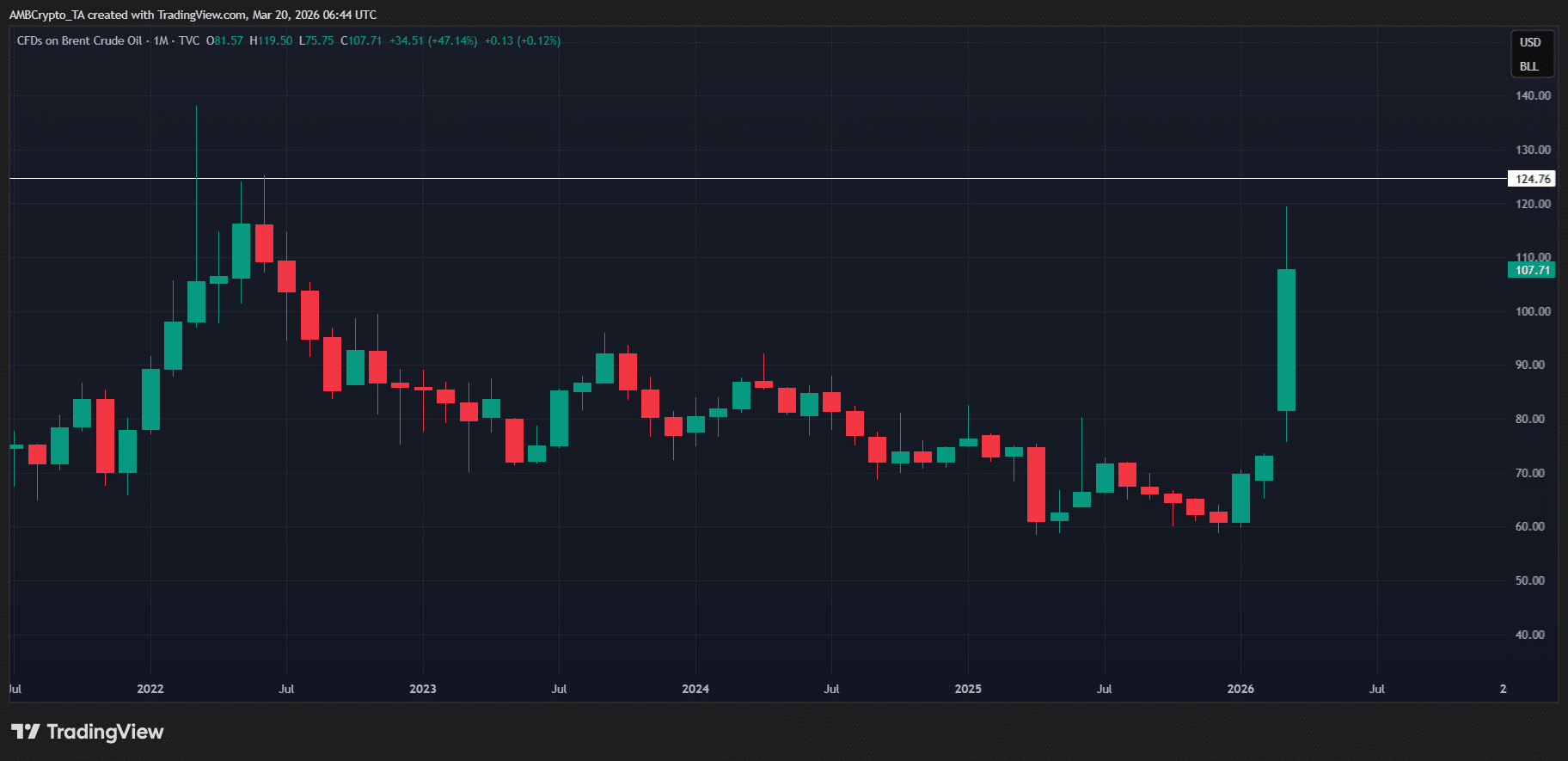
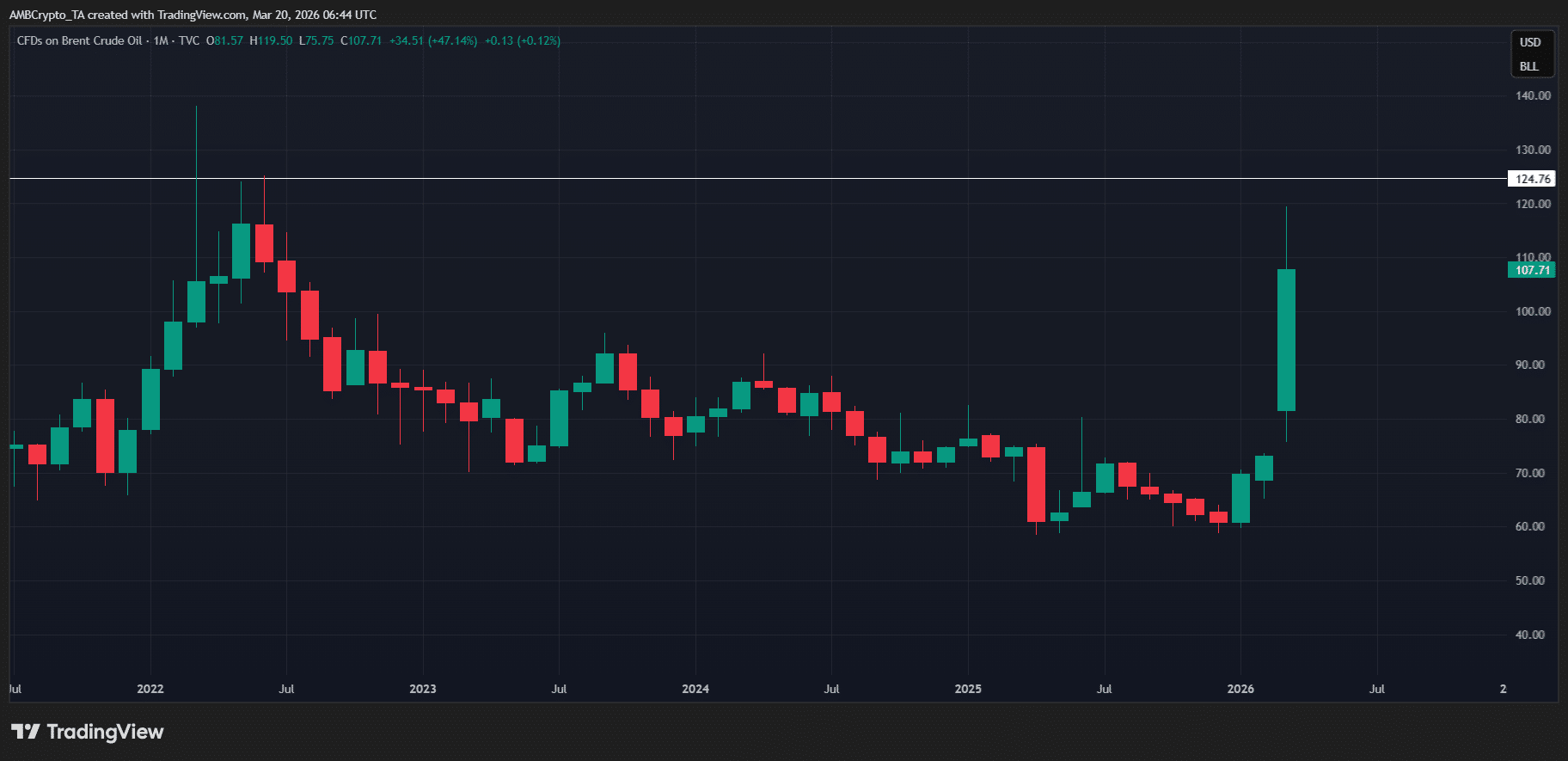
Source: TradingView (BRENT OIL/USD)

From a technical angle, these perp bets on Hyperliquid make total sense.

As the chart above shows, Brent Oil is up a massive 47% so far in March, marking its first 40%+ monthly rally since the COVID-19 crisis. Prices have already bounced back to 2022 levels around $110, with this trade’s liquidation set at $87.87, leaving the trader comfortably sitting on significant unrealized gains.

Meanwhile, the broader crypto market is still stuck around a $2.4 trillion market cap. Capital rotation into risk assets looks capped as traders chase oil momentum, with Hyperliquid standing out as the only altcoin posting double-digit gains.

According to AMBCrypto, this is a key trend to watch. The crypto market’s next risk-on move seems tied to long crowding on Hyperliquid. Once those positions start to unwind, it could signal geopolitical tensions easing and open the door for a broader risk-on rotation.


Final Summary

  • Middle East tensions are driving a supply shock in oil, fueling FOMO-driven longs on Hyperliquid and pushing HYPE up 30%, highlighting its central role in perp trading.
  • Brent oil rallies 47% in March while crypto remains stuck, showing that broader risk-on moves may hinge on potential unwind on Hyperliquid.

İlgili Sorular

QWhat is the main driver behind the spike in Hyperliquid's perp DEX volume according to JPMorgan analysts?

AJPMorgan analysts point to traders chasing 24/7 oil exposure as the main driver behind the spike in Hyperliquid's perp DEX volume, a gap that TradFi markets still don't cover.

QHow much has the price of HYPE increased on the monthly chart, and how does this compare to other altcoins?

AOn the monthly chart, HYPE is up roughly 30%, clearly diverging from other high-cap altcoins that are mostly printing single-digit gains.

QWhat is the 'base case' price target for oil according to Saudi Arabia's prediction markets mentioned in the article?

ASaudi Arabia's prediction markets are calling for the war to last through April, with $180 tagged as the 'base case' for oil.

QWhat specific example does Lookonchain provide to show how traders are chasing oil FOMO on Hyperliquid?

ALookonchain flagged a trader depositing 4.105 million USDC on Hyperliquid to open a 5x long on $20.19 Brent oil.

QAccording to the article, what could a potential unwind of long positions on Hyperliquid signal for the broader crypto market?

AA potential unwind of long positions on Hyperliquid could signal that geopolitical tensions are easing and open the door for a broader risk-on rotation in the crypto market.

İlgili Okumalar

E Fund "Quits Drinking"

"Yi Fang Da 'Gives Up Alcohol'" - Summary The article analyzes the recent portfolio adjustments of star fund manager Zhang Kun, focusing on his flagship funds, the Yi Fang Da Blue Chip Select and Yi Fang Da Quality Select. The key trend highlighted is a significant and ongoing reduction in exposure to the consumer sector, particularly liquor (baijiu) stocks like Kweichow Moutai and Wuliangye, which were once core holdings. This shift is driven by several factors: a downturn in the consumer sector's business cycle post-pandemic, with slowing earnings growth for major players; a change in consumer behavior towards value over premium brands; and high channel inventory pressures, especially in the liquor industry. These fundamentals have led to a prolonged phase of valuation contraction for consumer stocks. Concurrently, market capital has rotated aggressively towards the high-growth technology sector, especially AI-related chains, which have dominated fund inflows. This style shift has further diminished the attractiveness of traditional consumer "core assets" for many funds. As a result, Zhang Kun's funds have drastically cut their consumer stock allocations. For example, the Blue Chip Select's baijiu holding proportion has fallen from over 40% to around 20%, and its overall top 10 holdings concentration dropped sharply. This mirrors a broader trend in the active equity fund industry, where allocations to consumer staples have plummeted to multi-year lows while technology holdings have surged. The article concludes that while the consumer sector's valuations are now at historical lows, offering some margin of safety, the fundamental outlook remains challenging due to weak macro consumption recovery and intense internal competition. Therefore, the sector is likely to see only sporadic rebounds rather than a sustained recovery, continuing to weigh on the performance of funds still heavily invested in it. Zhang Kun's timely reduction of Korean semiconductor holdings in his Asia Select fund amid a market crash is also noted as a contrast to his domestic strategy.

marsbit15 dk önce

E Fund "Quits Drinking"

marsbit15 dk önce

Before the Second Attempt at Hong Kong IPO, Topstar 'Hands Out' 548 Million in Related-Party Orders

Tosda, an industrial robotics firm, is making its second attempt at a Hong Kong listing shortly after its first application lapsed. The company has undergone a significant strategic shift, pivoting away from its lower-margin intelligent energy and environmental management system (IEEMS) business to focus on core robotics and machinery. This "revenue-reduction, profit-growth" strategy saw revenue nearly halve from 2022 to 2025, but resulted in a sharp turnaround to profitability, with a 1147% year-on-year increase in Q1 2026 net profit. This restructuring involved spinning off the IEEMS business, leading to a substantial jump in related-party transactions. Following the departure of a former executive, two newly associated companies are expected to handle up to 548 million RMB worth of IEEMS orders in 2026, with Tosda acting as a platform charging a 3% management fee. While profitability has improved, several financial concerns remain. Accounts receivable collection cycles have lengthened, inventory—particularly for robots—has surged significantly despite falling revenue, and the company faces challenges in overseas market expansion. Notably, overseas business currently has a lower gross margin than domestic operations. The company was also recently reprimanded by regulators for accounting inaccuracies related to revenue recognition and bad debt provisions. The success of its strategic pivot and its second listing attempt will depend on managing these financial risks, the transparency of its new business model, and the long-term performance of its core robotics segment.

marsbit26 dk önce

Before the Second Attempt at Hong Kong IPO, Topstar 'Hands Out' 548 Million in Related-Party Orders

marsbit26 dk önce

Is the AI Bull Market in Jeopardy? Philadelphia Semiconductor Index Breaks Below Key Support at 11,200 Points

The Philadelphia Semiconductor Index (SOX) faces a critical technical and fundamental test. It recently breached a key short-term support level around 11,200 points—a level that held in mid-July—and closed below it. Technical indicators have deteriorated, with the 21-day moving average crossing below the 50-day, signaling bearish momentum. Should the 11,200 support fail, the next major support is the 200-day moving average. The sell-off, which saw memory chip stocks like Micron and Western Digital plunge over 10%, stems from growing concerns about the cyclicality and quality of AI demand. Market participants question the sustainability of the AI capital expenditure boom, highlighted by divergences between the capital expenditures of mega-cap tech firms and semiconductor index performance. However, some positive structural shifts are emerging. Institutional positioning has normalized, unwinding the previously crowded "long semiconductors, short Mag 7" trade, leaving cleaner positioning. Seasonal tailwinds are also approaching, as the NDX historically performs well after this period, potentially supporting a rebound if retail inflows resume. The core question is whether the SOX can hold the 11,200 support. A failure could trigger further declines toward the 200-day moving average, while a successful defense, combined with lighter positioning and seasonal support, could offer a recovery window for the sector.

marsbit26 dk önce

Is the AI Bull Market in Jeopardy? Philadelphia Semiconductor Index Breaks Below Key Support at 11,200 Points

marsbit26 dk önce

İşlemler

Spot
活动图片