Why Hyperliquid Funds Returned to Inflows After Three Weeks of Outflow

cryptonews.ru2026-08-09 tarihinde yayınlandı2026-08-09 tarihinde güncellendi

Özet

Hyperliquid (HYPE) funds returned to net inflows, attracting $2.84 million in the week ending August 7th. This ended a three-week period of outflows that had totaled $30.6 million, with the worst week seeing a $14.7 million withdrawal. The reversal coincided with a broader recovery in Bitcoin and Ethereum ETFs, which saw nearly $1.1 billion in inflows that same week, heavily concentrated in Bitcoin ($853.5M) and Ethereum ($244.9M). The renewed interest in HYPE funds comes despite the token's price trading around $54.75, down approximately 29% from its June peak. Analysts suggest the earlier outflow slowdown was linked to increased competition. The current inflow signals investors are once again evaluating the asset, which provides exposure to the Hyperliquid Layer 1 blockchain and derivatives infrastructure. The shift indicates capital is returning to riskier crypto segments, but with a primary focus on liquidity and major assets like Bitcoin and Ethereum.

Hyperliquid funds ($HYPE) have returned to positive net inflows: for the week ending August 7, investors poured $2.84 million into them after three consecutive weeks of capital withdrawals.

  • Funds based on $HYPE attracted $2.84 million after three weeks of outflow.
  • The cumulative net inflow since launch rose to $280.8 million.
  • The reversal coincided with strong recoveries in Bitcoin and Ethereum funds.

Inflow into $HYPE ETFs Broke a Weak Streak

Spot products based on $HYPE launched in mid-May and initially received new money for several consecutive weeks. Then the momentum noticeably weakened: over three weeks, investors withdrew $30.6 million from the $HYPE ETFs.

The most painful period was the week from July 27 to 31. Then, the net outflow reached $14.7 million, with the largest negative contribution coming from Bitwise BHYP.

JPMorgan strategist Nikolaos Panigirtzoglou linked the cooling interest in $HYPE to increasing competition.

The capital movement coincided with the dynamics of the token itself: the price of $HYPE began to decline from just above $60 in late July and fell to around $55 in early August.

At the time of assessment, the asset was trading around $54.75. It had lost about 3% in the last 24 hours and was down 29% from its record high of $76.87 reached on June 16.
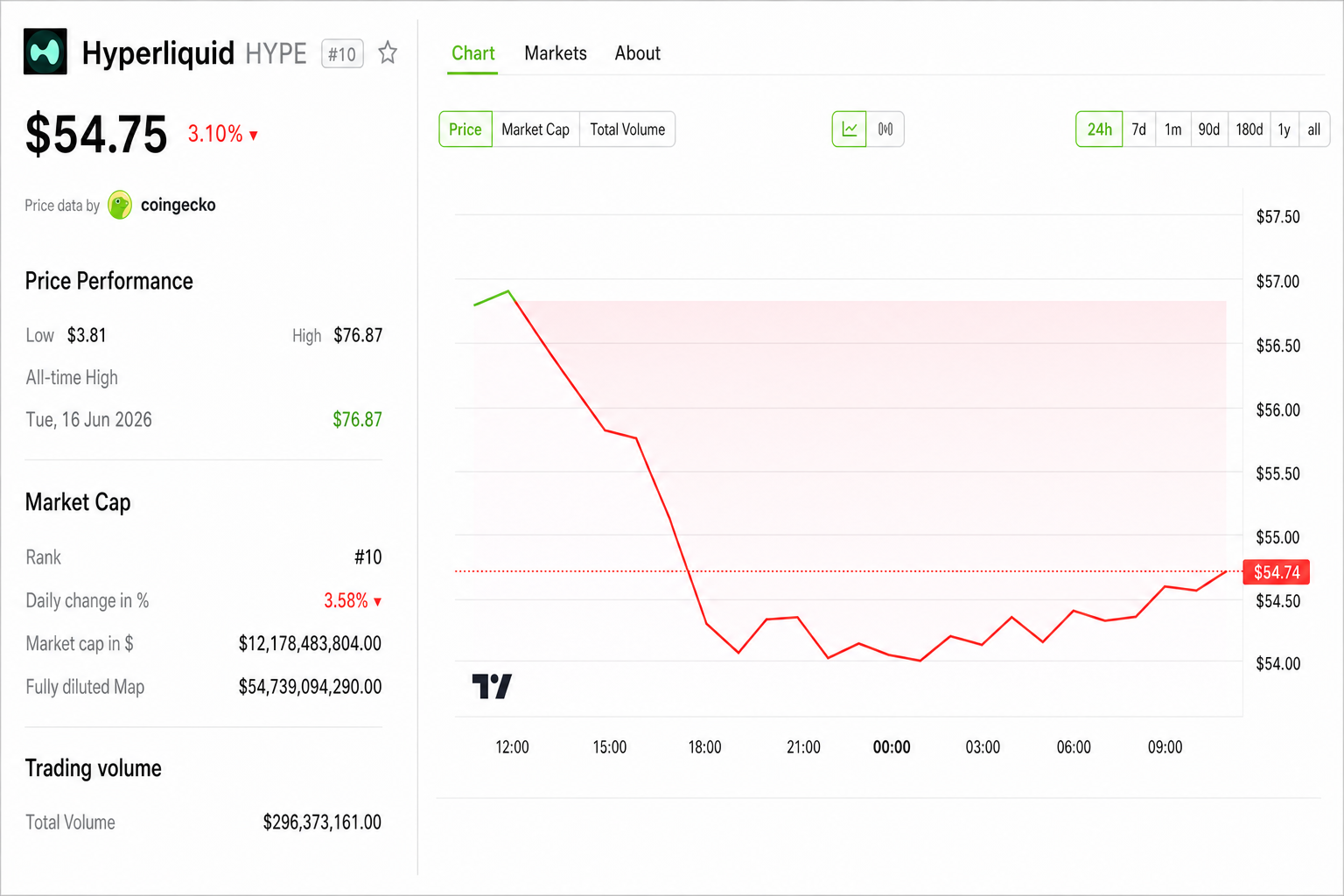
Price dynamics of Hyperliquid ($HYPE).

Why the Market is Looking at Large Crypto Funds Again

The return of inflows to $HYPE coincided with a broader revival in crypto ETFs. For the week from August 3 to 7, the total inflow into the segment approached $1.1 billion.

How Inflows Were Distributed Among Major Crypto Funds

  • Bitcoin: $853.5 million for the current week; the previous week, funds showed an outflow of $61.5 million.
  • Ethereum: $244.9 million for the current week; this is the best result since mid-April.
  • Solana: $145,000 for the current week versus $7.2 million two weeks earlier.
  • XRP: $1 million for the current week after $14.9 million the week before.

Capital Chooses Liquidity and Reduces Risk

This picture shows a concentration of demand. Fresh money primarily went into Bitcoin and Ethereum, while investors increased their positions in less prominent cryptocurrencies more cautiously.

For $HYPE, even a small inflow became an important signal after the most challenging period since the funds' launch. Investors are once again evaluating this digital asset through the lens of price, liquidity, and risk, as well as overall interest in the derivatives market.

The perception of Hyperliquid is also influenced by a broader context. Hyperliquid is associated with a Layer 1 blockchain and infrastructure for derivatives, and $HYPE serves as the digital asset through which investors gain exposure to this direction. The focus remains on:

  • Layer 1 Blockchain.
  • Decentralization.
  • Fees.
  • Contract Infrastructure.
  • Perpetual Futures.
  • The Futures Contract as a Market Instrument.

All of this shapes demand for assets linked to cryptocurrencies when capital returns to riskier market segments.

end-content

Trend Kriptolar

İlgili Sorular

QWhy did Hyperliquid funds see a net inflow after three weeks of outflows?

AThe Hyperliquid funds saw a net inflow of $2.84 million after three weeks of outflows. This reversal coincided with a strong recovery in Bitcoin and Ethereum funds, leading to a broader revival in crypto ETF interest.

QHow much did investors withdraw from Hyperliquid ETFs during the three-week outflow period?

ADuring the three-week outflow period, investors withdrew a total of $30.6 million from the Hyperliquid ETFs.

QAccording to JPMorgan strategist Nikolaos Panigirtzoglou, what was a reason for the cooling interest in Hyperliquid?

AAccording to JPMorgan strategist Nikolaos Panigirtzoglou, the cooling interest in Hyperliquid was linked to increased competition.

QWhat was the total net inflow for Bitcoin and Ethereum funds for the week of August 3-7?

AFor the week of August 3-7, Bitcoin funds had a total net inflow of $853.5 million, and Ethereum funds had a net inflow of $244.9 million, which was their best performance since mid-April.

QWhat are some of the key aspects of the Hyperliquid ecosystem that influence investor perception of its $HYPE token?

AKey aspects of the Hyperliquid ecosystem that influence investor perception of its $HYPE token include its layer-1 blockchain, focus on decentralization, fee structure, contract infrastructure, perpetual futures offerings, and futures contracts as market instruments.

İlgili Okumalar

Upbit is Anxious: A Hasty Counterattack Aimed at Regaining Stablecoin Market Share

Title: Upbit's Rushed Counterattack to Reclaim Stablecoin Market Share Facing a dramatic shift in South Korea's stablecoin market, leading exchange Upbit launched a promotional campaign from July 26 to August 9, waiving the 0.05% trading fee for stablecoins paired with the Korean Won (KRW) and rapidly listing new stablecoins like RLUSD and USDG. This move is a direct response to its plummeting market share in this sector. Historically a duopoly with Bithumb, the market has been reshaped since October 2025 when Coinone permanently removed fees for USDC trading. By June 2026, Coinone led with 34.8% of stablecoin volume, followed by Bithumb (31.1%) and Upbit (30.1%). This contrasts sharply with the overall crypto market, where Upbit commands 60%. The data shows stablecoin demand is highly sensitive to fees, as users primarily buy them to transfer capital overseas for derivatives trading or forex arbitrage. South Korean exchanges have seen a net outflow of stablecoins for 18 consecutive months, totaling approximately 14.9 trillion KRW, underscoring their role as a cross-border capital conduit. Upbit's limited-time promotion initially boosted its daily stablecoin volume by 162%, but the surge was almost entirely in USDT (98.1% of volume). The newly listed stablecoins saw negligible, fleeting interest. Furthermore, the promotional effect quickly waned in the second week, with volume dropping 33% on weekdays. A concurrent weakening of the KRW also contributed to the trading spike, independent of the fee waiver. The analysis suggests that once the promotion ends, Upbit is unlikely to retain its temporary gains unless it matches Coinone's permanent zero-fee policy, forcing a choice between market share and fee revenue. Upbit's strategic push may be less about immediate profit and more about preparing for future regulatory shifts. With South Korea's *Digital Asset Basic Act* on the horizon, which will regulate KRW-backed stablecoins, and following Dunamu's (Upbit's parent) integration into Naver Financial to build a payment ecosystem, securing a dominant position in the dollar stablecoin distribution channel holds long-term strategic value. However, potential regulatory conflicts could prevent Upbit from listing a future Naver-issued KRW stablecoin, making the current fight for dollar stablecoin flow even more critical.

marsbit6 dk önce

Upbit is Anxious: A Hasty Counterattack Aimed at Regaining Stablecoin Market Share

marsbit6 dk önce

Michael Saylor Compares Bitcoin and Gold!

Michael Saylor, founder of MicroStrategy, argues that Bitcoin fundamentally changes how wealth is stored and transferred by transforming digital scarcity into economic value. He describes Bitcoin as the first digital monetary network, combining computers, digital networks, and cryptography. It digitizes monetary assets, allowing their supply to be controlled by public protocols rather than institutions, thus converting economic value into information transmissible over global networks. Comparing Bitcoin to gold, Saylor states that while increasing Bitcoin's supply is harder, its integration with software and transfer is easier. He highlights Bitcoin's proof-of-work mechanism, which ties it to the physical world by consuming real energy to secure the ledger, making past transactions immutable. This creates a shared security system involving miners, energy companies, and investors. Saylor suggests "digital monetary energy" is a more accurate term than "digital gold." He emphasizes that the Bitcoin network is an adaptive ecosystem of miners, nodes, developers, and users. Its core design is intentionally simple, focused on maintaining a secure ledger for scarce digital assets, with complex functionalities built in higher-layer applications. This architecture allows Bitcoin to serve as a foundation for transmitting value and fostering innovation in payments and financial services. Saylor notes Bitcoin's deeper impact lies in creating digital sovereignty, where private keys give individuals permissionless control over their economic power, with ownership verified mathematically, not by institutions. He concludes that while gold's physical scarcity makes it money, Bitcoin's digital scarcity does the same, characterizing Bitcoin as the monetary energy of the digital age.

cryptonews.ru1 saat önce

Michael Saylor Compares Bitcoin and Gold!

cryptonews.ru1 saat önce

İşlemler

Spot

Popüler Makaleler

HYPE Nasıl Satın Alınır

HTX.com’a hoş geldiniz! Hyperliquid (HYPE) satın alma işlemlerini basit ve kullanışlı bir hâle getirdik. Adım adım açıkladığımız rehberimizi takip ederek kripto yolculuğunuza başlayın. 1. Adım: HTX Hesabınızı OluşturunHTX'te ücretsiz bir hesap açmak için e-posta adresinizi veya telefon numaranızı kullanın. Sorunsuzca kaydolun ve tüm özelliklerin kilidini açın. Hesabımı Aç2. Adım: Kripto Satın Al Bölümüne Gidin ve Ödeme Yönteminizi SeçinKredi/Banka Kartı: Visa veya Mastercard'ınızı kullanarak anında Hyperliquid (HYPE) satın alın.Bakiye: Sorunsuz bir şekilde işlem yapmak için HTX hesap bakiyenizdeki fonları kullanın.Üçüncü Taraflar: Kullanımı kolaylaştırmak için Google Pay ve Apple Pay gibi popüler ödeme yöntemlerini ekledik.P2P: HTX'teki diğer kullanıcılarla doğrudan işlem yapın.Borsa Dışı (OTC): Yatırımcılar için kişiye özel hizmetler ve rekabetçi döviz kurları sunuyoruz.3. Adım: Hyperliquid (HYPE) Varlıklarınızı SaklayınHyperliquid (HYPE) satın aldıktan sonra HTX hesabınızda saklayın. Alternatif olarak, blok zinciri transferi yoluyla başka bir yere gönderebilir veya diğer kripto para birimlerini takas etmek için kullanabilirsiniz.4. Adım: Hyperliquid (HYPE) Varlıklarınızla İşlem YapınHTX'in spot piyasasında Hyperliquid (HYPE) ile kolayca işlemler yapın.Hesabınıza erişin, işlem çiftinizi seçin, işlemlerinizi gerçekleştirin ve gerçek zamanlı olarak izleyin. Hem yeni başlayanlar hem de deneyimli yatırımcılar için kullanıcı dostu bir deneyim sunuyoruz.

468 Toplam GörüntülenmeYayınlanma 2024.12.11Güncellenme 2026.06.02

HYPE Nasıl Satın Alınır

Tartışmalar

HTX Topluluğuna hoş geldiniz. Burada, en son platform gelişmeleri hakkında bilgi sahibi olabilir ve profesyonel piyasa görüşlerine erişebilirsiniz. Kullanıcıların HYPE (HYPE) fiyatı hakkındaki görüşleri aşağıda sunulmaktadır.

活动图片