Why $HYPER Keeps Climbing: Investing in Infrastructure

bitcoinist2026-02-09 tarihinde yayınlandı2026-02-09 tarihinde güncellendi

Özet

The current market cycle shows capital shifting from speculative assets to critical infrastructure, particularly Bitcoin Layer 2 solutions. Bitcoin Hyper ($HYPER) is emerging as a key player by integrating Solana Virtual Machine (SVM) with Bitcoin’s security, aiming to solve scalability issues and enable high-speed, low-cost transactions. This architecture supports complex dApps while using Bitcoin as a secure settlement layer. With over $31M raised and significant whale accumulation during its presale, $HYPER reflects strong institutional interest. The project offers high APY staking to encourage long-term holding, positioning itself as infrastructure that enhances Bitcoin’s utility rather than competing with it.

The current market cycle is defined by a distinct rotation: capital is moving from speculative assets into critical infrastructure. While meme coins dominate social media volume, on-chain data reveals that ‘smart money’ is increasingly positioning itself in the rails that will carry the next generation of decentralized finance (DeFi).

Bitcoin remains the undisputed king of crypto, but let’s be honest, its utility has historically been capped by technical limitations. The network is secure, yes, but slow. While the Lightning Network attempted to solve payments, the broader issue of programmability remains. Institutions are watching this gap. Unlocking even 1% of Bitcoin’s dormant capital for decentralized applications represents a trillion-dollar opportunity.

The future isn’t about whether Bitcoin will recover and how high it climbs again. It’s about turning it from a place where Bitcoin isn’t just a store of value, but the settlement layer for a bustling ecosystem of high-speed applications. This structural shift is directing liquidity toward Layer 2 solutions that promise to modernize the network without compromising security.

Bitcoin Hyper ($HYPER) is capitalizing on this demand, effectively merging the speed of Solana with the security of Bitcoin. This makes it one of the best crypto to buy.

Solving The Scalability Trilemma With SVM Integration

The main driver here is the ‘Scalability Trilemma,’ the challenge of achieving speed, security, and decentralization all at once. Most Bitcoin layers sacrifice performance for security. The result? Sluggish user experiences that fail to retain retail users. Bitcoin Hyper addresses this by integrating the Solana Virtual Machine (SVM) directly into a Bitcoin Layer 2 framework.
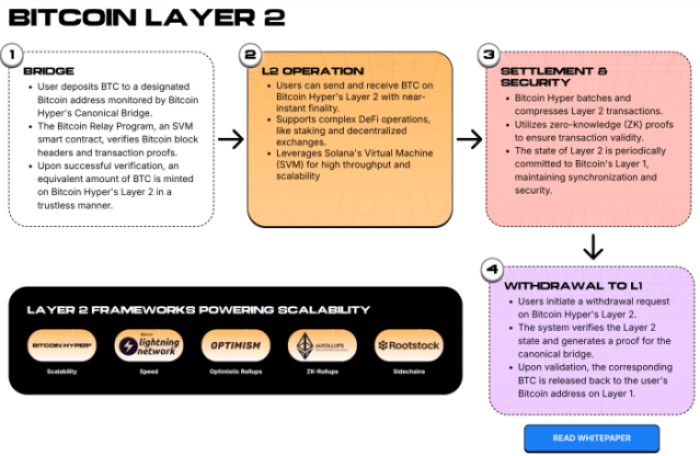
That matters because the SVM is currently the gold standard for high-throughput execution. By using this architecture, Bitcoin Hyper delivers sub-second finality and negligible transaction fees, a stark contrast to the costly execution found on traditional Ethereum-based L2s or the mainnet itself. It’s not just a technical upgrade; it’s a user experience revolution.

It lets developers build complex dApps, such as high-frequency trading platforms and interactive gaming, using Bitcoin’s robust liquidity as the settlement layer.

From a development perspective, this modular approach, using Bitcoin L1 for settlement and a real-time SVM L2 for execution, lowers the barrier to entry. Developers can use Rust to build applications that feel as fast as Solana but settle on the world’s most secure blockchain. Plus, the decentralized Canonical Bridge reduces friction, allowing for seamless $BTC transfers. Want a full project play-by-play? Check out our ‘What is Bitcoin Hyper ($HYPER)?‘ guide.

For investors, the value proposition is clear: infrastructure that eliminates bottlenecks captures value.

EXPLORE THE $HYPER ECOSYSTEM

Smart Money Flows Favor Early-Stage Infrastructure

Technical architecture provides the thesis, but on-chain flows provide the timing. Traders often look for divergences between price action and capital accumulation. In the case of Bitcoin Hyper ($HYPER), the funding data indicates significant demand for this infrastructure-focused approach.

$HYPER has already raised over $31M. That figure underscores strong conviction from early backers. With tokens currently priced at $0.0136753, the entry point reflects an early valuation relative to established Layer 2 competitors like Stacks. The sheer volume suggests the market is validating the ‘SVM on Bitcoin’ thesis before the mainnet is fully saturated.

Crucially, high-net-worth individuals are already taking positions. Smart money is moving. Etherscan data shows that during the presale, whales have bought up over $1M, with the largest purchase totalling $500K. Whale accumulation during a presale phase is a notable signal; it implies that sophisticated actors are locking in supply, anticipating a supply shock post-TGE.

Plus, the protocol’s decision to offer high APY staking immediately after the Token Generation Event (TGE), with a short 7-day vesting period for presale stakers, incentivizes long-term holding over short-term flipping.

$HYPER isn’t competing with $BTC; it’s lifting it up to what it can be, maximizing its potential.

BUY YOUR $HYPER FROM THE OFFICIAL PRESALE PAGE

The content provided in this article is for informational purposes only and does not constitute financial advice. Cryptocurrency markets are volatile, and presale investments carry inherent risks. Always perform your own due diligence before investing.


İlgili Sorular

QWhat is the main reason capital is moving from speculative assets to infrastructure according to the article?

AThe main reason is that 'smart money' is increasingly positioning itself in the infrastructure that will carry the next generation of decentralized finance (DeFi), seeing a trillion-dollar opportunity in unlocking Bitcoin's dormant capital.

QHow does Bitcoin Hyper ($HYPER) aim to solve the Scalability Trilemma?

ABitcoin Hyper addresses the Scalability Trilemma by integrating the Solana Virtual Machine (SVM) into a Bitcoin Layer 2 framework, achieving high speed, security, and decentralization simultaneously.

QWhat key advantage does the Solana Virtual Machine (SVM) provide to the Bitcoin Hyper network?

AThe SVM provides the advantage of high-throughput execution, enabling Bitcoin Hyper to deliver sub-second finality and negligible transaction fees.

QWhat on-chain data is provided as evidence of significant demand for the $HYPER token?

AThe article cites that $HYPER has raised over $31M, with Etherscan data showing whales bought over $1M during the presale, including a single purchase of $500K.

QWhat is the value proposition of $HYPER for investors, as stated in the article?

AThe value proposition for investors is that infrastructure which eliminates bottlenecks in the blockchain ecosystem captures value, and $HYPER provides this by modernizing Bitcoin's network without compromising security.

İlgili Okumalar

Dalio Warns: AI Boom Shows Signs of a Bubble, Day of Reckoning Will Be the Time of Burst

Ray Dalio, founder of Bridgewater Associates, warns that the current artificial intelligence investment boom shows classic signs of a bubble, which he expects will eventually burst. In a Bloomberg Television interview, he noted that great technological revolutions often lead to capital inflows that create bubbles, making it difficult for investors and companies to calibrate their spending accurately—either overspending to capture market share or underspending and losing their competitive position. This caution comes amid significant rallies in AI-related assets, particularly chipmakers, driven by soaring demand for data centers and high-bandwidth chips, raising debates about overheating valuations. In contrast, Nvidia CEO Jensen Huang recently asserted that investors embracing the AI wave would see "crazy" returns and dismissed concerns over return on investment for data center spending as outdated. Dalio, however, focuses on the risks in the profit realization phase. He argues that bubbles tend to show signs of破裂 when markets transition from investment to the need for tangible returns, describing the burst as a process of converting paper wealth into cash. While acknowledging AI's intrinsic value, he expressed concern over the future profitability of some AI companies, suggesting the market is repeating a familiar pattern. The 76-year-old billionaire, who fully exited Bridgewater in 2025, has a net worth estimated at $21.5 billion according to the Bloomberg Billionaires Index.

marsbit9 dk önce

Dalio Warns: AI Boom Shows Signs of a Bubble, Day of Reckoning Will Be the Time of Burst

marsbit9 dk önce

Privacy Coin Crisis of Confidence! ZEC Plunges Over 56% in a Single Day

Zcash (ZEC), a leading privacy-focused cryptocurrency, experienced a severe crash on June 5th, plummeting over 56% in a single day and erasing nearly two months of gains. The flash crash was triggered by the disclosure of a critical zero-knowledge proof vulnerability within Zcash's Orchard privacy pool, which had existed since the pool's launch in May 2022. The flaw theoretically allowed an attacker to forge unlimited ZEC undetectably due to the pool's privacy features. The vulnerability was discovered on May 29th by independent security researcher Taylor Hornby during a proactive audit commissioned by Shielded Labs, utilizing AI-assisted analysis. The Zcash development team responded swiftly, implementing an emergency soft fork to disable Orchard transactions on June 2nd and executing a permanent hard fork fix (NU6.2) on June 3rd. Despite the technical fix, a major crisis of confidence emerged. The core issue is that Orchard's privacy design makes it cryptographically impossible to prove whether the vulnerability was exploited over the past four years, casting permanent doubt on the historical supply integrity of ZEC. While Shielded Labs argues exploitation was unlikely, the inability to provide definitive proof has severely damaged market trust. This sentiment was exacerbated when BitMEX co-founder Arthur Hayes, a prominent ZEC supporter, announced he was selling his entire position. He stated that privacy assets require "perfect security" rather than "probable safety." The combined effect of the disclosure and Hayes's exit ignited widespread panic selling, leading to massive liquidations and significant price decline. Analysts note the event highlights a fundamental tension within privacy coins: the conflict between verifiable supply and cryptographic privacy.

链捕手12 dk önce

Privacy Coin Crisis of Confidence! ZEC Plunges Over 56% in a Single Day

链捕手12 dk önce

İşlemler

Spot
Futures
活动图片




