Why Does $1 Earn More in Banks? Analyzing the Structural Dilemma of DeFi Lending

marsbit2025-12-17 tarihinde yayınlandı2025-12-17 tarihinde güncellendi

Özet

Silvio's analysis explores why $1 in a bank deposit generates 10x more profit than the same amount of USDC on Aave, arguing this reflects structural differences rather than inherent limitations in DeFi lending. Currently, most borrowing on Aave is driven by crypto-native strategies like staking ETH to borrow WETH for basis trades (45% of loans), yield farming with volatile collateral, or leveraging stablecoins for arbitrage. These uses are tightly coupled with crypto market cycles and yield opportunities, making DeFi lending highly correlated with "crypto GDP." In contrast, banks benefit from lower funding costs (tied to Fed rates), complex risk transformation (e.g., unsecured corporate loans), and oligopolistic advantages. For DeFi lending to mature, it must decouple from crypto volatility by incorporating new collateral types like tokenized real-world assets (RWA), off-chain credit, and crypto-native underwriting. This shift could align DeFi closer to traditional credit markets, potentially unlocking higher margins and more stable valuations by 2026.

Author: Silvio

Compiled by: Saoirse, Foresight News

A $1 deposit in a bank generates 10 times more profit for the bank than the same amount of USDC on Aave. This phenomenon may seem unfavorable for the DeFi lending sector, but in reality, it reflects the structural characteristics of the current cryptocurrency market more than the long-term potential of on-chain credit.
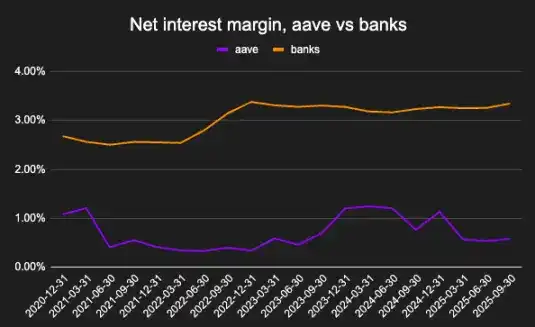
Net interest margin is an indicator of deposit profitability. Banks under FIDC, Aave under Blockworks.

This article will explore the following issues: the actual usage patterns of current lending protocols, the structural reasons for their lower profit margins compared to banks, and how this situation might change as lending activities gradually decouple from crypto-native leverage cycles.

The Role of On-Chain Credit

My first job involved analyzing bank books and assessing borrower qualifications. Banks channel credit funds to real businesses, and their profit margins are directly linked to the macroeconomy. Similarly, analyzing the borrowers of decentralized finance protocols helps in understanding the role credit plays in the on-chain economy.
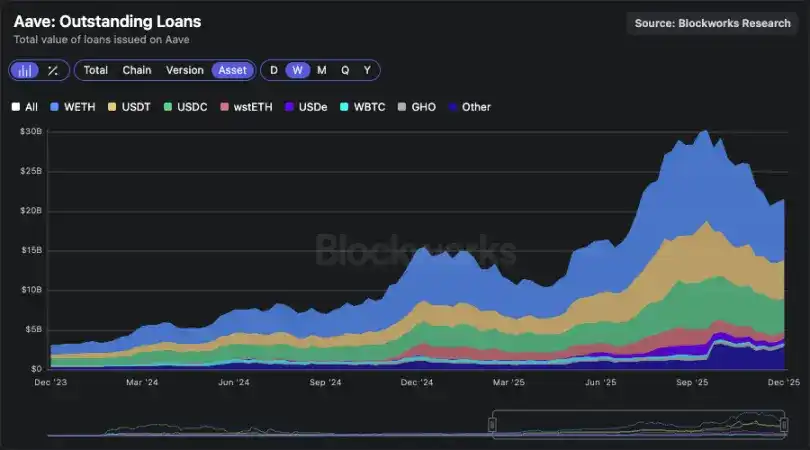
Chart of Aave's outstanding loan data

Aave's outstanding loan amount has exceeded $20 billion, an impressive achievement — but why do people borrow on-chain?

Actual Uses of Aave Borrowers

Borrower strategies can be categorized into four types:

1. Borrowing WETH using interest-bearing ETH as collateral: The yield from staking ETH is typically higher than that of WETH, creating a structural basis trade (essentially "borrowing WETH while earning yield"). Currently, this type of trade accounts for 45% of the total outstanding loans, with most of the funds coming from a few "whales." These wallet accounts are often related to staked ETH issuers (such as the EtherFi platform) and other "recursive stakers." The risk of this strategy is that the WETH borrowing cost may spike, which could quickly cause the collateral health factor to fall below the liquidation threshold.
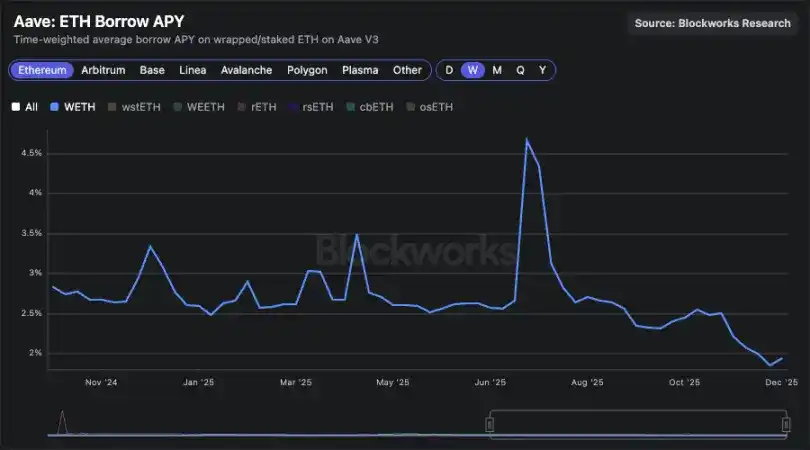
Presumed WETH borrowing rate chart: If the rate remains below 2.5%, the basis trade is profitable.

2. Stablecoin and PT recursive stakers: A similar basis trade can be formed with interest-bearing assets (such as USDe), where the yield may be higher than the borrowing cost of USDC. Before October 11, this strategy was very popular. Although structurally attractive, this strategy is highly sensitive to changes in funding rates and protocol incentive policies — which explains why the scale of such trades shrinks rapidly when market conditions change.

3. Volatile collateral + stablecoin debt: This is the most popular strategy among users, suitable for two types of demand: one is to increase exposure to cryptocurrencies through leverage, and the other is to reinvest borrowed stablecoins into high-yield "liquidity mining" for basis trading. This strategy is directly related to mining yield opportunities and is also the main source of stablecoin borrowing demand.

4. Other remaining types: Including "stable collateral + volatile debt" (for shorting assets) and "volatile collateral + volatile debt" (for currency pair trading).
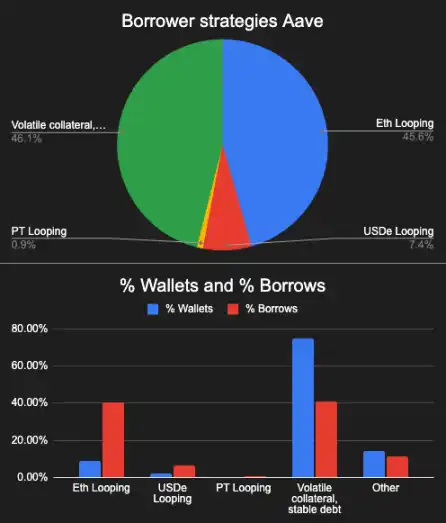
1) Weight distribution of Aave wallet borrowing strategies; 2) Distribution of wallets corresponding to each strategy
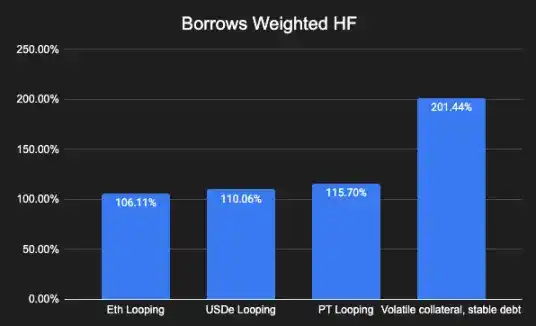
Chart of collateral health factor weighted by borrowing amount

For each of these strategies, there is a value chain composed of multiple protocols: these protocols integrate the trading process using Aave and distribute yields to retail users. Today, this integration capability is the core competitive barrier in the cryptocurrency lending market.

Among these, the "volatile collateral + stablecoin debt" strategy contributes the most to interest income (borrowing revenue from USDC and USDT accounts for over 50% of total revenue).
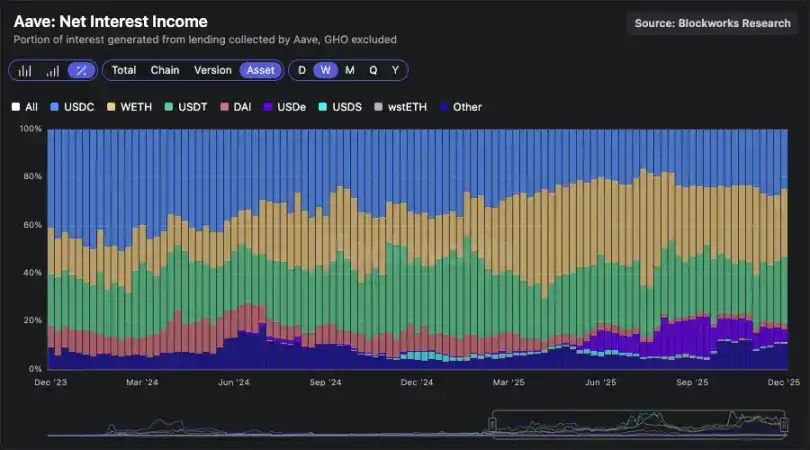
Chart of interest income share by asset type

Although some businesses or individuals do use cryptocurrency loans to finance operational activities or real-life expenses, the scale of such practical uses is very limited compared to the purpose of "leveraging on-chain leverage/yield differential arbitrage."

Three core factors driving the growth of lending protocols:

  1. On-chain yield opportunities: Such as new project launches, liquidity mining (e.g., Plasma platform mining activities);
  2. Structural basis trades with deep liquidity: Such as ETH/wstETH trading pairs and stablecoin-related trades;
  3. Partnerships with major issuers: These partnerships can help open up new markets (e.g., the combination of pyUSD stablecoin and RWA).

The lending market is mechanistically directly linked to "crypto GDP" (exhibiting Beta correlation), just as banks are essentially barometers of "real-world GDP." When cryptocurrency prices rise, yield opportunities increase, the scale of interest-bearing stablecoins expands, and issuers adopt more aggressive strategies — ultimately driving lending protocol revenue growth, increased token buybacks, and pushing up the price of Aave tokens.
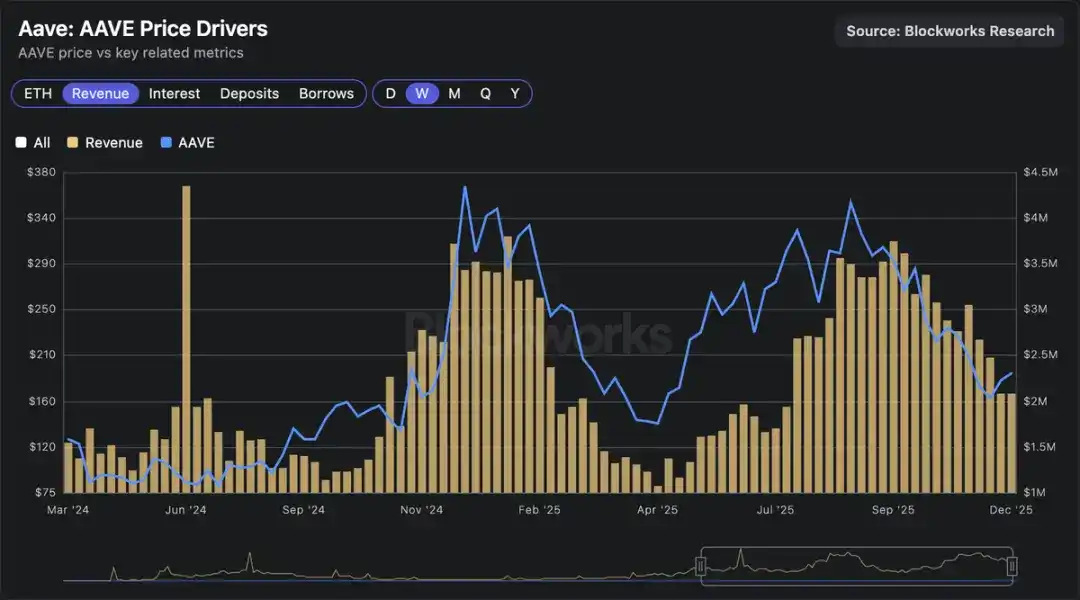
Chart of correlation between lending market valuation and revenue: Lending market valuation is directly correlated with revenue.

Comparison Between Banks and On-Chain Lending Markets

As mentioned earlier, $1 in a bank is 10 times more efficient in generating profit than $1 of USDC on Aave. Some see this as a bearish signal for on-chain lending, but in my view, this is essentially an inevitable result of market structure, for three reasons:

  1. Higher financing costs in the crypto space: Banks' financing costs are benchmarked against the Federal Reserve's base rate (lower than Treasury yields), while the deposit rate for USDC on Aave is typically slightly higher than Treasury yields;
  2. Traditional commercial banks engage in more complex risk transformation activities and deserve higher premiums: Large banks manage billions of dollars in unsecured loans to businesses (e.g., financing data center construction). This risk management is far more difficult than "managing the collateral value of ETH recursive staking" and therefore deserves higher returns;
  3. Regulatory environment and market dominance: The banking industry is an oligopoly, with high user switching costs and industry entry barriers.

Decoupling Lending from Cryptocurrency's "Cycle Binding"

Those successful cryptocurrency sectors are gradually decoupling from the boom-bust cycles of the crypto market itself. For example, the open interest of prediction markets continues to grow even amid price fluctuations; the same is true for stablecoin supply, whose volatility is much lower than other assets in the crypto market.

To move closer to the operational model of the broader credit market, lending protocols are gradually incorporating new risk types and collateral, such as:

  • Tokenized RWA and stocks;
  • On-chain credit originating from off-chain institutions;
  • Using stocks or real-world assets as collateral;
  • Structured underwriting through crypto-native credit scoring.

Asset tokenization creates the conditions for lending businesses to become the "natural endpoint" in the crypto space. When credit activities decouple from price cycles, their profit margins and valuations will also break free from cyclical constraints. I expect this transformation to begin manifesting in 2026.


İlgili Sorular

QWhy does $1 in a bank generate 10 times more profit than $1 in USDC on Aave?

AThis is due to structural factors in the crypto market: higher funding costs in crypto, the complexity and risk management of traditional banking activities which command higher premiums, and the oligopolistic nature of banking with high barriers to entry and switching costs.

QWhat are the four main strategies used by borrowers on Aave according to the article?

AThe four strategies are: 1) Borrowing WETH against staked ETH for a structural basis trade. 2) Stablecoin and PT restaking for similar basis trades. 3) Using volatile collateral to borrow stablecoins for leverage or yield farming. 4) Other types including stable collateral with volatile debt (for shorting) and volatile collateral with volatile debt (for pair trading).

QWhat is the growth of the lending market on Aave primarily tied to?

AIts growth is tied to three core factors: 1) On-chain yield opportunities like new project launches and liquidity mining. 2) Deeply liquid structural basis trades such as ETH/wstETH. 3) Partnerships with large issuers to access new markets, like integrating pyUSD with RWA.

QHow does the article suggest lending protocols can decouple from the crypto market's price cycles?

ABy incorporating new risk types and collateral, such as tokenized RWAs and stocks, on-chain credit from off-chain institutions, using stocks or real-world assets as collateral, and implementing crypto-native credit scoring for structured underwriting.

QWhat role does asset tokenization play in the future of DeFi lending according to the author?

AAsset tokenization creates the conditions for lending to become a 'natural endpoint' in crypto by allowing the business to decouple from price cycles. This is expected to allow its profit margins and valuations to break free from cyclical constraints, a shift anticipated to begin in 2026.

İlgili Okumalar

Blockchain Capital Partner: Most People Have a Narrow Understanding of the On-Chain Economy

Author Spencer Bogart, a partner at Blockchain Capital, argues that most people have a narrow view of the on-chain economy, seeing it primarily as a faster, cheaper version of existing financial systems. While this represents a significant opportunity, he believes it's only a small part of the story. Bogart compares the current state of crypto to the early internet, where email was the obvious "faster mail" application. The truly transformative categories—like search, social media, and cloud computing—were entirely new and unimaginable beforehand. Similarly, the most profound innovations in crypto will not be incremental improvements but entirely new categories enabled by the core properties of public blockchains: atomic execution, shared global state, programmable custody, and composability. He cites the "flash loan" as a prime example of a "new verb"—a financial action structurally impossible before programmable assets and atomic settlement. It allows for uncollateralized, trustless borrowing of any size, provided repayment occurs within the same transaction, enabling novel strategies like arbitrage and collateral swaps. Bogart admits the difficulty in precisely predicting these future innovations, as human imagination tends to extrapolate from the past. He posits that the most exciting applications in ten years will be things that don't exist today and have no precedent—products only possible in a global, composable, always-on environment with programmable assets. While the exploration of this vast design space will involve many failures, the potential for transformative, category-defining breakthroughs is what makes the next decade so promising.

链捕手22 dk önce

Blockchain Capital Partner: Most People Have a Narrow Understanding of the On-Chain Economy

链捕手22 dk önce

Cloud PC Gets a Second Chance, Google/Alibaba/Microsoft Battle for Cloud AI Dominance

Google unexpectedly announced "Android Computer," a new high-end productivity-focused PC series, positioning cloud AI as its core rather than an add-on. This move signals a potential revival for the "cloud computer" concept in the AI era. The article argues that current "AI PCs" are essentially traditional Windows machines with AI features grafted on, heavily reliant on cloud AI for complex tasks due to limited local consumer-grade hardware capabilities. This reliance raises questions about the value of premium local AI hardware. Cloud computers, which struggled with latency-sensitive applications like cloud gaming, are seen as a natural fit for AI PCs due to AI's higher tolerance for response time. Google's Android Computer deeply integrates AI (powered by its Gemini model) into the OS interface, making it contextually available. Its hardware-agnostic approach (supporting both x86 and ARM chips) further underscores the shift towards cloud-centric AI. Other players are adapting: Cloud service providers like Alibaba are enhancing their AI cloud computer offerings; chipmakers (Intel, AMD) are focusing on data center AI chips; traditional PC brands are adding AI software layers; and Apple is leveraging its ecosystem and affordable hardware. Microsoft is defining AI PC standards, embedding Copilot (powered by GPT and Bing) into Windows, and also relying on cloud AI. In conclusion, Android Computer challenges the traditional PC form factor by proposing a "light local, heavy cloud" model. This approach appears promising amid rising hardware costs and local compute bottlenecks. The future PC market will involve a multifaceted competition around cloud integration, OS-level AI, and cross-device ecosystems, potentially redefining the PC as a screen and network conduit to cloud-based AI productivity.

marsbit43 dk önce

Cloud PC Gets a Second Chance, Google/Alibaba/Microsoft Battle for Cloud AI Dominance

marsbit43 dk önce

Encrypted ETF Weekly Report | Last Week, US Bitcoin Spot ETF Net Outflow $9.95 Billion; US Ethereum Spot ETF Net Outflow $255 Million

Last week, U.S. Bitcoin spot ETFs saw significant net outflows totaling $995 million over three days, with a major contribution of $317 million from BlackRock's IBIT. Their total net asset value (NAV) stands at $104.2 billion. U.S. Ethereum spot ETFs also experienced net outflows of $255 million over five days, largely from BlackRock's ETHA ($186 million out), bringing their total NAV to $12.93 billion. In Hong Kong, Bitcoin spot ETFs recorded a net outflow of 24.91 BTC, reducing their NAV to $323 million. Hong Kong's Ethereum spot ETFs saw no inflows, with an NAV of $68.13 million. U.S. Bitcoin spot ETF options showed increased activity, with a total nominal trading volume of $797 million and a put/call trading ratio of 1.63, indicating a bullish market sentiment. The total open interest reached $23.08 billion. Key developments include VanEck and Grayscale simultaneously filing amended proposals for BNB ETFs, signaling potential SEC review progress. Grayscale also filed for the first U.S. privacy coin ETF (Zcash). Avenir Group remains Asia's largest institutional holder of Bitcoin ETFs. 21Shares launched an actively managed crypto ETF (TKNS), and Bitwise's Hyperliquid ETF (BHYP) is set to list on the NYSE. Institutional activity varied: JPMorgan dramatically increased its Bitcoin ETF holdings (IBIT up 174%), while Jane Street significantly reduced its exposure (IBIT down 71%). Dartmouth College disclosed holdings of $7.7M in Bitcoin ETF and $3.4M in a Solana ETF.

链捕手47 dk önce

Encrypted ETF Weekly Report | Last Week, US Bitcoin Spot ETF Net Outflow $9.95 Billion; US Ethereum Spot ETF Net Outflow $255 Million

链捕手47 dk önce

İşlemler

Spot
Futures
活动图片