Why Do Bitcoin and Ethereum Fall But Not Rise?

marsbit2026-01-30 tarihinde yayınlandı2026-01-30 tarihinde güncellendi

Özet

This article analyzes why Bitcoin (BTC) and Ethereum (ETH) have underperformed other risk assets like stocks and commodities recently, despite a generally bullish macro environment. The core argument is that the underperformance is not primarily a macro issue, but a result of the crypto market's own structural dynamics and its ongoing deleveraging cycle. Key reasons identified include: - The crypto market is in the late stages of a deleveraging process, which began with a sharp sell-off in October, wiping out highly-leveraged speculative capital (especially from retail traders) and making the market fragile and risk-averse. - A significant amount of retail capital has been diverted to other booming assets like AI-related stocks and precious metals, which are experiencing their own FOMO-driven rallies. - Crypto markets remain structurally isolated from traditional finance (TradFi), with barriers to capital flow between them. - The market is still dominated by retail traders and passive funds (like ETFs), making it susceptible to emotional narratives, market micro-structure manipulation, and high volatility amplified by the use of high leverage (10x-20x) by散户. This creates an environment where concentrated selling in low-liquidity hours can trigger cascading liquidations. - The author draws historical parallels to the deleveraging of China's A-share market in 2015 and compares ETH's current price action to Tesla's in 2024, suggesting both are in a prolonged consolidation phase...

Editor's Note: Against the backdrop of rising multiple asset classes, the periodic stagnation of BTC and ETH is often simplistically attributed to their 'risk asset attributes'. This article argues that the core of the issue lies not in macro factors, but in the crypto market's own deleveraging phase and market structure.

As deleveraging nears its end and trading activity falls to low levels, existing capital struggles to counter short-term volatility amplified by highly leveraged retail investors, passive funds, and speculative trading. Before new capital inflows and FOMO sentiment return, the market is more sensitive to negative narratives, which is a structural outcome.

Historical analogies suggest this performance is more likely a phase of adjustment within a long-term cycle rather than a failure of fundamentals. This article attempts to move beyond short-term price movements, starting from cycles and structure, to re-understand the current position of BTC and ETH.

The following is the original text:

Bitcoin (BTC) and Ethereum (ETH) have recently significantly underperformed other risk assets.


We believe the main reasons for this phenomenon include: the stage of the trading cycle, market microstructure, and market manipulation by certain exchanges, market makers, or speculative funds.

Market Background

Firstly, the deleveraging-driven decline that began last October has dealt a heavy blow to highly leveraged participants, especially retail traders. A large amount of speculative capital has been washed out, leaving the overall market fragile and risk-averse.

At the same time, AI-related stocks in China, Japan, South Korea, and the US experienced extremely aggressive rallies; the precious metals market also saw a meme-like surge driven by FOMO (Fear Of Missing Out) sentiment. The rise of these assets absorbed a significant amount of retail capital—a point that is particularly crucial, as retail investors in Asia and the US remain the primary trading force in the crypto market.

Another structural issue is that crypto assets have not yet been truly integrated into the traditional financial system. In TradFi, commodities, stocks, and forex can be traded within a single account, with almost no friction for asset allocation shifts; however, in reality, moving funds from TradFi to crypto still faces multiple hurdles—regulatory, operational, and psychological.

Furthermore, the proportion of professional institutional investors in the crypto market remains limited. Most participants are not professional investors, lack independent analytical frameworks, and are easily influenced by speculative capital or exchanges that also act as market makers, thus being led by emotion and narrative. Narratives such as the 'four-year cycle' or 'Santa Claus rally' are repeatedly emphasized, despite lacking rigorous logic or solid data support.

Overly linear thinking is prevalent in the market, for instance, directly attributing BTC's price fluctuations to a single event like the JPY appreciation in July 2024, without deeper analysis. Such narratives are often quickly disseminated and have a direct impact on prices.

Next, we will move away from short-term narratives and analyze this issue from an independent thinking perspective.

Time Dimension is Crucial

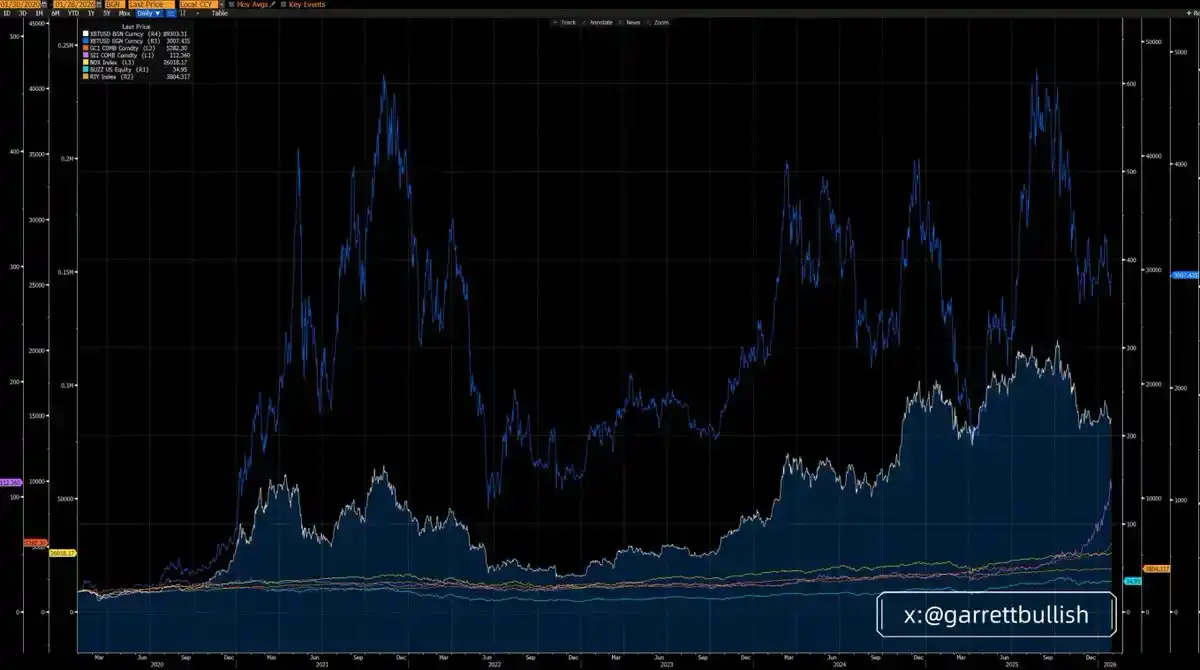
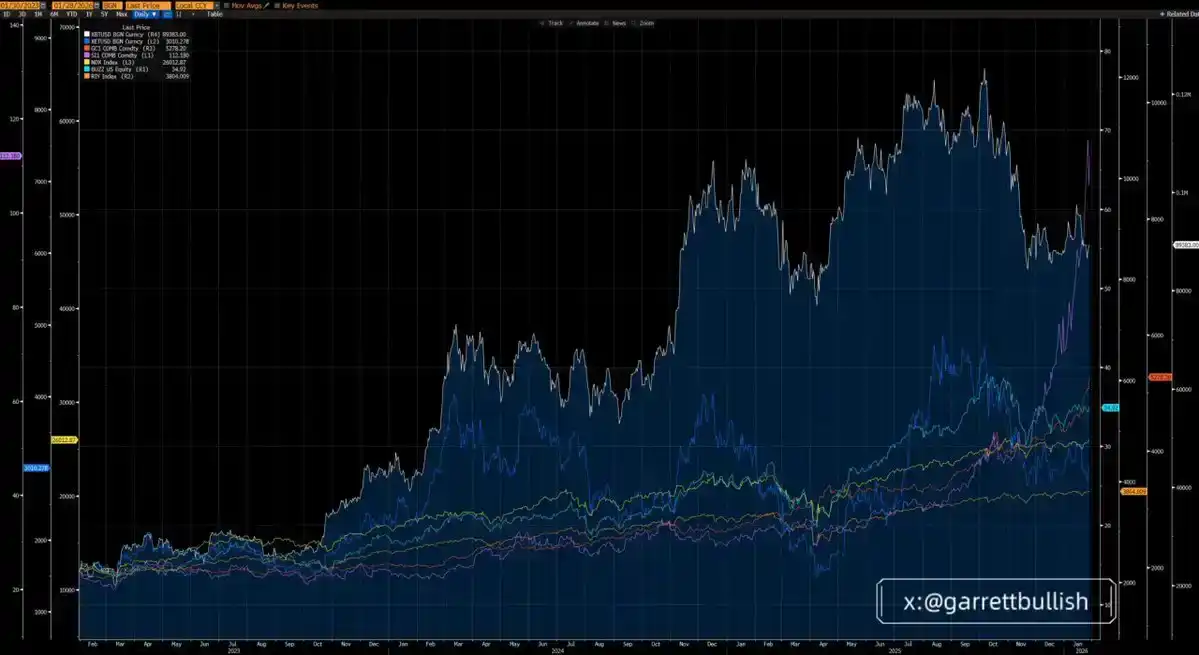
If viewed from a three-year cycle, BTC and ETH have indeed underperformed most major assets, with ETH being the weakest.

However, if extended to a six-year cycle (since March 12, 2020), the performance of BTC and ETH is significantly better than most assets, and ETH actually becomes the top performer.

From a longer time dimension and placed within a macro context, the current so-called 'short-term underperformance' is essentially a process of mean reversion within a longer historical cycle.

Ignoring the underlying logic and focusing only on short-term price fluctuations is one of the most common, and fatal, errors in investment analysis.

Rotation is a Normal Phenomenon

Before the short squeeze in silver prices last October, silver was also one of the worst-performing risk assets; yet now, on a three-year cycle dimension, silver has become the top-performing asset.

This change is highly similar to the current situation of BTC and ETH. Although they are underperforming in the short term, they remain among the most advantageous asset classes on a six-year cycle dimension.

As long as BTC's narrative as 'digital gold' and a store of value is not fundamentally disproven, as long as ETH continues to integrate with the AI wave and exists as core infrastructure in the RWA (Real World Assets) trend, there is no rational basis to believe they will consistently underperform other assets in the long run.

Emphasizing again: ignoring fundamentals and cherry-picking short-term price movements to draw conclusions is a serious analytical error.
Market Structure and Deleveraging

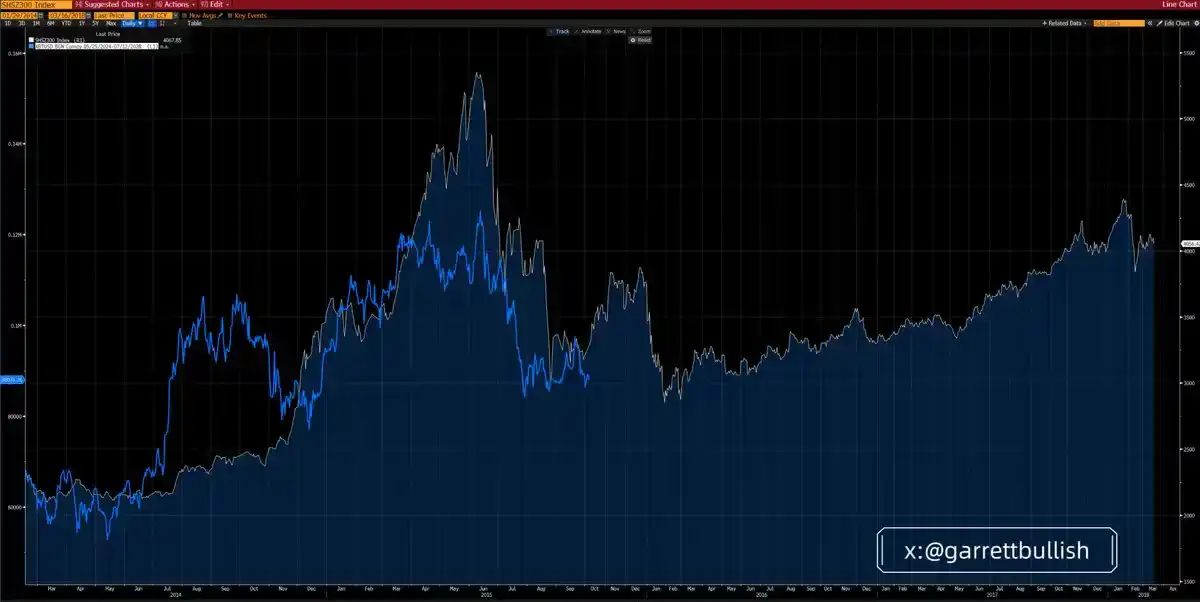
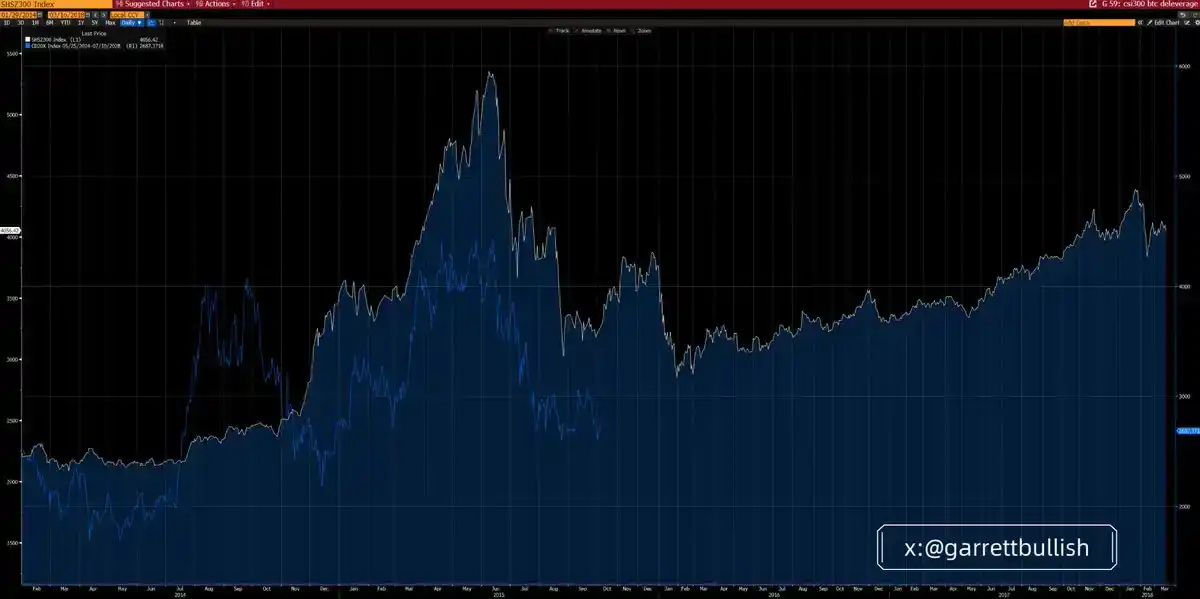
The current crypto market shows a striking similarity to the environment of China's A-share market in 2015 after a leverage-driven rally entered a deleveraging phase.

In June 2015, after a leverage-driven bull market stalled and the valuation bubble burst, the A-share market entered an A–B–C three-wave decline structure conforming to Elliott Wave Theory. After the C-wave bottomed, the market experienced months of sideways consolidation before gradually transitioning into a multi-year bull market.

The core drivers of that long-term bull market came from low valuations of blue-chip assets, improved macro policy environment, and significant monetary easing.

Bitcoin (BTC) and the CD20 index have almost completely replicated this 'leverage up - deleverage' evolution path in the current cycle, showing high consistency in both timing and structural form.

The underlying similarities are very clear: both market environments feature high leverage, extreme volatility, tops driven by valuation bubbles and herd behavior, repeated deleveraging shocks, a long and slow decline process, continuously falling volatility, and futures markets in a long-term contango structure.

In the current market, this contango structure is reflected in the discount of share prices of DAT (Digital Asset Treasury) related listed companies (like MSTR, BMNR) relative to their mNAV (adjusted Net Asset Value).

Meanwhile, the macro environment is gradually improving. Regulatory certainty is increasing, for example, through the ongoing promotion of legislation like the 'Clarity Act'; the US SEC and CFTC are also actively promoting the development of on-chain US equities trading.

Monetary conditions are also easing: rate cut expectations are heating up, quantitative tightening (QT) is nearing its end, repo market liquidity continues to be injected, and expectations of a more dovish stance from the next Fed chair are collectively improving the overall liquidity environment.
ETH and Tesla: An Informative Analogy

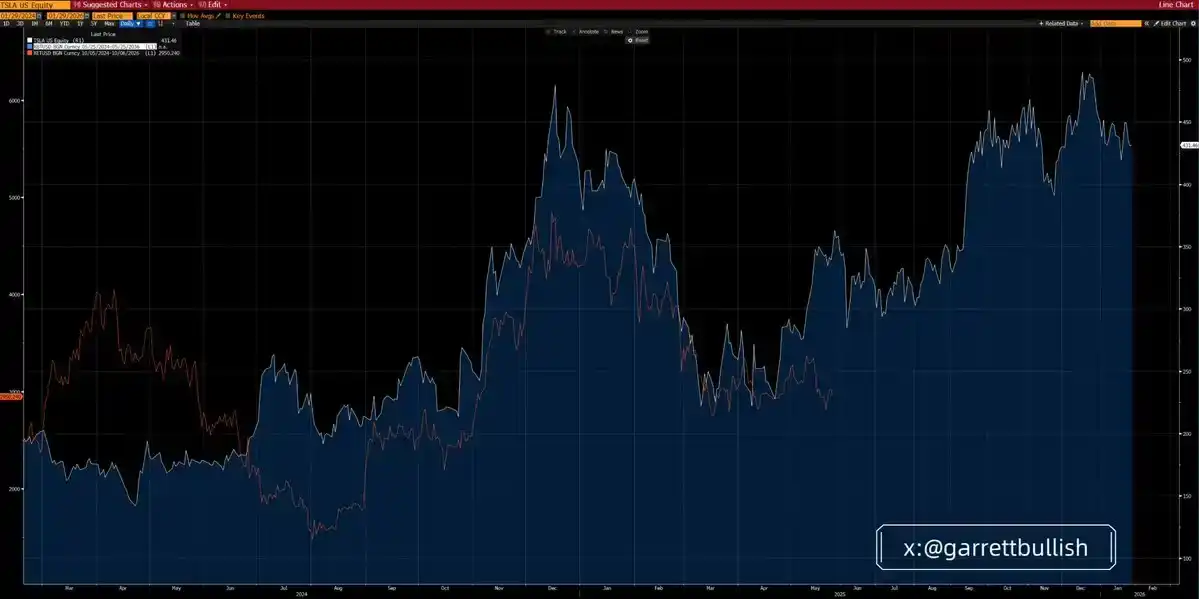
ETH's recent price action is highly similar to Tesla's (TSLA) performance in 2024.

At that time, Tesla's stock price first formed a head and shoulders bottom structure, then rebounded, consolidated sideways, surged again, entered a longer topping phase, fell rapidly, and then experienced a prolonged sideways consolidation at low levels.

It wasn't until May 2025 that Tesla finally broke out upwards, officially starting a new bull market. Its upward momentum came mainly from sales growth in the Chinese market, increased probability of Trump's election, and the commercialization of political networks.

From the current stage, ETH shows high similarity to Tesla at that time, both in technical patterns and fundamental background.

The underlying logic is also comparable: both carry technological narratives and meme attributes, attracted large amounts of highly leveraged capital, experienced violent fluctuations, peaked in valuation bubbles driven by herd behavior, and then entered an adjustment cycle of repeated deleveraging.

Over time, market volatility has gradually decreased, while fundamentals and the macro environment continue to improve.
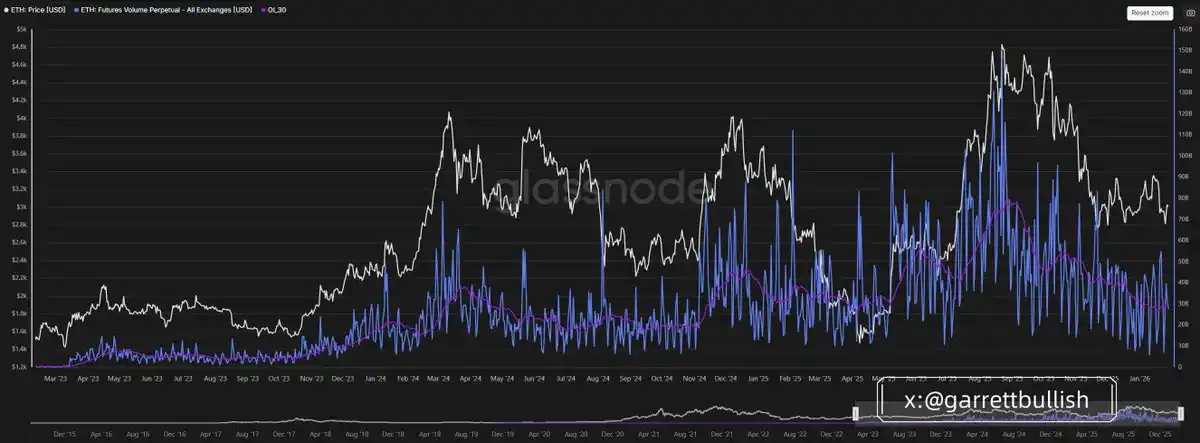
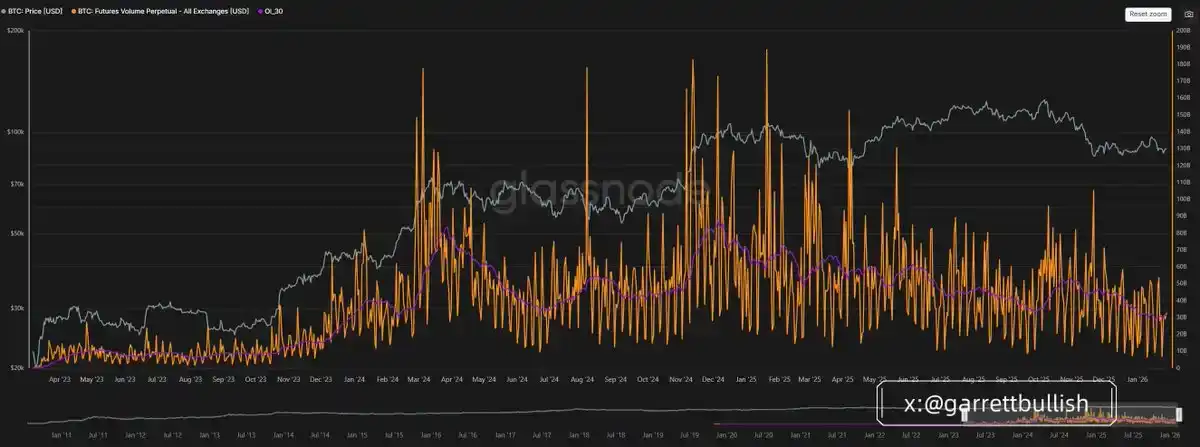
Looking at futures trading volume, market activity for BTC and ETH has neared historical lows, indicating the deleveraging process is approaching its end.

Are BTC and ETH 'Risk Assets'?

Recently, a rather strange narrative has emerged in the market: simply defining BTC and ETH as 'risk assets' and using this to explain why they haven't followed the rise of US stocks, A-shares, precious metals, or base metals.

By definition, risk assets typically feature high volatility and high beta. From both behavioral finance and quantitative statistical perspectives, US equities, A-shares, base metals, BTC, and ETH all meet this standard and often benefit in 'risk-on' environments.

But BTC and ETH possess additional attributes. Due to the DeFi ecosystem and on-chain settlement mechanisms, they also exhibit safe-haven characteristics similar to precious metals in specific situations, especially when geopolitical pressures rise.

Labeling BTC and ETH simply as 'pure risk assets' and asserting they cannot benefit from macro expansion based on this is essentially a narrative that selectively emphasizes negative factors.

Frequently cited examples include:

Potential EU-US tariff conflicts triggered by the Greenland issue

Canada-US tariff disputes

And potential military conflict between the US and Iran

This line of argument is essentially 'cherry-picking' and applying a double standard.

Theoretically, if these risks were truly systemic, then all risk assets should fall in sync, except perhaps base metals which might benefit from war demand. But the reality is that these risks lack the foundation to escalate into major systemic shocks.

AI and high-tech related demand remains extremely strong and is largely unaffected by geopolitical noise, especially in core economies like China and the US. Therefore, the stock market has not priced these risks substantively.

More importantly, most of these concerns have been downgraded or factually disproven. This leads to a key question: Why are BTC and ETH exceptionally sensitive to negative narratives, yet slow to react to positive developments or the subsidence of negative factors?

The Real Reasons

We believe the reasons lie primarily in the structural problems of the crypto market itself. The current market is at the tail end of a deleveraging cycle, with overall participant sentiment tight and highly sensitive to downside risks.

The crypto market is still dominated by retail investors, with limited participation from professional institutions. ETF flows reflect more passive sentiment following rather than active allocation based on fundamentals and judgment.

Similarly, the accumulation methods of most DATs (Digital Asset Treasuries) are also passive—whether through direct operation or third-party passive fund managers, often using non-aggressive algorithmic trading strategies like VWAP, TWAP, with the core goal of reducing intraday volatility.

This stands in stark contrast to speculative funds, whose main goal is precisely to create intraday volatility—and at this stage, this volatility manifests more on the downside, to manipulate price action.

At the same time, retail traders commonly use 10–20x leverage. This makes exchanges, market makers, or speculative funds more inclined to profit from market microstructure rather than endure medium-to-long-term price fluctuations.

We often observe concentrated selling during periods of thin liquidity, especially when Asian or US investors are asleep, for example, between 00:00–08:00 Asia time. Such fluctuations often trigger chain reactions, including liquidations, margin calls, and passive selling, further amplifying the decline.
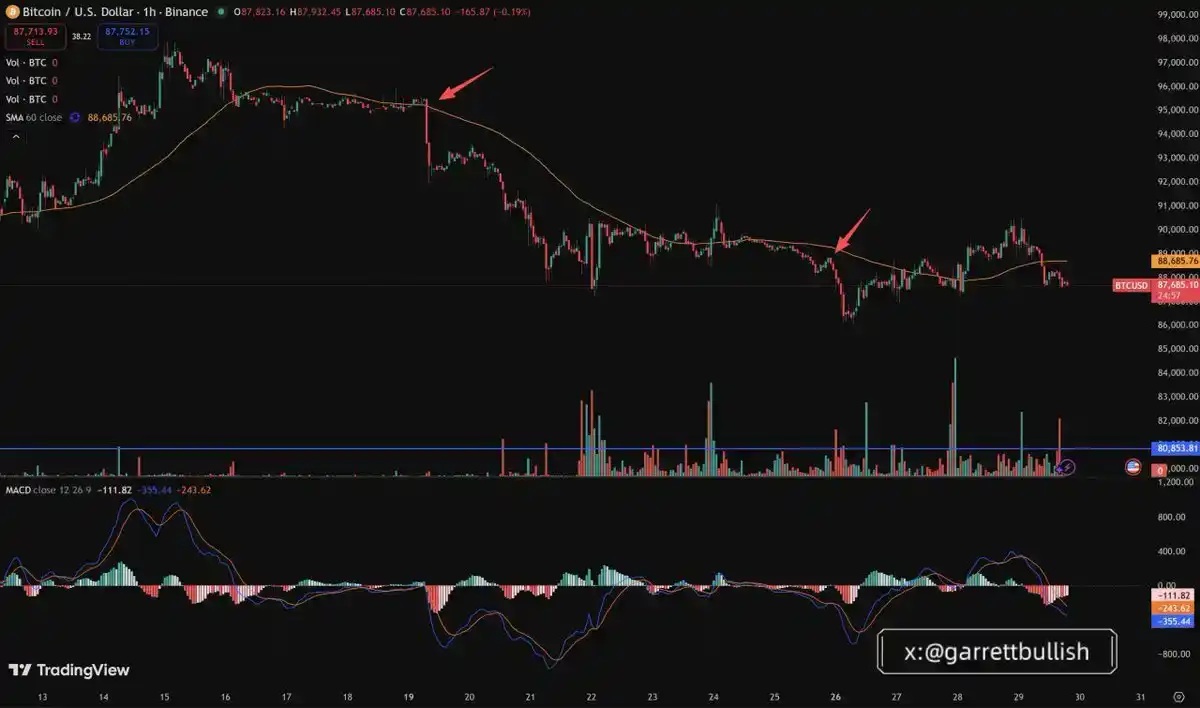
In the absence of substantial new capital inflows, or before FOMO sentiment returns, relying solely on existing capital is insufficient to counter the aforementioned types of market behavior.

Definition of Risk Assets

Risk Assets refer to financial instruments with certain risk characteristics, including stocks, commodities, high-yield bonds, real estate, and currencies.

Broadly speaking, risk assets refer to any financial security or investment vehicle not considered 'risk-free'. The common feature of such assets is that their prices are volatile and their value can change significantly over time.

Common types of risk assets include:

Equities / Stocks:
Shares of publicly traded companies, whose prices are affected by market conditions, company performance, and other factors, and can be highly volatile.

Commodities:
Physical assets like crude oil, gold, agricultural products, etc., whose prices are mainly influenced by changes in supply and demand.

High-Yield Bonds:
Bonds that offer higher interest rates due to lower credit ratings, but also come with higher default risk.

Real Estate:
Real property investments, whose value fluctuates with market cycles, economic conditions, and policy changes.

Currencies:
Various currencies in the foreign exchange market, whose prices can fluctuate rapidly due to geopolitical events, macroeconomic data, and policy changes.

Main Characteristics of Risk Assets

Volatility
Risk asset prices fluctuate frequently, which can lead to both gains and losses.

Coexistence of Return and Risk
Generally, the higher the risk of an asset, the higher the potential return, but also the greater the probability of loss.

High Sensitivity to Market Environment
The value of risk assets is influenced by various factors, including interest rate changes, macroeconomic conditions, and investor sentiment.


İlgili Sorular

QAccording to the article, what are the main reasons for Bitcoin and Ethereum's recent underperformance compared to other risk assets?

AThe main reasons are the stage of the trading cycle (deleveraging), the market microstructure, and market manipulation by some exchanges, market makers, or speculative funds.

QHow does the article explain the difference in performance of BTC and ETH when viewed on a 3-year versus a 6-year timeline?

AOn a 3-year timeline, BTC and ETH underperformed most major assets, with ETH being the weakest. However, on a 6-year timeline (since March 2020), they significantly outperformed most assets, with ETH being the strongest performer.

QWhat historical market does the article compare the current crypto market structure to, and what are the key characteristics they share?

AThe article compares it to the Chinese A-share market in 2015 after its leveraged-driven bull market. The key shared characteristics are high leverage, extreme volatility, a bubble top driven by valuation and herd behavior, repeated deleveraging shocks, a long and drawn-out decline, falling volatility, and a persistent contango structure in futures markets.

QWhy does the article argue that simply labeling BTC and ETH as 'risk assets' is an incomplete explanation for their recent price action?

ABecause while they are risk assets, they also possess additional safe-haven attributes similar to precious metals due to the DeFi ecosystem and on-chain settlement mechanisms, especially during rising geopolitical tensions. The label is a form of cherry-picking negative narratives.

QWhat structural issue within the crypto market itself does the article identify as a key amplifier of downside price moves?

AThe market is dominated by retail traders using high leverage (10-20x). This allows exchanges, market makers, or speculative funds to profit from market microstructure by engineering downward price moves, which trigger cascading liquidations and forced selling, especially during low-liquidity hours.

İlgili Okumalar

How Many Tokens Away Is Yang Zhilin from the 'Moon Chasing the Light'?

The article explores the intense competition between two leading Chinese AI companies, DeepSeek and Kimi (Moon Dark Side), and the mounting pressure on Yang Zhilin, the founder of Kimi. While DeepSeek re-emerged after 15 months of silence with its powerful V4 model—boasting 1.6 trillion parameters and low-cost, long-context capabilities—Kimi has been focusing on long-context processing and multi-agent systems with its K2.6 model. Yang faces a threefold challenge: technological rivalry, commercialization pressure, and investor expectations. Despite Kimi’s high valuation (reaching $18 billion), its revenue heavily relies on a single product with low paid conversion rates, while DeepSeek’s strategic silence and open-source influence have strengthened its market position and valuation prospects, now targeting over $20 billion. Both companies reflect broader trends in China’s AI ecosystem: Kimi aims for global influence through open-source contributions and agent-based advancements, while DeepSeek prioritizes foundational innovation and hardware independence, notably shifting to Huawei’s chips. Their competition is seen as vital for China’s AI progress, with the gap between top Chinese and U.S. models narrowing to just 2.7% on the Elo rating scale. Ultimately, the article argues that this rivalry, though anxiety-inducing for leaders like Zhilin, is essential for driving innovation and solidifying China’s role in the global AI landscape.

marsbit4 saat önce

How Many Tokens Away Is Yang Zhilin from the 'Moon Chasing the Light'?

marsbit4 saat önce

TechFlow Intelligence Bureau: ChatGPT Helps Amateur Mathematician Crack 60-Year-Old Problem, CFTC Sues New York Regulator Over Coinbase and Gemini

An amateur mathematician, with the assistance of ChatGPT, has solved a combinatorial mathematics puzzle originally proposed by Hungarian mathematician Paul Erdős in the 1960s. This marks another milestone in AI-aided mathematical research, demonstrating the evolving capabilities of large language models in formal reasoning. In other AI developments, OpenAI introduced a new privacy filter tool for enterprise API usage, automatically screening sensitive data. Meanwhile, the Qwen3.6-27B model achieved 100 tokens per second on a single RTX 5090 GPU using quantization, significantly lowering the cost barrier for local AI deployment. In crypto and Web3, the U.S. CFTC sued New York’s financial regulator, challenging its oversight of Coinbase and Gemini—a first-of-its-kind federal-state regulatory clash. Following a vulnerability, KelpDAO and major DeFi protocols established a recovery fund. Tether froze $344 million in assets linked to Iran’s central bank upon U.S. Treasury request, highlighting the centralized control risks in stablecoins. Separately, Litecoin underwent a 3-hour chain reorganization to undo a privacy-layer exploit. In the U.S., former President Trump invoked the Defense Production Act to address power grid bottlenecks affecting AI data centers and dismissed the entire National Science Board, raising concerns over research independence. A retail trader gained 250% on a $600k Intel options bet amid AI-related speculation. Xiaomi announced its first performance electric vehicle, targeting rivals like Tesla. Meanwhile, iPhone users reported devices automatically reinstalling a hidden app daily, suspected to be MDM-related. A Chinese securities report noted that A-share institutional crowding has reached its second-longest streak since 2007, signaling high valuations and potential style rotation. The day’s developments reflect a dual narrative: AI is enabling unprecedented individual breakthroughs, while centralized power structures—whether governmental or corporate—are becoming more assertive, underscoring that decentralization is as much a political-economic challenge as a technical one.

marsbit5 saat önce

TechFlow Intelligence Bureau: ChatGPT Helps Amateur Mathematician Crack 60-Year-Old Problem, CFTC Sues New York Regulator Over Coinbase and Gemini

marsbit5 saat önce

İşlemler

Spot
Futures

Popüler Makaleler

BITCOIN Nedir

HarryPotterObamaSonic10Inu (ERC-20)'yu ve Kripto Alanındaki Yerini Anlamak Son yıllarda, kripto para piyasası, hem ticaret yapanların hem de topluluk etkileşimi ve eğlence değeri arayanların ilgisini çeken meme coin'lerin popülaritesinde bir artış gördü. Bu benzersiz token'lar arasında, kripto para dokusuna kültürel referansları harmanlayan ilginç bir proje olan HarryPotterObamaSonic10Inu (ERC-20) bulunmaktadır. Bu makale, HarryPotterObamaSonic10Inu'nun temel yönlerini, mekanizmalarını, topluluk odaklı ethosunu ve daha geniş kripto manzarasıyla etkileşimini incelemektedir. HarryPotterObamaSonic10Inu (ERC-20) Nedir? Adından da anlaşılacağı gibi, HarryPotterObamaSonic10Inu, Ethereum blok zinciri üzerinde inşa edilen bir meme coin'dir ve ERC-20 standardı altında sınıflandırılmaktadır. Geleneksel kripto paraların pratik kullanılabilirlik veya yatırım potansiyeline odaklandığı durumların aksine, bu token eğlence değeri ve topluluğunun gücü üzerine kuruludur. Proje, bağlı kullanıcıların bir araya gelebileceği, fikirlerini paylaşabileceği ve çeşitli kültürel fenomenlerden ilham alan etkinliklere katılabileceği bir ortam yaratmayı hedeflemektedir. HarryPotterObamaSonic10Inu'nun dikkate değer özelliklerinden biri işlemlerde sıfır vergi olmasıdır. Bu çekici unsur, küçük ölçekli yatırımcıları caydırabilecek ek ücretlerden yoksun olarak ticareti ve topluluk katılımını teşvik etmeyi amaçlamaktadır. Coin'in toplam arzı bir milyar token olarak belirlenmiştir; bu, topluluk içinde önemli bir dolaşım sağlama niyetini göstermektedir. HarryPotterObamaSonic10Inu (ERC-20) Yaratıcısı HarryPotterObamaSonic10Inu'nun kökenleri bir miktar gizemlidir; yaratıcısı hakkında spesifik bilgilerin ne olduğu bilinmemektedir. Bu token'ın geliştirilmesi, belirli bir ekip veya açık bir plan eksikliği ile gerçekleşmiştir; bu durum, meme coin sektöründe oldukça yaygındır. Proje, topluluğunun heyecanı ve katılımına dayalı olarak organik bir şekilde ortaya çıkmıştır. HarryPotterObamaSonic10Inu (ERC-20) Yatırımcıları Dış yatırımlar ve destekler söz konusu olduğunda, HarryPotterObamaSonic10Inu da belirsiz kalmaktadır. Token, bilinen herhangi bir yatırım fonunu veya önemli bir kurumsal desteği listelememektedir. Bunun yerine, projenin can damarı, kolektif eylem ve kripto alanındaki katılım yoluyla büyüme ve sürdürülebilirlik sağlayan temel topluluğudur. HarryPotterObamaSonic10Inu (ERC-20) Nasıl Çalışır? Bir meme coin olarak, HarryPotterObamaSonic10Inu, genellikle varlık değerini yöneten geleneksel çerçevelerin dışında çalışmaktadır. Projenin nasıl çalıştığını tanımlayan birkaç özelliği vardır: Sıfır Vergi İşlemleri: İşlemlerde vergi ücreti olmadan, kullanıcılar gizli maliyet endişesi olmadan token'ı serbestçe alıp satabilirler. Topluluk Etkileşimi: Proje, topluluk etkileşimi üzerine kuruludur ve sosyal medya platformlarını kullanarak heyecan yaratarak katılımı kolaylaştırır. Tartışmalar, içerik paylaşımı ve katılım, projenin erişimini genişletmeye ve destekleyiciler arasında sadakat oluşturmaya yardımcı olan kritik unsurlardır. Pratik Kullanılabilirlik Yok: HarryPotterObamaSonic10Inu'nun mali ekosistem içinde somut bir kullanılabilirlik sunmadığı belirtilmelidir. Daha ziyade, eğlence ve topluluk etkinlikleri için bir token olarak sınıflandırılmaktadır. Kültürel Referans: Token, popüler kültürden unsurları zekice harmanlayarak ilgi çekmektedir ve hem meme meraklıları hem de kripto takipçileriyle bağlantı kurmaktadır. HarryPotterObamaSonic10Inu, meme coin'lerin, daha geleneksel kripto para projelerinden nasıl farklı çalıştığını örneklendirmektedir; bu projeler, utilitarist varlıklar yerine yenilikçi sosyal yapıların bir parçası olarak piyasaya girmektedir. HarryPotterObamaSonic10Inu (ERC-20) Zaman Çizelgesi HarryPotterObamaSonic10Inu'nun tarihi, birkaç dikkate değer kilometre taşı ile işaretlenmiştir: Oluşum: Token, birçok kripto meraklısının hayal gücünü yakalayan bir viral meme'den ortaya çıkmıştır. Spesifik yaratım tarihleri mevcut değildir ve bu onun organik yükselişini vurgulamaktadır. Borsa Listelemeleri: HarryPotterObamaSonic10Inu, topluluğun daha kolay erişim ve ticaret yapabilmesini sağlamak için çeşitli borsalarda yer bulmuştur. Topluluk Katılım İnisiyatifleri: Yarışmalar, sosyal medya kampanyaları ve hayranlar ile destekçilerden içerik üretimini içeren topluluk etkileşimini artırmayı amaçlayan devam eden etkinlikler. Gelecek Genişleme Planları: Projenin yol haritası, kültürel temalarına ilişkin bir NFT koleksiyonu, ticari ürünler ve bir e-ticaret sitesi başlatılmasını içermektedir; bu da topluluğun daha fazla katılımını sağlamayı ve ekosistemine daha fazla boyut kazandırmayı hedeflemektedir. HarryPotterObamaSonic10Inu (ERC-20) Hakkında Kilit Noktalar Topluluk Odaklı Doğası: Proje, kullanıcı katılımını geliştirme önceliği taşır ve böylece kullanıcıların sürecin en önünde yer almasını sağlar. Meme Coin Sınıflandırması: Eğlenceye dayalı kripto paranın doruk noktasıdır ve geleneksel yatırım araçlarından ayrılmaktadır. Bitcoin ile Doğrudan İlişki Yok: Ticker ismindeki benzeliğe rağmen, HarryPotterObamaSonic10Inu ayırt edicidir ve Bitcoin veya diğer yerleşik kripto paralarla herhangi bir ilişkisi yoktur. İşbirliğine Odaklanma: HarryPotterObamaSonic10Inu, sahipleri arasında işbirliği ve hikaye paylaşımı için bir alan oluşturmak üzere tasarlanmıştır ve bu da yaratıcılık ve topluluk bağlarını sağlamaktadır. Gelecek Beklentileri: Başlangıçta belirlendiği temalardan NFTs ve ticari ürünlere genişleme arzusu, projenin dijital kültürde daha ana akıma girebilmesi için bir yol haritası çizmektedir. Meme coin'ler, kripto para topluluğunun hayal gücünü çalmaya devam ederken, HarryPotterObamaSonic10Inu (ERC-20), kültürel bağları ve topluluk merkezli yaklaşımıyla öne çıkmaktadır. Geleneksel bir hizmet odaklı token modeliyle uyumlu olmasa da, özünde destekçileri arasında sağlanan neşe ve dostluğu vurgulayarak, giderek dijitalleşen bir çağda kripto paraların evrilen doğasını göstermektedir. Proje gelişmeye devam ettikçe, topluluk dinamiklerinin blockchain teknolojisi dünyasındaki seyrini nasıl etkilediğini izlemek önemli olacaktır.

1.4k Toplam GörüntülenmeYayınlanma 2024.04.01Güncellenme 2024.12.03

BITCOIN Nedir

BTC Nasıl Satın Alınır

HTX.com’a hoş geldiniz! Bitcoin (BTC) satın alma işlemlerini basit ve kullanışlı bir hâle getirdik. Adım adım açıkladığımız rehberimizi takip ederek kripto yolculuğunuza başlayın. 1. Adım: HTX Hesabınızı OluşturunHTX'te ücretsiz bir hesap açmak için e-posta adresinizi veya telefon numaranızı kullanın. Sorunsuzca kaydolun ve tüm özelliklerin kilidini açın. Hesabımı Aç2. Adım: Kripto Satın Al Bölümüne Gidin ve Ödeme Yönteminizi SeçinKredi/Banka Kartı: Visa veya Mastercard'ınızı kullanarak anında Bitcoin (BTC) satın alın.Bakiye: Sorunsuz bir şekilde işlem yapmak için HTX hesap bakiyenizdeki fonları kullanın.Üçüncü Taraflar: Kullanımı kolaylaştırmak için Google Pay ve Apple Pay gibi popüler ödeme yöntemlerini ekledik.P2P: HTX'teki diğer kullanıcılarla doğrudan işlem yapın.Borsa Dışı (OTC): Yatırımcılar için kişiye özel hizmetler ve rekabetçi döviz kurları sunuyoruz.3. Adım: Bitcoin (BTC) Varlıklarınızı SaklayınBitcoin (BTC) satın aldıktan sonra HTX hesabınızda saklayın. Alternatif olarak, blok zinciri transferi yoluyla başka bir yere gönderebilir veya diğer kripto para birimlerini takas etmek için kullanabilirsiniz.4. Adım: Bitcoin (BTC) Varlıklarınızla İşlem YapınHTX'in spot piyasasında Bitcoin (BTC) ile kolayca işlemler yapın.Hesabınıza erişin, işlem çiftinizi seçin, işlemlerinizi gerçekleştirin ve gerçek zamanlı olarak izleyin. Hem yeni başlayanlar hem de deneyimli yatırımcılar için kullanıcı dostu bir deneyim sunuyoruz.

7.3k Toplam GörüntülenmeYayınlanma 2024.12.12Güncellenme 2025.03.21

BTC Nasıl Satın Alınır

$BITCOIN Nedir

DİJİTAL ALTIN ($BITCOIN): Kapsamlı Bir Analiz DİJİTAL ALTIN ($BITCOIN) Tanıtımı DİJİTAL ALTIN ($BITCOIN), geleneksel değerli metallerin özelliklerini merkeziyetsiz teknolojilerin yeniliği ile birleştirmeyi amaçlayan Solana ağı üzerinde çalışan blockchain tabanlı bir projedir. Bitcoin ile aynı isme sahip olmasına rağmen, genellikle bir değer saklama aracı olarak algılandığı için “dijital altın” olarak anılmaktadır; DİJİTAL ALTIN, Web3 ortamında benzersiz bir ekosistem yaratmak için tasarlanmış ayrı bir tokendir. Hedefi, uygulanabilir bir alternatif dijital varlık olarak kendini konumlandırmaktır, ancak uygulamaları ve işlevleri ile ilgili ayrıntılar hala gelişmektedir. DİJİTAL ALTIN ($BITCOIN) Nedir? DİJİTAL ALTIN ($BITCOIN), Solana blockchain'inde kullanılmak üzere açıkça tasarlanmış bir kripto para tokenidir. Bitcoin'in yaygın olarak tanınan bir değer saklama rolü sağlamasının aksine, bu token daha geniş uygulamalara ve özelliklere odaklanıyor gibi görünmektedir. Dikkate değer yönler şunlardır: Blockchain Altyapısı: Token, yüksek hızlı ve düşük maliyetli işlemleri yönetme kapasitesi ile bilinen Solana blockchain'inde inşa edilmiştir. Arz Dinamikleri: DİJİTAL ALTIN'ın maksimum arzı 100 katrilyon token (100P $BITCOIN) ile sınırlıdır, ancak dolaşımdaki arzı ile ilgili ayrıntılar şu anda açıklanmamıştır. Kullanım Alanı: Kesin işlevler açıkça belirtilmemiş olsa da, token'ın merkeziyetsiz uygulamalar (dApps) veya varlık tokenizasyon stratejileri ile ilgili çeşitli uygulamalar için kullanılabileceğine dair işaretler bulunmaktadır. DİJİTAL ALTIN ($BITCOIN) Yaratıcısı Kimdir? Şu anda, DİJİTAL ALTIN ($BITCOIN) arkasındaki yaratıcıların ve geliştirme ekibinin kimliği bilinmemektedir. Bu durum, merkeziyetsiz finans ve meme coin fenomenleriyle uyumlu olan birçok yenilikçi proje arasında yaygındır. Böyle bir anonimlik, topluluk odaklı bir kültürü teşvik edebilirken, yönetişim ve hesap verebilirlik konusundaki endişeleri artırmaktadır. DİJİTAL ALTIN ($BITCOIN) Yatırımcıları Kimlerdir? Mevcut bilgiler, DİJİTAL ALTIN ($BITCOIN) için bilinen herhangi bir kurumsal destekçi veya önde gelen risk sermayesi yatırımı olmadığını göstermektedir. Proje, geleneksel finansman yolları yerine topluluk desteği ve benimsemeye odaklanan bir eşler arası modelde çalışıyor gibi görünmektedir. Faaliyetleri ve likiditesi esas olarak PumpSwap gibi merkeziyetsiz borsalarda (DEX'ler) yer almakta olup, bu da onun taban hareketine vurgu yapmaktadır. DİJİTAL ALTIN ($BITCOIN) Nasıl Çalışır DİJİTAL ALTIN ($BITCOIN) 'ın operasyonel mekanikleri, blockchain tasarımı ve ağ özellikleri temelinde açıklanabilir: Konsensüs Mekanizması: Solana'nın benzersiz tarih kanıtı (PoH) ile bir hisse kanıtı (PoS) modelini birleştirerek, proje ağın yüksek performansına katkıda bulunan verimli işlem doğrulamasını sağlar. Tokenomik: Belirli deflasyonist mekanizmalar kapsamlı bir şekilde detaylandırılmamış olsa da, geniş maksimum token arzı, henüz tanımlanmamış mikro işlemler veya niş kullanım durumlarına hitap edebileceğini ima etmektedir. Etkileşim: Solana'nın daha geniş ekosistemi ile entegrasyon potansiyeli bulunmaktadır; bu, çeşitli merkeziyetsiz finans (DeFi) platformlarını içermektedir. Ancak, belirli entegrasyonlarla ilgili ayrıntılar belirtilmemiştir. Önemli Olayların Zaman Çizelgesi DİJİTAL ALTIN ($BITCOIN) ile ilgili önemli kilometre taşlarını vurgulayan bir zaman çizelgesi: 2023: Token'ın Solana blockchain'inde ilk dağıtımı, sözleşme adresi ile işaretlenmiştir. 2024: DİJİTAL ALTIN, PumpSwap gibi merkeziyetsiz borsalarda işlem görmeye başladıkça görünürlük kazanır ve kullanıcıların bunu SOL karşısında ticaret yapmasına olanak tanır. 2025: Proje, topluluk odaklı etkileşimlere yönelik potansiyel ilgi ve ara sıra ticaret faaliyetleri görür, ancak şu ana kadar dikkate değer ortaklıklar veya teknik ilerlemeler belgelenmemiştir. Kritik Analiz Güçlü Yönler Ölçeklenebilirlik: Temel Solana altyapısı, yüksek işlem hacimlerini destekleyerek $BITCOIN'in çeşitli işlem senaryolarındaki faydasını artırabilir. Erişilebilirlik: Token başına potansiyel düşük ticaret fiyatı, perakende yatırımcıları çekebilir ve parçalı mülkiyet fırsatları sayesinde daha geniş katılımı kolaylaştırabilir. Riskler Şeffaflık Eksikliği: Kamuya açık olarak bilinen destekçilerin, geliştiricilerin veya bir denetim sürecinin olmaması, projenin sürdürülebilirliği ve güvenilirliği konusunda şüpheler doğurabilir. Piyasa Volatilitesi: Ticaret faaliyeti büyük ölçüde spekülatif davranışa dayanmakta olup, bu da yatırımcılar için önemli fiyat dalgalanmalarına ve belirsizliklere yol açabilir. Sonuç DİJİTAL ALTIN ($BITCOIN), hızla gelişen Solana ekosisteminde ilginç ama belirsiz bir proje olarak ortaya çıkmaktadır. “Dijital altın” anlatısını kullanmaya çalışırken, Bitcoin'in değer saklama rolünden ayrılması, amaçlanan faydasının ve yönetişim yapısının daha net bir şekilde tanımlanması gerekliliğini vurgulamaktadır. Gelecekteki kabul ve benimseme, mevcut belirsizliklerin giderilmesine ve operasyonel ile ekonomik stratejilerinin daha açık bir şekilde tanımlanmasına bağlı olacaktır. Not: Bu rapor, Ekim 2023 itibarıyla mevcut olan sentezlenmiş bilgileri kapsamaktadır ve araştırma döneminin ötesinde gelişmeler yaşanmış olabilir.

92 Toplam GörüntülenmeYayınlanma 2025.05.13Güncellenme 2025.05.13

$BITCOIN Nedir

Tartışmalar

HTX Topluluğuna hoş geldiniz. Burada, en son platform gelişmeleri hakkında bilgi sahibi olabilir ve profesyonel piyasa görüşlerine erişebilirsiniz. Kullanıcıların BTC (BTC) fiyatı hakkındaki görüşleri aşağıda sunulmaktadır.

活动图片