Why Did Zhipu Surge Nearly 30% in a Single Day?

marsbit2026-05-23 tarihinde yayınlandı2026-05-23 tarihinde güncellendi

Özet

"Global AI Model Unicorn" Zhipu's stock surged nearly 30% in a single day, reaching a new market cap high. The catalyst was the launch of its GLM-5.1-highspeed API, boasting a generation speed of **400 tokens per second**, setting a new global benchmark. This speed, roughly 3-5 times faster than industry leaders like OpenAI's GPT-4o and Anthropic's Claude, is achieved **without compromising the full-scale model's capabilities**. In the era of AI Agents requiring dozens of self-calls, such latency reduction is critical, transforming speed from a system metric into a determinant of intelligence limits. The breakthrough stems from a three-layer technical overhaul: 1. **TileRT Inference Engine**: Compiles the entire model into a continuous, always-on computation pipeline using "Warp Specialization," minimizing GPU idle time by having different processor groups handle data loading, computation, and communication in parallel. 2. **Heterogeneous Parallelism for MLA**: To efficiently run the GLM-5.1 model using the MLA attention mechanism, TileRT employs a heterogeneous strategy. One GPU handles sparse indexing/routing, while the others perform dense computation, optimizing for MLA's unique workflow. 3. **ZCube Network Architecture**: Replaces the standard Spine-Leaf (ROFT) network topology with a flat, dual-group interconnect. This design creates a single optimal path between any two GPUs, eliminating network congestion at scale and reducing latency. The business impact is sig...

By AIDeepDive

Today, Zhipu (02513.HK), hailed as the "world's first listed large language model company," surged once again.

Its intraday increase once exceeded 30%. It closed at HK$1,282, up over 26% for the day, with its market capitalization reaching HK$571.57 billion, setting another historical high.
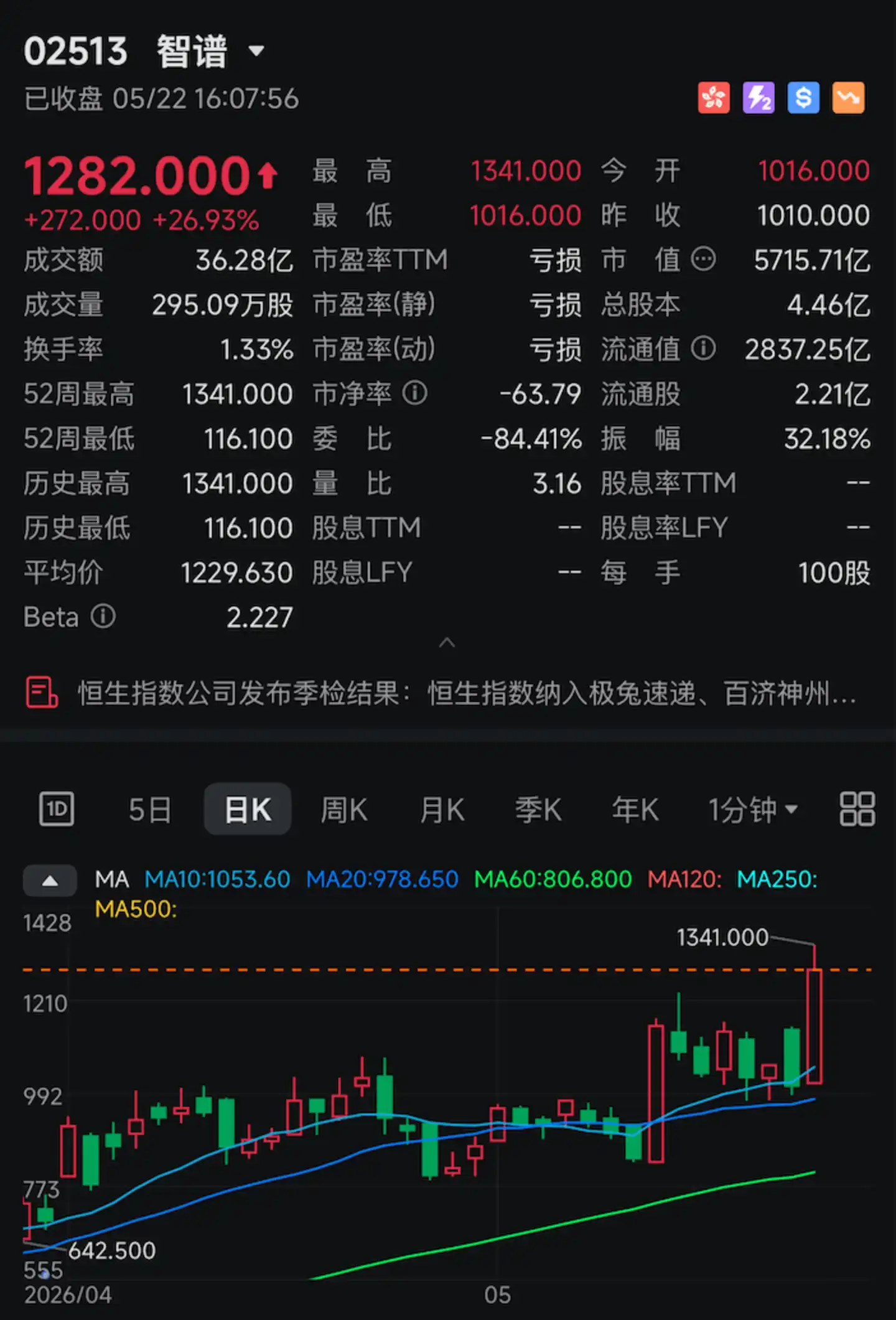
The trigger for this surge was a specific technical metric: 400 tokens/s.

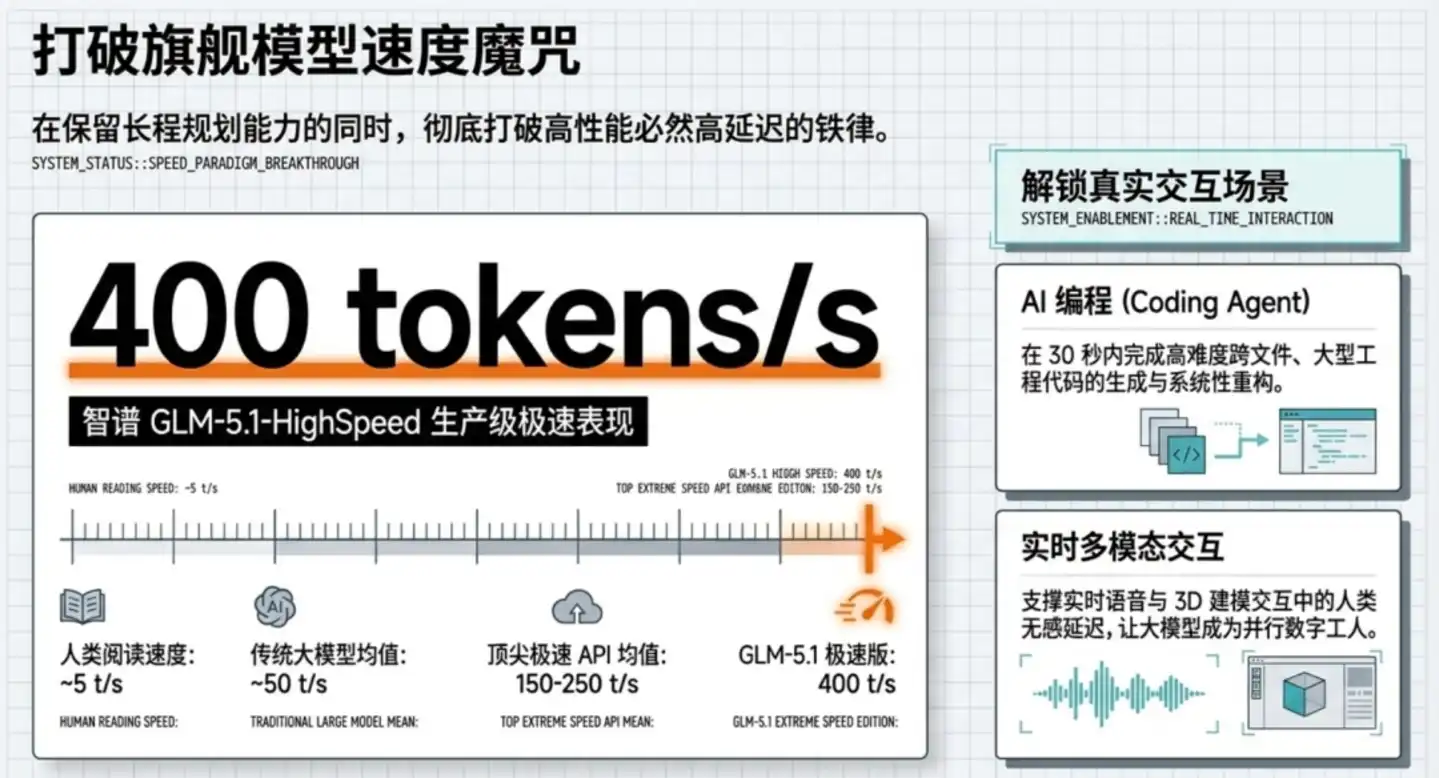
On May 22, Zhipu officially opened access to the GLM-5.1 Highspeed API (GLM-5.1-highspeed) for enterprise clients. The most critical core parameter is just one: model output speed reaching 400 tokens per second, setting a new global upper limit for API speed among major LLM providers.

I initially thought this was just another public relations stunt by a domestic LLM company, but after examining the technical details, I finally understood the logic behind the capital market's reaction.

What does 400 tokens/s mean?

The model can generate approximately 200 Chinese characters per second, equivalent to the high-intensity output of a professional writer in one minute, compressed into just one second.

A volume of text that would take a creator several days of desk work to complete can be delivered by the GLM-5.1 Highspeed in just 1 minute; a system refactoring task that would occupy an engineer for 3 days can be completed in the time it takes to drink a cup of coffee.

01 Speed Is More Important Than You Think

Speed has historically been the most easily overlooked dimension in AI model competition.

Over the past three years, the LLM arms race has centered on two tracks: parameter scale (making models larger and smarter) and price wars (making tokens cheaper and more accessible). "Speed" was never the protagonist.

This is because, in the past, "speed" was typically achieved by reducing model parameters. To increase speed, one had to use smaller, more streamlined models, at the cost of diminished capabilities.

The significance of the GLM-5.1 Highspeed lies in its achievement of pushing speed to 400 tokens/s while retaining the capabilities of the flagship full-size base model.

For both domestic and international models, "flagship-level capability" and "ultra-low latency" have been achieved without compromise for the first time.
Why is speed so critical? Because the main battlefield for AI is undergoing a fundamental shift.

As AI moves from the ChatBot era into the Agent era, Q&A is no longer the primary scenario. For an Agent to complete a task, it often requires the model to make dozens or even hundreds of self-calls: writing code, calling APIs, searching for information, utilizing tools...

In this operational mode, the latency between each call is mercilessly magnified. For a task requiring 50 calls, saving 1 second per call speeds up the entire task by nearly 1 minute. For AI programming assistants, voice interaction, and commercial decision systems, this difference can be a matter of life or death.

At a deeper level, within a fixed time budget, faster inference means the model can explore deeper reasoning paths and perform more rounds of self-verification. Speed is transforming from a system metric into an upper limit of intelligence itself.

02 How Difficult Is Achieving Speed?

So, what's the current industry standard for speed?

Among leading providers, OpenAI's GPT-4o is around 100–150 tokens/s, Anthropic's Claude Sonnet series around 80–120 tokens/s, while mainstream domestic flagship model APIs mostly fall within the 50–100 tokens/s range. 400 tokens/s is approximately 3 to 5 times the industry average.

More crucially, this gap cannot be bridged simply by throwing more computing power at it.

A server equipped with 8 H200 GPUs can theoretically move up to 38TB of data per second. For GLM-5.1, generating a single token only requires reading about 42GB of activation parameters. Purely theoretical calculation suggests it should approach 1000 tokens/s.

But real-world systems often only achieve a few dozen tokens/s.
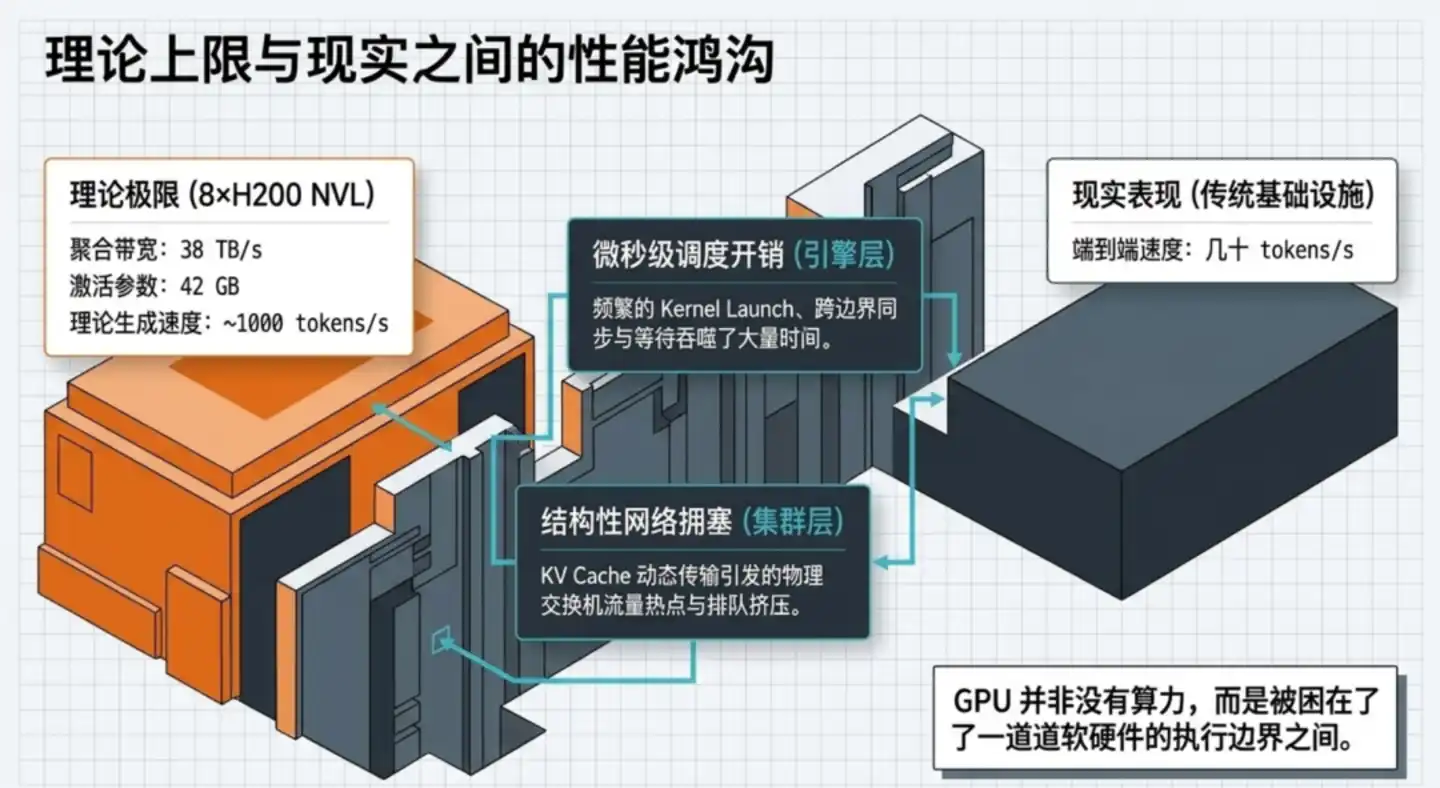
This is a gap of an order of magnitude. The GPUs aren't inherently too slow; rather, a significant amount of time is wasted on waiting, idling, and inefficient scheduling.

Zhipu's breakthrough this time stems from simultaneous innovations at three levels: the inference engine, parallelization strategy, and network architecture.
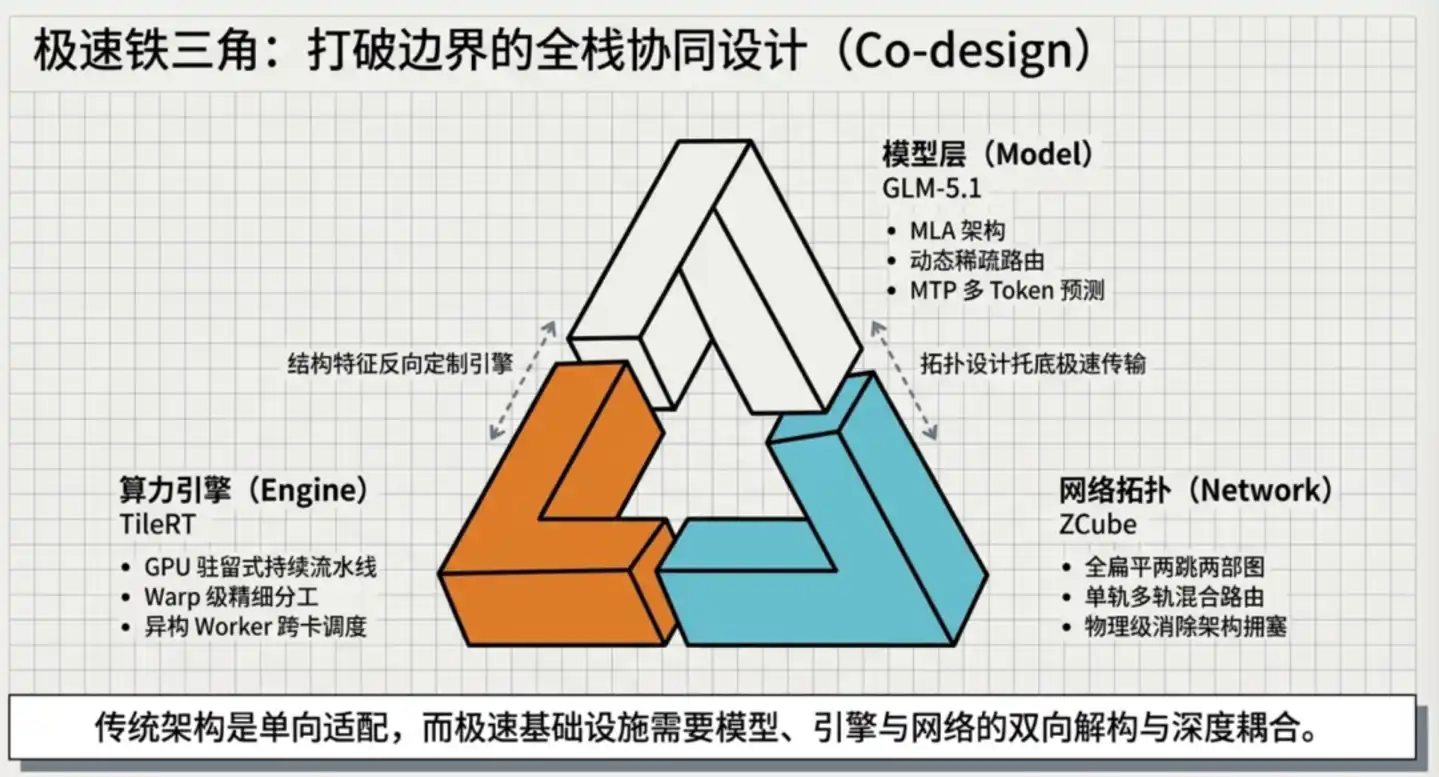
03 Three-Layer Technology Stack, Approaching Hardware Physical Limits

Here's how traditional LLMs operate: the model is decomposed into independent operators (kernels). Each operator launches a computing kernel, computes, stops, synchronizes and waits, then launches the next one.

During the training phase, each computation takes seconds or even minutes, making these startup and wait overheads negligible. But during inference, generating a single token, a key step might only require tens of microseconds, making the startup and wait overheads proportionally significant.

TileRT's Core Idea: Compile the entire model into a continuously running engine, start once, run perpetually.

TileRT statically unfolds all of the model's computational logic into a continuous pipeline during the code compilation phase. At runtime, the GPU maintains high-speed operation, with computation, data movement, and communication proceeding in parallel. Intermediate results are kept within the GPU's high-speed cache as much as possible, avoiding repeated writes to slow VRAM and subsequent re-reads.
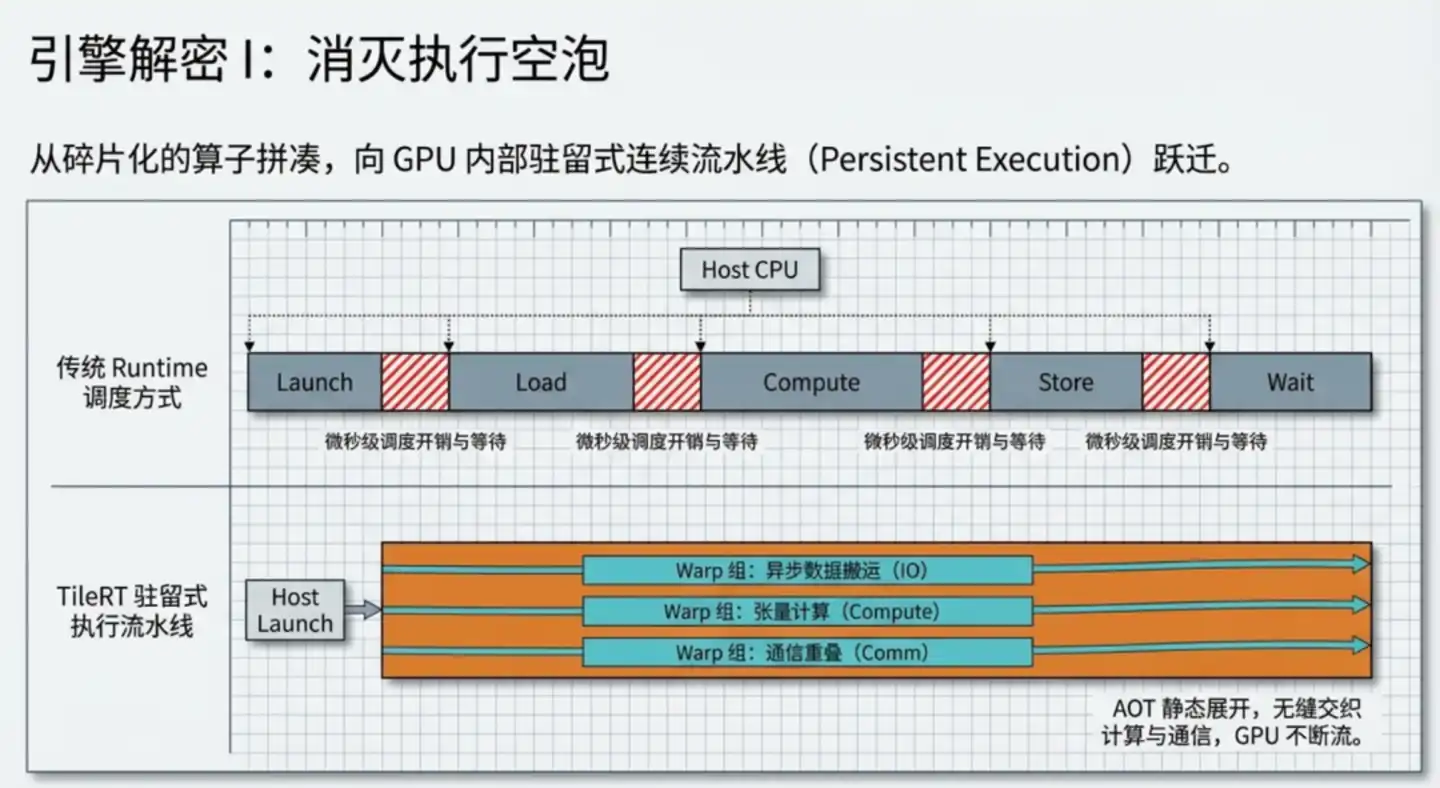
There's a crucial design detail here: Warp Specialization.

Understanding Warp requires first understanding GPU operation. The biggest difference between a GPU and a CPU is that a GPU contains thousands of relatively simple computing units, bundled together in groups of 32. This group is called a Warp.

All 32 units within the same Warp must always act synchronously, executing the same instruction, like a squad in the army where the squad leader orders everyone to perform the same action simultaneously.

In traditional frameworks, all Warps execute the same sequence of instructions. TileRT assigns different Warp groups different responsibilities: some specialize in prefetching the next batch of data, some in mathematical computation, some in communicating with other GPUs. The three groups work simultaneously, pipelining seamlessly without waiting for each other.

It's akin to moving from "one worker moving bricks, laying walls, and inspecting serially" to "a brick-moving group, a wall-laying group, and an inspection group operating concurrently."

With single-GPU efficiency solved, multi-GPU parallelism presents a new challenge.

The industry standard approach is Tensor Parallelism (TP): Split the model's weight matrices into several parts, with each GPU responsible for one part. After computing, results are aggregated via high-speed interconnects (NVLink).

This solution works well for regular, dense computations like matrix multiplication and is the standard multi-GPU solution for almost all current LLM inference frameworks.

GLM-5.1 employs **MLA (Multi-head Latent Attention), an attention mechanism proposed by DeepSeek.

Traditional attention mechanisms require storing large amounts of intermediate data (KV Cache) generated at each step for later use, which consumes significant VRAM. MLA's approach is to first compress this intermediate data into a compact "latent vector" for storage, then expand and restore it when needed, drastically reducing VRAM requirements and improving inference efficiency.

However, MLA's computational flow has a special step: performing sparse indexing from a large amount of historical information: similar to quickly finding the most relevant few books in a vast library before carefully reading them.

The "book-finding" step relies on global information and is not well-suited for distribution across multiple GPUs; the "careful reading" is the dense computation suitable for multi-GPU parallelism. If all 8 GPUs are forced to participate in "book-finding," a lot of time would be wasted on inter-GPU synchronization communication.

TileRT's solution is to have GPUs operate heterogeneously: GPU 0 specializes as the "library retriever," handling sparse indexing and routing decisions; GPUs 1–7 act as "detailed analysts," responsible for dense attention computation and matrix operations. The two types of workers each adopt the parallelization strategy best suited to them, collaborating to complete the entire computational layer.
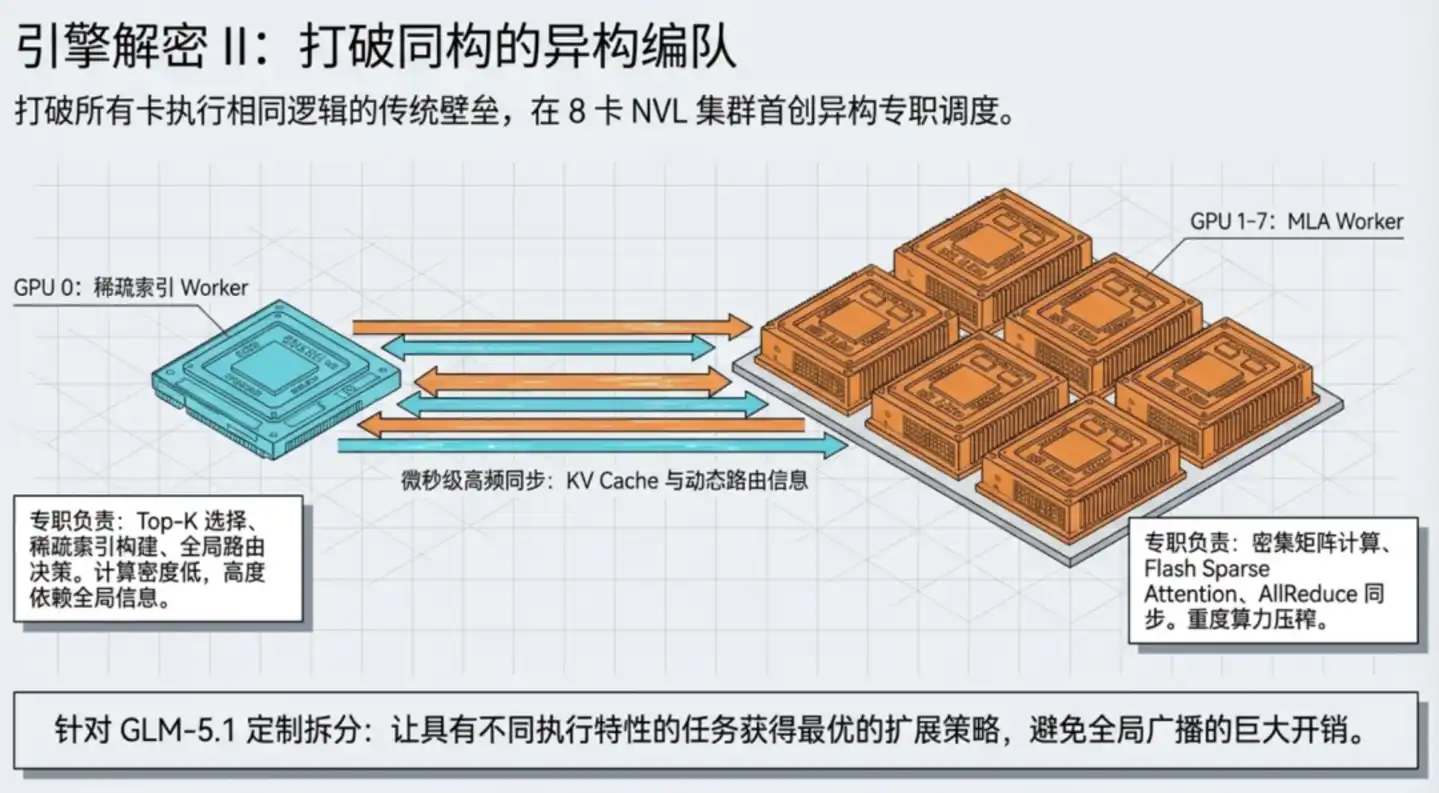
Next, TileRT embeds inter-GPU communication operations directly into the execution pipeline, no longer treating them as separate steps. Externally, the entire 8-GPU system completing one layer of attention computation requires only one kernel launch; internal communication and computation are all seamlessly completed within the continuous pipeline.

The above two layers address problems within a single server. When scaling clusters to hundreds or thousands of GPUs, data transmission between GPUs itself becomes the new bottleneck.

The industry standard approach is ROFT (Rail-Optimized Fat-Tree), NVIDIA's officially recommended solution and the absolute industry standard.

Its structure is like a tree: servers connect first to underlying Leaf switches (access layer, directly facing servers). Leaf switches then connect upward to Spine switches (backbone layer, responsible for interconnecting different Leafs, like highway hubs). Data transmission between two GPUs must "go up to a Spine, then down to the target Leaf," traversing at least 3 hops.

To prevent traffic from concentrating on a few links, this architecture relies on the ECMP algorithm to distribute data across multiple paths, functioning well under the premise of "statistically uniform" internet traffic.

But inference traffic is completely non-uniform. Context lengths between different requests can vary by tens of times, and the direction of KV Cache transmission between GPUs is almost random. A few Leaf switches periodically become hotspots, triggering backpressure mechanisms that spread congestion from local to the entire link. This congestion cannot be solved by protocol parameter tuning; it's inherent to the topology structure.
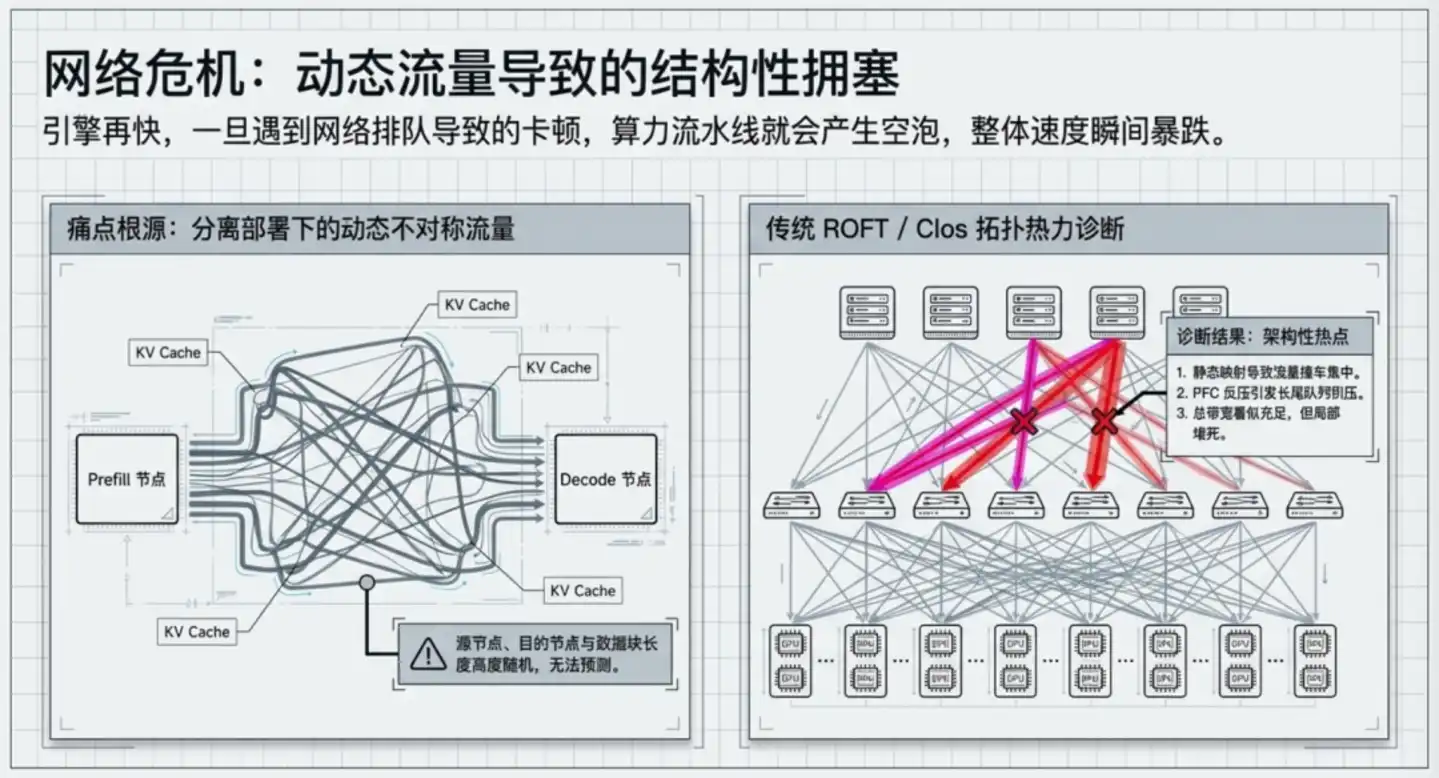
ZCube's fundamental breakthrough: Architecturally preventing this type of congestion from physically occurring.

The core design consists of two steps:

First, eliminate the Spine backbone layer, flatten the entire network. Divide all Leaf switches into two groups based on odd/even numbering, with the two groups fully interconnected. Any odd-numbered switch connects to all even-numbered switches, and vice versa. Any two GPUs can reach each other via at most two switches, reducing hops from 3 to 2.
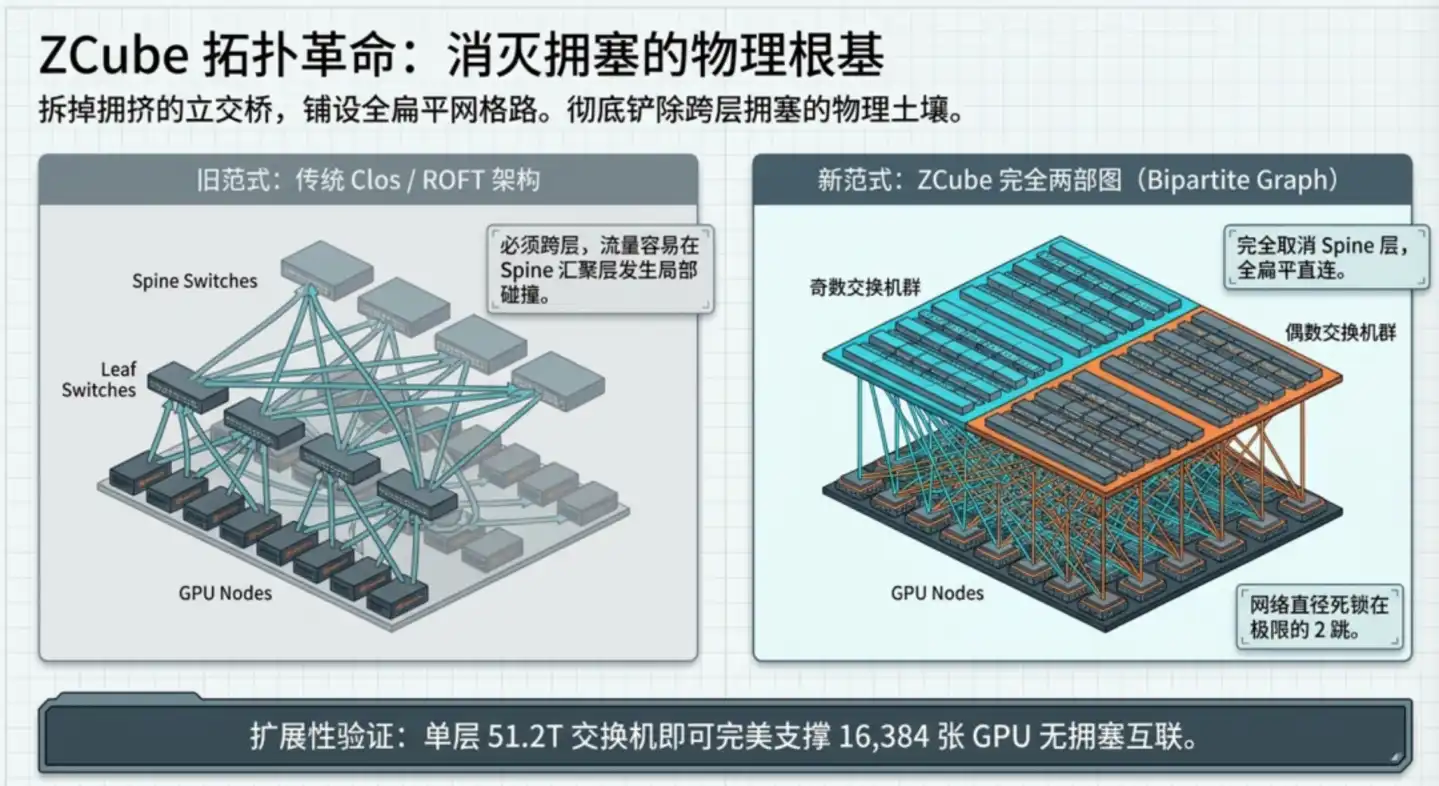
The second step, and the most ingenious part: Connect each GPU network card to the two groups of switches in two completely different ways. This special topology yields a key mathematical property: Between any two GPUs in the entire network, there is one and only one optimal path.
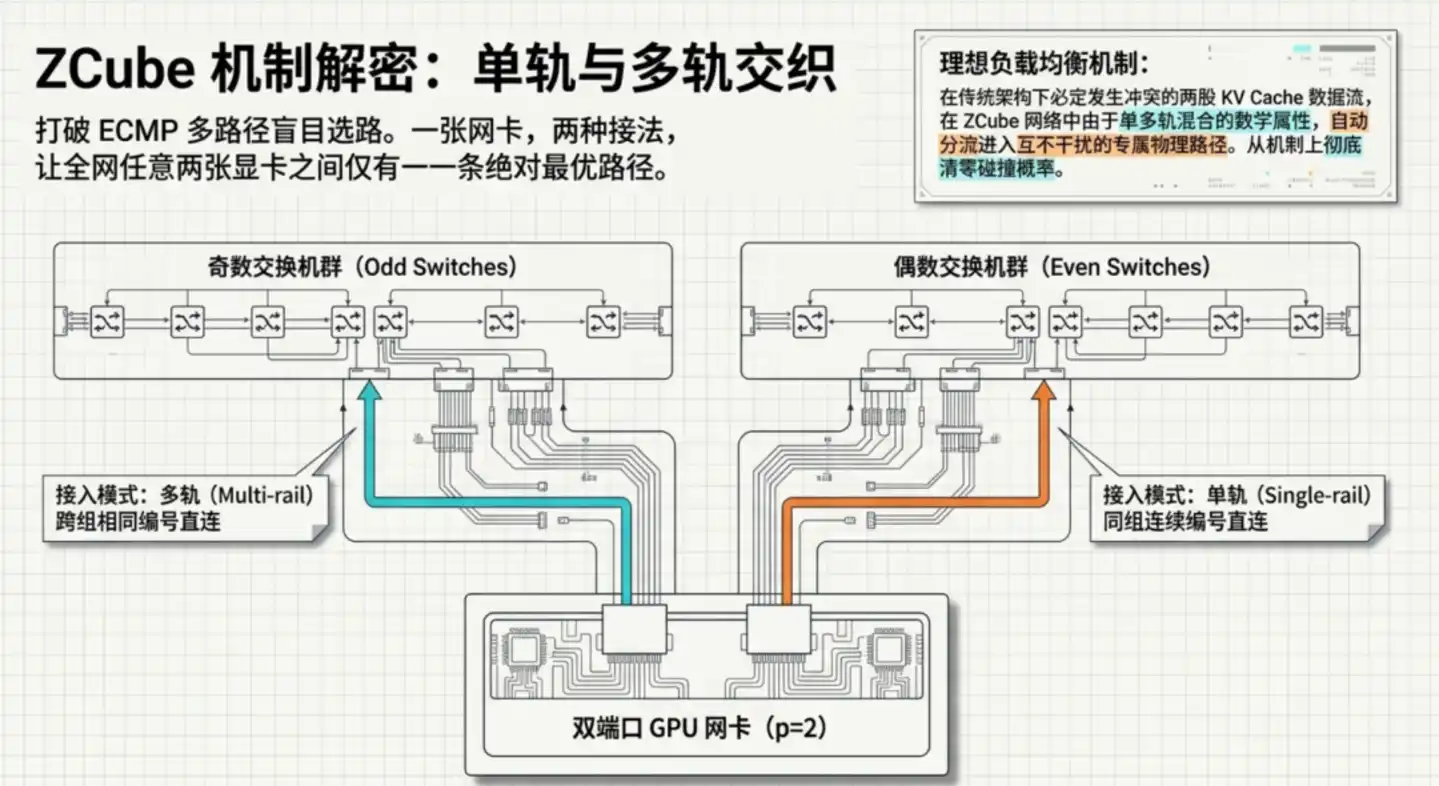
The "single path" directly eliminates the root cause of congestion. Traditional architectures are prone to hotspots precisely because there are multiple paths to choose from; if the load-balancing algorithm makes a wrong choice, traffic concentrates. ZCube eliminates "choice" itself by design: no balancing is needed because there are no forks.

04 Under the Same Hardware Conditions, How Does the Math Work?

After upgrading the GLM-5.1 production cluster from traditional ROFT to ZCube, Zhipu obtained three key numbers:

In summary, with the same GPU investment, the cluster can serve more users; with the same user experience requirements, the cluster can purchase one-third fewer network devices. Efficiency and cost are improved in both directions.
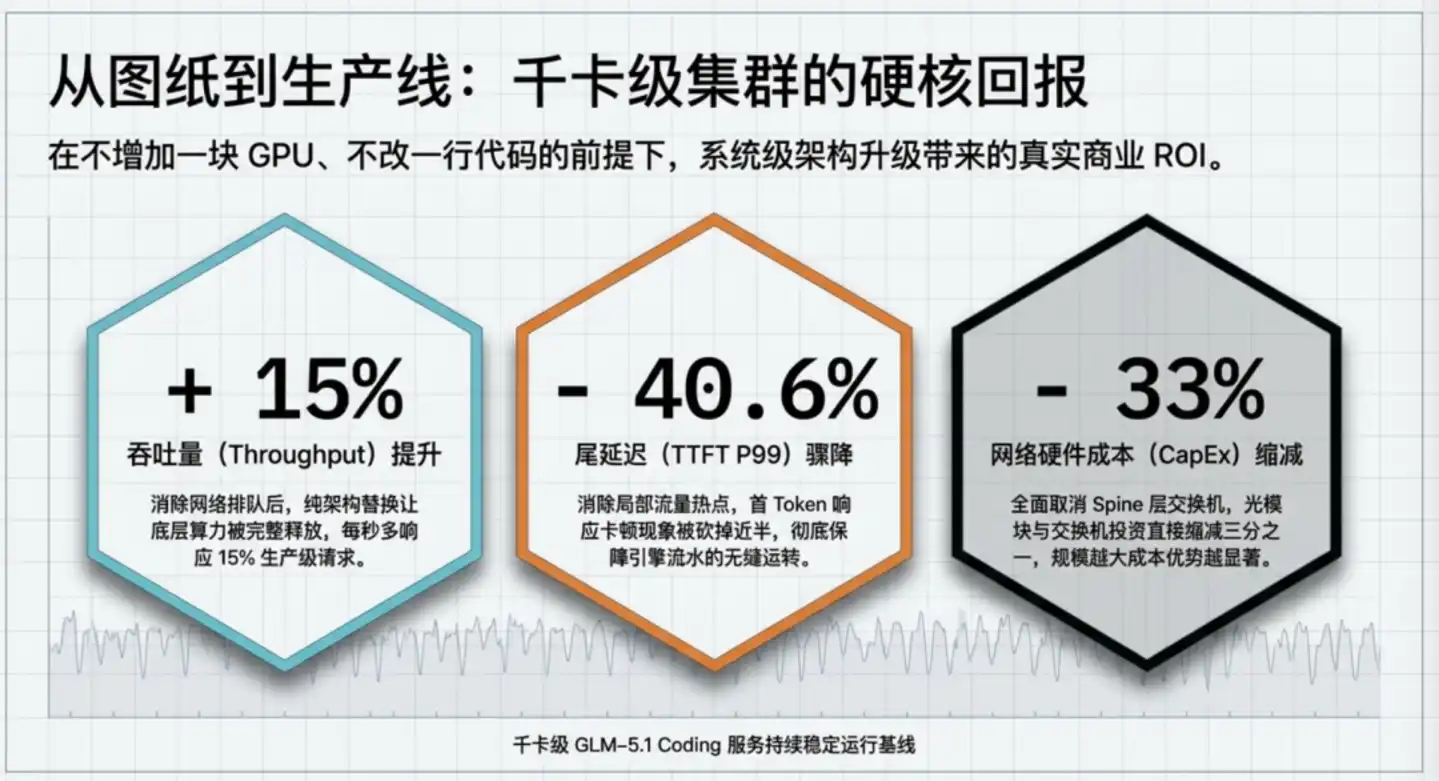
Specifically, throughput increased by 15%, equivalent to gaining 15% more computing power for free. With the same number of GPUs, a 15% higher throughput is equivalent to approximately a 13% reduction in the amortized hardware cost per token, or the ability to serve 15% more users at the same cost.

If a cluster has 1000 GPUs, this upgrade is equivalent to gaining the productive capacity of 150 additional cards for free. Based on current high-end inference GPU market prices, this represents computing power value in the billions of yuan.

A 40.6% reduction in tail latency addresses stability, not average speed. For an Agent task requiring 50 calls, if tail latency is reduced by 1 second per call, the worst-case completion time for the entire task is compressed by nearly 1 minute.

A one-third cost reduction is a direct saving at the construction level. ZCube eliminates the Spine layer, directly reducing the number of switches and optical modules required for the same cluster scale by one-third. According to Zhipu's calculations, in a ten-thousand-GPU scale cluster, this alone could save approximately 210 million to 640 million yuan.

In the long term, as cluster sizes expand exponentially, the complexity of inter-GPU communication grows manifold, and the probability and impact of congestion amplify accordingly. This means the value of architectural innovations like ZCube will accelerate as inference clusters continue to expand. The gains for tomorrow's ten-thousand-GPU clusters may far exceed today's 15%.

05 Final Thoughts

After reading Zhipu's technical report, I wondered: Could this bring a storm to the industry, much like DeepSeek's sudden emergence?

Upon careful consideration, their impacts seem to lie in different aspects. When DeepSeek emerged, it proved that the same level of intelligence could be achieved with far less computing power. The market worried that "fewer GPUs would be needed," causing NVIDIA's market cap to evaporate nearly $600 billion that day.

But Zhipu's technology today proves: The same computing power can produce more output. It is reshaping "what other infrastructure outside of GPUs should look like."

In the short term, NVIDIA may not be affected. But in the long run, the moat of GPU + NVLink interconnect + InfiniBand network + CUDA software ecosystem is being "loosened," especially the InfiniBand technology NVIDIA acquired with its $6.9 billion purchase of Mellanox in 2019. NVIDIA's premium on the network side will be significantly eroded.

Furthermore, while ZCube eliminates the Spine layer, it actually imposes higher requirements on the port density of Leaf switches. This benefits manufacturers capable of producing high-density, large-port Leaf switches (like Ruijie, Arista, Broadcom switching chips) and disadvantages those who primarily rely on high-end Spine layer switches for premium pricing.

In 2025, Celestica and NVIDIA together held about 50% of the AI backend network switch market share. This landscape faces a potential reshuffle if the ZCube paradigm proliferates.

Optical modules are the most directly beneficial segment in this industry chain change, with a very clear logic. For domestic optical module manufacturers (like Zhongji Innolight, Tianfu Communications, etc.), this is a structural positive: not only is the total volume growing, but the demand for high-speed optical modules (800G, 1.6T) under the ZCube paradigm is more concentrated and urgent compared to traditional architectures.

Whether it's TileRT or the ZCube architecture, this is a set of pure software inference engines running on standard GPUs, not reliant on NVIDIA's proprietary hardware features. In theory, they can be ported to domestic chips like Huawei's Ascend. Once this direction is viable, it will significantly lower the software stack barrier for domestic AI chips in inference scenarios.

This is perhaps the even greater significance behind this technological innovation.

İlgili Sorular

QWhat specific technical indicator triggered the surge in Zhipu AI's stock price?

AThe specific technical indicator that triggered the stock surge was the public availability of the GLM-5.1-highspeed API with an output speed of 400 tokens per second (tokens/s).

QWhy is the speed of 400 tokens/s considered a significant breakthrough according to the article?

AThe speed of 400 tokens/s is significant because it achieves extreme low latency while preserving the flagship-level full-scale base model capabilities, which is a first both domestically and internationally. This speed is crucial for AI Agent workflows involving many self-calls, where cumulative latency reduction directly impacts performance and user experience.

QWhat are the key technical innovations behind the GLM-5.1-highspeed performance, as mentioned in the text?

AThe key technical innovations are a three-layer optimization: 1) The TileRT inference engine, which compiles the model into a continuously running pipeline and uses Warp specialization for GPU efficiency. 2) Heterogeneous GPU parallelism strategies optimized for MLA's sparse indexing patterns. 3) The ZCube network architecture, which eliminates the Spine layer and creates a flat topology with unique optimal paths between GPUs to prevent congestion.

QWhat were the three key performance improvements Zhipu observed after upgrading to the ZCube architecture?

AAfter upgrading to the ZCube architecture, Zhipu observed three key improvements: 1) Throughput increased by 15%. 2) Tail latency decreased by 40.6%. 3) Infrastructure costs (for switches and optical modules) were reduced by approximately one-third.

QHow does the article differentiate the market impact of DeepSeek's arrival from that of Zhipu's current speed breakthrough?

AThe article differentiates the impacts as follows: DeepSeek demonstrated that the same level of AI intelligence could be achieved with significantly less computational power (fewer GPUs), which threatened the demand for Nvidia's hardware. In contrast, Zhipu's breakthrough demonstrates that the same amount of computational power (GPUs) can now produce more output, fundamentally redefining the infrastructure around the GPUs (like networks and switches) and potentially eroding the premium of Nvidia's integrated ecosystem, particularly in networking.

İlgili Okumalar

Three Years Later: Looking Back at My Predictions About ChatGPT in 2023

Three Years Later: Revisiting My 2023 Predictions on ChatGPT In March 2023, shortly after ChatGPT's launch, I made 20 predictions about its future. Now, in mid-2026, I've used AI agents to fact-check each one against the latest data. Overall, most major directional forecasts were correct, with only one outright error (incorrectly stating GPT-4 had 100 trillion parameters). Key successes included predicting that RAG and retrieval architectures would become the standard for handling knowledge and hallucinations, that natural language interfaces (LUI) would create a massive new industry layer beyond the models themselves, and that China would develop viable large language models, significantly closing the performance gap with Western counterparts within about three years. Predictions about the absence of mass unemployment, the rise of a new "robot network" for agent communication, and ChatGPT not possessing consciousness also held true in their core arguments. However, the "devil was in the details." Errors frequently involved specific numbers, timelines, or overlooking distributional effects. I tended to overestimate the speed of adoption (e.g., for agent networks) while underestimating the ultimate scale of capabilities or costs (e.g., AI winning IMO gold without tools, or the extreme capital required for frontier models). Other misjudgments included: underestimating how AI would reinforce, not dissolve, information filter bubbles; incorrectly assuming AI-generated content would easily circumvent copyright (it has instead triggered record-breaking settlements); and misidentifying where value would be captured (it accrued overwhelmingly to the compute layer, like Nvidia, not just the application or model layers). Key lessons from reviewing these predictions are: 1) Directional and mechanistic insights are far more reliable than precise numbers or absolute statements. 2) There's a consistent bias to overestimate short-term speed but underestimate long-term magnitude. 3) Errors often lie in missing distributional impacts within a generally correct aggregate trend. 4) Predictions phrased with nuance and caveats aged the best. 5) Some fundamental debates (e.g., on machine consciousness or the ultimate value chain) remain unresolved even after three years. This exercise is less about scoring the past and more about establishing rules for clearer thinking about the next three years of AI.

marsbit3 saat önce

Three Years Later: Looking Back at My Predictions About ChatGPT in 2023

marsbit3 saat önce

Three Years Later: Looking Back on My 2023 Predictions for ChatGPT

Looking Back After Three Years: Revisiting My 2023 Predictions on ChatGPT In March 2023, shortly after ChatGPT's debut and before GPT-4's release, I made over twenty predictions about AI's future based on limited information and intuition. Now, in May 2026, I revisited those forecasts using an AI-driven analysis with 41 Opus 4.8 agents to cross-reference them with the latest data. The assessment used symbols: ✅ Correct, 🟢 Mostly Correct, 🟡 Partially Correct, ❌ Incorrect. Overall, the directional judgments held up well, with only one major factual error regarding GPT-4's rumored parameter size (incorrectly cited as 100T). However, nuances and degrees of accuracy revealed more. **What Was Largely Correct:** Predictions about mechanisms and directions proved accurate. The rise of RAG (Retrieval-Augmented Generation) as the standard architecture for combating AI hallucination was confirmed, as was the transformative potential of LUI (Language User Interface) in creating a new industry layer atop GUIs. The emergence of "robot networks" (agent-to-agent communication protocols) and China's rapid catch-up in developing capable large models (closing the performance gap with top models to ~2.7%) were also on point. The analysis affirmed that LLMs lack consciousness and that the Turing Test merely measures perceived intelligence. **What Was Off Target:** Errors often involved specific numbers, over-optimistic timelines, or misjudged distributions. The prediction that value would primarily accrue to the application layer was half-right but missed NVIDIA's dominance as the profitable infrastructure layer. Forecasts about AI circumventing copyright issues and fostering a "global common ground" by averaging human viewpoints were incorrect; instead, major copyright settlements occurred and AI personalization is increasing. Estimates for model training costs ("$5-10 billion cap") were significantly off, underestimating frontier costs and overestimating replication costs. The notion that LLMs could never do complex math without tools was disproven by later models winning IMO gold. **Key Patterns from the Review:** 1. **Direction over precision:** Judgments about mechanisms and trends were more reliable than specific numbers or definitive statements. 2. **Timing bias:** There was a tendency to overestimate short-term speed but underestimate long-term magnitude and transformation. 3. **The distribution blind spot:** Aggregate-level correctness often masked uneven impacts (e.g., on young professionals' employment). 4. **The value of qualifiers:** Predictions framed with caution (e.g., "reportedly," "for now," "prototype in 2-3 years") aged better. 5. **Some debates continue:** Issues like the nature of "emergent abilities" or machine consciousness remain unresolved. This three-year review highlights that while seeing the big picture is crucial, humility regarding specifics, timelines, and disparate impacts is essential for future forecasting.

链捕手5 saat önce

Three Years Later: Looking Back on My 2023 Predictions for ChatGPT

链捕手5 saat önce

AI Bubble Warning: AI Investments Are Negative Returns for Most Tech Giants

The article issues a stark warning about a potential AI investment bubble. It notes that while the AI boom shares similarities with the TMT bubble of the late 1990s, its scale is vastly larger, currently driving 93% of U.S. GDP growth. Major hyperscale cloud providers like Microsoft, Alphabet, Amazon, Meta, and Oracle are planning to invest trillions in AI data centers over the coming years. However, calculations based on analyst projections for 2025-2030 reveal a concerning math problem: expected capital expenditure growth far outpaces projected revenue growth. Even under an extremely optimistic scenario of zero costs, the implied return on investment for most of these tech giants (except Amazon) is deeply negative. This suggests that the current trajectory could lead to one of history's largest shareholder value destruction events. The piece outlines two potential escapes: AI generating vastly more revenue than currently anticipated—a near-impossible task—or a significant cutback in the planned investment splurge. The latter scenario could trigger a domino effect, severely impacting the entire tech supply chain (from Nvidia to TSMC), potentially pushing the U.S. economy into recession, and causing a major stock market downturn. The author suggests upcoming high-profile IPOs by companies like OpenAI and Anthropic might represent a transfer of risk from early investors to public market participants. While the peak of the hype cycle might sustain investment through 2026, the fundamental financial dilemma remains unresolved, setting the stage for a potential market correction in 2027 or 2028, similar to the years following Alan Greenspan's "irrational exuberance" warning.

marsbit6 saat önce

AI Bubble Warning: AI Investments Are Negative Returns for Most Tech Giants

marsbit6 saat önce

From Tokens to Machine Labor: AI is Shifting from Tool to "Worker"

The article "From Token to Machine Labor: AI is Evolving from Tool to 'Worker'" argues that the business model for AI is shifting beyond simply selling computational resources (tokens, GPU hours) or model access. Instead, a new "machine labor market" is emerging, where the core economic transaction is the purchase of economically useful work directly performed by software. The central thesis is that AI pricing will evolve through four stages: 1) raw tokens, 2) standardized LLM capabilities (e.g., text generation), 3) industry-specific labor markets (e.g., legal review, radiology), and finally 4) a programmable results market where tasks like resolving a support ticket are bid on and priced based on outcome. In this future, buyers will care less about *which* model or GPU completes a task and more about whether the work meets specified standards for accuracy, latency, and cost. This transition reframes the impact of AI on human labor. Rather than simple replacement, it suggests a re-coordination where machines handle standardized, verifiable work, freeing humans for roles involving oversight, context management, responsibility, and final judgment. In some cases, this "last 1%" of human input becomes more valuable as it enables the other 99% to be automated. Furthermore, as AI reduces the cost of work, demand may expand, creating larger markets (e.g., 24/7 customer service) rather than just cheaper versions of existing ones. The article concludes that while infrastructure (GPUs, models, tokens) remains crucial upstream, the market is converging on a simpler, tradeable unit: machine labor that can be defined, measured, priced, and procured based on contractible specifications.

marsbit6 saat önce

From Tokens to Machine Labor: AI is Shifting from Tool to "Worker"

marsbit6 saat önce

Xiaomi MiMo's 99% Price Cut is Not Marketing! Luo Fuli Posts on X to Refute Critics

The price of Xiaomi's MiMo-V2.5 series API has been permanently reduced by up to 99%, specifically for the "Input (Cache Hit)" cost, which covers users re-reading historical context in long conversations. MiMo's head, Luo Fuli, published a detailed technical blog to clarify that this drastic price cut stems from genuine engineering breakthroughs, not a marketing stunt or a simple price war. The core of the achievement lies in six key engineering optimizations. First, the model architecture adopts a Hybrid Sliding Window Attention (SWA), reducing the memory footprint (KVCache) to 1/7th of a traditional model. Second, a dual-pool memory management system actually utilizes these savings, allowing a single GPU to handle over 5 times more concurrent users. Third, an upgraded prefix caching mechanism achieves a cache hit rate of 93-95% for repeated reads, meaning most such requests bypass GPU computation entirely. Fourth, a self-developed distributed cache (GCache) utilizes idle SSD space on existing GPU servers, eliminating additional storage costs. Fifth, an intelligent scheduling system (LLM-Router) efficiently routes requests to maximize cache reuse and performance. Sixth, Multi-Token Prediction (MTP) accelerates the model's text generation ("output") side. Together, these systemic optimizations dramatically lower the real computational cost per request, enabling the 99% price reduction for cached inputs while reportedly maintaining positive gross margins. Luo Fuli's disclosure aims to shift the narrative from "price war" to a demonstration of substantive AI engineering progress.

marsbit8 saat önce

Xiaomi MiMo's 99% Price Cut is Not Marketing! Luo Fuli Posts on X to Refute Critics

marsbit8 saat önce

İşlemler

Spot
Futures

Popüler Makaleler

$S$ Nedir

SPERO'yu Anlamak: Kapsamlı Bir Genel Bakış SPERO'ya Giriş İnovasyonun manzarası gelişmeye devam ederken, web3 teknolojilerinin ve kripto para projelerinin ortaya çıkışı dijital geleceği şekillendirmede önemli bir rol oynamaktadır. Bu dinamik alanda dikkat çeken projelerden biri SPERO, $$s$$ olarak adlandırılmaktadır. Bu makale, SPERO hakkında ayrıntılı bilgi toplamak ve sunmak amacıyla, meraklılar ve yatırımcıların web3 ve kripto alanlarındaki temellerini, hedeflerini ve yeniliklerini anlamalarına yardımcı olmayı amaçlamaktadır. SPERO,$$s$$ Nedir? SPERO,$$s$$, kripto alanında merkeziyetsizlik ve blok zinciri teknolojisi ilkelerini kullanarak etkileşimi, faydayı ve finansal kapsayıcılığı teşvik eden bir ekosistem yaratmayı amaçlayan benzersiz bir projedir. Proje, kullanıcıların yenilikçi finansal çözümler ve hizmetler sunarak eşler arası etkileşimleri yeni yollarla kolaylaştırmayı hedeflemektedir. SPERO,$$s$$'nin temel amacı, bireyleri güçlendirmek ve kripto para alanındaki kullanıcı deneyimini artıran araçlar ve platformlar sağlamaktır. Bu, daha esnek işlem yöntemlerini mümkün kılmayı, topluluk odaklı girişimleri teşvik etmeyi ve merkeziyetsiz uygulamalar (dApp'ler) aracılığıyla finansal fırsatlar yaratmayı içermektedir. SPERO,$$s$$'nin temel vizyonu kapsayıcılık etrafında dönmekte olup, geleneksel finansal sistemlerdeki boşlukları kapatmayı ve blok zinciri teknolojisinin faydalarından yararlanmayı hedeflemektedir. SPERO,$$s$$'nin Yaratıcısı Kimdir? SPERO,$$s$$'nin yaratıcısının kimliği bir miktar belirsizdir, çünkü kurucusu(ları) hakkında ayrıntılı arka plan bilgisi sağlayan sınırlı kamuya açık kaynaklar bulunmaktadır. Bu şeffaflık eksikliği, projenin merkeziyetsizlik taahhüdünden kaynaklanabilir—birçok web3 projesinin paylaştığı bir etik anlayışı, bireysel tanınmanın yerine kolektif katkıları önceliklendirmektedir. Topluluk ve onun kolektif hedefleri etrafında tartışmaları merkezileştirerek, SPERO,$$s$$, belirli bireyleri öne çıkarmadan güçlendirme özünü taşımaktadır. Bu nedenle, SPERO'nun etik anlayışını ve misyonunu anlamak, tek bir yaratıcının kimliğini belirlemekten daha önemlidir. SPERO,$$s$$'nin Yatırımcıları Kimlerdir? SPERO,$$s$$, kripto sektöründe yeniliği teşvik etmeye adanmış girişim sermayedarlarından melek yatırımcılara kadar çeşitli yatırımcılar tarafından desteklenmektedir. Bu yatırımcıların odak noktası genellikle SPERO'nun misyonuyla uyumlu olup, toplumsal teknolojik ilerlemeyi, finansal kapsayıcılığı ve merkeziyetsiz yönetimi vaat eden projeleri önceliklendirmektedir. Bu yatırımcı temelleri, yalnızca yenilikçi ürünler sunan projelere değil, aynı zamanda blok zinciri topluluğuna ve ekosistemlerine olumlu katkılarda bulunan projelere de ilgi duymaktadır. Bu yatırımcıların desteği, SPERO,$$s$$'yi hızla gelişen kripto projeleri alanında dikkate değer bir rakip haline getirmektedir. SPERO,$$s$$ Nasıl Çalışır? SPERO,$$s$$, onu geleneksel kripto para projelerinden ayıran çok yönlü bir çerçeve kullanmaktadır. İşte benzersizliğini ve yeniliğini vurgulayan bazı temel özellikler: Merkeziyetsiz Yönetim: SPERO,$$s$$, kullanıcıların projenin geleceğiyle ilgili karar alma süreçlerine aktif olarak katılmalarını sağlayan merkeziyetsiz yönetim modellerini entegre etmektedir. Bu yaklaşım, topluluk üyeleri arasında sahiplik ve hesap verebilirlik duygusunu teşvik etmektedir. Token Kullanımı: SPERO,$$s$$, ekosistem içinde çeşitli işlevler sunmak üzere tasarlanmış kendi kripto para token'ını kullanmaktadır. Bu token'lar, işlemleri, ödülleri ve platformda sunulan hizmetlerin kolaylaştırılmasını sağlayarak genel etkileşimi ve faydayı artırmaktadır. Katmanlı Mimari: SPERO,$$s$$'nin teknik mimarisi, modülerlik ve ölçeklenebilirliği destekleyerek projenin evrimi sırasında ek özelliklerin ve uygulamaların sorunsuz bir şekilde entegrasyonuna olanak tanımaktadır. Bu uyum sağlama yeteneği, sürekli değişen kripto manzarasında geçerliliği sürdürmek için hayati öneme sahiptir. Topluluk Katılımı: Proje, işbirliği ve geri bildirim teşvik eden mekanizmalar kullanarak topluluk odaklı girişimlere vurgu yapmaktadır. Güçlü bir topluluk oluşturarak, SPERO,$$s$$, kullanıcı ihtiyaçlarını daha iyi karşılayabilir ve piyasa trendlerine uyum sağlayabilir. Kapsayıcılığa Odaklanma: Düşük işlem ücretleri ve kullanıcı dostu arayüzler sunarak, SPERO,$$s$$, daha önce kripto alanında yer almamış bireyler de dahil olmak üzere çeşitli bir kullanıcı tabanını çekmeyi hedeflemektedir. Bu kapsayıcılık taahhüdü, erişilebilirlik yoluyla güçlendirme misyonuyla uyumludur. SPERO,$$s$$ Zaman Çizelgesi Bir projenin tarihini anlamak, gelişim yolculuğu ve kilometre taşları hakkında kritik bilgiler sağlar. Aşağıda, SPERO,$$s$$'nin evriminde önemli olayları haritalayan önerilen bir zaman çizelgesi bulunmaktadır: Kavram Geliştirme ve Fikir Aşaması: SPERO,$$s$$'nin temelini oluşturan ilk fikirler, blok zinciri endüstrisindeki merkeziyetsizlik ve topluluk odaklılık ilkeleriyle yakından uyumlu olarak geliştirildi. Proje Beyaz Kağıdının Yayınlanması: Kavramsal aşamayı takiben, SPERO,$$s$$'nin vizyonunu, hedeflerini ve teknolojik altyapısını ayrıntılı bir şekilde açıklayan kapsamlı bir beyaz kağıt yayımlandı ve topluluk ilgisini ve geri bildirimini toplamak amacıyla sunuldu. Topluluk Oluşturma ve Erken Katılımlar: Projenin hedefleri etrafında tartışmalar yürüterek destek toplamak ve erken benimseyenler ile potansiyel yatırımcılar için bir topluluk oluşturmak amacıyla aktif iletişim çabaları gerçekleştirildi. Token Üretim Etkinliği: SPERO,$$s$$, yerel token'larını erken destekçilere dağıtmak ve ekosistem içinde başlangıç likiditesini sağlamak amacıyla bir token üretim etkinliği (TGE) gerçekleştirdi. İlk dApp'in Yayınlanması: SPERO,$$s$$ ile ilişkili ilk merkeziyetsiz uygulama (dApp) faaliyete geçti ve kullanıcıların platformun temel işlevleriyle etkileşimde bulunmalarını sağladı. Sürekli Gelişim ve Ortaklıklar: Projenin tekliflerine sürekli güncellemeler ve iyileştirmeler yapılmakta olup, blok zinciri alanındaki diğer oyuncularla stratejik ortaklıklar, SPERO,$$s$$'yi rekabetçi ve gelişen bir oyuncu haline getirmiştir. Sonuç SPERO,$$s$$, web3 ve kripto paranın finansal sistemleri devrim niteliğinde dönüştürme ve bireyleri güçlendirme potansiyelinin bir kanıtıdır. Merkeziyetsiz yönetime, topluluk katılımına ve yenilikçi tasarlanmış işlevselliğe olan bağlılığıyla, daha kapsayıcı bir finansal manzaraya doğru bir yol açmaktadır. Hızla gelişen kripto alanındaki herhangi bir yatırımda olduğu gibi, potansiyel yatırımcılar ve kullanıcılar, SPERO,$$s$$ içindeki devam eden gelişmelerle ilgili olarak kapsamlı bir araştırma yapmaları ve düşünceli bir şekilde katılmaları teşvik edilmektedir. Proje, kripto endüstrisinin yenilikçi ruhunu sergileyerek, sayısız olasılığını keşfetmeye davet etmektedir. SPERO,$$s$$'nin yolculuğu hala devam ederken, temel ilkeleri, teknoloji, finans ve birbirimizle etkileşim biçimimizi etkileyebilir.

89 Toplam GörüntülenmeYayınlanma 2024.12.17Güncellenme 2024.12.17

$S$ Nedir

AGENT S Nedir

Agent S: Web3'te Otonom Etkileşimin Geleceği Giriş Web3 ve kripto para dünyasında sürekli gelişen manzarada, yenilikler bireylerin dijital platformlarla etkileşim biçimlerini sürekli olarak yeniden tanımlıyor. Bu tür öncü projelerden biri olan Agent S, açık ajans çerçevesi aracılığıyla insan-bilgisayar etkileşimini devrim niteliğinde değiştirmeyi vaat ediyor. Otonom etkileşimlerin yolunu açarak, Agent S karmaşık görevleri basitleştirmeyi ve yapay zeka (AI) alanında dönüştürücü uygulamalar sunmayı hedefliyor. Bu detaylı inceleme, projenin karmaşıklıklarına, benzersiz özelliklerine ve kripto para alanındaki etkilerine dalacaktır. Agent S Nedir? Agent S, bilgisayar görevlerinin otomasyonunda üç temel zorluğu ele almak üzere özel olarak tasarlanmış çığır açıcı bir açık ajans çerçevesidir: Alan Spesifik Bilgi Edinimi: Çerçeve, çeşitli dış bilgi kaynaklarından ve iç deneyimlerden akıllıca öğrenir. Bu çift yönlü yaklaşım, alan spesifik bilgi açısından zengin bir veri havuzu oluşturmasını sağlar ve görev yürütmedeki performansını artırır. Uzun Görev Ufukları Üzerinde Planlama: Agent S, karmaşık görevlerin verimli bir şekilde parçalanmasını ve yürütülmesini kolaylaştıran deneyim artırımlı hiyerarşik planlama kullanır. Bu özellik, çoklu alt görevleri etkili ve verimli bir şekilde yönetme yeteneğini önemli ölçüde artırır. Dinamik, Homojen Olmayan Arayüzlerle Başlama: Proje, ajanlar ve kullanıcılar arasındaki etkileşimi geliştiren yenilikçi bir çözüm olan Ajan-Bilgisayar Arayüzü'ni (ACI) tanıtmaktadır. Çok Modlu Büyük Dil Modellerini (MLLM'ler) kullanarak, Agent S çeşitli grafik kullanıcı arayüzlerini sorunsuz bir şekilde gezinebilir ve manipüle edebilir. Bu öncü özellikler aracılığıyla, Agent S, makinelerle insan etkileşimini otomatikleştirmede karşılaşılan karmaşıklıkları ele alan sağlam bir çerçeve sunarak, AI ve ötesinde birçok uygulama için zemin hazırlıyor. Agent S'nin Yaratıcısı Kimdir? Agent S'nin kavramı temelde yenilikçi olsa da, yaratıcısı hakkında spesifik bilgiler belirsizliğini koruyor. Yaratıcı şu anda bilinmiyor, bu da projenin yeni aşamasını veya kurucu üyeleri gizli tutma stratejik tercihini vurguluyor. Anonimlikten bağımsız olarak, odak çerçevenin yetenekleri ve potansiyeli üzerinde kalıyor. Agent S'nin Yatırımcıları Kimlerdir? Agent S, kriptografik ekosistemde oldukça yeni olduğundan, yatırımcıları ve finansal destekçileri hakkında ayrıntılı bilgiler açıkça belgelenmemiştir. Projeyi destekleyen yatırım temelleri veya organizasyonları hakkında kamuya açık bilgilerdeki eksiklik, finansman yapısı ve gelişim yol haritası hakkında sorular doğuruyor. Destekleyicilerin anlaşılması, projenin sürdürülebilirliğini ve potansiyel pazar etkisini değerlendirmek için kritik öneme sahiptir. Agent S Nasıl Çalışır? Agent S'nin temelinde, çeşitli ortamlarda etkili bir şekilde çalışmasını sağlayan son teknoloji bir sistem yatmaktadır. İşleyiş modeli birkaç ana özellik etrafında inşa edilmiştir: İnsan Benzeri Bilgisayar Etkileşimi: Çerçeve, bilgisayarlarla etkileşimleri daha sezgisel hale getirmeyi amaçlayan gelişmiş AI planlaması sunar. Görev yürütmedeki insan davranışını taklit ederek, kullanıcı deneyimlerini yükseltmeyi vaat eder. Anlatı Belleği: Yüksek düzeyde deneyimlerden yararlanmak için kullanılan Agent S, görev geçmişlerini takip etmek amacıyla anlatı belleğini kullanarak karar verme süreçlerini geliştirir. Episodik Bellek: Bu özellik, kullanıcılara adım adım rehberlik sağlayarak, çerçevenin görevler gelişirken bağlamsal destek sunmasına olanak tanır. OpenACI Desteği: Yerel olarak çalışabilme yeteneği ile Agent S, kullanıcıların etkileşimleri ve iş akışları üzerinde kontrol sağlamasına olanak tanır ve Web3'ün merkeziyetsiz felsefesiyle uyumlu hale gelir. Dış API'lerle Kolay Entegrasyon: Çeşitli AI platformlarıyla uyumluluğu ve çok yönlülüğü, Agent S'nin mevcut teknolojik ekosistemlere sorunsuz bir şekilde entegre olmasını sağlar ve geliştiriciler ile organizasyonlar için cazip bir seçenek haline getirir. Bu işlevsellikler, Agent S'nin kripto alanındaki benzersiz konumuna katkıda bulunarak, karmaşık, çok aşamalı görevleri minimum insan müdahalesi ile otomatikleştirir. Proje geliştikçe, Web3'teki potansiyel uygulamaları dijital etkileşimlerin nasıl gelişeceğini yeniden tanımlayabilir. Agent S'nin Zaman Çizelgesi Agent S'nin gelişimi ve kilometre taşları, önemli olaylarını vurgulayan bir zaman çizelgesinde özetlenebilir: 27 Eylül 2024: Agent S'nin kavramı, “Bilgisayarları İnsan Gibi Kullanan Açık Bir Ajans Çerçevesi” başlıklı kapsamlı bir araştırma makalesi ile tanıtıldı ve projenin temelini sergiledi. 10 Ekim 2024: Araştırma makalesi arXiv'de kamuya açık olarak yayınlandı ve çerçevenin derinlemesine bir incelemesini ve OSWorld benchmark'ına dayalı performans değerlendirmesini sundu. 12 Ekim 2024: Agent S'nin yetenekleri ve özellikleri hakkında görsel bir içgörü sağlayan bir video sunumu yayımlandı ve potansiyel kullanıcılar ve yatırımcılarla daha fazla etkileşim sağlandı. Bu zaman çizelgesindeki işaretler, sadece Agent S'nin ilerlemesini değil, aynı zamanda şeffaflık ve topluluk katılımına olan bağlılığını da göstermektedir. Agent S Hakkında Ana Noktalar Agent S çerçevesi gelişmeye devam ederken, birkaç ana özellik öne çıkmakta ve yenilikçi doğasını ve potansiyelini vurgulamaktadır: Yenilikçi Çerçeve: İnsan etkileşimine benzer bir bilgisayar kullanımı sağlamak üzere tasarlanan Agent S, görev otomasyonuna yeni bir yaklaşım getiriyor. Otonom Etkileşim: GUI aracılığıyla bilgisayarlarla otonom olarak etkileşim kurabilme yeteneği, daha akıllı ve verimli hesaplama çözümlerine doğru bir sıçrama anlamına geliyor. Karmaşık Görev Otomasyonu: Sağlam metodolojisi ile karmaşık, çok aşamalı görevleri otomatikleştirerek süreçleri daha hızlı ve daha az hata payı ile gerçekleştirebilir. Sürekli İyileştirme: Öğrenme mekanizmaları, Agent S'nin geçmiş deneyimlerden öğrenmesini sağlar ve sürekli olarak performansını ve etkinliğini artırır. Çok Yönlülük: OSWorld ve WindowsAgentArena gibi farklı işletim ortamlarında uyumlu olması, geniş bir uygulama yelpazesine hizmet edebilmesini sağlar. Agent S, Web3 ve kripto alanında kendini konumlandırırken, etkileşim yeteneklerini artırma ve süreçleri otomatikleştirme potansiyeli, AI teknolojilerinde önemli bir ilerlemeyi temsil etmektedir. Yenilikçi çerçevesi aracılığıyla, Agent S dijital etkileşimlerin geleceğini örneklemekte ve çeşitli sektörlerde kullanıcılar için daha sorunsuz ve verimli bir deneyim vaat etmektedir. Sonuç Agent S, AI ve Web3'ün birleşiminde cesur bir sıçramayı temsil ediyor ve teknoloji ile etkileşim biçimimizi yeniden tanımlama kapasitesine sahip. Henüz erken aşamalarında olmasına rağmen, uygulama olanakları geniş ve çekici. Kritik zorlukları ele alan kapsamlı çerçevesi ile Agent S, otonom etkileşimleri dijital deneyimin ön plana çıkmasına taşımayı hedefliyor. Kripto para ve merkeziyetsizlik alanlarına daha derinlemesine girdikçe, Agent S gibi projelerin teknoloji ve insan-bilgisayar işbirliğinin geleceğini şekillendirmede önemli bir rol oynayacağı kesin.

518 Toplam GörüntülenmeYayınlanma 2025.01.14Güncellenme 2025.01.14

AGENT S Nedir

S Nasıl Satın Alınır

HTX.com’a hoş geldiniz! Sonic (S) satın alma işlemlerini basit ve kullanışlı bir hâle getirdik. Adım adım açıkladığımız rehberimizi takip ederek kripto yolculuğunuza başlayın. 1. Adım: HTX Hesabınızı OluşturunHTX'te ücretsiz bir hesap açmak için e-posta adresinizi veya telefon numaranızı kullanın. Sorunsuzca kaydolun ve tüm özelliklerin kilidini açın. Hesabımı Aç2. Adım: Kripto Satın Al Bölümüne Gidin ve Ödeme Yönteminizi SeçinKredi/Banka Kartı: Visa veya Mastercard'ınızı kullanarak anında Sonic (S) satın alın.Bakiye: Sorunsuz bir şekilde işlem yapmak için HTX hesap bakiyenizdeki fonları kullanın.Üçüncü Taraflar: Kullanımı kolaylaştırmak için Google Pay ve Apple Pay gibi popüler ödeme yöntemlerini ekledik.P2P: HTX'teki diğer kullanıcılarla doğrudan işlem yapın.Borsa Dışı (OTC): Yatırımcılar için kişiye özel hizmetler ve rekabetçi döviz kurları sunuyoruz.3. Adım: Sonic (S) Varlıklarınızı SaklayınSonic (S) satın aldıktan sonra HTX hesabınızda saklayın. Alternatif olarak, blok zinciri transferi yoluyla başka bir yere gönderebilir veya diğer kripto para birimlerini takas etmek için kullanabilirsiniz.4. Adım: Sonic (S) Varlıklarınızla İşlem YapınHTX'in spot piyasasında Sonic (S) ile kolayca işlemler yapın.Hesabınıza erişin, işlem çiftinizi seçin, işlemlerinizi gerçekleştirin ve gerçek zamanlı olarak izleyin. Hem yeni başlayanlar hem de deneyimli yatırımcılar için kullanıcı dostu bir deneyim sunuyoruz.

1.5k Toplam GörüntülenmeYayınlanma 2025.01.15Güncellenme 2025.03.21

S Nasıl Satın Alınır

Tartışmalar

HTX Topluluğuna hoş geldiniz. Burada, en son platform gelişmeleri hakkında bilgi sahibi olabilir ve profesyonel piyasa görüşlerine erişebilirsiniz. Kullanıcıların S (S) fiyatı hakkındaki görüşleri aşağıda sunulmaktadır.

活动图片














