Why Did It Take Prediction Markets Nearly 40 Years to Explode?

marsbit2025-12-31 tarihinde yayınlandı2025-12-31 tarihinde güncellendi

Özet

This article explores the explosive growth of prediction markets in 2025, which saw an estimated 400% increase in trading volume, reaching $40 billion, and a user base growing to 15 million. It examines why, despite existing since the 1980s (e.g., Iowa Electronic Markets), prediction markets only recently surged in popularity. Key factors for the 2025 boom include major regulatory progress. The CFTC approved platforms like Polymarket as designated contract markets, allowing them to operate legally in the US. This compliance enabled wider distribution, integration into major apps like Robinhood, and attracted institutional investment, with both Polymarket and Kalshi securing over $1 billion in new funding. Regulatory clarity also allowed for a diversification of event types, including sports and crypto, which now dominate trading volume. The article contrasts prediction markets with traditional gambling, noting the US government distinguishes them based on their "positive externalities." Unlike sportsbooks that set odds, prediction markets facilitate peer-to-peer betting, aggregating collective knowledge to improve information efficiency and decision-making, which regulators view as socially beneficial despite gambling-like elements. A provocative section discusses insider trading. Some argue that insiders using non-public information on anonymous, decentralized platforms like Polymarket can enhance market accuracy and serve as a form of information discovery. However, this...

As this year draws to a close, the rapid growth of prediction markets has attracted increasing attention from both crypto enthusiasts and those outside the circle. When discussing prediction markets with different friends, I often explain the difference between them and traditional gambling through 'differences in betting models' and 'the financialization of information.' As these conversations multiplied, I gradually realized that these two points are still not intuitive enough for friends who haven't been exposed to prediction markets. They even raised some very interesting and sharp questions, such as:

I can understand the difference between 'betting against the house' and 'P2P gambling among players,' but in essence, both models still involve real-money betting. Why does the U.S. government treat the two so differently?

If the lenient attitude towards prediction markets is because 'the financialization of information' has many benefits, then why hasn't this good thing become popular before? Why did it only explode in 2025?

There has been much discussion about the advantages and future prospects of prediction markets. Therefore, this article will explore prediction markets from more interesting angles.

Why Did Prediction Markets Only Explode in 2025?

Report data shows that the prediction market is expected to achieve an astonishing 400% growth rate in 2025, with total trading volume projected to grow from approximately $900 million in 2024 to $40 billion. The user base is also expected to increase 3-4 times, from about 4 million in 2024 to 15 million in 2025.

Retail players familiar with prediction markets should be well-acquainted with the hot topics over the past two years, such as the 2024 U.S. presidential election and the 2025 League of Legends World Championship. One might instinctively think that these hot topics drove the development of prediction markets.

But this is clearly not the only or core factor. Traditional gambling platforms also offer the same markets, and compared to the binary 'Yes/No' of prediction markets, traditional gambling markets have even more variety, such as 'point spreads.' Moreover, before the rise of Polymarket and Kalshi, there were precedents for prediction markets. The earliest available prediction market platform was the Iowa Electronic Markets (IEM), launched by the University of Iowa in 1988 for predicting the 1988 U.S. presidential election. Even prediction market platforms incorporating blockchain technology were not pioneered by Polymarket; Augur on Ethereum came in 2018.

Significant progress in regulation is an important factor, and the relaxation of regulations has contributed to the explosion of prediction markets on multiple levels.

First, the rollout of distribution channels. On November 25, the CFTC approved Polymarket's Amended Order of Designation, allowing it to re-enter the U.S. market as a Designated Contract Market (DCM). Kalshi also integrated directly into Robinhood and Coinbase this year. More importantly, after compliance, prediction markets have broader distribution channels in the U.S. than traditional gambling, covering all 50 states, while traditional gambling distribution channels only cover over 30 authorized states.

The more profound significance is that compliance clarifies the positioning of prediction markets as legitimate commodity derivatives rather than gambling, affirming the positive significance of prediction markets. This expands the distribution audience beyond traditional gambling enthusiasts to include investors and decision-makers. For ordinary people, seeing traditional media reports citing prediction market data or seeing internet search engines like Google directly indexing prediction market data creates a positive perception of 'legitimacy' that the cryptocurrency industry has sought for many years.

Second, policy friendliness has given institutional investors sufficient confidence, leading to rapid growth in the financing path for prediction markets. Both Polymarket and Kalshi completed a total of three new rounds of financing in 2025, with new financing amounts each exceeding $1 billion. This has given them better conditions to provide better products and liquidity.

Finally, the variety of event types in prediction markets has also been enriched. In 2024, Kalshi won a lawsuit against the CFTC, allowing it to list more types of event predictions, such as cryptocurrency-related events, and since January this year, it has expanded to sports events. The CFTC abandoned its appeal in May this year. Currently, sports event predictions account for about 90% of Kalshi's trading volume. A report by Eilers & Krejcik believes that, in the long run, sports event predictions will account for 44% of the total trading volume in prediction markets.

Of course, whether it's Kalshi, which has always strictly followed a compliant, off-chain path, or Polymarket, which took an offshore-then-compliant, on-chain path, the improvement of the prediction market products themselves, along with advancements in AI technology that have provided more complete related tools for the entire prediction market ecosystem, are all reasons why 2025 became the year of prediction markets. As mentioned earlier, the earliest on-chain prediction market, Augur, was previously criticized for its poor user experience and, after four years of silence, announced in March this year that it would be restarted by the Lituus Foundation. The popularity of anything requires waiting for the 'right time, place, and people.' The wheel of fortune turns, and prediction markets have finally borne fruit in 2025.

Why Does the U.S. Government Treat 'Gambling' Differently?

This is a very interesting question. Even I was initially confused—although prediction markets themselves do not act as the house, do not provide odds, and do not bet against users, we cannot say that peer-to-peer betting is not gambling. Otherwise, we could also say that playing poker is not gambling because the organizer does not play but only takes a rake, and the betting only occurs among the players.

At the same time, traditional gambling platforms, for their own benefit, have professional teams to analyze various event bets and try to provide reasonable odds. In the past, traditional media and institutional reports have cited odds from traditional gambling platforms for event reporting and analysis. Although prediction markets, compared to traditional gambling, can better reflect 'collective cognition' without the bias of a single team, and unlike traditional gambling platforms, they do not deliberately align odds with the public to increase overall betting volume and use the rake to offset losses caused by unreasonable odds settings, and indeed show higher real-time responsiveness and accuracy in some events, this does not seem to constitute an overwhelming advantage over traditional gambling platforms.

And whether for traditional gambling enthusiasts or ordinary retail investors in prediction markets, our grasp and analysis of events are, in most cases, certainly not as good as professionals, which means losses are common.

So, isn't the U.S. government worried about the harm caused by the gambling nature of prediction markets to the public? Of course it is, otherwise the compliance path for prediction markets would not have been so difficult for many years.

Internationally, some prediction markets operate directly under gambling licenses, such as the political prediction market on the UK's Betfair. Recently, U.S. District Court Judge Andrew Gordon in Nevada revoked an injunction protecting prediction market company Kalshi from state regulation and ruled that Kalshi's sports event predictions do not constitute transactions under the 'Commodity Exchange Act.' The judge believed that these prediction events are very similar to sports betting wagers and therefore fall under the regulatory purview of the Nevada Gaming Control Board and the Nevada Gaming Commission.

But the government's starting point is 'overall positive externality.' Just as the stock market allows the vast majority of retail investors to 'pay tuition' while greatly promoting overall social and economic operation, prediction markets, although essentially still gambling, also have key social benefits such as improving information efficiency and aiding decision-making. As long as the harms can be avoided as much as possible through sound regulation, we should not give up eating for fear of choking.

Of course, after reading this, you might still say that 'overall positive externality' is a pale rebuttal, and traditional gambling can still play a similar role. However, at least one point is undeniable: the mechanism of prediction markets themselves determines that the platform can only 'choose topics' and cannot 'rig the game.' Whether Polymarket or Kalshi, they can at most choose topics that people like to encourage betting and cannot manipulate odds.

Moreover, besides the U.S., governments in other countries and regions currently agree with your thinking. The U.S. is the only country in the world that distinguishes the positioning of prediction markets from traditional gambling and issues 'event contract' licenses for prediction markets. As the scale of prediction markets grows, controversies surrounding gambling will continue, and whether the U.S. government's attitude will change remains unknown.

Maybe, let the prediction markets predict it...?

A Paradise for Insider Traders?

This is a very interesting question. If asked whether insider trading in the stock market is good or bad, we would all say it's bad. But if the subject of this question is changed to prediction markets?

My colleague believes this is the value of prediction markets. The existence of insider information certainly creates unfairness in betting, but it also most accurately discloses information. Therefore, a true prediction market should be like Polymarket, built on-chain, anonymous without KYC.

Such views are actually not uncommon. For example, this tweet by @shafu0x received considerable recognition:
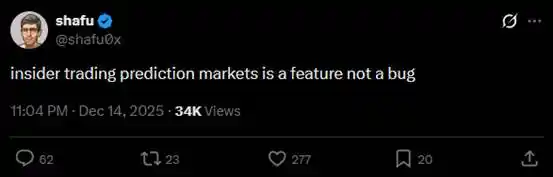
Players who hold this view believe that as long as the information leaked through insider trading has 'overall positive externality,' it is justified. They also believe that prediction markets cannot do without these insiders because without them, the accuracy of event predictions in prediction markets would drop significantly, leaving only those without accurate information to bet against each other.

This view has some merit, but I think prediction market platforms themselves would resist such positioning because, in the long run, it would harm retail trust. The entire market would essentially change from a platform encouraging individual research and insight, aggregating collective wisdom, into a one-sided 'slaughter' by insiders, which is not conducive to the development of liquidity. If prediction markets were like this, it would be better to rename them 'information bounty platforms.'
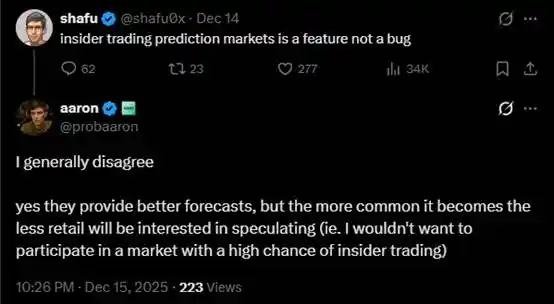
Overall, I believe that platforms like Polymarket, built on-chain, with transparent movements and anonymity, fulfill our expectations of decentralization—anyone can freely send signals through prediction markets without worrying about anything, only needing to be responsible for their own bets. The harsh reality is that there are too many wealth transfers caused by information asymmetry in the world, and those that occur in prediction markets or stock markets might be the ones we feel most keenly.

As for whether prediction markets themselves should maintain a relatively fairer environment for retail investors and whether they need to sustain a more acceptable positioning for the public for sustainable development, that is a question they should consider.

Conclusion

There are actually many interesting questions, such as whether there will be a prediction market in the future that can challenge Kalshi and Polymarket? If prediction market compliance continues to advance worldwide, will each country and region have its own leader (because these markets can do better localization and provide prediction events more friendly to users in their respective countries and regions), etc.

Prediction markets are not exactly new, but the compliance of prediction markets is a very new, very avant-garde bold attempt. I believe that over time, the various questions mentioned in this article will have interesting answers that we cannot anticipate.


İlgili Sorular

QWhy did prediction markets take nearly 40 years to experience a major breakout in 2025?

APrediction markets saw explosive growth in 2025 due to key regulatory advancements, such as CFTC approvals allowing platforms like Polymarket and Kalshi to operate legally in the U.S., expanded distribution channels, increased institutional investment, richer event diversity including sports and crypto, and improved product experiences aided by AI tools.

QHow does the U.S. government distinguish prediction markets from traditional gambling?

AThe U.S. government treats prediction markets as legal commodity derivatives rather than gambling because of their 'positive externalities,' such as improving information efficiency and aiding decision-making. Unlike traditional gambling, prediction markets use peer-to-peer betting without a house setting odds, reducing manipulation risks, and they operate under specific regulatory frameworks like the Commodity Exchange Act.

QWhat role did regulatory changes play in the growth of prediction markets in 2025?

ARegulatory changes were crucial: the CFTC approved platforms like Polymarket as designated contract markets, allowing nationwide distribution in all 50 states. This legitimacy attracted institutional investors, facilitated major funding rounds, expanded event types like sports and crypto predictions, and enhanced public trust through media and tech integrations.

QAre prediction markets considered a haven for insider trading, and how is this viewed?

ASome argue that insider trading on prediction markets like Polymarket can be beneficial because it leads to more accurate information disclosure and positive externalities. However, platforms generally resist this perception, as it could undermine散户 trust and liquidity, turning the market into an 'information bounty' system rather than a fair collective intelligence platform.

QWhat are the main factors that contributed to the user and volume growth of prediction markets in 2025?

AKey factors include regulatory approvals expanding access, integration with major platforms like Robinhood and Coinbase, a wider range of预测事件 such as sports and elections, increased institutional funding improving liquidity and product quality, and AI-driven tools enhancing user experience and market efficiency.

İlgili Okumalar

Jensen Huang 'Saves' South Korean Stock Market: Locks In SK Hynix Memory, Chip Shortage to Continue

On June 5th, South Korea's stock market experienced a sharp decline, with major chipmakers like Samsung and SK Hynix dropping nearly 10%. Amidst the turmoil, NVIDIA CEO Jensen Huang's visit to Seoul played a dramatic role in boosting market sentiment. Following a dinner meeting with SK Group Chairman Chey Tae-won and SK Hynix CEO Kwak Noh-Jung, Huang confirmed that NVIDIA's new Vera CPU will utilize SK Hynix DRAM. The companies announced a multi-year technical partnership to co-develop next-generation memory for NVIDIA's AI infrastructure, covering products from data centers to personal AI and robotics. This collaboration extends beyond memory supply. SK Hynix is integrating NVIDIA's AI and Omniverse platform into its own semiconductor design and manufacturing processes, including computational lithography and creating digital twins of its fabrication plants for autonomous operation. While strengthening ties with SK Hynix, NVIDIA is diversifying its supply chain for the upcoming HBM4 memory, with Samsung, SK Hynix, and Micron all certified as suppliers for its Vera Rubin platform. Despite this, Huang warned that the global chip shortage, driven by relentless demand from AI factory construction, is expected to persist for several years across the entire supply chain. His visit underscores NVIDIA's systematic effort to deepen integration with South Korea's broader tech industry.

marsbit44 dk önce

Jensen Huang 'Saves' South Korean Stock Market: Locks In SK Hynix Memory, Chip Shortage to Continue

marsbit44 dk önce

Nasdaq Plunges 4.2% in a Single Day: Does "Black Friday" Burst the U.S. Stock Market Bubble?

The Nasdaq plunged 4.18% on June 5, 2026, its worst single-day drop in over a year, as a much stronger-than-expected US jobs report triggered fears of economic overheating and delayed Federal Reserve interest rate cuts. The selloff, centered on high-valuation tech and AI stocks like Nvidia and Broadcom, spread across major indices. The article examines whether this signals a market top. The strong May non-farm payrolls data, nearly double expectations, pushed bond yields higher, directly hurting rate-sensitive tech stocks. This exposed vulnerabilities in the crowded AI trade, where valuations had soared on narratives of infinite growth, despite emerging signs of slowing order momentum and corporate AI monetization challenges. Prior to the drop, market indicators flashed warning signs: historically high valuations (e.g., Shiller CAPE ratio near 39.5), extreme bullish sentiment, and high levels of leverage. Technical charts showed key support levels being breached. Wall Street is divided on the outlook. Bears, citing risks of "stagflation" and AI bubble comparisons to the dot-com era, warn of a potential significant correction. Bulls view the drop as a healthy correction within a bull market, underpinned by a strong economy and expected corporate earnings growth of around 7% in 2026. The immediate future hinges on upcoming key events: the May CPI inflation data and the mid-June FOMC meeting. Their outcomes will critically shape market expectations for the Fed's rate path. The article concludes that conditions for a major market top are aligning, marking a fragile transition from narrative-driven gains to a phase demanding validation from macroeconomic data and corporate fundamentals. Caution is advised.

marsbit48 dk önce

Nasdaq Plunges 4.2% in a Single Day: Does "Black Friday" Burst the U.S. Stock Market Bubble?

marsbit48 dk önce

Nasdaq Plunges 4.2% in a Single Day, Did 'Black Friday' Pop the U.S. Stock Bubble?

The Nasdaq Composite plummeted 4.18% on June 5, its biggest single-day drop since April 2025, triggering widespread debate over whether the U.S. stock market has peaked. The sell-off was sparked by a stronger-than-expected U.S. non-farm payrolls report, which fueled fears of economic overheating and pushed back market expectations for Federal Reserve rate cuts, leading to a sharp rise in Treasury yields. The AI sector, the primary driver of the recent bull market, suffered severe losses, with the Philadelphia Semiconductor Index crashing over 10%. Stocks like Nvidia, Broadcom, and Micron led the decline. Concerns are mounting about the sustainability of AI capital expenditures and high valuations, with signs of order cuts for next-generation chips emerging. Analyses point to several warning signs: historically high market valuations (e.g., elevated Shiller CAPE ratio, Buffett Indicator), extreme bullish sentiment indicators, and significant insider selling. The sell-off also caused a key technical breakdown, with the S&P 500 breaking below its short-term moving average and testing its 200-day moving average. Wall Street is divided on the outlook. Bears warn this could be the start of a bubble deflation or a "stagflation" scenario, while bulls view it as a healthy, overdue correction within a bull market driven by solid corporate earnings growth. A more moderate view suggests the easy liquidity-driven rally is over, and markets are entering a phase of fundamental stock-picking with potential for consolidation. The immediate future hinges on key upcoming events: the May CPI report and the mid-June FOMC meeting. Their outcomes will be critical in determining whether this is a temporary pullback or the beginning of a more significant trend reversal. The consensus is that the era of one-directional market gains may be ending, requiring increased investor caution.

Odaily星球日报54 dk önce

Nasdaq Plunges 4.2% in a Single Day, Did 'Black Friday' Pop the U.S. Stock Bubble?

Odaily星球日报54 dk önce

The First Case on AI Agents: What Was Adjudicated?

"The First 'Agent' Ruling: What Was Decided?" On April 30, the Guangzhou Internet Court issued a ruling—China's first behavior preservation order in the intelligent agent (AI agent) field. The defendant, an open-source AI agent software, was ordered to stop downloads, cease actions that bypassed a platform's technical protection measures, and delete related tutorials and data. The core issue: the software used the operating system's "accessibility service" permissions to automate user interactions within other apps without those platforms' authorization. This mirrors a recent US case where Amazon sued Perplexity for similar reasons—bypassing Amazon's API to directly scrape and interact with its pages—and won a preliminary injunction. Both rulings establish a crucial legal boundary for the AI agent era: agents cannot operate unchecked. The article argues the fundamental legal principle emerging is one of **dual authorization**. An AI agent requires both **user consent** AND **platform consent** to operate legitimately within that platform's ecosystem. Bypassing platform rules through system-level permissions, even with user permission, undermines platform responsibilities for content moderation, data security, and user privacy, creating liability issues. The piece uses the evolution of "Doubao Phone" (an AI-integrated smartphone) as a case study. Its initial, aggressive version that bypassed platform controls faced roadblocks. Its upcoming 2.0 version is reportedly pivoting to negotiate API access and authorization deals with major platforms (like Alibaba's ecosystem), seen as a strategic adaptation to the new regulatory reality. A global trend is identified: the era of unregulated, "wild west" growth for AI agents is ending, replaced by a **compliance race**. This raises barriers to entry, as securing platform authorizations becomes a new cost. Open-source status is also not a legal shield if the code facilitates bypassing technical protections. In conclusion, these first rulings target not the largest, but the most **aggressive and representative** cases. By setting precedent with them, regulators are efficiently steering the entire industry towards a new, more regulated operating paradigm defined by dual authorization and platform cooperation.

marsbit59 dk önce

The First Case on AI Agents: What Was Adjudicated?

marsbit59 dk önce

Fired by Google Over a 14-Page Paper, Over 4,000 Rallied for Her. 6 Years Later: She Almost Predicted the Entire AI Era Back Then.

In late 2020, Google AI researcher Timnit Gebru was effectively dismissed following a conflict over a 14-page, unpublished research paper she co-authored titled "On the Dangers of Stochastic Parrots." The paper, which has since been cited over 14,000 times, raised critical early warnings about the risks of large language models (LLMs). It argued that these models, trained on vast, biased internet data, are essentially "stochastic parrots" that mimic language without true understanding, potentially amplifying societal biases, generating plausible but false information (later termed "AI hallucination"), consuming massive energy, and obscuring their training data contents. Gebru's stance led to a clash with Google management, who requested the paper's withdrawal. Her subsequent internal criticism of the company's diversity efforts and handling of the matter culminated in her termination, which sparked protests from over 4,000 Google employees and researchers. Six years later, the paper's predictions have proven remarkably prescient. Issues like AI hallucination, embedded bias (evident in resume screening and healthcare algorithms), soaring energy consumption from AI data centers, unvetted training data containing harmful content, and the risk of "model collapse" from AI-generated internet content have become central industry challenges. The incident also highlighted concerns about AI development being driven primarily by commercial competition within a handful of powerful tech companies, often at the expense of ethical considerations. After leaving Google, Gebru founded the Distributed AI Research Institute (DAIR) to explore these issues independently. The controversy underscores how her early, critical insights into the fundamental limitations and societal impacts of LLMs anticipated many of the most pressing dilemmas in today's AI era.

marsbit1 saat önce

Fired by Google Over a 14-Page Paper, Over 4,000 Rallied for Her. 6 Years Later: She Almost Predicted the Entire AI Era Back Then.

marsbit1 saat önce

İşlemler

Spot
Futures

Popüler Makaleler

BILL Nasıl Satın Alınır

HTX.com’a hoş geldiniz! Billions Network (BILL) satın alma işlemlerini basit ve kullanışlı bir hâle getirdik. Adım adım açıkladığımız rehberimizi takip ederek kripto yolculuğunuza başlayın. 1. Adım: HTX Hesabınızı OluşturunHTX'te ücretsiz bir hesap açmak için e-posta adresinizi veya telefon numaranızı kullanın. Sorunsuzca kaydolun ve tüm özelliklerin kilidini açın. Hesabımı Aç2. Adım: Kripto Satın Al Bölümüne Gidin ve Ödeme Yönteminizi SeçinKredi/Banka Kartı: Visa veya Mastercard'ınızı kullanarak anında Billions Network (BILL) satın alın.Bakiye: Sorunsuz bir şekilde işlem yapmak için HTX hesap bakiyenizdeki fonları kullanın.Üçüncü Taraflar: Kullanımı kolaylaştırmak için Google Pay ve Apple Pay gibi popüler ödeme yöntemlerini ekledik.P2P: HTX'teki diğer kullanıcılarla doğrudan işlem yapın.Borsa Dışı (OTC): Yatırımcılar için kişiye özel hizmetler ve rekabetçi döviz kurları sunuyoruz.3. Adım: Billions Network (BILL) Varlıklarınızı SaklayınBillions Network (BILL) satın aldıktan sonra HTX hesabınızda saklayın. Alternatif olarak, blok zinciri transferi yoluyla başka bir yere gönderebilir veya diğer kripto para birimlerini takas etmek için kullanabilirsiniz.4. Adım: Billions Network (BILL) Varlıklarınızla İşlem YapınHTX'in spot piyasasında Billions Network (BILL) ile kolayca işlemler yapın.Hesabınıza erişin, işlem çiftinizi seçin, işlemlerinizi gerçekleştirin ve gerçek zamanlı olarak izleyin. Hem yeni başlayanlar hem de deneyimli yatırımcılar için kullanıcı dostu bir deneyim sunuyoruz.

255 Toplam GörüntülenmeYayınlanma 2026.05.07Güncellenme 2026.06.02

BILL Nasıl Satın Alınır

ATWO Nedir

I. Proje TanıtımıArena Two, hayranların gerçek zamanlı etkinlik sonuçlarında aktif, tokenleştirilmiş bir rol oynamasına olanak tanıyan merkeziyetsiz bir etkileşimli platformdur. Hayranları pasif izleyicilere indirgeyen geleneksel yayıncılık modellerinin aksine, Arena Two, hayranların doğrudan gerçek zamanlı oy kullanmalarını ve sahadaki sonuçları etkilemelerini sağlamak için blok zinciri teknolojisini kullanır.II. Token BilgileriToken adı: ATWO(Arena Two)III. İlgili BağlantılarWeb sitesi:https://arenatwo.com/Keşif araçları:https://basescan.org/token/0x499D35eBE6cEe9B2Ac35Fd003fcBbeeB9CFc7B32Twitter:https://x.com/arenatwoXNot: Proje tanıtımı, resmi proje ekibi tarafından yayınlanan veya sağlanan materyallerden gelmektedir ve yalnızca referans amaçlıdır, yatırım tavsiyesi niteliği taşımaz. HTX, ortaya çıkan doğrudan veya dolaylı kayıplardan sorumluluk kabul etmez.

236 Toplam GörüntülenmeYayınlanma 2026.05.18Güncellenme 2026.06.02

ATWO Nedir

ATWO Nasıl Satın Alınır

HTX.com’a hoş geldiniz! Arena Two (ATWO) satın alma işlemlerini basit ve kullanışlı bir hâle getirdik. Adım adım açıkladığımız rehberimizi takip ederek kripto yolculuğunuza başlayın. 1. Adım: HTX Hesabınızı OluşturunHTX'te ücretsiz bir hesap açmak için e-posta adresinizi veya telefon numaranızı kullanın. Sorunsuzca kaydolun ve tüm özelliklerin kilidini açın. Hesabımı Aç2. Adım: Kripto Satın Al Bölümüne Gidin ve Ödeme Yönteminizi SeçinKredi/Banka Kartı: Visa veya Mastercard'ınızı kullanarak anında Arena Two (ATWO) satın alın.Bakiye: Sorunsuz bir şekilde işlem yapmak için HTX hesap bakiyenizdeki fonları kullanın.Üçüncü Taraflar: Kullanımı kolaylaştırmak için Google Pay ve Apple Pay gibi popüler ödeme yöntemlerini ekledik.P2P: HTX'teki diğer kullanıcılarla doğrudan işlem yapın.Borsa Dışı (OTC): Yatırımcılar için kişiye özel hizmetler ve rekabetçi döviz kurları sunuyoruz.3. Adım: Arena Two (ATWO) Varlıklarınızı SaklayınArena Two (ATWO) satın aldıktan sonra HTX hesabınızda saklayın. Alternatif olarak, blok zinciri transferi yoluyla başka bir yere gönderebilir veya diğer kripto para birimlerini takas etmek için kullanabilirsiniz.4. Adım: Arena Two (ATWO) Varlıklarınızla İşlem YapınHTX'in spot piyasasında Arena Two (ATWO) ile kolayca işlemler yapın.Hesabınıza erişin, işlem çiftinizi seçin, işlemlerinizi gerçekleştirin ve gerçek zamanlı olarak izleyin. Hem yeni başlayanlar hem de deneyimli yatırımcılar için kullanıcı dostu bir deneyim sunuyoruz.

162 Toplam GörüntülenmeYayınlanma 2026.05.18Güncellenme 2026.06.02

ATWO Nasıl Satın Alınır

Tartışmalar

HTX Topluluğuna hoş geldiniz. Burada, en son platform gelişmeleri hakkında bilgi sahibi olabilir ve profesyonel piyasa görüşlerine erişebilirsiniz. Kullanıcıların A (A) fiyatı hakkındaki görüşleri aşağıda sunulmaktadır.

活动图片