Why Crypto Cards Are Doomed to Fail?

marsbit2025-12-12 tarihinde yayınlandı2025-12-12 tarihinde güncellendi

Özet

Crypto cards are a temporary solution designed to bridge traditional payment systems with the cryptocurrency world, but they are ultimately doomed to fail. They rely on centralized banking infrastructure, depend on compliance with traditional financial regulations, and lack the privacy and decentralization that are core to crypto values. These cards function as an abstraction layer, adding extra fees and complexity while still being controlled by entities like Visa or Mastercard. They do not replace traditional payment systems but instead reinforce them. Most crypto cards operate like liquidity bridges, converting crypto to fiat for spending, which incurs taxable events and additional costs. They also fail to provide true financial inclusivity, as users from restricted countries cannot access them, contradicting crypto’s ethos of equality. While companies continue developing crypto cards to lock users into their ecosystems (e.g., MetaMask using Linea), these efforts are largely superficial, relying on third-party services like Rain for infrastructure. The only model that aligns with crypto principles is EtherFi, which allows users to spend against crypto collateral without selling assets, avoiding taxable events and embodying a true DeFi-TradFi hybrid. Ultimately, crypto cards are a flawed transitional product, not a long-term innovation.

Editor's Note: Crypto cards were once seen as a bridge connecting the traditional payment system with the crypto world, but as the industry develops, the limitations of this model have become increasingly apparent: centralization, reliance on compliance, lack of privacy, additional fees, and even a departure from the core spirit of cryptocurrency.

This article provides an in-depth analysis of the nature of crypto cards, pointing out that they are merely transitional solutions, not true innovations in decentralized payments. At the same time, the article presents EtherFi as one of the few models that aligns with crypto values, demonstrating the potential for DeFi and TradFi integration.

Below is the original text:

My overall view is that crypto cards are only a temporary solution to address two problems we all know well: first, bringing cryptocurrency to the masses; second, ensuring that cryptocurrency can be accepted as a payment method globally.

Crypto cards are still cards after all. If someone truly identifies with the core values of cryptocurrency but believes that the future will be dominated by cards, then you might need to rethink your vision.

All Crypto Card Companies Will Eventually Fail


In the long run, crypto cards will likely die out, but traditional cards will not. Crypto cards just add a layer of abstraction; they are not pure cryptocurrency use cases. The card issuer is still a bank. Yes, they may have different logos, different designs, different user experiences, but as I said before, this is just abstraction. Abstraction makes things more convenient for users, but the underlying process hasn't changed.

Different public chains and Rollups have been obsessed with comparing their TPS and infrastructure to Visa and Mastercard. This goal has existed for years: either "replace" or, more aggressively, "disrupt" Visa, Mastercard, AmEx, and other payment processors.

But this goal cannot be achieved through crypto cards—they are not replacements; instead, they bring more value to Visa and Mastercard.

These institutions are still the critical "gatekeepers." They have the power to set rules, define compliance standards, and even ban your card, company, or even bank if necessary.

Why would an industry that has always pursued "permissionless" and "decentralized" ideals now hand everything over to payment processors?

Your card is Visa, not Ethereum. Your card is a traditional bank, not MetaMask. You are spending fiat, not cryptocurrency.

Your favorite crypto card companies have done almost nothing except put their logo on the card. They are just riding the narrative and will disappear in a few years, and those digital cards issued until 2030 won't actually function by then.

I'll explain later how easy it is to make a crypto card now—in the future, you might even make one yourself!

The Same Problems + More Fees

The best analogy I can think of is "Application-Specific Sequencing." Yes, it's cool that applications can process transactions themselves and profit from it, but it's only temporary: infrastructure costs are falling, communication is maturing, and the economic issues exist at a higher level, not a lower one. (If you're interested, check out @mvyletel_jr's great talk on ASS.)

The same goes for crypto cards. Yes, you can top up with cryptocurrency, and the card will convert it to fiat for payment, but the problems of centralization and permissioned access remain.

It does help in the short term: merchants don't need to adopt new payment methods, and crypto spending is almost "invisible."

But this is just a transitional step toward what most crypto believers truly want:
Demand: Pay directly with stablecoins, Solana, Ethereum, Zcash
No need: The indirect path of USDT → Crypto Card → Bank → Fiat

Adding a layer of abstraction adds a layer of fees: spread fees, withdrawal fees, transfer fees, and sometimes even custody earnings. These fees may seem insignificant, but they compound: a penny saved is a penny earned.

Using a Crypto Card Doesn't Mean You Are "Unbanked" or "Debanked"

Another misconception I've observed is that people think using a crypto card means they are unbanked or debanked. Of course, this isn't true. Under the label of a crypto card, there is still a bank, and the bank must report some of your information to the local government. Not all data, but at least some key data.

If you are an EU citizen or resident, the government will know your bank account earnings, large suspicious transactions, certain investment income, account balances, etc. If the underlying bank is in the US, they know even more.

From a crypto perspective, this has both pros and cons. The pro is transparency and verifiability, but the same rules apply when you use a standard debit or credit card from your local bank. The con is that it is not anonymous or pseudonymous: the bank still sees your name, not an EVM or SVM address, and you still need to do KYC.

Limitations Still Exist

You might say that crypto cards are great because they are really easy to set up: download the app, complete KYC, wait 1–2 minutes for verification, top up with cryptocurrency, and then you're ready to use it. Yes, this is indeed a killer feature, extremely convenient, but not everyone can use it.

Russia, Ukraine, Syria, Iraq, Iran, Myanmar, Lebanon, Afghanistan, and half of Africa—citizens of these countries cannot use cryptocurrency for daily spending without residency in another country.

But hey, it's only 10–20 countries that don't qualify, what about the other 150+ countries? The issue is not whether the majority can use it, but the core value of crypto: a decentralized network with equal nodes, financial equality, and equal rights for all. This does not exist in crypto cards because they are not "crypto" at all.

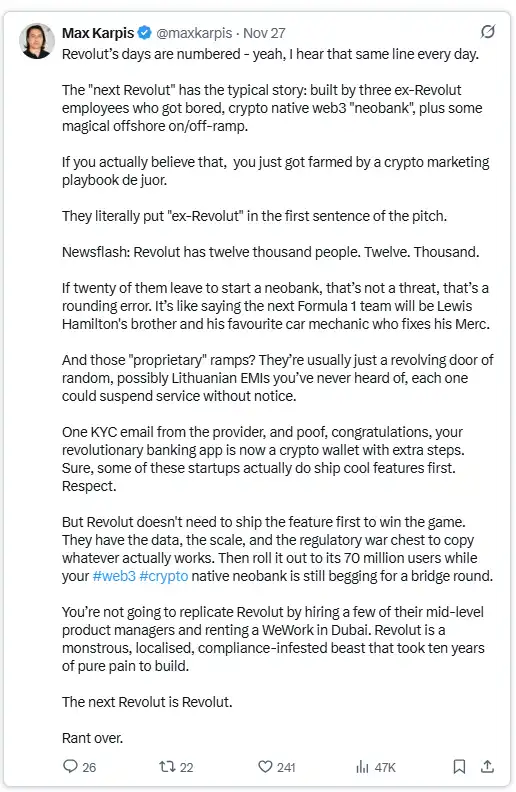
Max Karpis perfectly explains here why "neo-banks" are doomed to fail from the start.
For reference, a real scenario where I used cryptocurrency for payment was when booking a flight on Trip.com. They recently added an option to pay with stablecoins, directly from your wallet, and of course, it's available to anyone in the world.
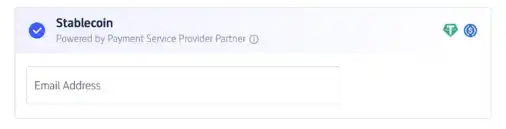
This is the real cryptocurrency use case and a true crypto payment. I believe the final form will be like this: wallets will be specifically optimized for the user experience of payments and spending, or (less likely) wallets will evolve into crypto cards, if crypto payments are somehow widely adopted.

Crypto Cards Function Similarly to Liquidity Bridges (Rain)

I have an interesting observation: self-custody crypto cards operate very similarly to cross-chain bridges.

This only applies to self-custody cards: cards issued by centralized exchanges (CEX) are not self-custody, so exchanges like Coinbase have no obligation to make users think the funds are under their control.

A legitimate use case for CEX cards is that they can serve as proof of funds for government, visa applications, or similar scenarios. When you use a crypto card tied to your CEX balance, you are still within the same ecosystem.

Self-custody crypto cards are different: they operate like liquidity bridges, where you lock funds (cryptocurrency) on chain A (crypto balance), and then unlock funds (fiat) on chain B (the real world).

This "bridge" in the crypto card space is like the shovel during the California Gold Rush: it is the key secure channel connecting crypto-native users and businesses that want to issue their own cards.

@stablewatchHQ's analysis of this bridge is spot-on, considering it essentially a Card-as-a-Service (CaaS) model. This is the most overlooked aspect by everyone discussing crypto cards. These CaaS platforms provide the infrastructure for businesses to launch their own branded cards.
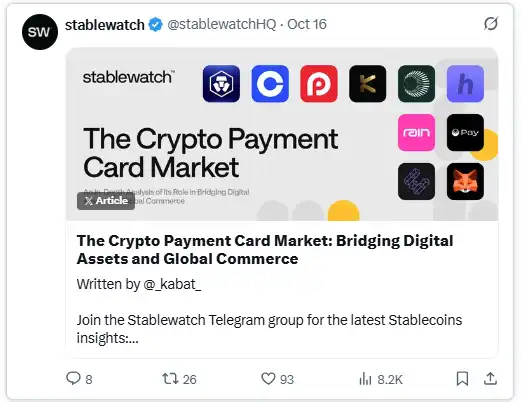
Rain: How Crypto Cards Are Born

About half of your favorite crypto cards are probably powered by @raincards, and you may never have heard of it. Rain is one of the most fundamental protocols in the neo-banking system because it handles almost all the core components behind crypto cards. All that's left for the remaining companies to do is slap their logo on it (sounds harsh, but it's close to the truth).
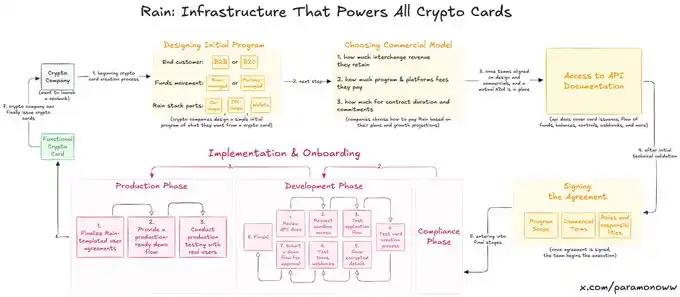
Rain enables companies to quickly launch their own crypto cards, and frankly, Rain's execution capabilities could even allow it to exist long-term outside the crypto space. So, stop fantasizing that teams need to raise tens of millions of dollars to issue a crypto card—they don't need that capital; they just need Rain.

The reason I emphasize Rain so much is that people generally overestimate the effort required to issue a crypto card. Maybe I'll write a separate article about Rain in the future because it is truly a severely underestimated technology.

Crypto Cards Have No Privacy or Anonymity

The lack of privacy or anonymity in crypto cards is not a problem with the cards themselves, but rather an issue deliberately ignored by those promoting them, hiding behind so-called "crypto values."


Privacy is not a widely used feature in the crypto space; pseudoprivacy (pseudonymity) does exist because we see addresses, not names. However, if you are ZachXBT, Wintermute's Igor Igamberdiev, Paradigm's Storm, or someone else with strong on-chain analysis capabilities, you can significantly narrow down the real identity corresponding to an address.

Of course, crypto cards don't even have the pseudonymity of traditional cryptocurrencies because you must complete KYC to activate a crypto card (actually, you're not activating a crypto card; you're opening a bank account).

If you are in the EU, the company providing the crypto card will still send some of your data to the government for tax purposes or other reasons the government needs to know. Now, you've given regulators a new opportunity to track you: linking your crypto address to your real identity.

Personal Data: The Currency of the Future

Cash still exists (the only form of anonymity, except the seller seeing you) and will exist for a long time. But eventually, everything will be digitized. The current digital system does not offer any benefits to consumers in terms of privacy: the more you spend, the higher the fees you pay, and in exchange, they know more about you. What a "great deal"!


Privacy is a luxury, and in the crypto card space, it will remain so. An interesting idea is that if we achieve truly good privacy, even to the point where businesses and institutions are willing to pay for it (not like Facebook, but with our consent), it could become the currency of the future, or even the only currency in a jobless, AI-driven world.

If Everything Is Doomed to Fail, Why Are Tempo, Arc Plasma, Stable Still Being Built?

The answer is simple—to lock users into the ecosystem.

Most non-custodial cards choose L2s (e.g., MetaMask uses @LineaBuild) or independent L1s (e.g., Plasma Card uses @Plasma). Due to high costs and finality issues, Ethereum or Bitcoin are generally not suitable for such operations. Some cards use Solana, but this is still a minority.

Of course, companies choose different blockchains not only for infrastructure but also for economic benefits.

MetaMask uses Linea not because Linea is the fastest or most secure, but because both Linea and MetaMask belong to the ConsenSys ecosystem.

I specifically use MetaMask as an example because it uses Linea. Everyone knows that almost no one uses Linea; it is far behind Base or Arbitrum in the L2 competition.

But ConsenSys made a smart decision to put Linea underneath their card because it locks users into the ecosystem. Users get accustomed to a good user experience through something they use daily. Linea naturally attracts liquidity, trading volume, and other metrics, rather than relying on liquidity mining campaigns or begging users to bridge.

This strategy is similar to what Apple did when it launched the iPhone in 2007, keeping users on iOS until they become so habituated they can't switch to another ecosystem. Never underestimate the power of habit.

EtherFi Is the Only Viable Crypto Card

After all this thinking, I've concluded that: @ether_fi is probably the only crypto card that truly aligns with the crypto spirit (this research is not sponsored by EtherFi, and even if it were, I wouldn't mind).

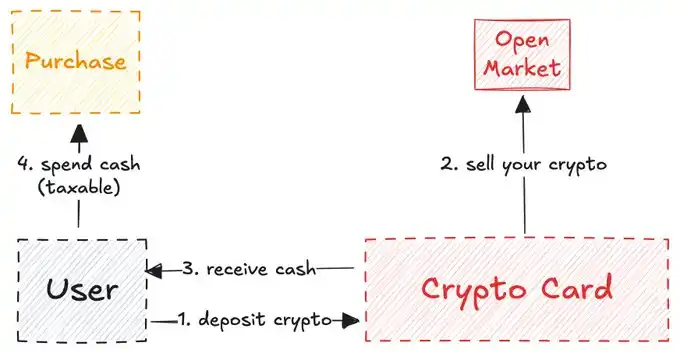
In most crypto cards, the cryptocurrency you top up is sold, and then your balance is replenished with cash (similar to the liquidity bridge I described earlier).

EtherFi is different: the system never sells your cryptocurrency; instead, it gives you a cash loan and uses your crypto assets to earn yield.

EtherFi's model is similar to Aave. Most DeFi users dream of seamlessly taking out cash loans collateralized by their crypto assets, and this capability has emerged. You might ask: "Isn't this the same? I can top up with crypto and spend with a crypto card like a normal debit card; is this extra step necessary?"
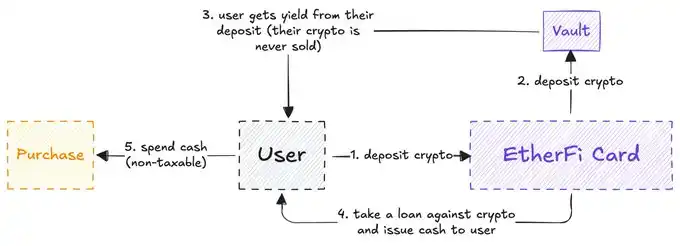
The problem is that selling your cryptocurrency is a taxable event, sometimes even more taxable than daily spending. And in most cards, every operation you do might be taxed, leading to you paying more taxes (again, using a crypto card does not mean being debanked).

EtherFi solves this problem to some extent because you are not actually selling cryptocurrency; you are just using it as collateral for a loan.

For this reason alone (plus no foreign exchange fees on USD, cashback, and other benefits), EtherFi becomes the best example of the convergence of DeFi and TradFi.

Most cards try to pretend they are crypto products but are actually just liquidity bridges, while EtherFi is truly for crypto users, not just for bringing cryptocurrency to the masses: it allows crypto users to spend locally until the masses realize how cool this model is. Among all crypto cards, EtherFi might be the only one that can survive long-term.

I think crypto cards are an experimental field, but unfortunately, most teams you see are just riding the narrative without giving due recognition to the underlying systems and developers.

Let's see where progress and innovation take us. Currently, we are seeing the globalization of crypto cards (horizontal growth), but there is a lack of vertical growth, which is precisely what this payment technology needs in its early stages.


İlgili Sorular

QWhy does the author believe that crypto cards are ultimately doomed to fail?

AThe author argues that crypto cards are merely a temporary solution that adds a layer of abstraction without addressing the core values of cryptocurrency, such as decentralization and permissionless access. They rely on traditional banking systems and payment processors like Visa and Mastercard, which centralize control, impose fees, and require KYC, contradicting crypto's foundational principles.

QWhat is the fundamental issue with the privacy and anonymity of crypto cards?

ACrypto cards lack privacy and anonymity because they require KYC (Know Your Customer) verification, linking users' real identities to their transactions. Unlike pseudonymous crypto transactions using addresses, crypto cards expose personal data to banks and governments, eliminating any form of financial privacy.

QHow does the author describe the operational model of most self-custody crypto cards?

AThe author compares self-custody crypto cards to liquidity bridges: users lock funds in cryptocurrency on one chain (e.g., a blockchain), and the card unlocks fiat currency in the real world for spending. This model involves intermediaries and fees, similar to a cross-chain bridge, rather than enabling direct crypto payments.

QWhat makes EtherFi's crypto card different from others according to the author?

AEtherFi's card differs by not selling users' cryptocurrency for fiat. Instead, it provides cash loans collateralized by crypto assets, allowing users to spend without triggering taxable events. This model aligns with DeFi principles, such as earning yield on locked assets, and avoids the pitfalls of traditional crypto cards that rely on selling crypto.

QWhy do companies build crypto cards despite their perceived limitations and inevitable failure?

ACompanies build crypto cards primarily to lock users into their ecosystems, leveraging habit and convenience to retain them. For example, MetaMask uses Linea to integrate users into ConsenSys' ecosystem. This strategy mimics Apple's approach with iOS, fostering user dependency rather than genuinely advancing crypto payment innovation.

İlgili Okumalar

$292 Million KelpDAO Cross-Chain Bridge Hack: Who Should Foot the Bill?

On April 18, 2026, an attacker stole 116,500 rsETH (worth ~$292M) from KelpDAO’s cross-chain bridge in 46 minutes—the largest DeFi exploit of 2026. The stolen assets were deposited into Aave V3 as collateral, causing $177–200M in bad debt and triggering a cascade of losses across nine DeFi protocols. Aave’s TVL dropped by ~$6B overnight. This legal analysis argues that KelpDAO and LayerZero Labs share concurrent liability, with fault apportioned 60%/40%. KelpDAO negligently configured its bridge with a 1-of-1 decentralized verifier network (DVN)—a single point of failure—despite LayerZero’s explicit recommendation of a 2-of-3 setup. LayerZero, which operated the compromised DVN, failed to secure its RPC infrastructure against a known poisoning attack vector. Both protocols’ terms of service cap liability at $200 (KelpDAO) or $50 (LayerZero), but these limits are likely unenforceable due to unconscionability, gross negligence exceptions, and potential securities law invalidation (if rsETH is deemed a security under the Howey test). Aave’s governance also faces fiduciary duty claims for raising rsETH’s loan-to-value ratio to 93%—far above competitors’ 72–75%—without adequately assessing bridge risks, amplifying the systemic fallout. Practical recovery targets include LayerZero Labs (a registered Canadian entity), KelpDAO’s founders, auditors, and identifiable Aave governance delegates. The incident underscores escalating legal risks for DeFi protocols, infrastructure providers, and governance participants.

marsbit53 dk önce

$292 Million KelpDAO Cross-Chain Bridge Hack: Who Should Foot the Bill?

marsbit53 dk önce

Insider Trading in War: 5 People Involved, the Highest Earner Was Arrested

On April 24, the U.S. Department of Justice arrested U.S. Army Special Forces Staff Sergeant Gannon Ken Van Dyke for insider trading related to the capture of Venezuelan President Nicolás Maduro on January 3. Van Dyke allegedly profited over $400,000 by placing bets on a prediction market, Polymarket, using insider knowledge of the covert operation. According to the indictment, Van Dyke registered an account (0x31a5) on December 26 and made a series of bets predicting Maduro’s capture and U.S. military involvement in Venezuela. He withdrew most of his funds on the day of the operation and attempted to obscure his tracks by transferring assets through crypto and brokerage accounts. This case marks the first time the DOJ has prosecuted insider trading on Polymarket. PolyBeats had previously identified five suspicious accounts, including Van Dyke’s—the highest earner—in January. The other accounts, with profits ranging from $34,000 to $145,000, remain under unofficial scrutiny but have not been charged. Their lower profits, indirect access to information, and unclear legal boundaries may complicate prosecution. Polymarket has since strengthened its market integrity rules, explicitly prohibiting trading based on confidential or insider information. Van Dyke’s arrest, nearly four months after his trades, signals increased regulatory attention and the persistent traceability of blockchain-based transactions.

marsbit55 dk önce

Insider Trading in War: 5 People Involved, the Highest Earner Was Arrested

marsbit55 dk önce

Bitwise: Bullish on Bitcoin's Performance in the Second Half of the Year, AI and Regulation Will Spark a New Altcoin Season

Bitwise CIO Matt Hougan and Research Lead Ryan Rasmussen express strong bullish sentiment on Bitcoin's long-term prospects, suggesting that its $1 million price target may be too conservative. They argue Bitcoin serves a dual role: as digital gold and a potential global settlement asset, especially amid declining trust in traditional monetary systems. Despite a weak Q1 2026 where nearly all crypto assets and prices saw double-digit declines, the analysts remain optimistic due to strong forward-looking catalysts, including institutional adoption via Bitcoin ETFs from major firms like Morgan Stanley and Goldman Sachs. Geopolitical instability, such as Iran’s mention of using Bitcoin for international payments, increases the value of Bitcoin’s “out-of-the-money call option” as a non-political, global settlement currency. This enhances its appeal beyond a mere store of value. . Additionally, Hougan highlights that a clearer regulatory token framework under current SEC leadership, combined with AI efficiency gains and high-performance blockchains, could fuel a new “altseason” by late 2026. This may lead to a wave of legitimate, value-capturing token projects, unlike the earlier ICO boom. . Bitwise also announced an Avalanche ETF, citing its unique architecture and rapid growth in real-world asset (RWA) tokenization, which has surged 10x to nearly $30 billion in two years. The firm believes Layer 1 blockchains are still early in their growth cycle, with significant potential ahead.

marsbit1 saat önce

Bitwise: Bullish on Bitcoin's Performance in the Second Half of the Year, AI and Regulation Will Spark a New Altcoin Season

marsbit1 saat önce

İşlemler

Spot
Futures

Popüler Makaleler

$S$ Nedir

SPERO'yu Anlamak: Kapsamlı Bir Genel Bakış SPERO'ya Giriş İnovasyonun manzarası gelişmeye devam ederken, web3 teknolojilerinin ve kripto para projelerinin ortaya çıkışı dijital geleceği şekillendirmede önemli bir rol oynamaktadır. Bu dinamik alanda dikkat çeken projelerden biri SPERO, $$s$$ olarak adlandırılmaktadır. Bu makale, SPERO hakkında ayrıntılı bilgi toplamak ve sunmak amacıyla, meraklılar ve yatırımcıların web3 ve kripto alanlarındaki temellerini, hedeflerini ve yeniliklerini anlamalarına yardımcı olmayı amaçlamaktadır. SPERO,$$s$$ Nedir? SPERO,$$s$$, kripto alanında merkeziyetsizlik ve blok zinciri teknolojisi ilkelerini kullanarak etkileşimi, faydayı ve finansal kapsayıcılığı teşvik eden bir ekosistem yaratmayı amaçlayan benzersiz bir projedir. Proje, kullanıcıların yenilikçi finansal çözümler ve hizmetler sunarak eşler arası etkileşimleri yeni yollarla kolaylaştırmayı hedeflemektedir. SPERO,$$s$$'nin temel amacı, bireyleri güçlendirmek ve kripto para alanındaki kullanıcı deneyimini artıran araçlar ve platformlar sağlamaktır. Bu, daha esnek işlem yöntemlerini mümkün kılmayı, topluluk odaklı girişimleri teşvik etmeyi ve merkeziyetsiz uygulamalar (dApp'ler) aracılığıyla finansal fırsatlar yaratmayı içermektedir. SPERO,$$s$$'nin temel vizyonu kapsayıcılık etrafında dönmekte olup, geleneksel finansal sistemlerdeki boşlukları kapatmayı ve blok zinciri teknolojisinin faydalarından yararlanmayı hedeflemektedir. SPERO,$$s$$'nin Yaratıcısı Kimdir? SPERO,$$s$$'nin yaratıcısının kimliği bir miktar belirsizdir, çünkü kurucusu(ları) hakkında ayrıntılı arka plan bilgisi sağlayan sınırlı kamuya açık kaynaklar bulunmaktadır. Bu şeffaflık eksikliği, projenin merkeziyetsizlik taahhüdünden kaynaklanabilir—birçok web3 projesinin paylaştığı bir etik anlayışı, bireysel tanınmanın yerine kolektif katkıları önceliklendirmektedir. Topluluk ve onun kolektif hedefleri etrafında tartışmaları merkezileştirerek, SPERO,$$s$$, belirli bireyleri öne çıkarmadan güçlendirme özünü taşımaktadır. Bu nedenle, SPERO'nun etik anlayışını ve misyonunu anlamak, tek bir yaratıcının kimliğini belirlemekten daha önemlidir. SPERO,$$s$$'nin Yatırımcıları Kimlerdir? SPERO,$$s$$, kripto sektöründe yeniliği teşvik etmeye adanmış girişim sermayedarlarından melek yatırımcılara kadar çeşitli yatırımcılar tarafından desteklenmektedir. Bu yatırımcıların odak noktası genellikle SPERO'nun misyonuyla uyumlu olup, toplumsal teknolojik ilerlemeyi, finansal kapsayıcılığı ve merkeziyetsiz yönetimi vaat eden projeleri önceliklendirmektedir. Bu yatırımcı temelleri, yalnızca yenilikçi ürünler sunan projelere değil, aynı zamanda blok zinciri topluluğuna ve ekosistemlerine olumlu katkılarda bulunan projelere de ilgi duymaktadır. Bu yatırımcıların desteği, SPERO,$$s$$'yi hızla gelişen kripto projeleri alanında dikkate değer bir rakip haline getirmektedir. SPERO,$$s$$ Nasıl Çalışır? SPERO,$$s$$, onu geleneksel kripto para projelerinden ayıran çok yönlü bir çerçeve kullanmaktadır. İşte benzersizliğini ve yeniliğini vurgulayan bazı temel özellikler: Merkeziyetsiz Yönetim: SPERO,$$s$$, kullanıcıların projenin geleceğiyle ilgili karar alma süreçlerine aktif olarak katılmalarını sağlayan merkeziyetsiz yönetim modellerini entegre etmektedir. Bu yaklaşım, topluluk üyeleri arasında sahiplik ve hesap verebilirlik duygusunu teşvik etmektedir. Token Kullanımı: SPERO,$$s$$, ekosistem içinde çeşitli işlevler sunmak üzere tasarlanmış kendi kripto para token'ını kullanmaktadır. Bu token'lar, işlemleri, ödülleri ve platformda sunulan hizmetlerin kolaylaştırılmasını sağlayarak genel etkileşimi ve faydayı artırmaktadır. Katmanlı Mimari: SPERO,$$s$$'nin teknik mimarisi, modülerlik ve ölçeklenebilirliği destekleyerek projenin evrimi sırasında ek özelliklerin ve uygulamaların sorunsuz bir şekilde entegrasyonuna olanak tanımaktadır. Bu uyum sağlama yeteneği, sürekli değişen kripto manzarasında geçerliliği sürdürmek için hayati öneme sahiptir. Topluluk Katılımı: Proje, işbirliği ve geri bildirim teşvik eden mekanizmalar kullanarak topluluk odaklı girişimlere vurgu yapmaktadır. Güçlü bir topluluk oluşturarak, SPERO,$$s$$, kullanıcı ihtiyaçlarını daha iyi karşılayabilir ve piyasa trendlerine uyum sağlayabilir. Kapsayıcılığa Odaklanma: Düşük işlem ücretleri ve kullanıcı dostu arayüzler sunarak, SPERO,$$s$$, daha önce kripto alanında yer almamış bireyler de dahil olmak üzere çeşitli bir kullanıcı tabanını çekmeyi hedeflemektedir. Bu kapsayıcılık taahhüdü, erişilebilirlik yoluyla güçlendirme misyonuyla uyumludur. SPERO,$$s$$ Zaman Çizelgesi Bir projenin tarihini anlamak, gelişim yolculuğu ve kilometre taşları hakkında kritik bilgiler sağlar. Aşağıda, SPERO,$$s$$'nin evriminde önemli olayları haritalayan önerilen bir zaman çizelgesi bulunmaktadır: Kavram Geliştirme ve Fikir Aşaması: SPERO,$$s$$'nin temelini oluşturan ilk fikirler, blok zinciri endüstrisindeki merkeziyetsizlik ve topluluk odaklılık ilkeleriyle yakından uyumlu olarak geliştirildi. Proje Beyaz Kağıdının Yayınlanması: Kavramsal aşamayı takiben, SPERO,$$s$$'nin vizyonunu, hedeflerini ve teknolojik altyapısını ayrıntılı bir şekilde açıklayan kapsamlı bir beyaz kağıt yayımlandı ve topluluk ilgisini ve geri bildirimini toplamak amacıyla sunuldu. Topluluk Oluşturma ve Erken Katılımlar: Projenin hedefleri etrafında tartışmalar yürüterek destek toplamak ve erken benimseyenler ile potansiyel yatırımcılar için bir topluluk oluşturmak amacıyla aktif iletişim çabaları gerçekleştirildi. Token Üretim Etkinliği: SPERO,$$s$$, yerel token'larını erken destekçilere dağıtmak ve ekosistem içinde başlangıç likiditesini sağlamak amacıyla bir token üretim etkinliği (TGE) gerçekleştirdi. İlk dApp'in Yayınlanması: SPERO,$$s$$ ile ilişkili ilk merkeziyetsiz uygulama (dApp) faaliyete geçti ve kullanıcıların platformun temel işlevleriyle etkileşimde bulunmalarını sağladı. Sürekli Gelişim ve Ortaklıklar: Projenin tekliflerine sürekli güncellemeler ve iyileştirmeler yapılmakta olup, blok zinciri alanındaki diğer oyuncularla stratejik ortaklıklar, SPERO,$$s$$'yi rekabetçi ve gelişen bir oyuncu haline getirmiştir. Sonuç SPERO,$$s$$, web3 ve kripto paranın finansal sistemleri devrim niteliğinde dönüştürme ve bireyleri güçlendirme potansiyelinin bir kanıtıdır. Merkeziyetsiz yönetime, topluluk katılımına ve yenilikçi tasarlanmış işlevselliğe olan bağlılığıyla, daha kapsayıcı bir finansal manzaraya doğru bir yol açmaktadır. Hızla gelişen kripto alanındaki herhangi bir yatırımda olduğu gibi, potansiyel yatırımcılar ve kullanıcılar, SPERO,$$s$$ içindeki devam eden gelişmelerle ilgili olarak kapsamlı bir araştırma yapmaları ve düşünceli bir şekilde katılmaları teşvik edilmektedir. Proje, kripto endüstrisinin yenilikçi ruhunu sergileyerek, sayısız olasılığını keşfetmeye davet etmektedir. SPERO,$$s$$'nin yolculuğu hala devam ederken, temel ilkeleri, teknoloji, finans ve birbirimizle etkileşim biçimimizi etkileyebilir.

89 Toplam GörüntülenmeYayınlanma 2024.12.17Güncellenme 2024.12.17

$S$ Nedir

AGENT S Nedir

Agent S: Web3'te Otonom Etkileşimin Geleceği Giriş Web3 ve kripto para dünyasında sürekli gelişen manzarada, yenilikler bireylerin dijital platformlarla etkileşim biçimlerini sürekli olarak yeniden tanımlıyor. Bu tür öncü projelerden biri olan Agent S, açık ajans çerçevesi aracılığıyla insan-bilgisayar etkileşimini devrim niteliğinde değiştirmeyi vaat ediyor. Otonom etkileşimlerin yolunu açarak, Agent S karmaşık görevleri basitleştirmeyi ve yapay zeka (AI) alanında dönüştürücü uygulamalar sunmayı hedefliyor. Bu detaylı inceleme, projenin karmaşıklıklarına, benzersiz özelliklerine ve kripto para alanındaki etkilerine dalacaktır. Agent S Nedir? Agent S, bilgisayar görevlerinin otomasyonunda üç temel zorluğu ele almak üzere özel olarak tasarlanmış çığır açıcı bir açık ajans çerçevesidir: Alan Spesifik Bilgi Edinimi: Çerçeve, çeşitli dış bilgi kaynaklarından ve iç deneyimlerden akıllıca öğrenir. Bu çift yönlü yaklaşım, alan spesifik bilgi açısından zengin bir veri havuzu oluşturmasını sağlar ve görev yürütmedeki performansını artırır. Uzun Görev Ufukları Üzerinde Planlama: Agent S, karmaşık görevlerin verimli bir şekilde parçalanmasını ve yürütülmesini kolaylaştıran deneyim artırımlı hiyerarşik planlama kullanır. Bu özellik, çoklu alt görevleri etkili ve verimli bir şekilde yönetme yeteneğini önemli ölçüde artırır. Dinamik, Homojen Olmayan Arayüzlerle Başlama: Proje, ajanlar ve kullanıcılar arasındaki etkileşimi geliştiren yenilikçi bir çözüm olan Ajan-Bilgisayar Arayüzü'ni (ACI) tanıtmaktadır. Çok Modlu Büyük Dil Modellerini (MLLM'ler) kullanarak, Agent S çeşitli grafik kullanıcı arayüzlerini sorunsuz bir şekilde gezinebilir ve manipüle edebilir. Bu öncü özellikler aracılığıyla, Agent S, makinelerle insan etkileşimini otomatikleştirmede karşılaşılan karmaşıklıkları ele alan sağlam bir çerçeve sunarak, AI ve ötesinde birçok uygulama için zemin hazırlıyor. Agent S'nin Yaratıcısı Kimdir? Agent S'nin kavramı temelde yenilikçi olsa da, yaratıcısı hakkında spesifik bilgiler belirsizliğini koruyor. Yaratıcı şu anda bilinmiyor, bu da projenin yeni aşamasını veya kurucu üyeleri gizli tutma stratejik tercihini vurguluyor. Anonimlikten bağımsız olarak, odak çerçevenin yetenekleri ve potansiyeli üzerinde kalıyor. Agent S'nin Yatırımcıları Kimlerdir? Agent S, kriptografik ekosistemde oldukça yeni olduğundan, yatırımcıları ve finansal destekçileri hakkında ayrıntılı bilgiler açıkça belgelenmemiştir. Projeyi destekleyen yatırım temelleri veya organizasyonları hakkında kamuya açık bilgilerdeki eksiklik, finansman yapısı ve gelişim yol haritası hakkında sorular doğuruyor. Destekleyicilerin anlaşılması, projenin sürdürülebilirliğini ve potansiyel pazar etkisini değerlendirmek için kritik öneme sahiptir. Agent S Nasıl Çalışır? Agent S'nin temelinde, çeşitli ortamlarda etkili bir şekilde çalışmasını sağlayan son teknoloji bir sistem yatmaktadır. İşleyiş modeli birkaç ana özellik etrafında inşa edilmiştir: İnsan Benzeri Bilgisayar Etkileşimi: Çerçeve, bilgisayarlarla etkileşimleri daha sezgisel hale getirmeyi amaçlayan gelişmiş AI planlaması sunar. Görev yürütmedeki insan davranışını taklit ederek, kullanıcı deneyimlerini yükseltmeyi vaat eder. Anlatı Belleği: Yüksek düzeyde deneyimlerden yararlanmak için kullanılan Agent S, görev geçmişlerini takip etmek amacıyla anlatı belleğini kullanarak karar verme süreçlerini geliştirir. Episodik Bellek: Bu özellik, kullanıcılara adım adım rehberlik sağlayarak, çerçevenin görevler gelişirken bağlamsal destek sunmasına olanak tanır. OpenACI Desteği: Yerel olarak çalışabilme yeteneği ile Agent S, kullanıcıların etkileşimleri ve iş akışları üzerinde kontrol sağlamasına olanak tanır ve Web3'ün merkeziyetsiz felsefesiyle uyumlu hale gelir. Dış API'lerle Kolay Entegrasyon: Çeşitli AI platformlarıyla uyumluluğu ve çok yönlülüğü, Agent S'nin mevcut teknolojik ekosistemlere sorunsuz bir şekilde entegre olmasını sağlar ve geliştiriciler ile organizasyonlar için cazip bir seçenek haline getirir. Bu işlevsellikler, Agent S'nin kripto alanındaki benzersiz konumuna katkıda bulunarak, karmaşık, çok aşamalı görevleri minimum insan müdahalesi ile otomatikleştirir. Proje geliştikçe, Web3'teki potansiyel uygulamaları dijital etkileşimlerin nasıl gelişeceğini yeniden tanımlayabilir. Agent S'nin Zaman Çizelgesi Agent S'nin gelişimi ve kilometre taşları, önemli olaylarını vurgulayan bir zaman çizelgesinde özetlenebilir: 27 Eylül 2024: Agent S'nin kavramı, “Bilgisayarları İnsan Gibi Kullanan Açık Bir Ajans Çerçevesi” başlıklı kapsamlı bir araştırma makalesi ile tanıtıldı ve projenin temelini sergiledi. 10 Ekim 2024: Araştırma makalesi arXiv'de kamuya açık olarak yayınlandı ve çerçevenin derinlemesine bir incelemesini ve OSWorld benchmark'ına dayalı performans değerlendirmesini sundu. 12 Ekim 2024: Agent S'nin yetenekleri ve özellikleri hakkında görsel bir içgörü sağlayan bir video sunumu yayımlandı ve potansiyel kullanıcılar ve yatırımcılarla daha fazla etkileşim sağlandı. Bu zaman çizelgesindeki işaretler, sadece Agent S'nin ilerlemesini değil, aynı zamanda şeffaflık ve topluluk katılımına olan bağlılığını da göstermektedir. Agent S Hakkında Ana Noktalar Agent S çerçevesi gelişmeye devam ederken, birkaç ana özellik öne çıkmakta ve yenilikçi doğasını ve potansiyelini vurgulamaktadır: Yenilikçi Çerçeve: İnsan etkileşimine benzer bir bilgisayar kullanımı sağlamak üzere tasarlanan Agent S, görev otomasyonuna yeni bir yaklaşım getiriyor. Otonom Etkileşim: GUI aracılığıyla bilgisayarlarla otonom olarak etkileşim kurabilme yeteneği, daha akıllı ve verimli hesaplama çözümlerine doğru bir sıçrama anlamına geliyor. Karmaşık Görev Otomasyonu: Sağlam metodolojisi ile karmaşık, çok aşamalı görevleri otomatikleştirerek süreçleri daha hızlı ve daha az hata payı ile gerçekleştirebilir. Sürekli İyileştirme: Öğrenme mekanizmaları, Agent S'nin geçmiş deneyimlerden öğrenmesini sağlar ve sürekli olarak performansını ve etkinliğini artırır. Çok Yönlülük: OSWorld ve WindowsAgentArena gibi farklı işletim ortamlarında uyumlu olması, geniş bir uygulama yelpazesine hizmet edebilmesini sağlar. Agent S, Web3 ve kripto alanında kendini konumlandırırken, etkileşim yeteneklerini artırma ve süreçleri otomatikleştirme potansiyeli, AI teknolojilerinde önemli bir ilerlemeyi temsil etmektedir. Yenilikçi çerçevesi aracılığıyla, Agent S dijital etkileşimlerin geleceğini örneklemekte ve çeşitli sektörlerde kullanıcılar için daha sorunsuz ve verimli bir deneyim vaat etmektedir. Sonuç Agent S, AI ve Web3'ün birleşiminde cesur bir sıçramayı temsil ediyor ve teknoloji ile etkileşim biçimimizi yeniden tanımlama kapasitesine sahip. Henüz erken aşamalarında olmasına rağmen, uygulama olanakları geniş ve çekici. Kritik zorlukları ele alan kapsamlı çerçevesi ile Agent S, otonom etkileşimleri dijital deneyimin ön plana çıkmasına taşımayı hedefliyor. Kripto para ve merkeziyetsizlik alanlarına daha derinlemesine girdikçe, Agent S gibi projelerin teknoloji ve insan-bilgisayar işbirliğinin geleceğini şekillendirmede önemli bir rol oynayacağı kesin.

435 Toplam GörüntülenmeYayınlanma 2025.01.14Güncellenme 2025.01.14

AGENT S Nedir

S Nasıl Satın Alınır

HTX.com’a hoş geldiniz! Sonic (S) satın alma işlemlerini basit ve kullanışlı bir hâle getirdik. Adım adım açıkladığımız rehberimizi takip ederek kripto yolculuğunuza başlayın. 1. Adım: HTX Hesabınızı OluşturunHTX'te ücretsiz bir hesap açmak için e-posta adresinizi veya telefon numaranızı kullanın. Sorunsuzca kaydolun ve tüm özelliklerin kilidini açın. Hesabımı Aç2. Adım: Kripto Satın Al Bölümüne Gidin ve Ödeme Yönteminizi SeçinKredi/Banka Kartı: Visa veya Mastercard'ınızı kullanarak anında Sonic (S) satın alın.Bakiye: Sorunsuz bir şekilde işlem yapmak için HTX hesap bakiyenizdeki fonları kullanın.Üçüncü Taraflar: Kullanımı kolaylaştırmak için Google Pay ve Apple Pay gibi popüler ödeme yöntemlerini ekledik.P2P: HTX'teki diğer kullanıcılarla doğrudan işlem yapın.Borsa Dışı (OTC): Yatırımcılar için kişiye özel hizmetler ve rekabetçi döviz kurları sunuyoruz.3. Adım: Sonic (S) Varlıklarınızı SaklayınSonic (S) satın aldıktan sonra HTX hesabınızda saklayın. Alternatif olarak, blok zinciri transferi yoluyla başka bir yere gönderebilir veya diğer kripto para birimlerini takas etmek için kullanabilirsiniz.4. Adım: Sonic (S) Varlıklarınızla İşlem YapınHTX'in spot piyasasında Sonic (S) ile kolayca işlemler yapın.Hesabınıza erişin, işlem çiftinizi seçin, işlemlerinizi gerçekleştirin ve gerçek zamanlı olarak izleyin. Hem yeni başlayanlar hem de deneyimli yatırımcılar için kullanıcı dostu bir deneyim sunuyoruz.

1.3k Toplam GörüntülenmeYayınlanma 2025.01.15Güncellenme 2025.03.21

S Nasıl Satın Alınır

Tartışmalar

HTX Topluluğuna hoş geldiniz. Burada, en son platform gelişmeleri hakkında bilgi sahibi olabilir ve profesyonel piyasa görüşlerine erişebilirsiniz. Kullanıcıların S (S) fiyatı hakkındaki görüşleri aşağıda sunulmaktadır.

活动图片