Why CLARITY Act faces crucial test as approval odds drop to 42%

ambcrypto2026-02-24 tarihinde yayınlandı2026-02-24 tarihinde güncellendi

Özet

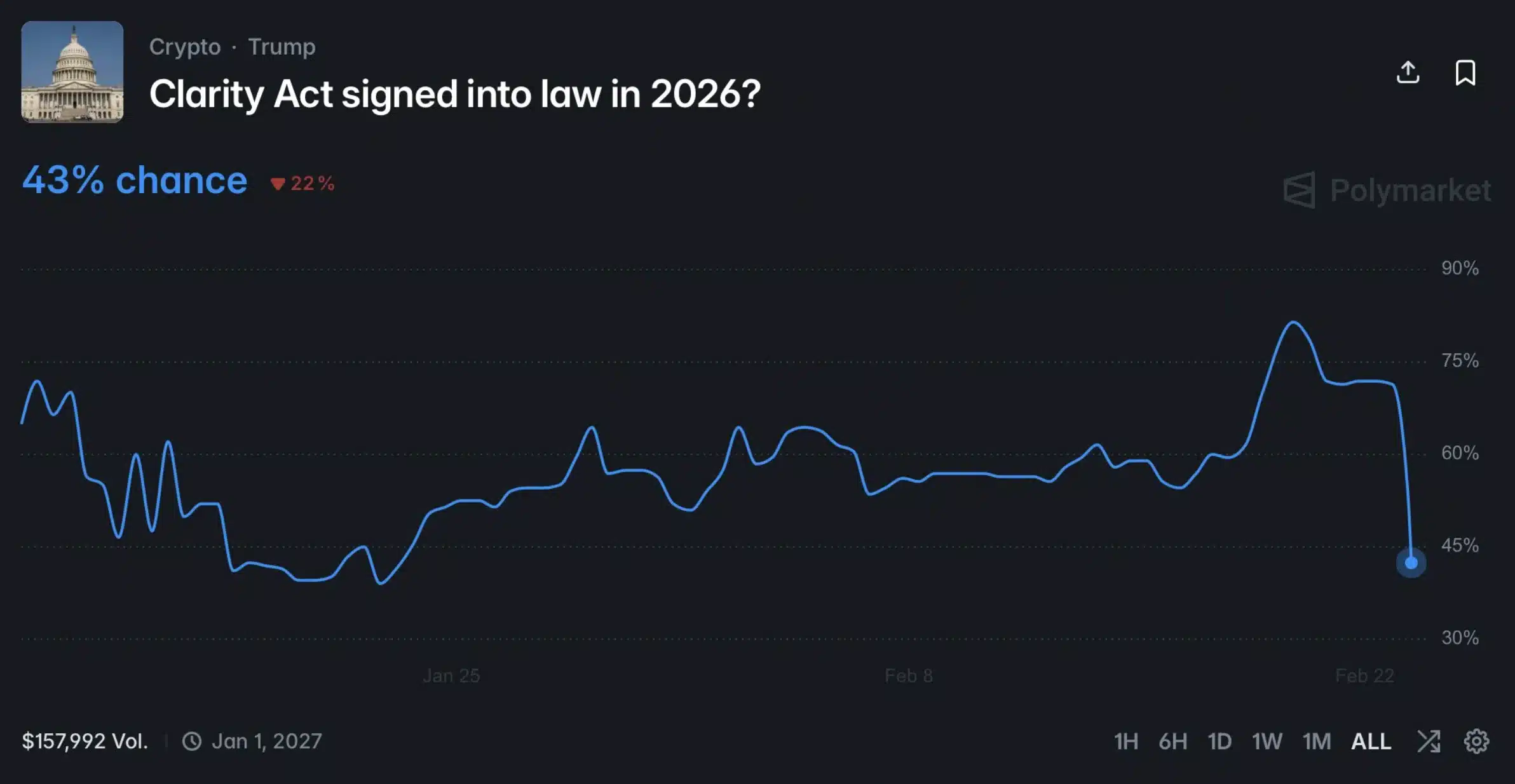
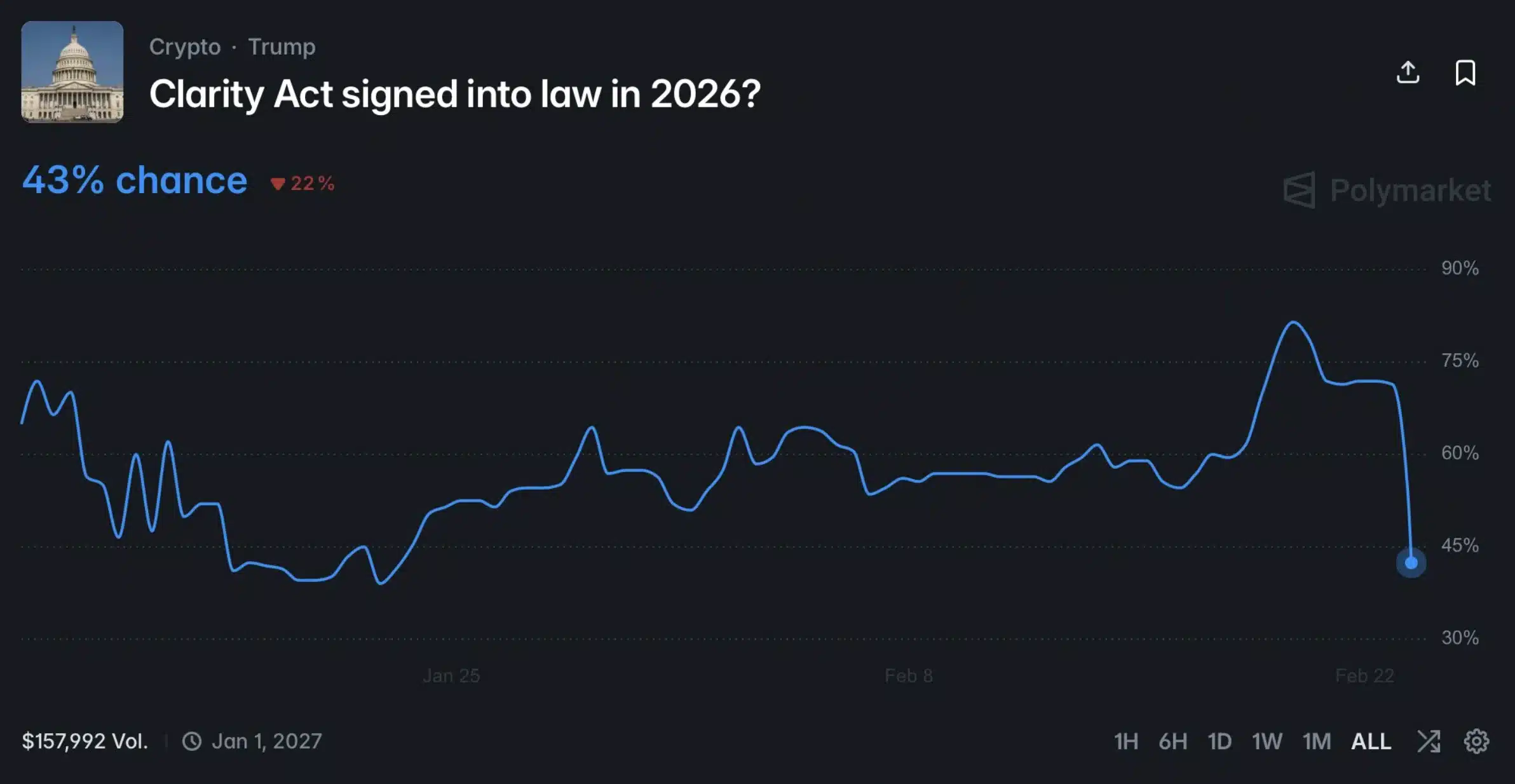
The CLARITY Act faces a critical test as its approval odds on Polymarket dropped sharply from 72% to 42%, reflecting declining market confidence. The White House is mediating between crypto firms (like Coinbase and Ripple) advocating for stablecoin features such as programmability and rewards, and banking groups concerned about deposit outflows and financial stability. A key disagreement revolves around whether crypto companies should be allowed to offer high yields on stablecoins, which banks fear could weaken the traditional financial system. The White House has set a March 1 deadline for a compromise, warning that failure could stall the bill. The latest draft imposes strict rules, with severe penalties for attempts to disguise interest payments. Its future also depends on Senator Tim Scott’s support. While some industry leaders remain optimistic about passage by April, the political deadlock and tight timeline pose significant roadblocks.

As expectations grow around the possible approval of the CLARITY Act, the White House held its third round of talks this week, where a so-called “compromise” began to take shape.

During the event held at ETHDenver, Patrick Witt from the White House Crypto Council said that the gap between both sides has “shrunk considerably” after a long private meeting last week.

On one side were major crypto players, including Coinbase, Ripple, and Andreessen Horowitz, advocating for the preservation of stablecoins’ unique features, such as programmability and rewards.

The other side included major banking groups, such as the American Bankers Association and the Bank Policy Institute, which focused on safeguarding the traditional banking system.

What is the main point of disagreement?

That being said, the main disagreement comes from fear of the unknown. Banks worry that if crypto companies are allowed to offer high rewards on stablecoins, people may pull their money out of banks. This could weaken banks and harm the economy.

However, crypto supporters see this differently. They believe banks are trying to block competition. In their view, banning yield gives banks unfair control over people’s savings and slows down innovation.

Now that the White House is taking direct control of the draft law, the crypto industry knows regulation is coming.

The White House has set a firm March 1 deadline, warning that if negotiators fail to finalize the bill by then, it could stall or collapse.

The latest draft includes strict rules to prevent loopholes. If companies try to disguise interest as “rewards,” they could face action from the SEC, Treasury, and CFTC, with fines of up to $500,000 per day.

This shows the administration is focused on tight control, not a soft compromise, keeping stablecoins close to the traditional banking system.

Roadblocks remain

However, the bill’s future still depends on Senator Tim Scott, who has yet to reschedule a key meeting. If talks succeed, the long delay may finally end. If not, the CLARITY Act could remain stuck in political deadlock.

Remarking on the same, Witt said,

“I believe if we solve this, it’s going to start a domino effect here, and I think things could move pretty fast once it’s resolved.”

Weighing in on the sentiment, Dan Gambardello added,

“Seems like they’re just playing games...”

Source: Dan Gambardello/X
Even though Patrick Witt says talks are improving and both sides are working honestly, many people in the market think the deal may still fail.

CLARITY Act odds are decreasing

In just one day, the odds on Polymarket for the CLARITY Act passing dropped sharply, from 72% to 42%. This shows that traders and investors are losing confidence.

Data from Santiment also suggests that people are starting to expect the bill to stall or collapse.

But some people are still optimistic,

Additionally, many leaders in the crypto industry are still hopeful about the CLARITY Act.

On the 20th of February, Ripple CEO Brad Garlinghouse also said that he believes the bill could pass as early as April.

For now, the crypto community and investors are waiting nervously. They want to see if Washington can finally deliver the clear rules it has been promising for years.


Final Summary

  • The CLARITY Act is entering its most critical phase, with the 1st of March deadline leaving little room for further delays.
  • Talks between crypto firms and banks have narrowed differences, but key disagreements over stablecoin rewards remain unresolved.


İlgili Sorular

QWhat is the main point of disagreement between crypto companies and banks regarding the CLARITY Act?

AThe main disagreement stems from banks' fear that if crypto companies are allowed to offer high rewards on stablecoins, people may withdraw their money from traditional banks, potentially weakening the banking system and harming the economy. Crypto supporters, however, view this as banks trying to block competition and maintain unfair control over people's savings, which slows down innovation.

QWhat is the deadline set by the White House for finalizing the CLARITY Act, and what is the consequence of missing it?

AThe White House has set a firm deadline of March 1st. It has warned that if negotiators fail to finalize the bill by then, the legislation could stall or collapse entirely.

QAccording to the article, what has happened to the market's prediction for the CLARITY Act's approval?

AThe odds for the CLARITY Act passing on Polymarket dropped sharply from 72% to 42% in just one day, indicating that traders and investors are losing confidence and starting to expect the bill to stall or fail.

QWho is a key political figure whose support is critical for the future of the CLARITY Act?

ASenator Tim Scott is a key figure, as the bill's future depends on him rescheduling a crucial meeting. His actions will determine if the long delay ends or if the act remains in political deadlock.

QWhat are the potential penalties for companies that try to disguise interest payments as 'rewards' under the latest draft of the act?

ACompanies that try to disguise interest as 'rewards' could face enforcement action from the SEC, Treasury, and CFTC, with fines of up to $500,000 per day for such violations.

İlgili Okumalar

Will the Next Crypto Bull Run Start with On-Chain Trading of SpaceX?

This article presents a scenario-based forecast for the crypto industry from 2026 to 2029, arguing that the next major cycle will be driven not by technological narratives but by legal access to real-world assets. The author predicts that by mid-2026, pre-IPO perpetual contracts for top private companies like SpaceX, OpenAI, and Anthropic on platforms like Hyperliquid will become the primary gateway for accessing quality assets, as most crypto-native tokens fail to capture real value. The much-hyped AI x Crypto intersection largely fails except for prediction markets, which thrive on betting on AI model supremacy. By 2027, public blockchain foundations are forced to choose between catering to retail speculation or building compliant infrastructure for institutions, with many opting for the latter. Growth in stablecoins and tokenized private credit/equity hits a "triple ceiling" due to regulatory and political uncertainty rather than market demand. The pivotal shift is forecast for 2028. A major liquidation event in pre-IPO perpetuals exposes the structural flaw of synthetic markets lacking a real underlying asset anchor. In response, regulatory changes finally allow the public solicitation of private securities resales to verified accredited investors. This creates a legitimate secondary market for real company equity, which then becomes the core asset class of the new bull market, relegating synthetic perps to a niche role. By 2029, the industry becomes "boring" but foundational. Tokens without claims on real cash flows or assets cease trading. Stablecoin growth is steady but politically capped. Crypto infrastructure fades from view as it gets absorbed into traditional finance backends. The article's central thesis is that the key bottleneck for crypto's next phase is legal and regulatory channels for real asset ownership, not technology.

marsbit1 saat önce

Will the Next Crypto Bull Run Start with On-Chain Trading of SpaceX?

marsbit1 saat önce

The Value Distribution of Stablecoins

**Summary: The Value Distribution of Stablecoins** The article argues that stablecoins are evolving from mere trading tools into broader channels for dollar access. It divides the stablecoin ecosystem into four layers to analyze how value is distributed: 1. **Issuance Layer:** Mints stablecoins, holds reserve assets, and captures the spread between reserve yield and user costs (e.g., Tether, Circle). This layer currently earns the largest profit margin. 2. **Infrastructure Layer:** Connects stablecoins to the traditional financial system, handling fiat on/off-ramps, banking integration, compliance (KYC/AML), and asset management (e.g., Bridge, BVNK). This is the "unglamorous" but critical work, building the essential bridges between crypto and real-world finance. 3. **Acquiring/Distribution Layer:** Integrates stablecoins into merchant systems, manages payment flows, and provides enterprise financial software (e.g., Stripe, Coinbase). They act as the access point for businesses. 4. **Application Layer:** The end-users and businesses that ultimately use stablecoins for payments, settlements, or as a store of value. They benefit from convenience but have little pricing power. The core thesis is that while the issuance layer currently dominates profits, the often-overlooked **infrastructure layer holds significant long-term potential**. The real challenge and barrier to mass adoption is not the on-chain transfer of stablecoins (which is simple), but the complex "last mile" integration into existing business workflows, banking systems, and regulatory frameworks across different countries. Companies in this layer are currently in a "land grab" phase, investing heavily to build networks, secure bank partnerships, and establish compliance pathways. While their position is currently pressured by the profitable issuers above and distribution platforms below, the article suggests that if stablecoins become a default financial rail for businesses, the infrastructure providers who have done the hard work of integration will ultimately gain strong pricing power and become entrenched, essential players.

marsbit8 saat önce

The Value Distribution of Stablecoins

marsbit8 saat önce

The Value Distribution of Stablecoins

The Value Distribution of Stablecoins The article argues that stablecoins are evolving from a mere trading tool into a broad "dollar channel." It analyzes the industry's value chain through four layers: 1. **Issuance Layer (e.g., Tether, Circle):** The top layer that mints stablecoins, holds reserve assets, and captures the thickest interest rate spread. 2. **Infrastructure Layer (e.g., Bridge, BVNK):** Connects stablecoins to the traditional financial system, handling critical but complex "dirty work" like fiat on/off-ramps, banking integration, compliance (KYC/AML), and cross-border settlement. 3. **Acquiring/Distribution Layer (e.g., Stripe, Coinbase):** Embeds stablecoins into merchant systems, manages payment flows, and integrates with enterprise software. 4. **Application Layer:** End-users and businesses that ultimately use stablecoins for payments, settlement, or storing value. The author posits that while the issuance layer currently captures the most profit, the most overlooked and potentially critical layer is infrastructure. The core challenge for stablecoin adoption isn't the on-chain transfer (which is simple), but bridging the gap between blockchain and the real-world financial system. This involves solving practical problems for businesses: fiat conversion, reconciliation, tax handling, and user onboarding. Infrastructure companies are currently in a difficult "land-grab" phase—building networks, securing banking relationships, and achieving compliance country-by-country. They face pressure from both the profitable issuance layer above and distribution platforms below. However, the author suggests this layer is building a crucial moat. Once stablecoins become a default business rail, the infrastructure players who have done the hard work of integration may gain significant, durable value and pricing power.

链捕手8 saat önce

The Value Distribution of Stablecoins

链捕手8 saat önce

İşlemler

Spot
Futures
活动图片