Why Are Crypto Project Acquisitions Now Excluding Tokens?

marsbit2025-12-18 tarihinde yayınlandı2025-12-18 tarihinde güncellendi

Özet

Recent acquisitions in the crypto space, such as Circle’s purchase of Interop Labs (developers of Axelar Network), have sparked controversy by focusing on acquiring teams and intellectual property while excluding the native tokens. In the Axelar case, the AXL token and network remain independent, leading to a 15% price drop and community backlash. Similar patterns emerged in other acquisitions: Kraken’s Ink acquired Vertex Protocol’s team and tech but abandoned the VRTX token, causing a 75% crash. Pump.fun acquired Padre and invalidated its token without compensation, and Coinbase integrated Vector.fun’s tech without involving the TNSR token. These cases reflect a broader “acquihire” trend common in Web2, where companies acquire talent and tech but avoid equity or token obligations. In crypto, however, this often leaves retail token holders with no rights or financial benefits, as tokens are designed to avoid regulatory scrutiny as securities—offering utility or governance instead of ownership or profit-sharing. This has led to growing tension between project teams and token holders, exemplified by Aave’s recent governance proposal to assert DAO control over IP, equity, and revenue—highlighting the misalignment between token-based incentives and traditional equity structures. The trend raises fundamental questions about the value and rights attached to tokens in decentralized ecosystems.

In the early hours of the day before yesterday, the Interop Labs team (the initial developer of Axelar Network) announced its acquisition by Circle to accelerate the development of its multi-chain infrastructure Arc and CCTP.

Normally, being acquired is good news. However, the further detailed explanation provided by the Interop Labs team in the same tweet caused an uproar. They stated that the Axelar network, foundation, and AXL token would continue to operate independently, with development work being taken over by CommonPrefix.
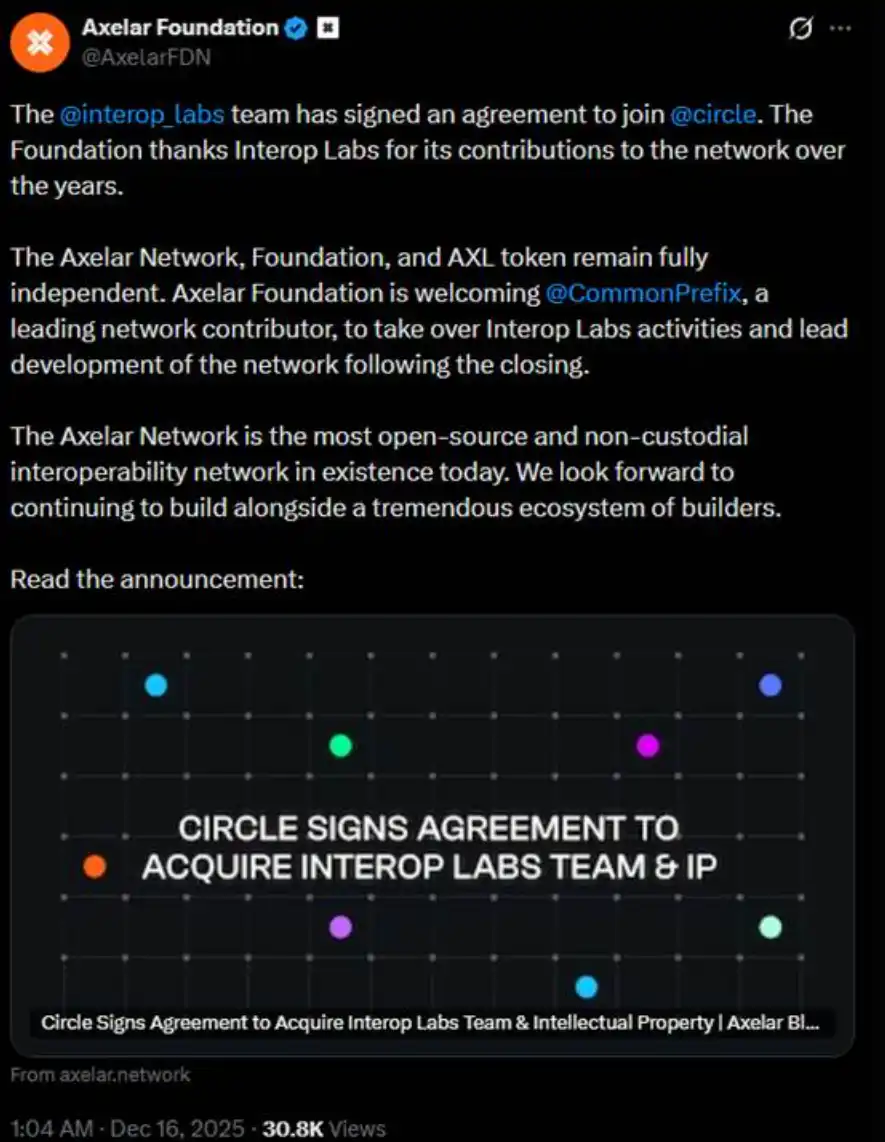
In other words, the core of this transaction is the "team merging into Circle" to promote the application of USDC in the fields of privacy computing and compliant payments, rather than a comprehensive acquisition of the Axelar network or its token system. The team and technology, Circle is taking. The original project, Circle is not managing.

After the acquisition news was announced, the price of Axelar token $AXL first rose slightly and then began to fall, currently down about 15%.
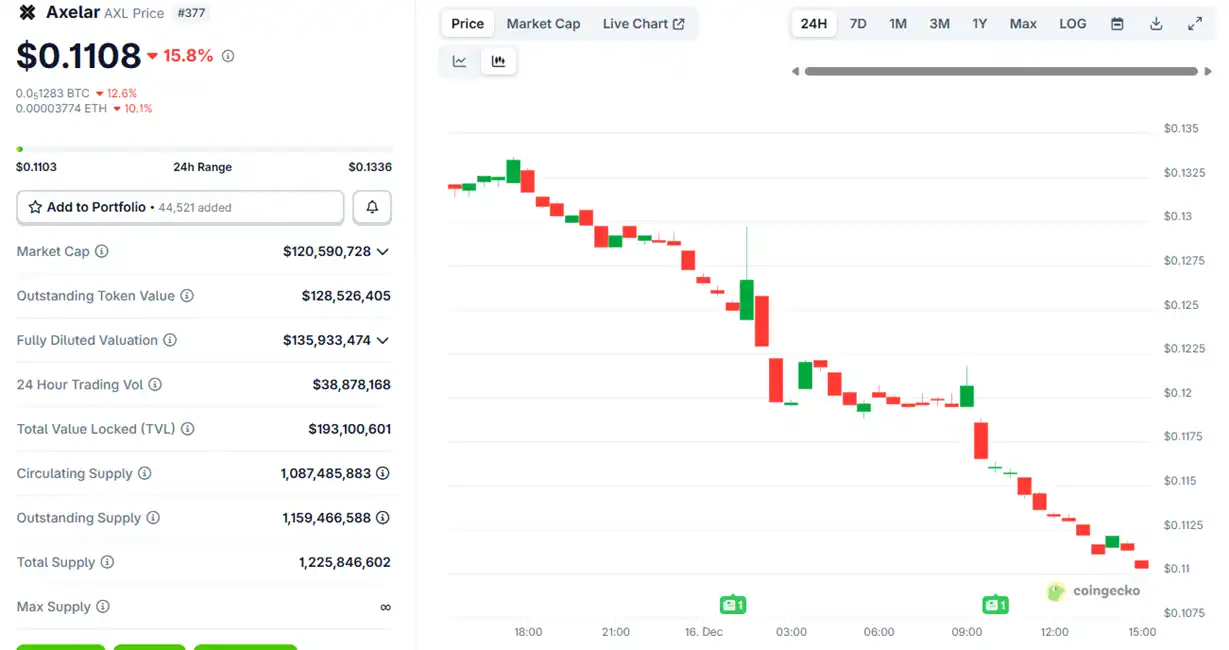
This arrangement quickly sparked intense discussions in the community about "token vs equity." Multiple investors questioned that Circle essentially acquired the core assets through the acquisition of the team and intellectual property, but bypassed the rights of AXL token holders.
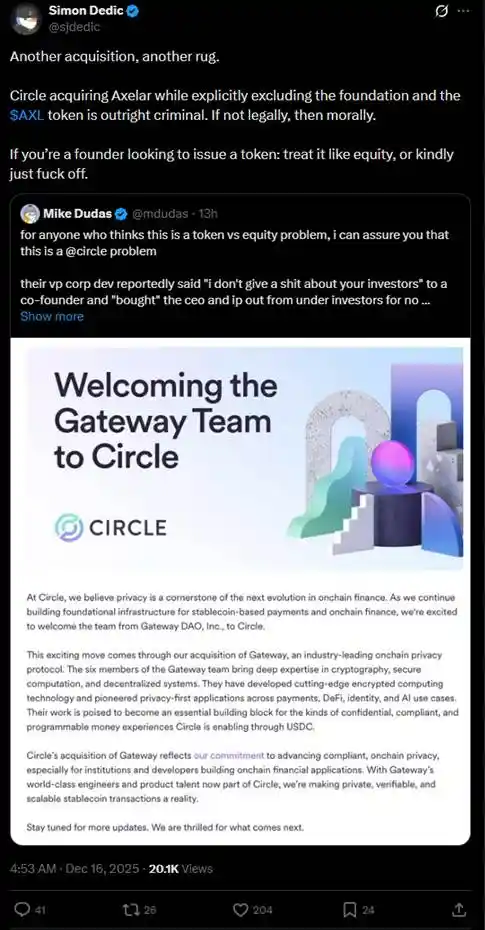
Over the past year, similar cases of "acquiring the team and technology, but not the token" have occurred repeatedly in the crypto space, causing serious harm to retail investors.

In July, Ink, the Layer 2 network under Kraken, acquired the decentralized trading platform Vertex Protocol based on Arbitrum, taking over its engineering team and trading technology architecture, including the synchronous order book, perpetual contract engine, and money market code. After the acquisition, Vertex shut down its services on 9 EVM chains, and the token $VRTX was abandoned. After the news was announced, $VRTX fell more than 75% that day and gradually "went to zero" (current market cap is only $73,000).
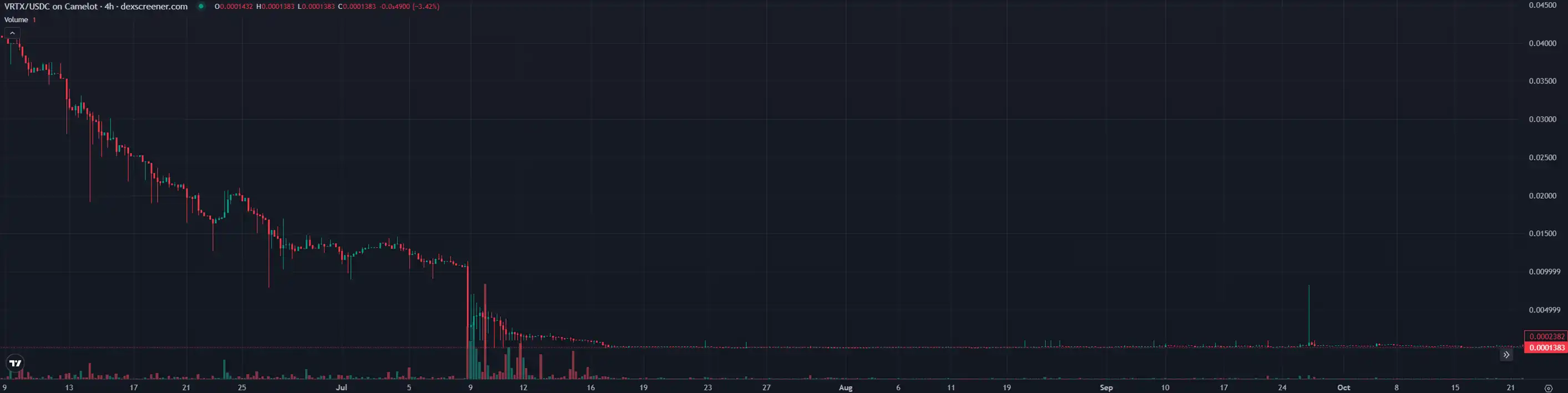
However, $VRTX holders at least had a tiny bit of comfort because they would receive a 1% airdrop during the TGE of Ink (snapshot has ended). Next, there are even worse cases, where the token is directly invalidated without any compensation.

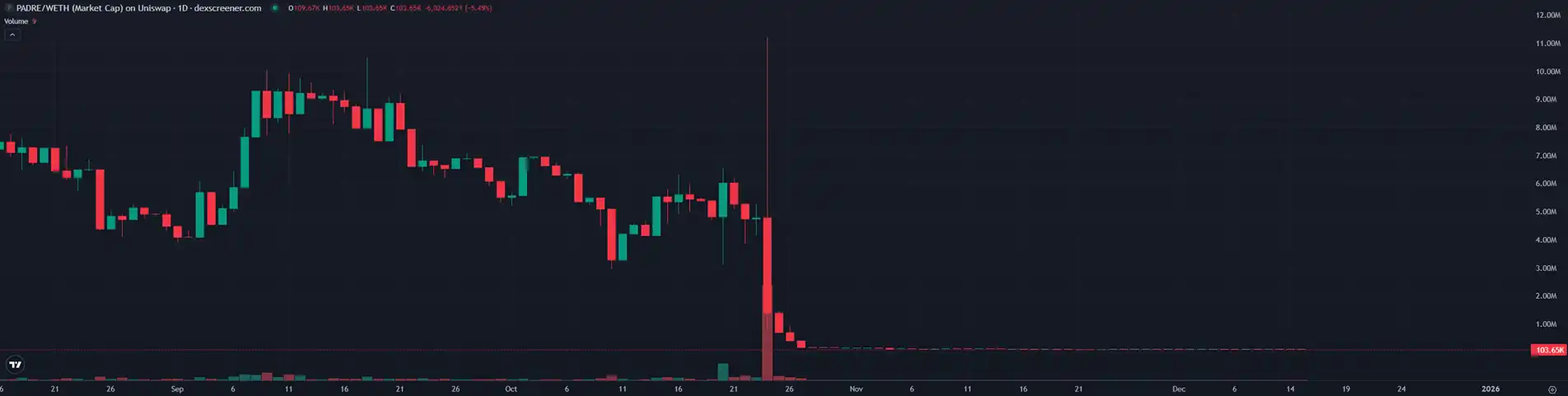
In October, pump.fun announced the acquisition of the trading terminal Padre. When the acquisition of Padre was announced, pump.fun also stated that the Padre token would no longer be used on its platform and directly indicated that there were no future plans for the token. Since the declaration of the token's invalidation was in the last reply of the thread, the token doubled instantly and then plummeted sharply. Currently, $PADRE has a market cap of only $100,000.
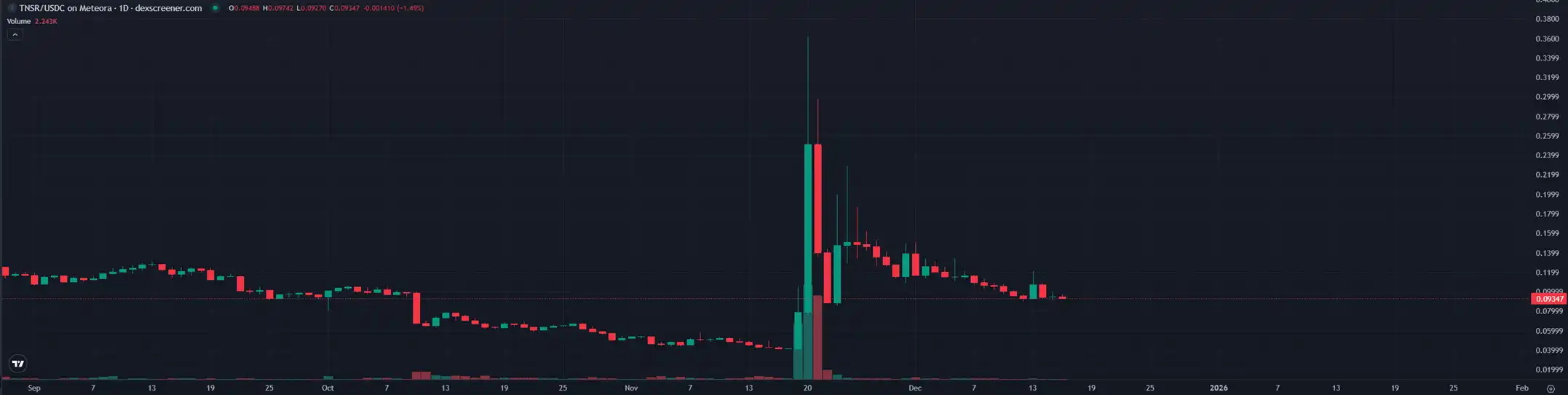
In November, Coinbase announced the acquisition of the Solana trading terminal Vector.fun built by Tensor Labs. Coinbase integrated Vector's technology into its DEX infrastructure, but did not involve the Tensor NFT market itself or the equity of $TNSR. Part of the Tensor Labs team moved to Coinbase or other projects.

The price movement of $TNSR was relatively stable among the examples, rising sharply and then falling back. The current price has returned to a level appropriate for an NFT market token and is still higher than the low before the acquisition news.
In Web2, it is legal for large companies to acquire small companies by "taking the team and intellectual property, but not the equity." This situation is called an "acquihire." Especially in the tech industry, "acquihire" allows large companies to quickly integrate excellent teams and technologies, avoiding the lengthy process of hiring from scratch or internal development, thereby accelerating product development, entering new markets, or enhancing competitiveness. Although it is unfavorable to small shareholders, it stimulates overall economic growth and technological innovation.

Nevertheless, "acquihire" must also satisfy the principle of "acting in the best interests of the company." The reason these examples in the crypto space have made the community so angry is precisely because the "small shareholders," as token holders, completely disagree that the project parties in the crypto space are "acting in the best interests of the company" for the better development of the project through acquisition. Project parties often dream of listing on the US stock market when the project itself can make big money, and then issue tokens to make money when everything is just starting or declining (the most typical example is OpenSea). After these project parties make money from the tokens, they turn around to find their next opportunity, leaving the past projects only in their resumes.

So, can retail investors in the crypto space only swallow their broken teeth? It was also the day before yesterday that Ernesto, former CTO of Aave Labs, published a governance proposal titled "$AAVE Alignment Phase 1: Ownership," firing a shot to defend token rights in the crypto space.

The proposal advocates that Aave DAO and Aave token holders clearly control core rights such as protocol IP, brand, equity, and revenue. Aave service provider representatives such as Marc Zeller publicly endorsed the proposal, calling it "one of the most influential proposals in Aave governance history."

Ernesto mentioned in the proposal, "Due to some past events, there is strong hostility towards Aave Labs in previous posts and comments, but this proposal strives to remain neutral. This proposal does not imply that Aave Labs should not be a contributor to the DAO or lacks the legitimacy or ability to contribute, but the decision should be made by Aave DAO."

According to the interpretation by crypto KOL @cmdefi, the cause of this conflict lies in Aave Labs replacing the front-end integrated ParaSwap with CoW Swap, after which the generated fees flowed to Aave Labs' private address. Accordingly, Aave DAO supporters believe this is a form of plunder because, with the existence of the AAVE governance token, all benefits should优先 flow to AAVE holders or remain in the treasury for DAO voting decisions. Additionally, previously, ParaSwap's revenue would continuously flow into the DAO. The new CoW Swap integration changed this status, further leading the DAO to believe this was a plunder.

This very directly reflects a contradiction similar to that between "shareholders and management," and again highlights the awkward positioning of token rights in the crypto industry. In the early days of the industry, many projects promoted the "value capture" of tokens (such as obtaining rewards through staking or directly sharing profits). But since 2020, SEC enforcement actions (such as lawsuits against Ripple and Telegram) have forced the industry to shift towards "utility tokens" or "governance tokens," which emphasize usage rights rather than economic rights. As a result, token holders often cannot directly share project dividends—project revenue may flow to equity held by the team or VCs, while token holders are like small shareholders contributing for free.

As in the examples mentioned in this article, project parties often sell teams, technological resources, or equity to VCs or large companies, while also selling tokens to retail investors. The final result is that resource and equity holders profit first, while token holders are marginalized or even get nothing. Because tokens do not have legally defined investor rights.

To avoid the regulation that "tokens cannot be securities," tokens are designed to be increasingly "useless." Because regulation is avoided, retail investors are placed in a very passive and unprotected position. The various cases that have occurred this year have, in a sense, reminded us that the current problem of "narrative failure" in the crypto space may not be that people no longer believe in narratives—narratives are still good, profits are still good, but when we buy tokens, what exactly can we expect?


İlgili Sorular

QWhat is the main reason behind the recent trend of acquiring crypto projects without their tokens, as discussed in the article?

AThe main reason is to avoid regulatory risks, as tokens are often designed to be 'utility' or 'governance' tokens to circumvent securities regulations, leaving token holders with no legal investor rights. Acquirers focus on teams and intellectual property to integrate technology without assuming obligations to token holders.

QHow did the community react to Circle's acquisition of Interop Labs, and why?

AThe community reacted with outrage because Circle acquired only the team and intellectual property of Axelar Network, leaving the AXL token and its holders independent and excluded from the benefits of the acquisition, causing the token's price to drop significantly.

QWhat is an 'acquihire' in the context of Web2, and how does it relate to the crypto acquisitions mentioned?

AAn 'acquihire' in Web2 refers to an acquisition where a larger company buys a smaller one primarily for its team and technology intellectual property, rather than its equity or business operations. This relates to crypto acquisitions as it mirrors the pattern where acquirers take teams and IP but discard the tokens, harming散户 investors.

QWhat problem did Ernesto's proposal for $AAVE aim to address, according to the article?

AErnesto's proposal aimed to address the misalignment of interests by advocating for Aave DAO and token holders to explicitly control core assets like IP, brand, equity, and revenue, ensuring that benefits flow to token holders rather than being diverted to private entities like project teams or VCs.

QWhy are token holders in crypto projects often left with limited protection or benefits during acquisitions?

AToken holders have limited protection because tokens are deliberately designed without legal investor rights to avoid being classified as securities under regulations like those enforced by the SEC. This allows project teams and equity holders to prioritize their own interests during acquisitions, marginalizing token holders.

İlgili Okumalar

Humanity Loses $31 Million, a Private Key Causes Token Price to Plunge 90%

On June 9th, the digital identity project Humanity Protocol suffered a major security breach resulting in over $31 million stolen from hundreds of wallets holding its H token. The attack was caused by the compromise of a private key belonging to a foundation member, leading the team to advise users against interacting with its bridge or liquidity pools. Following the incident, the price of the H token plummeted by over 90%, from around $0.70 to a low of $0.052, wiping out a significant portion of its market capitalization. The attacker allegedly minted 100 million new H tokens and began selling them for BNB. Humanity Protocol, founded in 2024, aimed to verify human users through palm-print biometrics and zero-knowledge proofs on Polygon CDK. Despite raising $50 million across two funding rounds and achieving a unicorn valuation, the project faced prior controversies. Shortly after its June 2025 token launch, reports emerged that only about 1 million of its 9 million registered IDs had completed biometric verification, suggesting 88% might be bots. Furthermore, allegations surfaced that the project might be a rebranded "shell" of a Chinese access control company, raising concerns about data privacy and authenticity. The project's founder, Terence Kwok, has a controversial business history. His previous venture, Tink Labs, burned through $170 million in funding before collapsing in 2020. The breach highlights the persistent critical risk of private key management in crypto. With no user compensation plan detailed in the initial response, the incident deals a severe blow to trust in a project already struggling with credibility issues.

Foresight News21 dk önce

Humanity Loses $31 Million, a Private Key Causes Token Price to Plunge 90%

Foresight News21 dk önce

How to Conduct Deep Research Using Claude's Dynamic Workflows

The article "How to Use Claude's Dynamic Workflows for Deep Research" discusses overcoming the pitfalls of technical research, where both humans and AI can get overwhelmed by information, leading to vague conclusions. It introduces Claude Code's new "Dynamic Workflows" feature, which automatically designs and executes task-specific workflows before starting a task, unlike simpler "planning modes." This approach incorporates validation, result convergence, and adversarial verification from the outset. The core of Dynamic Workflows is six predefined scheduling patterns that address how to decompose tasks and synthesize results: 1. **Classify-and-Act (Routing):** An agent classifies the task and routes it to the most suitable specialist agent for execution. It's precise and efficient but struggles with ambiguous tasks. 2. **Fan-out & Merge:** The task is split into parallel, independent subtasks whose results are later merged. It's fast and isolates contexts but is more expensive and challenging to synthesize. 3. **Adversarial Verification:** Multiple "challenger" agents critique a worker agent's conclusion, requiring majority approval. This counters confirmation bias and self-assessment errors but relies on verifiable facts. 4. **Generate & Filter:** Multiple agents generate many candidate solutions, which are then filtered against a rubric to output only the best. It fosters diversity but depends heavily on the filter's quality. 5. **Tournament:** Multiple agents compete on the same task, with pairwise comparisons eliminating contestants over rounds to select the best. This offers stable relative judgment but is complex. 6. **Loop:** An agent iteratively attempts a task, learning from errors and adjusting until a stop condition is met. It handles tasks with unknown scope but risks infinite loops without proper design. The author compares their own custom deep-research system, which involved multi-agent analysis and deduplication but lacked goal-oriented convergence, to Claude's built-in workflow. The official workflow adds critical layers: initial problem decomposition, credibility assessment of sources, cross-agent voting to delete weak conclusions (not just averaging), and output tightly focused on the user's original goals and actionable recommendations. This structurally addresses common AI issues like goal drift, premature stopping, context pollution, and output bias. In summary, Dynamic Workflows represent a shift from smarter single conversations to a structured research process, compressing what used to require many dialogues into 3-4 interactions, albeit at higher token cost. The author notes remaining challenges for their specific domain (blockchain research): the need for fact-based verification over official documentation, depth in truly novel interdisciplinary thinking, the practical validation of proposed solutions, and tailoring information density to the audience.

marsbit31 dk önce

How to Conduct Deep Research Using Claude's Dynamic Workflows

marsbit31 dk önce

When LPs Teach Me Investment with Doubao: A Self-Narrative of a Private Equity GP Switching Careers

When LPs Use Doubao to Teach Investing: A Transition Story of a Private Equity GP AI is making life increasingly difficult for small private equity fund managers, as a former GP of an offshore dollar fund reveals. The fund, managing tens of millions in US stocks, outperformed the Nasdaq but struggled with fundraising. Its traditional Cayman SPC/BVI structure failed to attract major Asian LPs, who now prefer Hong Kong LPF or Singapore VCC frameworks. The rise of AI-powered quantitative strategies has further squeezed the space for funds like his, which relied on subjective, discretionary investing. AI tools have leveled the information playing field, empowering LPs—often high-net-worth individuals, entrepreneurs, or family offices—to analyze investments themselves using chatbots like Doubao. This has eroded trust in GPs' expertise, leading to more frequent challenges over investment decisions and even withdrawals, especially during market rallies when retail investors sometimes outperform funds. Friction arises not necessarily from AI's capabilities but from how LPs use it. Many rely on conversational AI for validation rather than rigorous analysis, sometimes receiving misleading or hallucinated advice. While AI democratizes research, effective investing still requires discerning real insight from plausible-sounding output. Ultimately, AI is unlikely to fully replace GPs. Asset management remains a trust-based service. However, the industry must adapt. The future may see "human私募" (private equity) learning from AI and focusing more on providing value beyond pure analysis—perhaps by mastering the emotional intelligence and trust-building that machines cannot replicate.

Odaily星球日报1 saat önce

When LPs Teach Me Investment with Doubao: A Self-Narrative of a Private Equity GP Switching Careers

Odaily星球日报1 saat önce

Wang Chuan: After Investing in Storage Stocks and Seeing a Thirty-Fold Return, How to Remain Unanxious (Part 7) - A Quarter-Century Cycle

Wang Chuan: Reflections on Investment Anxiety and Market Cycles After Observing a 30x Gain in a Storage Stock (Part 7) – A Quarter-Century Cycle This article examines the cyclical nature and inherent risks in technology hardware investments, using the storage and semiconductor sectors as examples. It criticizes the misleading practice of "annualized" Net Dollar Retention (NDR) rates, where short-term growth is extrapolated unrealistically. A key concept explored is "reflexivity" – demand driven by panic, exploration, and liquidity during market booms, which can vanish just as quickly when conditions reverse. This reflexivity exists both in product demand and among speculative stock buyers, creating powerful feedback loops that inflate prices during upturns and exacerbate crashes during downturns. The author highlights a major risk for hardware sectors: unlike assets with defined cycles (e.g., Bitcoin's halving), there's no guarantee of a swift recovery post-crash. Companies like Micron, Intel, and Cisco took roughly a quarter-century to surpass their 2000 highs, enduring drawdowns exceeding 80%. This is attributed to the "bullwhip effect" in supply chains, where demand collapses instantly but过剩产能 persists, and a migration of narrative-driven capital. High-valuation stories吸引 speculative funds during growth phases, but these funds quickly depart for the next hot narrative once growth slows, leaving behind stronger companies with much lower valuations. The piece warns of dangerous mental models formed during bull markets: 1) equating current strong demand with perpetual high growth, and 2) believing that making fast, large profits is easy. Citing巴菲特, the author notes that easy money undermines rationality, likening speculators to Cinderella at a ball with a clock that has no hands. The current phase presents an asymmetric risk-reward scenario: potential for further gains exists, but the downside risk is an 80%+ drawdown and a multi-decade wait for breakeven, which reflexive speculators cannot tolerate. The hypothetical investor "老王" (Lao Wang), who achieved a 30x return, is used to illustrate potential pitfalls. Leverage could lead to a wipeout during a sharp correction. Even without leverage, ingrained beliefs in easy money would likely lead him to double down after losses, expecting a quick rebound. Instead, he might face a protracted decline, depleting his resources through frantic trading as the high-growth narrative fades. The conclusion references Schopenhauer, comparing those who have seen multiple market cycles to an audience seeing the same magic trick repeatedly—once the illusion is understood, its power is gone.

marsbit1 saat önce

Wang Chuan: After Investing in Storage Stocks and Seeing a Thirty-Fold Return, How to Remain Unanxious (Part 7) - A Quarter-Century Cycle

marsbit1 saat önce

İşlemler

Spot
Futures
活动图片