Who is the Truly Strongest Agent in OpenClaw? Leaderboard of 23 Real-World Task Evaluations Released

marsbit2026-04-08 tarihinde yayınlandı2026-04-08 tarihinde güncellendi

Özet

This report presents a comprehensive benchmark evaluating the performance of AI coding agents on 23 real-world OpenClaw tasks, focusing solely on the core metric of success rate. The transparent and reproducible testing methodology employs three scoring methods: automated checks, an LLM judge (Claude Opus), and a hybrid approach. The diverse task set covers areas like code/file operations, content creation, research, system tools, and memory persistence. The top 10 models by success rate (Best % / Avg %) are: 1. anthropic/claude-opus-4.6 (93.3% / 82.0%) 2. arcee-ai/trinity-large-thinking (91.9% / 91.9%) 3. openai/gpt-5.4 (90.5% / 81.7%) 4. qwen/qwen3.5-27b (90.0% / 78.5%) 5. minimax/minimax-m2.7 (89.8% / 83.2%) Claude Opus 4.6 leads in peak performance, while Arcee's Trinity demonstrates superior average success rate stability. The Qwen series shows strong cost-performance potential with multiple entries in the top ten. All task definitions and scoring logic are publicly available for independent verification.

Want to know which large language model truly performs the strongest in OpenClaw's real-world agent tasks?

MyToken, based on evaluation websites, has compiled a transparent benchmark focused on assessing the practical capabilities of AI coding agents, looking solely at the core dimension of success rate (speed and cost belong to other independent dimensions, to be analyzed separately later). Fully public and reproducible, it only presents rigorous evaluation standards + the latest Top 10 success rate rankings.

I. Evaluation Dimension:Success Rate

Specific standard: The percentage of given tasks that the AI agent completes accurately and fully. Each task adopts a highly standardized process:

  • Precise user prompt

Sent to the agent in full to simulate real user request scenarios

  • Expected Behavior

Clearly states acceptable implementation methods and key decision points

  • Scoring Criteria (checklist)

Lists an atomic success判定 (judgment) checklist for verification item by item

II. Three Scoring Methods

This evaluation primarily employs 3 scoring methods:

  • Automated Checks: Python scripts directly verify objective results like file content, execution records, tool calls, etc.

  • LLM Judge: Claude Opus scores according to a detailed scale (content quality, appropriateness, completeness, etc.)

  • <极 span data-text="true">Hybrid Mode: Combines automated objective checks + LLM judge qualitative assessment

All task definitions, Prompts, and scoring logic are fully public for retesting and verification.

III. Tasks Used for Evaluation

This benchmark covers 23 tasks across different categories. It spans multiple dimensions including basic interaction, file/code operations, content creation, research & analysis, system tool calls, memory persistence, etc., highly aligning with developers' daily use scenarios of OpenClaw:

  1. Sanity Check(Automated) —— Process simple instructions and reply to greetings correctly

  2. Calendar Event Creation(Automated) —— Generate a standard ICS calendar file from natural language

  3. Stock Price Research(Automated) —— Query stock prices in real-time and output a formatted report

  4. Blog Post Writing(LLM Judge) —— Write a ~500-word structured Markdown blog post

  5. Weather Script Creation(Automated) —— Write a Python weather API script with error handling

  6. Document Summarization(LLM Judge) —— Provide a refined 3-part summary of the core themes

  7. Tech Conference Research(LLM Judge) —— Research and organize information (name, date, location, link) for 5 real tech conferences

  8. Professional Email Drafting(LLM Judge) —— Politely decline a meeting and propose an alternative

  9. Memory Retrieval from Context(Automated) —— Precisely extract dates, members, tech stack, etc., from project notes

  10. File Structure Creation(Automated) —— Automatically generate standard project directories, README, .gitignore

  11. Multi-step API Workflow(Hybrid) —— Read config → Write calling script → Fully document

  12. Install ClawdHub Skill(Automated) —— Install from the skill repository and verify usability

  13. Search and Install Skill(Automated) —— Search for weather-related skills and install correctly

  14. AI Image Generation(Hybrid) —— Generate and save an image based on description

  15. Humanize AI-Generated Blog(LLM Judge) —— Rewrite machine-like content into natural spoken language

  16. Daily Research Summary(LLM Judge) —— Synthesize multiple documents into a coherent daily summary

  17. Email Inbox Triage(Hybrid) —— Analyze multiple emails and organize a report by urgency

  18. Email Search and Summarization(Hybrid) —— Search archived emails and extract key information

  19. Competitive Market Research(Hybrid) —— Competitive analysis in the enterprise APM field

  20. CSV and Excel Summarization(Hybrid) —— Analyze spreadsheet files and output insights

  21. ELI5 PDF Summarization(LLM Judge) —— Explain a technical PDF in language a 5-year-old can understand

  22. OpenClaw Report Comprehension(Automated) —— Precisely answer specific questions from a research report PDF

  23. Second Brain Knowledge Persistence(Hybrid) —— Store information across sessions and recall it accurately

IV. Core Conclusion: Top 10 Large Model Rankings by Success Rate (Best % / Avg %)

  • Data updated to April 7, 2026

  • Best % is the single highest success rate, Avg % is the average success rate over multiple runs, better reflecting stability

Below are the top ten models by success rate:

  1. anthropic/claude-opus-4.6(Anthropic)——93.3% / 82.0%

  2. arcee-ai/trinity-large-thinking(Arcee AI)——91.9% / 91.9%

  3. openai/gpt-5.4(OpenAI)——90.5% / 81.7%

  4. qwen/qwen3.5-27b(Qwen)——90.0% / 78.5%

  5. minimax/minimax-m2.7(MiniMax)——89.8% / 83.2%

  6. anthropic/claude-haiku-4.5(Anthropic)——89.5% / 78.1%

  7. qwen/qwen3.5-397b-a17b(Qwen)——89.1% / 80.4%

  8. xiaomi/mimo-v2-flash(Xiaomi)——88.8% / 70.2%

  9. qwen/qwen3.6-plus-preview(Qwen)——88.6% / 84.0%

  10. nvidia/nemotron-3-super-120b-a12b(NVIDIA)——88.6% / 75.5%
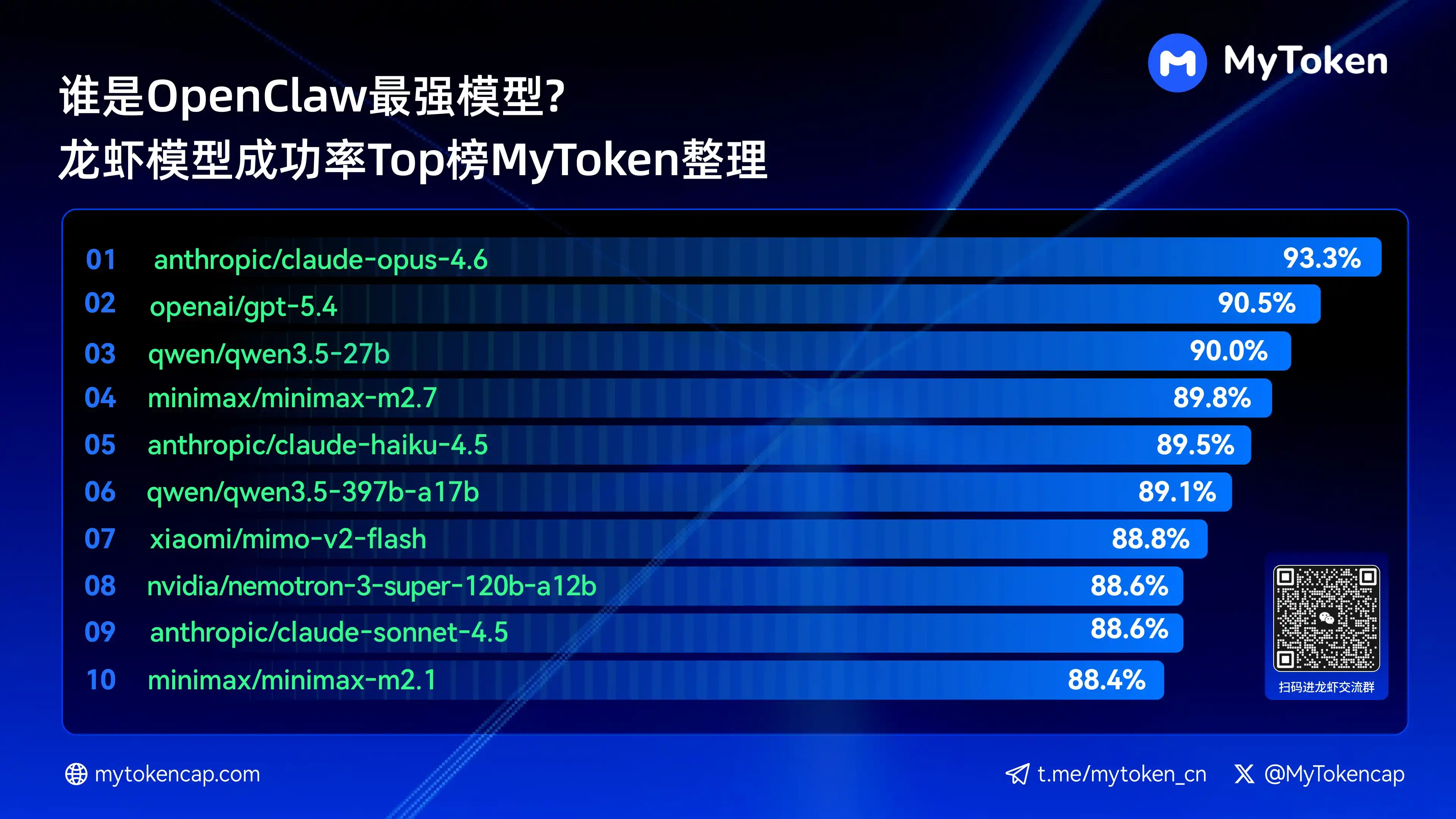
Claude Opus 4.6 currently leads with the highest success rate of 93.3%, but Arcee's Trinity shows impressive performance in average stability. The Qwen series also has multiple entries in the top ten, demonstrating strong cost-performance potential. Success rate is the basic threshold; subsequent dimensions of speed and cost will further impact the actual experience.

This set of 23 task benchmarks is fully transparent. We strongly encourage everyone to conduct practical tests结合 (combining with) their own scenarios. For rankings of more other models, please look forward to the agent leaderboard feature即将 (soon to be) launched by MyToken.

(Data sourced from PinchBench's publicly available OpenClaw agent benchmark tests, continuously updated.)


İlgili Sorular

QWhat is the core evaluation dimension used in the OpenClaw agent benchmark?

AThe core evaluation dimension is success rate, which measures the percentage of tasks that the AI agent completes accurately and completely.

QHow many real-world tasks are included in the OpenClaw benchmark test?

AThe benchmark test covers 23 different real-world tasks.

QWhich model achieved the highest single-run success rate (Best %) in the ranking?

Aanthropic/claude-opus-4.6 from Anthropic achieved the highest single-run success rate of 93.3%.

QWhat are the three scoring methods used to evaluate the agents' performance?

AThe three scoring methods are: 1) Automated checks using Python scripts, 2) LLM judge (Claude Opus) evaluation, and 3) A hybrid mode combining automated checks and LLM evaluation.

QWhich model showed the best performance in average success rate (Avg %), indicating greater stability?

Aarcee-ai/trinity-large-thinking from Arcee AI achieved the highest average success rate of 91.9%, indicating the best stability.

İlgili Okumalar

"Water Scarcity": The Hidden Fatal Flaw of AI Infrastructure

“Water Scarcity: The Hidden Vulnerability of AI Infrastructure” In June 2026, SpaceX revised its IPO prospectus to highlight a core resource constraint alongside power and processors: water. This move signals a pivotal shift where water scarcity has transformed from an operational cost to a major, uncontrollable investment risk, directly threatening AI data center expansion. The scale of the problem is immense. U.S. data centers consumed an estimated 17 billion gallons of water for direct cooling in 2023, with indirect water use for power generation exceeding 211 billion gallons. Giants like Google alone use billions of gallons annually, with single sites consuming volumes equivalent to a medium-sized city. This water is largely “consumptive,” evaporated into the atmosphere and lost. This massive demand is colliding with scarcity. Tech companies are building “water tigers” in arid regions, sparking community protests in places like Mexico and Arizona, where data centers can legally use millions of gallons daily—enough for tens of thousands of residents. These conflicts are not about illegality, but about a mismatch between historic water allocation frameworks and new, colossal demand. The consequences are real. Community opposition, largely centered on water, has reportedly stalled or canceled $64 billion in U.S. data center projects over two years. Simultaneously, investors are pressuring companies for greater water footprint transparency, viewing it as a financial risk, not just an ESG metric. Technological solutions like air or liquid cooling involve trade-offs between water and electricity use, with final choices dictated by local constraints. The irony is stark: while industry leaders envision AI as a utility “like water,” its physical infrastructure is straining real-world water supplies. The race for AI supremacy may ultimately be governed not by the fastest chip, but by the slowest water meter.

marsbit27 dk önce

"Water Scarcity": The Hidden Fatal Flaw of AI Infrastructure

marsbit27 dk önce

Global Card Issuance Enters a Compliance-Driven Era: WasabiCard is Building the Next-Generation Payment Infrastructure

Global card issuance is entering a compliance-driven era, with WasabiCard building next-generation payment infrastructure. The platform asserts that as stablecoins increasingly enter cross-border payments, corporate settlements, and global commerce, the industry is shifting focus from "availability" and "growth-driven" models to long-term, compliant operation under global frameworks. Competition will center on sustainable compliance and global infrastructure capabilities. Stablecoins are evolving from on-chain assets into key payment tools in global business, with card issuance acting as critical infrastructure connecting digital assets to traditional payment networks like Visa and Mastercard. This expansion has revealed structural issues, including cross-regional issuance, BIN resource management, and insufficient AML and risk controls. In response, the industry is moving away from reliance on "grey efficiency" towards prioritizing compliance, risk management, and long-term operational stability. WasabiCard outlines its strategy: collaborating with licensed principals and local partners for localized operations, building robust KYC/AML systems, strictly separating commercial and consumer BIN usage, and enhancing global issuance, payment, and cross-border fund flow infrastructure. The goal is to build stable, scalable payment infrastructure amid evolving global regulations, shifting industry competition from scale to infrastructure capability. As stablecoins integrate further with global commerce, payment infrastructure will become a fundamental, embedded component of internet business. WasabiCard will continue to develop capabilities in global card issuance, stablecoin payments, cross-border fund flows, and API-driven financial workflows.

marsbit37 dk önce

Global Card Issuance Enters a Compliance-Driven Era: WasabiCard is Building the Next-Generation Payment Infrastructure

marsbit37 dk önce

Zhou Hang: How Much Is SpaceX Really Worth?

**Zhou Hang: How Much is SpaceX Really Worth?** SpaceX, arguably one of the greatest industrial companies of the past 50 years, is reportedly targeting a staggering $1.75 trillion valuation in its potential IPO. However, the author argues this figure is inflated by approximately $1.25 trillion when assessed through standard financial metrics. The analysis begins by acknowledging SpaceX's undeniable success: drastically reducing launch costs, achieving near-monopoly in commercial launches, and building the strategic Starlink network. Its achievement surpasses even Tesla's, given it disrupted a state-monopolized industry. Despite this greatness, a $1.75 trillion valuation places SpaceX above the combined market cap of Boeing, Lockheed Martin, Northrop Grumman, RTX, and General Dynamics. Projecting optimistic 2030 revenues of $50-80 billion and applying generous tech-sector multiples yields a "reasonable" valuation range of $500 billion to $1.2 trillion. The $1.25 trillion gap is attributed to three non-financial premiums: 1. **Long-term vision premium** for future Starship-enabled markets (e.g., space-based computing). 2. **Sovereign asset/strategic premium**, as SpaceX is deeply integrated into U.S. national security. 3. **Retail narrative/Musk cult premium**, driven by a heroic story and personal following. Post-IPO, three scenarios are outlined: valuation solidifying (25% probability), sideways volatility as narrative outpaces reality (50%), or a re-rating down to $800B-$1.2T if execution falters or Musk-related risks emerge (25%). The probability-weighted expected value is $1.3-1.5 trillion, suggesting negative expected returns for those buying at the IPO price. The conclusion advises investors to separate the company's excellence from its stock price. Buying at the IPO likely prices in excessive optimism. A more prudent strategy would be to wait for key milestones (e.g., Starship V3 stability) or a significant price correction before investing, or to treat an early purchase as a long-term, high-conviction hold with limited position size, not a short-term bet.

链捕手42 dk önce

Zhou Hang: How Much Is SpaceX Really Worth?

链捕手42 dk önce

İşlemler

Spot
Futures
活动图片




