Who is the 'Only Alternative' to SpaceX, Valued at Trillions?

marsbit2026-05-08 tarihinde yayınlandı2026-05-08 tarihinde güncellendi

Özet

Rocket Lab (RKLB), considered by many as the "only alternative" to SpaceX, reported strong Q1 2026 results with revenue of $200.3M, beating expectations. Its stock has surged 240% over the past year. The company is seen as replicating SpaceX's proven path. Its small-lift Electron rocket is the world's only frequently and reliably launched vehicle in its class and has demonstrated reusability through ocean recovery. The key to its future growth, however, is the upcoming medium-lift Neutron rocket, designed to compete directly with SpaceX's Falcon 9. Neutron features innovative designs like the fixed, reusable "HungryHippo" payload fairing, aiming for greater efficiency. Like SpaceX with Starlink, Rocket Lab operates a dual business model of "Launch + Space Systems," with satellite components already generating nearly 70% of its revenue. While SpaceX's valuation is estimated at $1.75-$2 trillion, Rocket Lab's market cap is around $45 billion. This gap represents both the reality of SpaceX's dominance and the significant upside potential investors see in Rocket Lab if Neutron succeeds. The major risk is that Neutron's first flight, currently scheduled for late 2026, could face delays or failures—a common challenge in aerospace. Its success is critical for validating Rocket Lab's ambition to become the world's second provider of reusable medium-lift launch capability.

Author|Azuma(@azuma_eth)
After the U.S. stock market closed on May 8th, commercial aerospace company Rocket Lab (RKLB) announced a much better-than-expected Q1 2026 earnings report.

The financial report data showed that Rocket Lab's Q1 revenue reached $200.3 million, a significant year-on-year increase of 63.5%, higher than the expected $189 million; the Q2 revenue guidance was raised to $225-240 million, far exceeding analysts' expectations of $205 million. Although the operating loss of $56 million shows the company is still in a "cash-burning" mode, the adjusted gross margin has climbed to 43% (only 33.4% in the same period last year), indicating that the company's unit economics are significantly improving while scaling up — in simple terms, it's "burning money" more efficiently.

Boosted by the positive earnings report, RKLB rose nearly 7% after hours, and has gained a whopping 240% over the past year.

As SpaceX's century-level IPO approaches, commercial aerospace has become another hot theme in the U.S. stock market, with capital beginning to assign internet-level valuation imagination to the business of "building rockets." In this frenzy, apart from SpaceX, whose valuation is pointing to $1.75-2 trillion with significant pre-market premium, Rocket Lab, positioned as "the pure commercial aerospace stock most similar to SpaceX," has also become an alternative option in the eyes of many investors.

The 'Only Alternative' to SpaceX?

The reason Rocket Lab is seen as the current "only alternative" to SpaceX is that it is perfectly replicating the successful path already proven by SpaceX — first achieving commercial closure and reusable technology with a small rocket, then using a larger rocket to optimize costs and capture the core market.

Electron: The Dominant Player in the Small Rocket Segment

In the business of building rockets, PPT presentations are everywhere, but companies that can reliably launch rockets are few and far between. Currently, Rocket Lab's "Electron" is the world's only small launch vehicle achieving frequent and reliable commercial operation, and it is also the second most frequently launched rocket in the U.S., second only to SpaceX's "Falcon 9."

The "maturity" of Electron is reflected not only in its dozens of launch records and extremely high success rate but also in the implementation of its recovery technology. Rocket Lab has successfully retrieved the first-stage booster from the ocean multiple times and has even reused engines in subsequent launches. This mastery of engineering "reusability" technology is precisely the trump card weapon that allowed SpaceX to dominate the commercial aerospace market.

Neutron: The Falcon 9 Chaser

If the small rocket is Rocket Lab's entry ticket, then the medium-to-large rocket "Neutron" currently under development is the main engine for its charge towards a hundred-billion-dollar market cap.

Neutron is not simply a scaled-up version of Electron; it was designed from the outset with a strong "target" — to chase Falcon 9. Falcon 9 is currently the only commercially reusable medium-to-large rocket on the market, and SpaceX holds an absolute monopoly in this field.
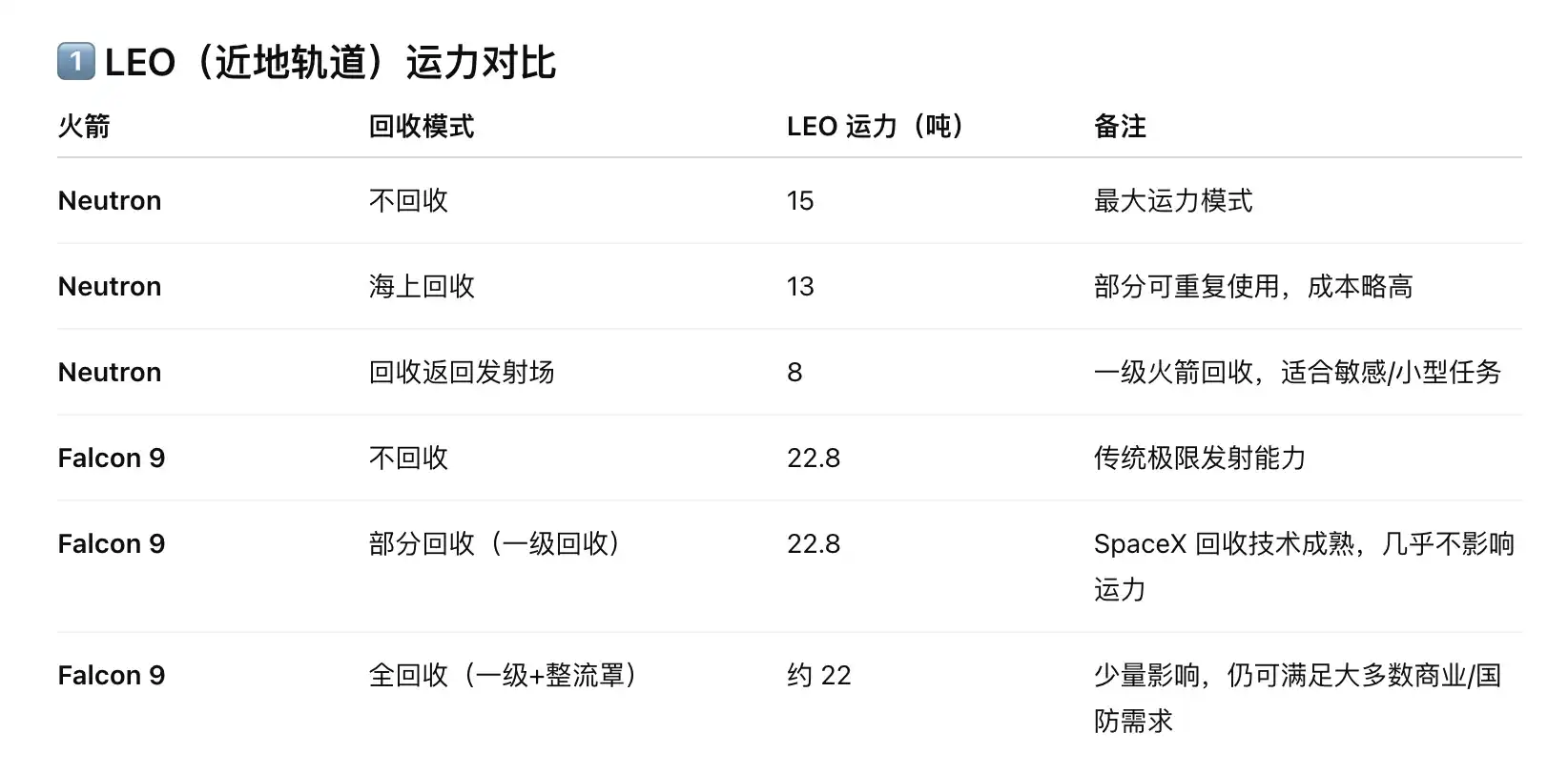
The biggest significance of Neutron's emergence is that it is expected to become the world's only second option that can compete with Falcon 9, although its designed payload capacity (approx. 8-15 tons) is still slightly inferior to Falcon 9. However, in engineering logic, it attempts to achieve a curved overtaking of its predecessor through "late-mover advantages" — with unique designs like the HungryHippo fairing and Archimedes engine, Neutron aims to surpass Falcon 9 in efficiency regarding fairing recovery and engine reusability.
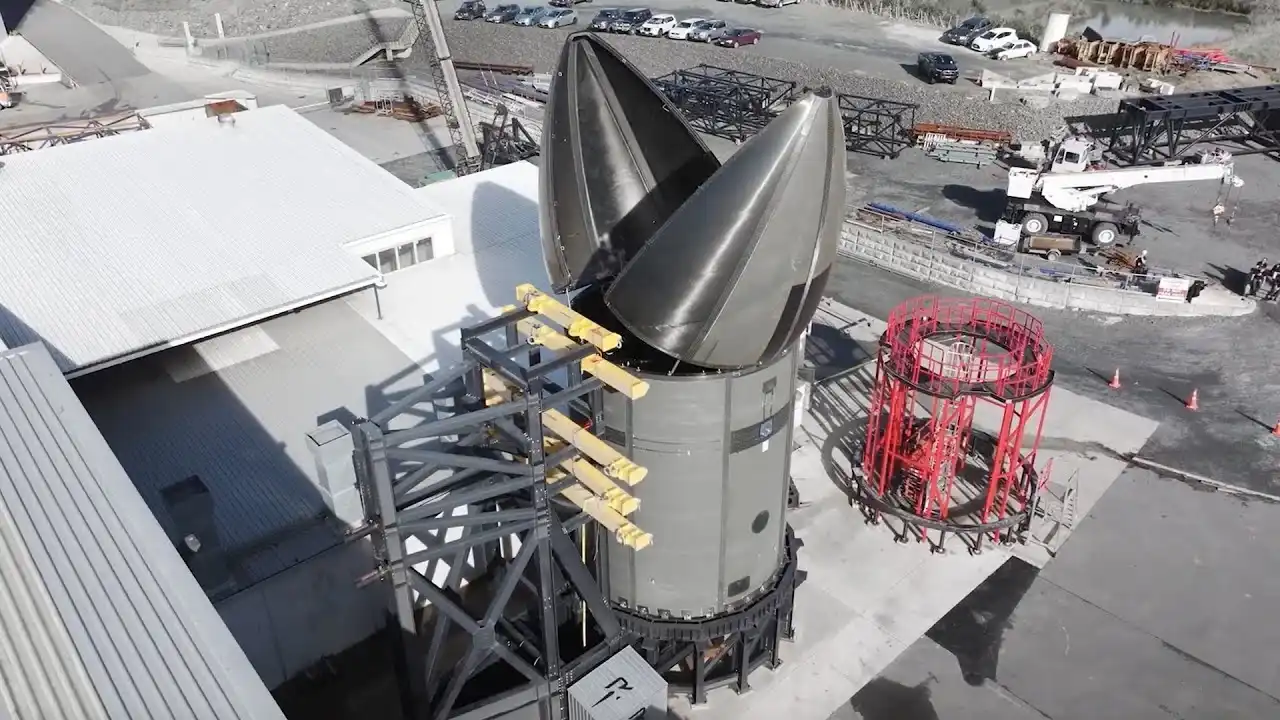
  • Odaily Note: HungryHippo is Neutron's most significant design highlight. Unlike SpaceX, which needs to retrieve millions of dollars worth of fairing debris from the sea after each launch, Neutron's fairing adopts a fixed, non-separating design connected to the first-stage booster. When releasing the second stage, it opens like a "hippopotamus mouth," closes after deployment, and lands with the first stage for recovery. This means the fairing avoids the complex process of at-sea recovery and post-landing reassembly; it's ready for refueling immediately after landing.

Judging from the disclosed testing progress, Rocket Lab is rapidly narrowing the generational gap with SpaceX in medium-to-large launch capabilities.

"Building Rockets" plus "Building Satellites": Replicating SpaceX's Ecological Loop

Just as SpaceX has Starlink, Rocket Lab is also building its own "launch + manufacturing" dual-drive ecosystem. Rocket Lab's "Space Systems" business (covering satellite platforms, laser communication, solar arrays, etc.) currently accounts for nearly 70% of its total revenue. This means that even during Neutron's R&D phase, Rocket Lab can still generate substantial revenue by selling satellite components.

This kind of "full industry chain" business model is almost unique to Rocket Lab in the public market, before SpaceX's own potential listing.

Huge Valuation Gap: A Reflection of Reality and an Investment Opportunity

Currently, SpaceX's private market valuation is as high as $1.75 to $2 trillion, while Rocket Lab's market cap has just surpassed $45 billion. The huge valuation gap objectively reflects the real-world status difference between the two companies, but this is precisely where investors see the most attractive "odds."

In the current global commercial aerospace field, the only company that can stably achieve frequent launches, reusability, high payload capacity, and low costs is SpaceX. Falcon 9's cost advantage has reached a level that makes most competitors despair, and this advantage is gradually forming a terrifying positive spiral — the cheaper, the more launches; the more launches, the more data; the more data, the faster the upgrades; the faster the upgrades, the cheaper it gets... This moat built by scale, data, and pace has left countless latecomers in awe.

But Rocket Lab's opportunity lies in the fact that, currently, Neutron appears to be the most promising reusable medium-to-large rocket to catch up with Falcon 9's pace. "The only choice after SpaceX" — this single label alone is compelling enough. Once Neutron successfully completes its maiden flight, Rocket Lab's valuation logic will completely shift from "a small rocket company" to "the world's second platform company with medium-to-large reusable rocket capability," poised to capture a large number of commercial contracts from SpaceX's hands. Therefore, the current market enthusiasm for Rocket Lab is largely a bet on the success probability of Neutron.

At this point in 2026, with SpaceX having broken through the trillion-dollar valuation ceiling, Rocket Lab, with a market cap of only about 2.5% of SpaceX's, clearly has more room for upside imagination.

Biggest Risk: "Neutron" Hasn't Flown Yet...

But there's still one big suspense — Can Neutron actually fly on schedule?

According to the latest disclosure, Neutron's maiden flight is scheduled for the end of 2026. However, looking back at history, no new rocket launch has ever proceeded without delays. The aerospace industry has a harsh reality — a PPT rocket ≠ a real rocket.

Historically, many rockets never flew; many rockets blew up on their first flight; and many rockets failed in their cost-control designs. Neutron has yet to make its first flight. If Neutron's R&D progress encounters setbacks or its maiden flight is delayed, the current market cap will face severe pressure tests, and even the best story will be hard to continue telling.


İlgili Sorular

QWhy is Rocket Lab considered the 'only alternative' to SpaceX in the commercial space sector?

ARocket Lab is seen as the primary alternative to SpaceX because it is replicating SpaceX's proven path to success. It established a viable commercial business with its small Electron rocket and reusability technology, and is now developing the Neutron medium-lift rocket to compete with SpaceX's Falcon 9. Additionally, Rocket Lab operates a dual business model of 'launch + manufacturing' similar to SpaceX's Starlink ecosystem.

QWhat was the market reaction to Rocket Lab's Q1 2026 earnings report?

AFollowing its Q1 2026 earnings report, Rocket Lab's stock (RKLB) rose nearly 7% in after-hours trading. The report showed revenue of $200.3 million, a 63.5% year-over-year increase, surpassing expectations of $189 million, and provided strong Q2 guidance.

QWhat is the key design feature of Rocket Lab's Neutron rocket that aims to surpass the Falcon 9's efficiency?

AA key efficiency feature of the Neutron rocket is its 'HungryHippo' fairing. Unlike SpaceX's fairings which separate and require sea recovery, Neutron's fairing is fixed and non-separating. It opens to release the second stage and then closes, allowing it to be recovered intact with the first stage, eliminating complex recovery and refurbishment processes.

QWhat is the primary risk currently facing Rocket Lab's growth story?

AThe primary risk for Rocket Lab is the development and first launch of its Neutron rocket. Scheduled for late 2026, any significant delays, technical failures, or cost overruns in Neutron's development could severely impact the company's valuation and growth narrative, as much of its future potential is tied to this vehicle.

QHow does Rocket Lab's current valuation compare to SpaceX's, and what opportunity does this present for investors?

ASpaceX's valuation is estimated at $1.75 to $2 trillion, while Rocket Lab's market capitalization is just over $45 billion. This massive gap reflects their current market positions but presents a significant opportunity for investors. If Rocket Lab's Neutron rocket succeeds, the company's valuation could be re-rated from a small-launch provider to the world's second platform with medium-lift reusable rocket capability, offering substantial upside potential.

İlgili Okumalar

Fed's Internal Doves Flock to Hawkish Stance, Warsh's Debut "Between a Rock and a Hard Place"

U.S. Federal Reserve officials who previously advocated for rate cuts, including Governor Christopher Waller, have recently shifted their stance, with many now not ruling out the possibility of future rate hikes. This sets a challenging stage for new Fed Chair Kevin Warsh's first policy meeting. Appointed by President Trump based on his dovish views, Warsh now faces a committee where the debate has pivoted from "when to cut" to "whether to hike," driven by persistent inflation above 3%, a strong labor market, and supply-side pressures from AI infrastructure demands and geopolitical tensions. Key figures illustrate the shift. Governor Waller, once concerned about employment, now says data has pushed him toward considering rate increases. Even moderate voices like Governor Lisa Cook, while expecting inflation to ease, have indicated readiness to hike if it fails to do so. Long-time hawks such as regional Fed presidents Beth Hammack, Lorie Logan, and Neel Kashkari have grown more vocal, arguing that the real policy rate is effectively falling and that action may soon be needed. The upcoming Fed meeting is expected to keep rates steady but will likely remove the "easing bias" from its statement, signaling a neutral stance between cuts and hikes. The quarterly "dot plot" is anticipated to show most officials projecting no cuts this year, with some potentially indicating hikes. Chair Warsh, a critic of the Fed's reliance on forward guidance like the dot plot, must navigate communicating this pivot using tools he has questioned, all while steering policy in a direction counter to the preferences of the president who appointed him. The consensus suggests the Fed's next move could well be a rate increase.

marsbit3 dk önce

Fed's Internal Doves Flock to Hawkish Stance, Warsh's Debut "Between a Rock and a Hard Place"

marsbit3 dk önce

The Trillion-Yuan Market Cap 'Yi Zhong Tian': Who is the True Value King?

The article analyzes the three leading Chinese optical module companies, collectively nicknamed "Yi Zhong Tian": Xinyisheng, Zhongji Innolight, and TFC Optical Communication. It evaluates their "cost-performance" not by current stock price, but through three lenses: PEG ratio (growth vs. valuation), earnings quality, and premium/discount for certainty. Xinyisheng shows the most attractive PEG ratio and high profitability, but its valuation reflects discounts for risks like high customer concentration and reliance on overseas markets. Zhongji Innolight, the most expensive, commands a premium for its market leadership, dominant share in key products like 800G/1.6T modules, and higher earnings certainty, though it faces geopolitical risks. TFC Optical, as an upstream component supplier ("water seller"), has the highest gross margin and bets on the long-term CPO/NPO architecture trend, but trades at a high valuation with more stable, less explosive growth. The core argument is that while these companies dominate module assembly, the true profit pool and technological moat lie upstream in laser and switch chips, currently controlled by U.S. firms like Lumentum and Coherent. The long-term "cost-performance" for these Chinese leaders hinges on whether the domestic industry, exemplified by companies like Yuanjie Technology, can successfully move up the value chain into high-power laser chips. Otherwise, their high growth may remain confined to the lower-margin assembly segment.

marsbit13 dk önce

The Trillion-Yuan Market Cap 'Yi Zhong Tian': Who is the True Value King?

marsbit13 dk önce

Has the Crypto Market Bottomed? Here's What Institutions Think

The crypto market is in a period of significant debate, with leading institutions offering differing views on whether a bottom has been reached. Three prominent firms have published detailed analyses: * **Galaxy Digital** argues Bitcoin has **not yet bottomed**. Their analysis of 13 historical indicators across six dimensions (valuation, profit-taking, miner pressure, etc.) shows only four are fully met. They project a potential bottom range between $30k and $54k. * **NYDIG** states a bottom is **possible but not likely**. While metrics are close to historic bear market extremes, they note the absence of a classic panic-selling event. They also suggest increased institutional adoption may have structurally altered the market cycle, potentially leading to a shallower downturn. * **Standard Chartered Bank** asserts the **bottom has already occurred** at around $59k. They cite two key factors: potential US-Iran diplomatic progress and the anticipated SpaceX IPO, which they believe absorbed capital and caused ETF selling pressure that is now subsiding. They forecast a year-end price target of $100k. Despite the surface-level disagreement, the reports share critical common ground more valuable for long-term investors: 1. All three believe the market bottom will form **within this year**. 2. All agree the current price is **closer to the bottom than to previous highs**. 3. All maintain a **bullish long-term outlook** for Bitcoin and a new cycle. The core takeaway is that while the exact bottom price ($40k, $50k, or $60k) is debated, the consensus is that a bottom is imminent. For long-term holders, the primary focus should not be pinpointing the absolute low, but on the future potential for prices to reach $100k, $200k, or higher. The fundamental thesis for Bitcoin—sovereign debt accumulation, inflation, declining trust in centralized institutions, global digitization, and improved accessibility—remains intact and is arguably strengthening. The overall landscape is viewed as more favorable than in previous crypto winters.

marsbit23 dk önce

Has the Crypto Market Bottomed? Here's What Institutions Think

marsbit23 dk önce

The 'Chip' Challenge and Breakthroughs in China's Optical Industry Chain

China's Photonics Industry: Bottlenecks and Breakthroughs In the global AI race, computing chips dominate the narrative, but the underlying bottleneck increasingly defining the scale of AI clusters is light—or more specifically, optical connectivity. Optical modules, which translate electrical signals to light and vice versa, are crucial for connecting thousands of GPUs in AI data centers, preventing data congestion and ensuring efficient model training. High-speed modules (800G, 1.6T) are now standard, with performance hinging on advanced DSP (Digital Signal Processor) chips. This is where a critical dependency lies. Two US giants—Marvell and Broadcom—collectively dominate over 90% of the high-end DSP chip market. Chinese optical module leaders like Zhongji Innolight and Eoptolink rely on these chips to manufacture modules for overseas AI customers, primarily in North America. While this creates a supply chain vulnerability, complete decoupling is difficult. Marvell derives over half its revenue from Greater China, and the US firms depend on Chinese partners for chip packaging and optical components. The risk from laser chips (e.g., from Lumentum), another key component, is considered more manageable due to multiple global suppliers and faster progress in domestic alternatives from companies like YOFC and Accelink. To mitigate risks, China's industry is pursuing a multi-pronged strategy: diversifying supply chains and locking in long-term orders; fostering a domestic market ecosystem to adopt homegrown DSPs from firms like Huawei HiSilicon and CETC; accelerating R&D in high-speed DSPs and advanced packaging; and investing in next-gen technologies like silicon photonics and Co-Packaged Optics (CPO) to reduce reliance on discrete DSPs. The ultimate solution lies not in short-term博弈 but in persistent advancement of domestic high-end chip R&D and manufacturing. While challenges remain in performance, certification, and ecosystem building, China's vast domestic market and manufacturing base provide a crucial buffer, buying time for the industry to achieve greater technological independence.

marsbit37 dk önce

The 'Chip' Challenge and Breakthroughs in China's Optical Industry Chain

marsbit37 dk önce

Behind SpaceX's $2 Trillion Market Cap: Why Does Musk Always Have the Next Move Planned?

On June 12th, SpaceX debuted on the Nasdaq, reaching a valuation that briefly touched $2 trillion. This marked the culmination of a 24-year journey from its founding in 2002, driven by Elon Musk's frustration at the high cost of buying rockets. The company's path was defined by early failures, with its first three Falcon 1 launches ending in explosions before a successful 2008 flight opened the era of commercial spaceflight. Key to its model was a fixed-price NASA contract, incentivizing cost reduction. SpaceX mastered rocket reusability, first achieving a Falcon 9 landing in 2015, which drastically cut launch costs. This enabled its profitable Starlink satellite internet constellation, envisioned years before reusability was proven, to create an internal market for frequent launches. Similarly, the next-generation Starship rocket was in development long before its first flight, with its business case evolving from Mars colonization to supporting the emerging concept of in-orbit data centers for AI—a story now central to its valuation. The company's recent IPO, a reversal of its long-standing "no IPO" stance, is funding this ambitious "space-based compute" vision. While major tech players like Google, Blue Origin, and others are investing heavily, significant technical and cost hurdles remain. Ultimately, SpaceX's history is one of creating its own demand: first with Starlink and now with space-based AI compute, betting that its next rocket will enable its next giant market.

marsbit39 dk önce

Behind SpaceX's $2 Trillion Market Cap: Why Does Musk Always Have the Next Move Planned?

marsbit39 dk önce

İşlemler

Spot
Futures
活动图片