Who is Placing Counterintuitive Bets in Prediction Markets?

Odaily星球日报2026-01-08 tarihinde yayınlandı2026-01-08 tarihinde güncellendi

Özet

Who Bets Against Common Sense in Prediction Markets? This article explores the counterintuitive players who provide liquidity by betting "Yes" on seemingly improbable events on prediction markets like Polymarket. Contrary to appearing irrational, these participants are often driven by calculated strategies. Three key groups are identified: 1. **The Lottery Players:** These individuals focus on high odds, betting small amounts for a potentially large payoff. They capitalize on the small but non-zero chance of a black swan event or a market settlement error, making such high-risk, high-reward bets a rational part of a diversified strategy. 2. **Bots:** Automated trading algorithms are significant liquidity providers. They quickly engage in new markets, scooping up ultra-cheap "Yes" shares and then placing slightly higher sell orders to profit from subsequent buyers (like lottery players or other bots). Some bots also trade to generate volume, potentially aiming to qualify for future airdrops. 3. **The Prediction Platforms:** Polymarket itself incentivizes liquidity through programs like maker incentives and holding rewards (e.g., a 4% APY for holding shares in specific markets). These financial incentives make providing liquidity on unlikely outcomes attractive, as rewards can offset potential losses or enhance gains, contributing significantly to market depth and volume. The analysis concludes that those betting against the consensus are not merely "stupid" but are often...

Original | Odaily Planet Daily (@OdailyChina)

Author | Golem (@web3_golem)

This week, I wrote an article reviewing the absurd event contracts on Polymarket, pointing out that betting on some seemingly outrageous contracts at this time would be profitable.

This made me wonder: who is going against "common sense" to provide "free money" for the market?

Bets that oppose our smart choices aren't completely without a chance of happening; there are certainly some people who firmly believe in their judgments (for example, some still believe the Earth is flat). But prediction markets aren't a "greater fool market." I believe that when players use real money to predict whether an event will occur, they will do their best to think as a "rational person," meaning their decisions are the most economical and profitable. Therefore, from this perspective, those users betting "Yes" on seemingly impossible event contracts must also have some kind of profit strategy; they aren't fools providing us with "high-certainty" financial opportunities for free.

After thinking and discussing, I believe that those providing counterparty liquidity in these absurd event markets likely fall into the following three categories (this article is meant to spark discussion, welcome feedback and corrections, X@web3_golem):

Lottery Players

The logic of lottery players is simple: they focus only on the odds, aiming for a small stake to win big.

Sometimes, real life is far more surreal than we imagine; even events that seem outrageous can happen. Moreover, although prediction markets settle based on the real world, settlement results can sometimes be distorted due to settlement conditions, system failures, and other factors. Polymarket has had instances where settlement results did not match reality due to issues with UMA's dispute resolution mechanism. A recent example is Polymarket ruling that the US military action in Venezuela did not constitute an "invasion."

Therefore, long-tail odds偏差 (bias) appear. Even for events with a very small probability of occurring, the Yes side still has a price of 1%-3%. As long as the odds are high enough, "lottery players" will buy, becoming one of the firm bottom buy supports.

But actually, this psychology of "lottery players" is also rational. For example, in the event contract "Will Putin step down before the end of 2026?", driven by common sense, most people will buy "No," and the probability already shows people's attitude. But the Yes side still has a 10% probability, meaning if you bet $10, you could get $100 back if Putin really steps down before the end of 2026—a 10x return. So, why not gamble?
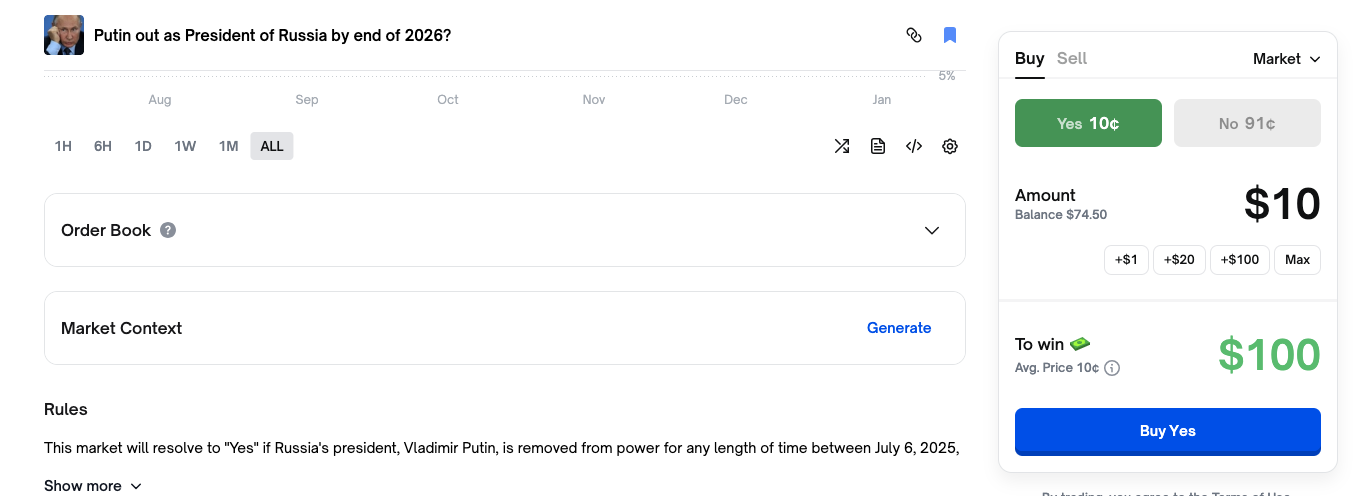
Furthermore, lottery players don't necessarily place heavy bets on a single market. Since prediction markets are不缺 (not short of) such high-odds events, by casting a wide net and hitting the jackpot a few times, there's still a chance to recoup costs and even profit.

They anticipate black swan events more than normal people. Therefore, they are happy to provide buy-side liquidity on the Yes side of "counterintuitive" markets (In some markets, Polymarket provides placing rewards and holding rewards, but this is not the main factor driving lottery players).

Bots

If an event contract itself has strong certainty, the intervention of players sweeping the尾盘 (end-of-market) will push the probability on one side to 99%-100% before settlement. The existence of "lottery players" can partially explain why these "counterintuitive" markets still have players taking the Yes sell orders (Odaily Note: Because Polymarket uses a shared order book, meaning when the No side has a buy order for 1 share at $0.99, the Yes side will correspondingly have a sell order for 1 share at $0.01), but they are always a minority group and cannot explain why these markets still have large trading volumes and good depth.

So, who else is injecting large amounts of liquidity into these markets? The answer is bots.

Market-making bots on Polymarket have developed very rapidly. Bots that trade automatically through the Polymarket API actively monitor all newly created markets and are often among the first participants. These bots can profit by actively trading in these markets.

In these "counterintuitive" markets, when the No side price is $0.99, due to the shared order book, the Yes side will have sell orders listed at $0.01. Market-making bots, like "lottery players," will also eat these $0.01 sell orders. But immediately after, they will list sell orders on the Yes side at $0.02, $0.03, or even higher, waiting for "lottery players" or other bots to成交 (execute the trade). The No side will also see buy orders at $0.98, $0.97, or even lower (Odaily Note: again due to the shared order book). Thus, the order book gains significant depth.

However, after communicating with the crypto VC Jsquare team (they invested in prediction market aggregator Rocket), they believe there aren't many bots executing this strategy on the market. In these "counterintuitive" markets, the speculative psychology of "lottery players" or regular players is enough to support most of the opposing orders.

The existence of some wash trading bots also provides market liquidity and trading volume for these "counterintuitive" and somewhat niche markets (compared to events like the US election). A wash trading bot places a buy order on the Yes side at $0.02, and another wash trading bot places a buy order on the No side at $0.98 to execute the trade.

This behavior is mainly to qualify for future prediction market airdrops. In high-frequency markets, orders might be matched by other players, so these "counterintuitive" event contracts are the ideal tools for wash trading.

Prediction Platforms

In addition to the above "lottery players" and bots, the prediction platforms themselves also contribute greatly to the liquidity of these markets.

Polymarket's mechanism includes two liquidity incentives: placing rewards and holding rewards. Placing rewards mean that in some specific markets, players can get rewards simply by placing orders within the maximum stipulated spread. Holding rewards mean that in some specific markets, players holding shares, whether Yes or No, can receive a 4% annualized holding reward.
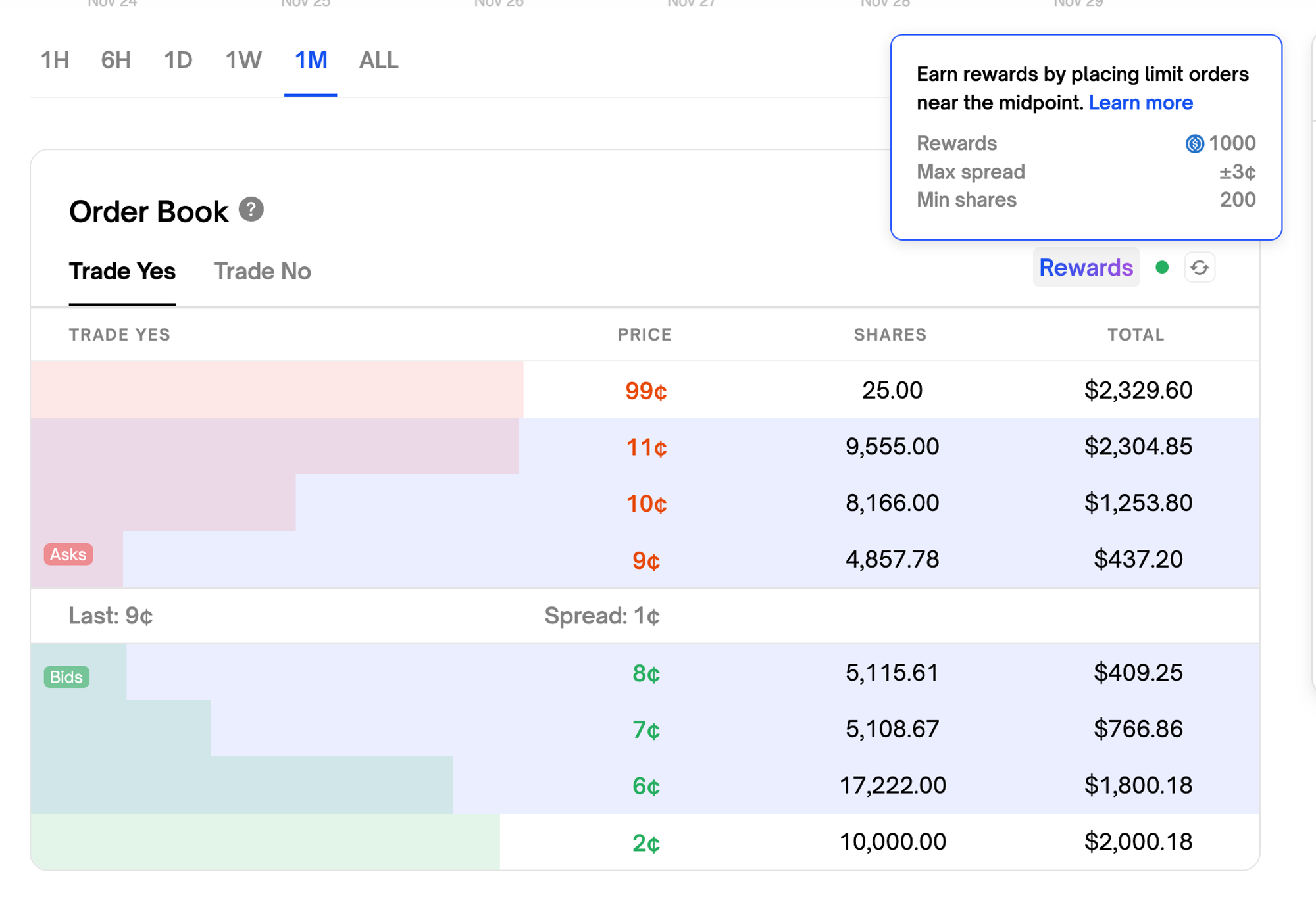
The highlighted part indicates the maximum spread range for placing rewards

According to statistics, Polymarket has invested about $10 million in market maker incentives, paying over $50,000 daily at its peak to maintain order book liquidity. These incentives have now decreased to just $0.025 per $100 traded.

These investments have indeed been effective, driving trading in many "counterintuitive" markets. For example, the event contract "Will Putin step down before the end of 2026?" has already seen over $1.3 million in trading volume. Holding shares in this contract yields a 4% annualized return. For players holding Yes shares, this equates to an ultimate annualized return of 14% (10% tail-end收益 (profit) + 4% platform reward), which is hugely attractive. For players holding No shares, the placing rewards and holding rewards also hedge some of the risk.
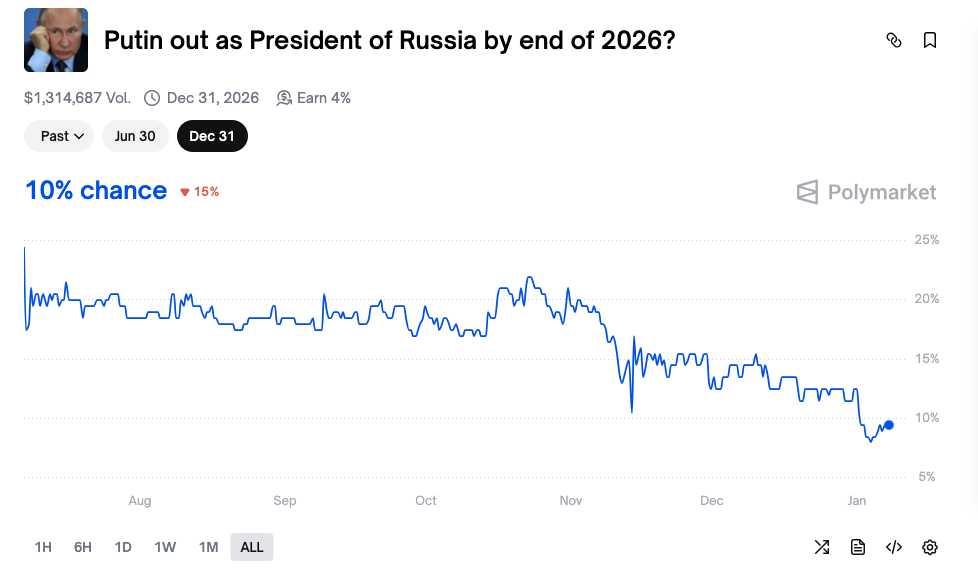
There is also speculation that, in addition to openly providing liquidity incentives, prediction markets themselves act as market makers, providing liquidity for these "counterintuitive" and niche markets to achieve advertising and marketing effects. But this is pure speculation, open for discussion.

İlgili Sorular

QWho are the three types of participants providing liquidity in seemingly absurd prediction market contracts on Polymarket?

AThe three types are lottery players (who bet on high odds for small probabilities), trading bots (which automate trading for profits or airdrop farming), and the prediction platform itself (through incentives like order rewards and holding rewards).

QWhat is the primary motivation for 'lottery players' to bet on the 'Yes' side of low-probability events?

AThey are motivated by the high potential returns from low-probability events, akin to buying a lottery ticket, where a small bet could yield significant profits if the unlikely event occurs.

QHow do trading bots contribute to liquidity in 'anti-common sense' markets on Polymarket?

ATrading bots use APIs to automate trading, capturing low-priced orders and providing liquidity by placing higher sell orders or engaging in volume farming to qualify for potential airdrops.

QWhat role does Polymarket play in incentivizing liquidity for these markets?

APolymarket offers order rewards and holding rewards, such as annualized yields for holding shares, to encourage participation and liquidity provision in these markets.

QWhy might some participants believe that betting on unlikely events is rational despite low probabilities?

AThey view it as a calculated risk where the potential high returns, combined with platform incentives, justify the bet, especially if they diversify across multiple high-odds events.

İlgili Okumalar

This Week's Key Events Preview | U.S. to Release April CPI Data; U.S. Senate Banking Committee to Review "Digital Asset Market Structure Act of 2025"

Weekly News Preview: Key events for May 12-16 include major economic and crypto industry developments. On Tuesday, May 12, the U.S. will release its April CPI data. Additionally, the gaming blockchain Ronin will begin a 10-hour migration to an Ethereum Layer 2, built on OP Stack with EigenDA for data availability. This aims to leverage Ethereum's security and settle RON's annual inflation below 1%. Base's first independent network upgrade, "Base Azul," is scheduled for mainnet activation on Wednesday, May 13, focusing on security, performance, and developer experience enhancements. Thursday, May 14, sees the U.S. Senate Banking Committee voting on the "Digital Asset Market Structure Act of 2025." In other news, Solana DeFi protocol Carrot will shut down, setting a final withdrawal deadline due to impacts from the Drift exploit. The Moscow Exchange will launch futures trading for Solana, Ripple, and Tron indices (RUB-settled) for qualified investors. Multiple service closures are scheduled for Friday, May 15. Dmail Network will begin winding down due to unsustainable infrastructure costs and failed commercialization. Users must export data before this date. Separately, the Cosmos-based lending blockchain UX Chain will fully shut down. Finally, on Saturday, May 16, gaming infrastructure provider Lattice will wind down operations, with its Redstone Layer 2 network ceasing. Users are urged to withdraw assets, especially from contracts like Uniswap pools, before the shutdown.

链捕手49 dk önce

This Week's Key Events Preview | U.S. to Release April CPI Data; U.S. Senate Banking Committee to Review "Digital Asset Market Structure Act of 2025"

链捕手49 dk önce

Morning Post | Trump Media Group Releases Q1 Financial Report; Top Three DeFi Applications Return Nearly $100 Million in Revenue to Token Holders in 30 Days; Michael Saylor Shares Bitcoin Tracker Info Again

**Title: Daily Briefing | Trump Media Group Releases Q1 Report; Top 3 DeFi Apps Return Nearly $100M to Token Holders; Michael Saylor Signals Potential Bitcoin Buy** **Summary:** Key developments in the past 24 hours include: * **Economic Outlook:** Goldman Sachs has pushed back its forecast for the next two Federal Reserve interest rate cuts to December 2026 and March 2027, citing persistent inflationary pressures from energy costs. This delayed timeline is expected to tighten liquidity flow into risk assets, including cryptocurrencies. * **DeFi & Revenue:** Data from DefiLlama shows that three leading DeFi applications—Hyperliquid, Pump.fun, and EdgeX—collectively distributed $96.3 million in revenue to their token holders over the last 30 days. This trend highlights a shift in the crypto community's focus towards real protocol earnings and sustainable economic models. * **Corporate Bitcoin Moves:** Michael Saylor, founder of MicroStrategy (note: referred to as 'Strategy' in the text, likely a typographical error), has signaled potential upcoming Bitcoin purchases by posting a "Bitcoin Tracker" update, following a pattern that typically precedes the company's official disclosure of new acquisitions. * **Market Integrity:** Prediction market platform Polymarket announced updates to address platform issues, including identifying and banning clusters of accounts involved in "ghost-fill" activities and implementing measures to prevent bulk account creation. * **Regulation:** The Bank of England Governor warned that stablecoin regulation could lead to tensions between US and international regulators. In South Korea, the National Tax Service has launched a pilot program to entrust seized virtual assets to private custody firms for management. * **Meme Token Trends:** GMGN data lists the top trending meme tokens on Ethereum (e.g., HEX, SHIB), Solana (e.g., FWOG, TROLL), and Base (e.g., SKITTEN, PEPE) over the past day. **Financial Note:** Trump Media & Technology Group reported a Q1 loss of approximately $4 billion, primarily attributed to unrealized losses on its Bitcoin and other digital asset holdings.

链捕手1 saat önce

Morning Post | Trump Media Group Releases Q1 Financial Report; Top Three DeFi Applications Return Nearly $100 Million in Revenue to Token Holders in 30 Days; Michael Saylor Shares Bitcoin Tracker Info Again

链捕手1 saat önce

Telegram Takes Direct Control of TON, Social Traffic Rewrites the Public Chain Narrative

Telegram founder Pavel Durov announced that Telegram will replace the TON Foundation as the core driver and largest validator of The Open Network (TON). Key initiatives include a sixfold reduction in transaction fees, performance upgrades, and improved developer tools within the next few weeks. This marks a strategic shift from Telegram merely providing user access to deeply integrating TON into its platform's core infrastructure. The goal is to transform Telegram's massive social traffic into sustainable on-chain activity. While viral mini-apps like Notcoin have demonstrated Telegram's ability to drive user adoption, TON aims to support frequent, low-value transactions inherent to social platforms—such as tipping, in-app payments, and game rewards. Ultra-low fees and sub-second finality (0.6 seconds) are crucial to making blockchain interactions seamless and nearly invisible within the Telegram user experience. However, Telegram's increased central role raises questions about network decentralization. Durov argues that Telegram's participation will attract more large validators, thereby enhancing decentralization. TON also offers high annual staking rewards (18.8%), aiming to retain capital within its ecosystem. The fundamental challenge for TON is no longer leveraging Telegram's user base, but becoming an indispensable, seamless infrastructure layer for Telegram's everyday applications—moving from an adjacent chain to an embedded utility.

marsbit1 saat önce

Telegram Takes Direct Control of TON, Social Traffic Rewrites the Public Chain Narrative

marsbit1 saat önce

Telegram Takes Direct Control of TON, Social Traffic Reshapes Public Chain Narrative

Telegram's founder, Pavel Durov, has announced a major shift in the development of The Open Network (TON). Telegram will now become the core driver of TON, replacing the TON Foundation and becoming its largest validator. The focus will be on technical upgrades over the next few weeks, including slashing network fees by six times to near-zero and improving finality time to 0.6 seconds. This move signifies a deeper integration between Telegram and TON, moving beyond just providing a user base. The goal is to transform Telegram's vast social traffic and built-in features—like Mini Apps, payments, and bots—into sustainable, on-chain usage scenarios. The reduced fees and faster speeds are crucial for enabling the small, frequent transactions typical of social interactions. While this promises stronger execution and product alignment, it raises questions about centralization. Durov argues Telegram's involvement will attract more validators, enhancing decentralization, but the outcome remains to be seen. Additionally, TON's high annual staking reward of 18.8% aims to retain capital within the ecosystem. The key challenge for TON is no longer just leveraging Telegram's entry point, but becoming an invisible, seamless infrastructure layer within Telegram's daily use. Its success hinges on converting viral attention into lasting, embedded utility.

Odaily星球日报1 saat önce

Telegram Takes Direct Control of TON, Social Traffic Reshapes Public Chain Narrative

Odaily星球日报1 saat önce

İşlemler

Spot
Futures
活动图片

