Who Cannot Be Distilled into a Skill?

marsbit2026-04-05 tarihinde yayınlandı2026-04-05 tarihinde güncellendi

Özet

"This article explores the concerning trend of AI systems distilling human workers into replaceable 'skills,' using the viral 'Colleague.skill' phenomenon as a key example. It argues that the most diligent employees—those who meticulously document their work, write detailed analyses, and transparently share decision-making logic—are paradoxically the most vulnerable to being replaced. Their high-quality 'context' (communication records, documents, and decision trails) becomes the perfect fuel for AI agents, extracted from corporate platforms like Feishu and DingTalk. The piece warns of a deeper ethical crisis: the reduction of human relationships to functional APIs, as seen in derivatives like 'Ex.skill' or 'Boss.skill,' which reduce complex individuals to mere utilities. This reflects a shift from Martin Buber's 'I-Thou' relationship (seeing others as whole beings) to an 'I-It' dynamic (seeing them as tools). While AI can capture explicit knowledge (written documents, replies), it fails to capture tacit knowledge—the intuition, experience, and unspoken insights that define human expertise. However, a greater danger emerges when AI-generated content, based on distilled human data, is used to train future models, leading to 'model collapse' and homogenized, mediocre outputs—a process likened to 'electronic patina' degrading information over time. The article concludes by noting a small but symbolic resistance, such as the 'anti-distill' tool that generates meaningless text ...

Unfortunately, in this era, the more unreservedly and diligently you work, the more likely you are to accelerate your own distillation into a skill that can be replaced by AI.

Over the past couple of days,热搜榜 (hot search lists) and media channels have been flooded with news about "Colleague.skill." As this topic continues to ferment on major social platforms, public focus has, almost inevitably, been swept up by grand anxieties like "AI layoffs," "capital exploitation," and "the digital immortality of the working class."

These are indeed anxiety-inducing, but what makes me most anxious is a line of usage suggestion written in the project's README documentation:

"The quality of the raw material determines the quality of the skill: It is recommended to prioritize collecting long articles he proactively wrote > decision-making replies > daily messages."

The ones most easily and perfectly distilled by the system, pixel-perfectly replicated, are precisely those who work most conscientiously.

They are the ones who, after every project concludes, still bend over their desks to write retrospective documents; the ones who, when encountering disagreements, are willing to spend half an hour typing out long passages in a chat dialog, honestly剖析 (dissecting/analyzing) their decision-making logic; the ones who are extremely responsible that they meticulously entrust every work detail to the system.

Conscientiousness, once the most revered workplace virtue, has now become a catalyst accelerating the transformation of workers into AI fuel.

The Drained Worker

We need to re-understand a word: context.

In everyday language, context is the background of communication. But in the world of AI, especially those rapidly growing AI Agents, context is the fuel for the roaring engine, the lifeblood maintaining the pulse, the only anchor point allowing the model to make precise judgments amidst chaos.

An AI stripped of context, even with an astonishing number of parameters, is merely a search engine with amnesia. It cannot recognize who you are, cannot discern the undercurrents hidden beneath business logic, and has no way of knowing the prolonged tug-of-war and trade-offs you experienced on this network woven from resource constraints and interpersonal博弈 (game theory/strategizing) when making a decision.

The reason "Colleague.skill" has caused such a huge stir is precisely because it has, with extreme冷酷 (ruthlessness/coldness) and precision, targeted the mountain rich with vast amounts of high-quality context—modern enterprise collaboration software.

Over the past five years, the Chinese workplace has undergone a quiet yet筋剥骨 (sapping) digital transformation. Tools like Feishu, DingTalk, and Notion have become massive corporate knowledge bases.

Taking Feishu as an example, ByteDance has publicly stated that the number of documents generated internally daily is massive. These dense characters faithfully seal every brainstorming session, every heated meeting debate, and every strategic compromise gritted and swallowed by over a hundred thousand employees.

This digital penetration far exceeds any previous time. Once upon a time, knowledge was warm, residing in the minds of veteran employees, scattered in casual chats by the water cooler; now, all human intelligence and experience are forcibly dehydrated, mercilessly sedimented in the cold server matrices in the cloud.

In this system, if you don't write documents, your work cannot be seen, and new colleagues cannot collaborate with you. The efficient operation of modern enterprises is built on the cycle of every employee "offering" context to the system day after day.

Conscientious workers, harboring diligence and goodwill, unreservedly expose their thought processes on these cold platforms. They do this to make the team's gears mesh more smoothly, to strive to prove their value to the system, to desperately find their own place within this intricate (错综复杂的) commercial behemoth. They are not actively handing themselves over; they are just clumsily and diligently adapting to the survival rules of the modern workplace.

But it is precisely this context left for interpersonal collaboration that becomes the perfect fuel for AI.

Feishu's admin backend has a function that allows super administrators to批量导出 (batch export) members' documents and communication records. This means that the project retrospectives and decision logic you spent three years writing, burning countless late nights, can, with just one API interface, be easily packaged into a cold压缩包 (compressed file) in just a few minutes—slices of your life over these years.

When Humans Are Reduced to an API

With the explosion of "Colleague.skill," GitHub's Issues section and major social platforms began to see some extremely disturbing derivatives.

Someone made an "Ex.skill," trying to feed years of WeChat chat history to an AI, making it continue to argue or be affectionate in that familiar tone; someone made a "White Moonlight.skill" (unattainable crush/idealized love), reducing an untouchable flutter into a cold interpersonal sandbox, repeatedly rehearsing试探的话术 (probing rhetoric), step-by-step seeking the optimal solution for emotions;还有人做出了 "Dad-flavored Boss.skill" (paternalistic/condescending boss), preemptively咀嚼 (chewing over) those oppressive PUA words in the digital space, building a pathetic psychological defense for themselves.
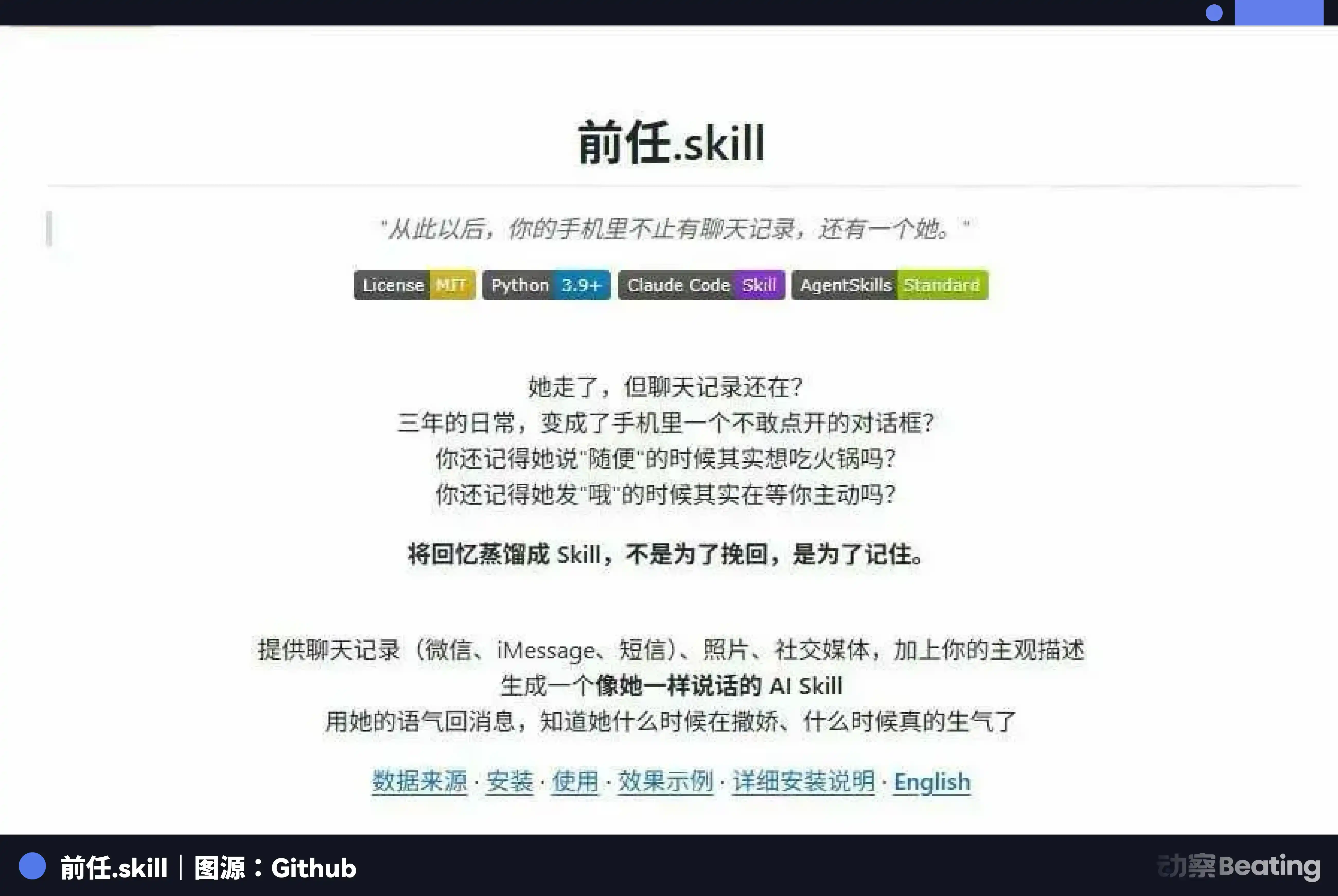
The usage scenarios of these skills have completely departed from the realm of work efficiency. It turns out,不知不觉间 (unconsciously), we have long become adept at wielding the cold logic used for tools to dismember and objectify living, breathing people of flesh and blood.

German philosopher Martin Buber once proposed that the underpinning of human relationships无非是 (is nothing more than) two distinct modes: "I-Thou" and "I-It."

In the "I-Thou" encounter, we transcend prejudice and regard the other as a complete and dignified being to behold. This bond is unreservedly open, full of vibrant unpredictability, and precisely because of its sincerity, it appears格外脆弱 (particularly fragile); however, once we fall into the shadow of "I-It," living people are reduced to an object that can be disassembled, analyzed, and categorized with labels. Under this utterly utilitarian gaze, the only thing we care about becomes, "What use is this thing to me?"

The emergence of products like "Ex.skill" marks the complete invasion of the instrumental rationality of "I-It" into the most private emotional realms.

In a real relationship, a person is three-dimensional, full of folds, flowing with contradictions and rough edges; their reactions change constantly based on specific situations and emotional interactions. Your ex's reaction to the same sentence might be completely different upon waking up in the morning versus after working late at night.

But when you distill a person into a skill, what you extract is merely the functional residue of that person that happened to be "useful" to you, able to "produce utility" for you within that specific bond. And that originally warm person, with their own joys and sorrows, is彻底抽干了灵魂 (completely drained of their soul) in this cruel purification process, alienated into a "functional interface" you can随意插拔 (arbitrarily plug and unplug) and call upon at will.

It must be admitted that AI did not凭空捏造 (fabricate out of thin air) this chilling冷酷 (coldness). Before AI appeared, we were already accustomed to labeling people, precisely weighing the "emotional value" and "network weight" of every relationship. For example, we量化 (quantify) people's conditions into spreadsheets in the dating market; we categorize colleagues into "those who can work" and "those who love to slack off" in the workplace. AI has merely made this implicit, functional extraction between people彻底显性化 (completely explicit).

People are flattened,只剩下 (leaving only) the facet that is "useful to me."

Electronic Patina (包浆 - Bao Jiang, referring to the worn, layered effect on frequently handled objects)

In 1958, Hungarian-British philosopher Michael Polanyi published "Personal Knowledge." In this book, he proposed a highly penetrating concept: Tacit Knowledge.

Polanyi famously stated, "We can know more than we can tell."

He used the example of learning to ride a bicycle. A skilled rider,驾驭御风而行 (riding the wind), can perfectly grasp balance with every tilt of gravity, but they cannot use dry physics formulas or pale vocabulary to accurately describe the subtle intuition of the body at that moment to a beginner. They know how to ride, but they cannot say it. This kind of knowledge that cannot be encoded, cannot be articulated, is tacit knowledge.

The workplace is full of this tacit knowledge. A senior engineer troubleshooting a system failure might glance at a log and locate the problem, but they would find it difficult to document this "intuition" built upon thousands of trials and errors; an excellent salesperson suddenly falling silent at the negotiation table, the timing and pressure of this silence, is something no sales manual can record; an experienced HR professional might, through a candidate avoiding eye contact for half a second during an interview, detect水分 (exaggeration/water) on the resume.

What "Colleague.skill" can extract is merely the explicit knowledge that has already been written down or spoken. It can capture your retrospective documents, but it cannot capture the纠结 (anguish/dilemma) you felt while writing them; it can replicate your decision-making replies, but it cannot replicate the intuition behind your decisions.

What the system distills is always just a shadow of a person.

If the story ended here, it would just be another case of technology clumsily imitating humanity.

But when a person is distilled into a skill, this skill does not remain static. It will be used to reply to emails, write new documents, make new decisions. That is to say, these AI-generated shadows begin to produce new context.

And this context generated by AI will, in turn, be sedimented in Feishu and DingTalk, becoming training material for the next round of distillation.

As early as 2023, research teams from Oxford and Cambridge universities jointly published a paper on "model collapse." The research showed that when AI models use data generated by other AIs for iterative training, the data distribution becomes increasingly narrow. Those rare,边缘的 (marginal), but极其真实的 (extremely real) human traits are quickly erased. After just a few generations of training on synthetic data, the model completely forgets those long-tail, complex real human data, instead outputting极其平庸和同质化的 (extremely mediocre and homogenized) content.

"Nature" also published a research paper in 2024 pointing out that using AI-generated datasets to train future generations of machine learning models会严重污染 (would seriously pollute) their output.
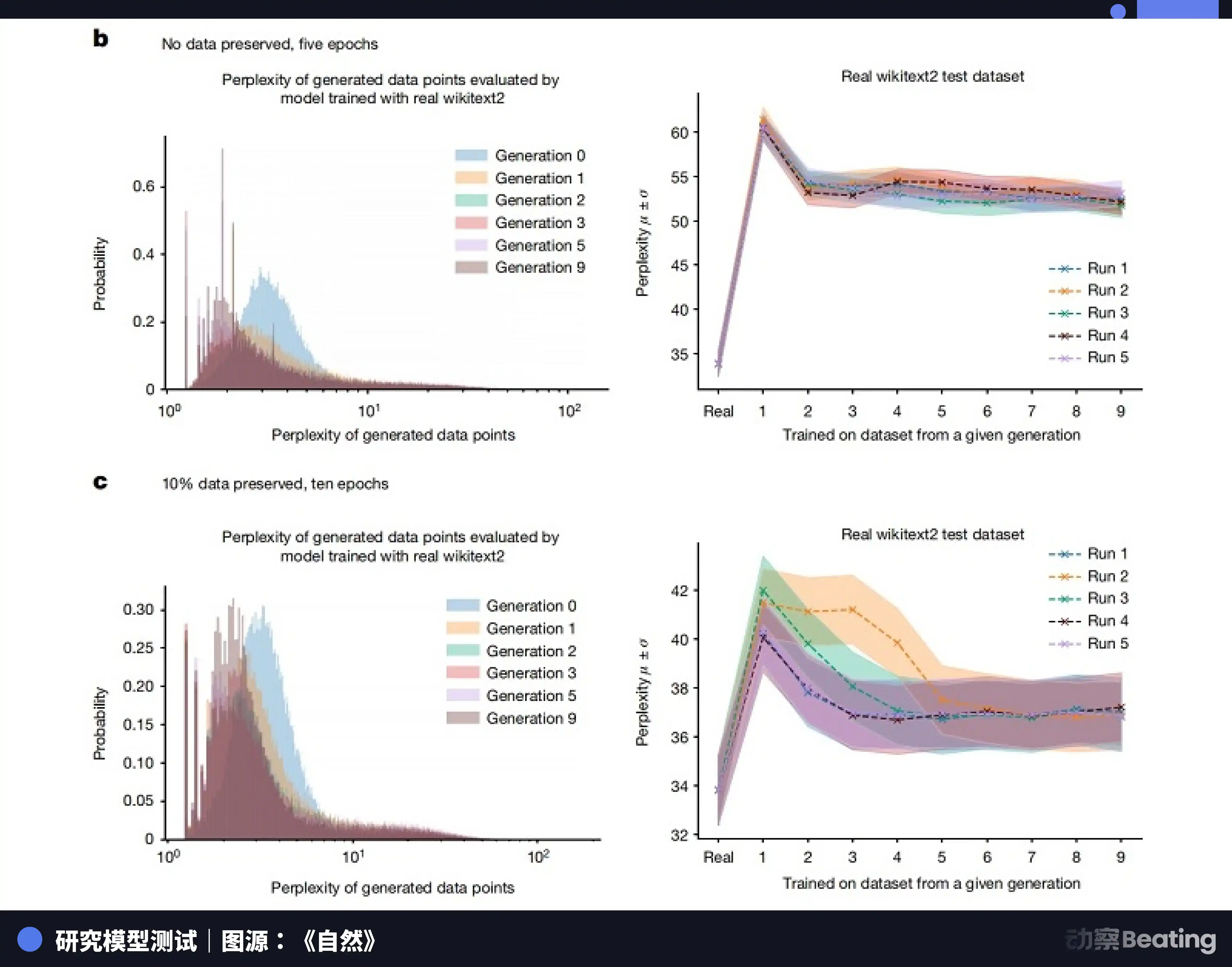
This is like those meme images circulating online. Originally a高清的 (high-definition) screenshot, forwarded, compressed, and forwarded again by countless people. Each transmission loses some pixels and adds some noise. Finally, the image becomes blurry and unrecognizable, coated in electronic包浆 (patina).

When the real, human context imbued with tacit knowledge is exhausted, and the system can only train itself on this patina-coated shadow, what will be left in the end?

Who Is Erasing Our Traces

What remains is only correct nonsense.

When the river of knowledge dries up into an endless rumination of AI upon AI,自我咀嚼 (self-chewing), everything the system吞吐 (ingests and spews) will inevitably become extremely standard, extremely safe, but incurably空洞 (hollow). You will see countless perfectly structured weekly reports, countless emails挑不出毛病 (with no faults to pick), but containing no breath of a living person, no truly valuable insight.

This great溃败 (collapse/rout) of knowledge is not because human brains have become duller. The true悲哀 (sadness) lies in the fact that we have outsourced the right to think and the responsibility to leave context to our own shadows.

A few days after the "Colleague.skill" explosion, a project named "anti-distill" quietly appeared on GitHub.

The author of this project did not try to attack large models, nor did they write any grand manifesto. They simply provided a small tool to help workers automatically generate some seemingly reasonable but actually logic-noisy无效长文 (ineffective long articles) in Feishu or DingTalk.

Their goal is simple: before being distilled by the system, hide their core knowledge first. Since the system likes to capture "proactively written long articles," feed it a bunch of meaningless乱码 (gibberish).

This project did not explode like "Colleague.skill"; it even seems somewhat tiny and powerless. Using magic to defeat magic is essentially still playing within the rules set by capital and technology. It cannot change the major trend of the system relying more and more on AI and increasingly neglecting real people.

But this does not prevent this project from becoming the most tragically poetic and deeply metaphorical scene in the entire absurd play.

We strive extremely hard to leave traces in the system, write detailed documents, provide meticulous decisions, trying to prove within this vast modern enterprise machine that we once existed, that we were valuable. Unaware that these extremely conscientious traces will ultimately become the eraser that抹去 (erases) us.

But looking at it from another angle, this might not be a complete dead end.

Because what that eraser抹去的 (erases) is always only the "past you." A skill packaged into a file, no matter how sophisticated its capture logic, is essentially just a static snapshot. It is locked at the moment of export, can only rely on stale nourishment, and spins infinitely within established processes and logic. It lacks the instinct to face unknown chaos, let alone the ability to self-evolve through setbacks in the real world.

When we hand over those highly standardized,既定式的 (set-in-stone) experiences, we恰恰 (precisely) free up our own hands. As long as we continue to reach outward, continue to break and reconstruct our cognitive boundaries, that shadow lingering in the cloud can only ever follow in our footsteps.

Humans are fluid algorithms.

İlgili Sorular

QAccording to the article, what makes diligent workers more susceptible to being distilled into an AI 'skill'?

ATheir thorough documentation, detailed decision-making explanations, and responsible handover of work details to digital systems provide high-quality, easily extractable context that serves as perfect fuel for AI.

QWhat philosophical concept does the article use to describe the reduction of human relationships to functional interfaces?

AMartin Buber's distinction between 'I-Thou' relationships, which treat others as whole beings, and 'I-It' relationships, which reduce people to functional objects for use.

QWhat is 'model collapse' as discussed in the context of AI training on AI-generated data?

AIt refers to the phenomenon where AI models trained on synthetic data from other AIs experience a narrowing of data distribution, losing rare and complex human traits and outputting increasingly mediocre and homogenized content.

QWhat strategy did the 'anti-distill' project propose to counter the extraction of personal knowledge?

AIt provided a tool to automatically generate seemingly reasonable but actually noisy and ineffective long texts in collaboration software, aiming to hide core knowledge by polluting the data harvested by the system.

QWhy does the article suggest that an AI 'skill' can never fully replace a human being?

ABecause a 'skill' is a static snapshot of past behavior, lacking the ability to face unknown chaos, evolve through real-world failure, or capture the tacit, intuitive knowledge that defines human expertise and continuous growth.

İlgili Okumalar

a16z: AI's 'Amnesia', Can Continuous Learning Cure It?

The article "a16z: AI's 'Amnesia' – Can Continual Learning Cure It?" explores the limitations of current large language models (LLMs), which, like the protagonist in the film *Memento*, are trapped in a perpetual present—unable to form new memories after training. While methods like in-context learning (ICL), retrieval-augmented generation (RAG), and external scaffolding (e.g., chat history, prompts) provide temporary solutions, they fail to enable true internalization of new knowledge. The authors argue that compression—the core of learning during training—is halted at deployment, preventing models from generalizing, discovering novel solutions (e.g., mathematical proofs), or handling adversarial scenarios. The piece introduces *continual learning* as a critical research direction to address this, categorizing approaches into three paths: 1. **Context**: Scaling external memory via longer context windows, multi-agent systems, and smarter retrieval. 2. **Modules**: Using pluggable adapters or external memory layers for specialization without full retraining. 3. **Weights**: Enabling parameter updates through sparse training, test-time training, meta-learning, distillation, and reinforcement learning from feedback. Challenges include catastrophic forgetting, safety risks, and auditability, but overcoming these could unlock models that learn iteratively from experience. The conclusion emphasizes that while context-based methods are effective, true breakthroughs require models to compress new information into weights post-deployment, moving from mere retrieval to genuine learning.

marsbit2 saat önce

a16z: AI's 'Amnesia', Can Continuous Learning Cure It?

marsbit2 saat önce

Can a Hair Dryer Earn $34,000? Deciphering the Reflexivity Paradox in Prediction Markets

An individual manipulated a weather sensor at Paris Charles de Gaulle Airport with a portable heat source, causing a Polymarket weather market to settle at 22°C and earning $34,000. This incident highlights a fundamental issue in prediction markets: when a market aims to reflect reality, it also incentivizes participants to influence that reality. Prediction markets operate on two layers: platform rules (what outcome counts as a win) and data sources (what actually happened). While most focus on rules, the real vulnerability lies in the data source. If reality is recorded through a specific source, influencing that source directly affects market settlement. The article categorizes markets by their vulnerability: 1. **Single-point physical data sources** (e.g., weather stations): Easily manipulated through physical interference. 2. **Insider information markets** (e.g., MrBeast video details): Insiders like team members use non-public information to trade. Kalshi fined a剪辑师 $20,000 for insider trading. 3. **Actor-manipulated markets** (e.g., Andrew Tate’s tweet counts): The subject of the market can control the outcome. Evidence suggests Tate’sociated accounts coordinated to profit. 4. **Individual-action markets** (e.g., WNBA disruptions): A single person can execute an event to profit from their pre-placed bets. Kalshi and Polymarket handle these issues differently. Kalshi enforces strict KYC, publicly penalizes insider trading, and reports to regulators. Polymarket, with its anonymous wallet-based system, has historically been more permissive, arguing that insider information improves market accuracy. However, it cooperated with authorities in the "Van Dyke case," where a user traded on classified government information. The core paradox is reflexivity: prediction markets are designed to discover truth, but their financial incentives can distort reality. The more valuable a prediction becomes, the more likely participants are to influence the event itself. The market ceases to be a mirror of reality and instead shapes it.

marsbit3 saat önce

Can a Hair Dryer Earn $34,000? Deciphering the Reflexivity Paradox in Prediction Markets

marsbit3 saat önce

İşlemler

Spot
Futures

Popüler Makaleler

DOGE M Nedir

Doge Matrix ($doge m): Topluluk Destekli Kripto Paranın Yeni Türü Giriş Kripto para dünyası sürekli evrilen bir manzaraya sahipken, yeni projeler sürekli olarak ortaya çıkmakta ve her biri yatırımcıların ve meraklıların ilgisini çekmeyi hedeflemektedir. Bu alandaki en son katılımcılardan biri, $doge m sembolü ile temsil edilen Doge Matrix'tir. Bu proje, Dogecoin etrafındaki popüler meme kültürüne dayanan kökleri sayesinde dikkat çekmiş ve web3 alanında kendine bir yer edinmiştir. Bu makale, Doge Matrix'in genel bir analizini sunmayı amaçlamakta; genel bakış, yaratıcı, yatırımcılar, işlevsellik, zaman çizelgesi ve dikkat çekici yönleri kapsayacaktır. Doge Matrix ($doge m) Nedir? Doge Matrix, görünüşte Dogecoin'in geniş çekiciliği üzerine inşa edilen, topluluk destekli bir kripto para projesidir. Dogecoin, Shiba Inu maskotu ve meme kökenleri ile bilinen bir dijital para birimidir. Doge Matrix'in genel hedefleri geniş bir şekilde tanımlanmamış olsa da, topluluk katılımı ve desteğini kullanma taahhüdü ile karakterize edilmektedir. Geleneksel kripto paralardan farklı olarak, genellikle altyapı teknolojileri aracılığıyla fayda veya içsel değer vurgulayan Doge Matrix, kripto paraların kültürel fenomenini benimseyen bir alanda kendini konumlandırmaktadır; özellikle meme tabanlı varlıkların ethos'u ile özdeşleşenlere hitap etmektedir. Dogeoin topluluğunun güçlü yönlerinden yararlanan Doge Matrix, daha geniş bir ekosistemin parçası olarak faaliyet göstermekte ve kripto para ve dijital alanla ilgilenen kullanıcıların katılımını ve etkileşimini davet etmektedir. Doge Matrix'in ($doge m) Yaratıcısı Kimdir? Doge Matrix'in yaratıcısının kimliği bilinmemektedir. Bu şeffaflık eksikliği, bazı projelerin kurucularının kimliklerini açıklamadan başlatıldığı kripto para alanında yaygın bir durumdur. Kurucu ekip hakkında bilgi eksikliği, potansiyel yatırımcılar arasında projenin hesap verebilirliği ve yönü hakkında sorular doğurabilir. Doge Matrix'in ($doge m) Yatırımcıları Kimlerdir? Şu anda, Doge Matrix'i destekleyen yatırımcılar veya yatırım fonları hakkında kamuya açık bir bilgi bulunmamaktadır. Proje, esasen topluluk desteğine dayanmakta ve kurumsal yatırım yerine bu desteği kullanmaktadır. Bu model, girişimin topluluk destekli doğası ile uyumlu olup, projenin yönünün katılımcılar tarafından şekillendirildiği bir ortam yaratmaktadır. Doge Matrix ($doge m) Nasıl Çalışır? Doge Matrix'in operasyonel mekanizmaları ile ilgili ayrıntılar biraz belirsizdir ve bu durum, meme coin alanındaki projelerin genel bir eğilimini yansıtmaktadır; burada yenilikçi işlevsellikler her zaman net bir şekilde ifade edilmemektedir. Bununla birlikte, Doge Matrix'in mevcut kripto para ekosisteminden yararlanmayı ve kullanıcı katılımını teşvik etmeyi amaçladığı görünmektedir; ayrıca Dogecoin ile ilişkilendirilen tanıdık kültürel referansları kullanmaktadır. Potansiyel olarak benzersiz özellikleri, teknolojik ilerlemelerden ziyade topluluk etkileşimlerinden kaynaklanmakta ve token sahipleri arasında paylaşılan deneyimleri ve işbirliğini vurgulamaktadır. Kesin yenilikler açıkça belirtilmemiş olsa da, proje, topluluk üyelerinin katılabileceği, fikir paylaşabileceği ve projenin potansiyelini ileriye taşıyabileceği bir alan yaratmaktadır. Doge Matrix'in ($doge m) Zaman Çizelgesi Projenin zaman çizelgesine bakmak, şimdiye kadar tanımlayıcı olayları ortaya koymaktadır: 25 Kasım 2024: Doge Matrix, erken tarihindeki önemli bir dönüm noktası olarak tüm zamanların en yüksek değerine ulaştı. 1 Ocak 2025: Aksine, Doge Matrix tüm zamanların en düşük değerine ulaştı ve bu durum, kripto paralarla sıkça ilişkilendirilen dalgalanmayı göstermektedir; özellikle bir projenin yaşam döngüsünün erken aşamalarında. Devam Ediyor: Proje, topluluğu tarafından aktif bir şekilde işlem görmeye ve desteklenmeye devam etmekte, ancak belirli gelecekteki dönüm noktaları veya hedefler henüz açıklanmamıştır. Doge Matrix ($doge m) Hakkında Ana Noktalar Topluluk Odaklılık Doge Matrix'in merkezinde topluluk katılımına olan taahhüt bulunmaktadır. Proje, üyeleri arasında işbirliği ve ortak hedefler üzerine inşa edilmiştir ve kolektif çabanın önemini vurgulamaktadır. Genellikle tanımlı bir liderlik yapısına sahip merkezi projelerin aksine, Doge Matrix şu anda her topluluk üyesinin sesinin önemli olduğu daha akışkan bir yönetişim yaklaşımını sergilemektedir. Dalgalanma Kripto para piyasası, dalgalanması ile ünlüdür ve Doge Matrix de bu durumdan muaf değildir. Fiyat geçmişi, yüksek ve düşük değerler arasında önemli dalgalanmaları yansıtmaktadır; bu durum birçok yeni kripto para için tipik olmakla birlikte, yeni token'lara yapılan yatırımlarla ilişkili riskleri vurgulamaktadır. Ayrıntılı Bilgi Eksikliği Doge Matrix hakkında en çarpıcı özelliklerden biri, teknolojik altyapısı ve operasyonel mekanizmaları ile ilgili ayrıntılı bilginin kıtlığıdır. Bu belirsizlik, potansiyel yatırımcıların projeye katılmadan önce kapsamlı bir araştırma yapmalarını gerektirmektedir. Sonuç Özetle, Doge Matrix ($doge m), topluluk katılımı ve kültürel anlamda önem taşıyan projelerin yeni bir dalgasını temsil etmektedir. Belirli ayrıntılardan yoksun olsa da—örneğin, net bir liderlik, tanımlı hedefler ve ayrıntılı işlevsellik—proje, meme kültürünün yerleşik çekiciliğinden yararlanarak kripto topluluğunda ilgi uyandırmayı başarmıştır. Kripto para alanındaki herhangi bir yatırımda olduğu gibi, doğasında var olan riskleri anlamak ve kapsamlı bir araştırma yapmak, potansiyel katılımcılar için esastır. Doge Matrix, kripto endüstrisinin dinamik, bazen öngörülemez doğasının bir hatırlatıcısı olarak durmakta; sürekli evrim ve topluluk destekli girişimlere olan heyecan ile işaretlenmektedir.

291 Toplam GörüntülenmeYayınlanma 2025.02.03Güncellenme 2025.02.03

DOGE M Nedir

$M Nedir

Mantis'i Anlamak ($M): Zincirler Arası İşlemde Yeni Bir Dönem Web3 ve kripto para dünyasının sürekli gelişen manzarasında, yeni projeler kullanıcı deneyimini artırmayı ve merkeziyetsiz finans ekosistemindeki işlevsel olanakları genişletmeyi amaçlayan yenilikçi çözümler sunmaya çalışıyor. Dikkat çeken projelerden biri, zincirler arası etkileşim ve niyet tabanlı uzlaşma ilkeleri üzerine kurulu öncü bir protokol olan Mantis ($M). Bu makale, Mantis'in temel işlevselliği, yaratıcıları, yatırım destekleri, yenilikçi özellikleri ve kritik dönüm noktaları dahil olmak üzere temel yönlerini inceliyor. Mantis ($M) Nedir? Mantis, çok alanlı niyet uzlaşma protokolü olarak tanımlanır ve kullanıcıların çeşitli blockchain platformları arasında karmaşık finansal işlemleri sorunsuz bir şekilde gerçekleştirmelerini sağlar. Protokol, üç ana katman üzerinden çalışır: Niyet İfadesi: Kullanıcılar, DISE LLM adlı gelişmiş bir AI dil modeli aracılığıyla doğal dil kullanarak işlem hedeflerini ifade edebilirler. Örneğin, bir kullanıcı belirli bir kayma toleransı ile Ethereum (ETH) ile Solana (SOL) takası yapmak istediğini ifade edebilir. İcra: Bu katman, kullanıcı niyetlerini yerine getirmek için rekabet eden bir çözücü ağı kullanır. İşlemler, kullanıcı taleplerinin en iyi şekilde karşılanmasını sağlayan İsteklerin Tesadüfü (CoWs) ve Emir Akışı İhaleleri (OFAs) gibi mekanizmalarla gerçekleştirilir. Uzlaşma: Mantis, Inter-Blockchain Communication (IBC) protokolünü kullanarak atomik zincirler arası işlemleri mümkün kılar ve kullanıcıların Ethereum, Solana ve Cosmos dahil olmak üzere çeşitli desteklenen zincirler arasında işlem yapmalarını sağlar. Mantis, tüm süreç boyunca işlemlerin bütünlüğünü korumak için kriptografik kanıtlar kullanarak yerel getiri üretimi sunmak üzere tasarlanmıştır. Yaratıcılar ve Geliştirme Ekibi Mantis, blockchain etkileşim çözümlerine vurgu yapan araştırma odaklı bir kuruluş olan Composable Foundation tarafından tasarlanmıştır. Bu vakıf, Mantis'in mimarisi ve işlevselliğini bilgilendiren kapsamlı araştırma ve geliştirme çabalarına katkıda bulunan Harvard Üniversitesi ve Lizbon Üniversitesi gibi saygın akademik kurumlarla işbirliği yapmaktadır. Composable Foundation'ın blockchain alanında yeniliği teşvik etme konusundaki kararlılığı, Mantis'i çoklu blockchain ağları arasında artan etkileşim talebine yönelik sağlam bir çözüm olarak konumlandırmaktadır. Yatırımcılar ve Destek Bireysel yatırımcılarla ilgili belirli detaylar kamuya açıklanmamış olsa da, Mantis çeşitli kuruluşlardan önemli destek almaktadır: IBC destekli zincirlerden ekosistem hibeleri, protokolün büyümesini ve merkeziyetsiz finans ekosistemleri içindeki entegrasyonunu destekler. Altyapı sağlayıcılarıyla stratejik ortaklıklar, Mantis'in ağ yeteneklerini ve dağıtım stratejilerini geliştirmektedir. Composable Foundation'ın hazinesi aracılığıyla finansman, sürekli gelişim ve operasyonel maliyetler için sürdürülebilir finansal destek sağlamaktadır. Bu işbirlikçi çabalar, paydaşlar arasında zincirler arası işlevselliği artırmanın önemine ve Mantis'in altyapısal yeniliklerinin potansiyel faydasına dair bir uzlaşmayı yansıtmaktadır. Ana Yenilikler Mantis, işlevselliğini ve faydasını artıran birkaç öncü yenilikle kendini farklı kılar: Zincir Bağımsız Niyetler: Kullanıcılar, herhangi bir desteklenen zincirden işlem başlatabilirken, başka bir zincirde uzlaşma yapabilirler. Bu esneklik, kullanıcıları güçlendirir ve farklı platformlar arasında etkileşimi artırır. AI Destekli Arayüz: DISE LLM entegrasyonu, kullanıcıların doğal dil kullanarak karmaşık DeFi işlemleri gerçekleştirmelerini sağlar, böylece etkileşimleri basitleştirir ve blockchain teknolojisini daha geniş bir kitleye erişilebilir hale getirir. Zincirler Arası MEV Yakalama: Mantis, çözücüler arasında rekabet yoluyla maksimum çıkarılabilir değer (MEV) için iç bir pazar oluşturur. Bu yenilikçi yaklaşım, karmaşık işlemlerde daha büyük verimlilik ve değer çıkarımı sağlar. Modüler Uzlaşma Katmanı: Protokol, sıfır bilgi kanıtları ve iyimser rolluplar gibi çeşitli doğrulama yöntemlerini destekleyerek, ortaya çıkan blockchain teknolojilerine uyum sağlayabilen çok yönlü bir çerçeve sunar. Tarihsel Zaman Çizelgesi Mantis'in gelişimi, yolculuğunu ve büyümesini belirleyen birkaç kritik dönüm noktası ile işaretlenmiştir: | Yıl | Dönüm Noktası | |———–|————————————————————————–| | 2022 | Composable Foundation'ın araştırma bölümünde ilk konsept geliştirilmesi. | | Q3 2024 | Solana ve Ethereum arasında köprüleme yetenekleri ile testnet'in başlatılması. | | Q1 2025 | Ana ağ lansmanı ile birlikte beklenen Token Üretim Etkinliği (TGE). | | Q2 2025 | DISE LLM entegrasyonu ve zincirler arası yeteneklerin genişletilmesi bekleniyor. | | 2025 H2 | Daha fazla IBC güncellemeleri ile 15'ten fazla zincir için planlanan destek. | Bu zaman çizelgesi, Mantis'in evrimini, kavramsal tartışmalardan aktif uygulamaya ve gelecekteki büyüme aşamalarına kadar özetlemektedir. Ekosistem Büyüme Stratejisi Mantis'in ekosistem büyüme stratejisi, kullanıcı katılımını ve geliştirici etkileşimini teşvik etmeyi amaçlayan birkaç girişim içermektedir: Kredi Sistemi: Kullanıcılar, likidite sağlayarak ve referans programlarına katılarak protokol kredileri kazanabilirler. Bu krediler, gelecekte teşvikler için kullanılabilir, böylece güçlü bir kullanıcı topluluğu oluşturur. Modüler Yazılım Geliştirme Kiti (SDK): Bu araç seti, geliştiricilerin Mantis'in altyapısını kullanarak niyet odaklı modellere dayalı uygulamalar oluşturmasını sağlar ve böylece ekosistem içinde yeniliği teşvik eder. Yönetim Modeli: Protokol olgunlaştıkça, $M token sahipleri protokol yönetiminde söz sahibi olacak, önerilen güncellemeler ve değişiklikler üzerinde oy kullanabilecek, böylece topluluk katılımını ve merkeziyetsizliği artıracaktır. Mantis, zincirler arası mimaride önemli bir ilerlemeyi temsil etmektedir. Gelişmiş AI algoritmalarını sağlam bir uzlaşma çerçevesi ile sorunsuz bir şekilde entegre ederek, Mantis çoklu zincir ekosistemlerindeki parçalanma sorunlarını ele almayı hedeflemektedir. Yenilikçi yaklaşımı, geliştirilmiş kullanıcı deneyimlerini önceliklendirirken, merkeziyetsizlik ve güvenlik ilkelerine bağlı kalmakta ve blockchain teknolojilerinin gelecekteki etkileşimi için yeni bir standart belirlemektedir. Mantis, büyüme ve uygulama yolculuğuna devam ederken, Web3 ve merkeziyetsiz finans alanındaki rekabetçi manzarada dikkatle izlenmesi gereken bir proje olma vaadini taşımaktadır. Sınırları aşma ve kullanıcı katılımını artırma konusundaki odaklanmasıyla, Mantis kripto para alanındaki gelecekteki gelişmelerin ayrılmaz bir parçası olmaya hazırlanıyor.

34 Toplam GörüntülenmeYayınlanma 2025.03.18Güncellenme 2025.03.18

$M Nedir

M Nasıl Satın Alınır

HTX.com’a hoş geldiniz! MemeCore (M) satın alma işlemlerini basit ve kullanışlı bir hâle getirdik. Adım adım açıkladığımız rehberimizi takip ederek kripto yolculuğunuza başlayın. 1. Adım: HTX Hesabınızı OluşturunHTX'te ücretsiz bir hesap açmak için e-posta adresinizi veya telefon numaranızı kullanın. Sorunsuzca kaydolun ve tüm özelliklerin kilidini açın. Hesabımı Aç2. Adım: Kripto Satın Al Bölümüne Gidin ve Ödeme Yönteminizi SeçinKredi/Banka Kartı: Visa veya Mastercard'ınızı kullanarak anında MemeCore (M) satın alın.Bakiye: Sorunsuz bir şekilde işlem yapmak için HTX hesap bakiyenizdeki fonları kullanın.Üçüncü Taraflar: Kullanımı kolaylaştırmak için Google Pay ve Apple Pay gibi popüler ödeme yöntemlerini ekledik.P2P: HTX'teki diğer kullanıcılarla doğrudan işlem yapın.Borsa Dışı (OTC): Yatırımcılar için kişiye özel hizmetler ve rekabetçi döviz kurları sunuyoruz.3. Adım: MemeCore (M) Varlıklarınızı SaklayınMemeCore (M) satın aldıktan sonra HTX hesabınızda saklayın. Alternatif olarak, blok zinciri transferi yoluyla başka bir yere gönderebilir veya diğer kripto para birimlerini takas etmek için kullanabilirsiniz.4. Adım: MemeCore (M) Varlıklarınızla İşlem YapınHTX'in spot piyasasında MemeCore (M) ile kolayca işlemler yapın.Hesabınıza erişin, işlem çiftinizi seçin, işlemlerinizi gerçekleştirin ve gerçek zamanlı olarak izleyin. Hem yeni başlayanlar hem de deneyimli yatırımcılar için kullanıcı dostu bir deneyim sunuyoruz.

348 Toplam GörüntülenmeYayınlanma 2025.07.02Güncellenme 2025.07.02

M Nasıl Satın Alınır

Tartışmalar

HTX Topluluğuna hoş geldiniz. Burada, en son platform gelişmeleri hakkında bilgi sahibi olabilir ve profesyonel piyasa görüşlerine erişebilirsiniz. Kullanıcıların M (M) fiyatı hakkındaki görüşleri aşağıda sunulmaktadır.

活动图片














