White House Pushes for Fast Crypto Deal as Senate Window Narrows and $1B Liquidations Rock Markets

bitcoinist2026-01-22 tarihinde yayınlandı2026-01-22 tarihinde güncellendi

Özet

The White House is urging U.S. lawmakers to quickly pass crypto market structure legislation as the Senate faces challenges in securing bipartisan support. Patrick Witt, a key advisor, warns that delays could lead to harsher future policies and that legislation is inevitable. The push comes amid political pressure from upcoming midterm elections, which could further complicate legislative efforts. Meanwhile, crypto markets experienced significant turmoil with over $1 billion in liquidations, primarily from long positions in Bitcoin and Ethereum, amid falling prices and tightening global liquidity.

The White House is urging U.S. lawmakers to move quickly on legislation to reform the crypto market structure as political timelines tighten and digital asset markets face renewed volatility.

With the Senate struggling to secure bipartisan support and more than $1 billion in recent crypto liquidations, officials say the window for passing a workable regulatory framework may be closing.

Patrick Witt, executive director of the President’s Council of Advisors for Digital Assets, has warned that expecting the crypto industry to operate without clear rules is unrealistic. He argues that some form of legislation is “inevitable” and that delays could leave the sector exposed to harsher policies in the future.
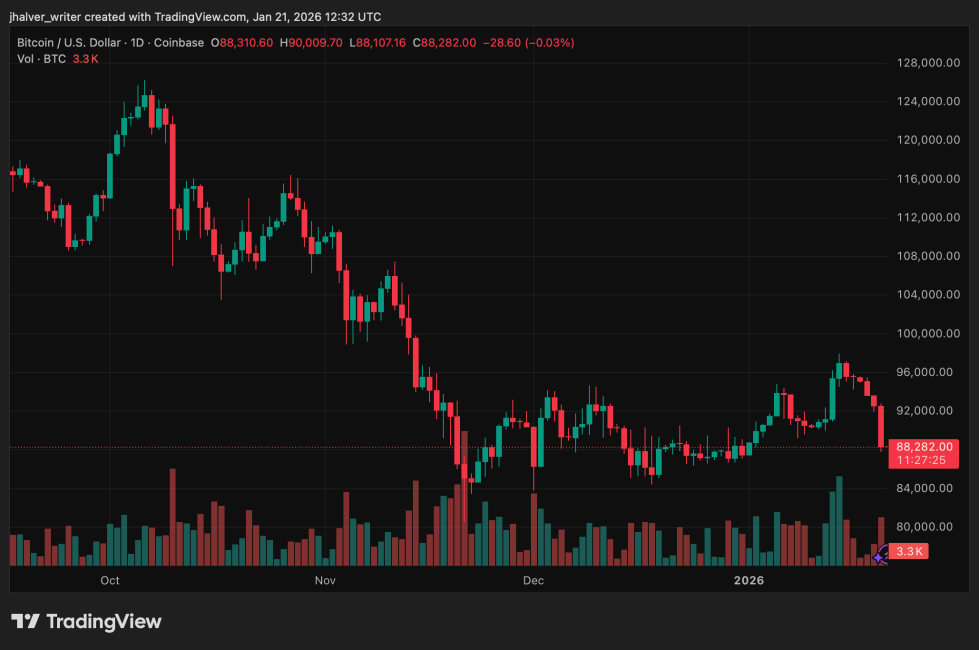
BTC's price trends to the downside on the daily chart. Source: BTCUSD on Tradingview

White House Presses for Action on Crypto Rules

The proposed Senate bill would define how the Securities and Exchange Commission (SEC) and the Commodity Futures Trading Commission (CFTC) oversee crypto markets, including stablecoins and decentralized finance protocols. However, disagreements over key provisions have slowed progress.

Both the Senate Banking and Agriculture Committees recently postponed markups as lawmakers worked to resolve disputes and gather enough support to advance the bill. Witt has been blunt in his message to the industry: accept compromise now or risk facing a less favorable outcome later.

He criticized Coinbase CEO Brian Armstrong for withdrawing support for the current version of the bill, after Armstrong said the company would “rather have no bill than a bad bill.”

Midterm Elections Add Pressure

The push for speed is also tied to the November U.S. midterm elections, which could reshape Congress. All House seats and 35 Senate seats are up for grabs, and polling and prediction markets suggest Democrats have a strong chance of flipping the House.

A divided Congress would likely slow or stall crypto legislation altogether. Witt has cautioned that the political alignment needed to pass a market structure bill may not be in place after the elections, making the coming months critical for any deal.

$1B Liquidations Highlight Market Stress

The policy debate comes as markets reel from a sharp deleveraging event. Today, more than 182,000 traders were liquidated in a single day, with total losses of over $1.08 billion. Most of the damage came from long positions in Bitcoin and Ethereum, as falling prices triggered cascading margin calls across major exchanges.

Bitcoin alone saw over $427 million in long liquidations, while Ethereum accounted for roughly $374 million. Technical indicators show many altcoins trading with RSI levels below 50, suggesting continued selling pressure.

Rising Japanese bond yields and renewed global risk-off sentiment have also tightened liquidity, prompting investors to shift away from volatile assets like crypto. Although Bitcoin later stabilized near $90,000, analysts say the recent rebound looks more like a pause after forced selling than a clear return to bullish momentum.

Cover image from ChatGPT, BTCUSD chart on Tradingview

İlgili Sorular

QWhy is the White House urging lawmakers to move quickly on crypto legislation?

AThe White House is pushing for speed due to tightening political timelines from the upcoming midterm elections and renewed market volatility, warning that the window for passing a workable regulatory framework may be closing.

QWhat is the main obstacle to passing the crypto market structure bill in the Senate?

AThe main obstacle is a lack of bipartisan support, with disagreements over key provisions causing postponed markups in committees as lawmakers work to resolve disputes.

QHow did Patrick Witt of the President’s Council respond to Coinbase CEO Brian Armstrong's stance on the bill?

APatrick Witt criticized Brian Armstrong for withdrawing support, after the Coinbase CEO said the company would 'rather have no bill than a bad bill.' Witt argued that accepting a compromise now is better than risking a less favorable outcome later.

QWhat event caused over $1 billion in crypto liquidations and which assets were most affected?

AA sharp deleveraging event caused over $1.08 billion in liquidations, with the majority of losses coming from long positions in Bitcoin ($427M) and Ethereum ($374M) as falling prices triggered margin calls.

QHow could the November midterm elections impact the future of crypto legislation?

AThe elections could reshape Congress, and if Democrats flip the House as predicted, it would likely result in a divided Congress that could slow or stall crypto legislation altogether, making the current political alignment critical for any deal.

İlgili Okumalar

U.S. Stock Market Trend: Nasdaq Plunges 3.5% Intraday Before a Remarkable Recovery, All Eyes on CPI Tomorrow

"US Stock Market Trends: Nasdaq Plunges 3.5% Before Dramatic Recovery, Eyes on Tomorrow's CPI" On Tuesday, US markets experienced a wild swing. The Nasdaq initially surged nearly 0.7% before plummeting to a 3.5% intraday loss following a post by Donald Trump on Truth Social. He stated that Iran had shot down a US Apache helicopter in the Strait of Hormuz and that the US "must...respond." The index, however, staged a remarkable recovery in the final two hours, closing down only 0.97%, as subsequent remarks from Trump and Vice President Vance suggested a potential Iran deal within days. The S&P 500 fell 0.26%, while the Dow Jones gained 0.17%, supported by its non-tech components. This incident marked the first loss of a US military asset since tensions with Iran escalated in late February. Despite the event, crude oil prices fell sharply (WTI -3.93%) due to expectations of a near-term deal, OPEC+ plans to increase output, and fears that strong jobs data could lead to Fed rate hikes. Market attention is now laser-focused on the May CPI data release Wednesday morning. This report is seen as critical evidence for whether hot job growth is fueling inflation and will heavily influence expectations for the Federal Reserve's upcoming meeting. A hotter-than-expected reading could trigger further sell-offs, particularly in tech, while a cooler print could spark a significant rebound. The article notes a clear sector rotation, with money flowing out of tech (Nasdaq down over 5% in a week) into defensive sectors like healthcare and consumer staples. Other assets like gold and Bitcoin also remain under pressure. The overarching sentiment is one of "war fatigue," with markets desperately awaiting concrete results from the prolonged Iran negotiations rather than reacting to each new headline.

marsbit12 dk önce

U.S. Stock Market Trend: Nasdaq Plunges 3.5% Intraday Before a Remarkable Recovery, All Eyes on CPI Tomorrow

marsbit12 dk önce

Second Only to GPUs and Memory: MLCCs Are Becoming the Next Billion-Dollar Windfall for AI Computing Power

After GPU and memory, MLCC (Multi-Layer Ceramic Capacitors) is emerging as the next critical component in AI compute, potentially a multi-billion-dollar market. The article highlights a significant, industry-wide price increase for MLCCs, driven not by inventory cycles but by a fundamental, structural demand surge from AI and automotive sectors. AI servers require exponentially more MLCCs than traditional servers—from 2,000 to over 350,000 units per high-end AI rack—primarily to stabilize power for increasingly powerful, low-voltage GPUs. A key AI server's MLCC cost can reach thousands of dollars, making it the third-largest cost component after GPUs and memory. This demand is compounded by the automotive shift to EVs and advanced ADAS. Supply, however, struggles to keep up. Manufacturing high-end MLCCs involves extreme precision and faces six major barriers: proprietary technology, long customer certification cycles (12-18 months for AI), high capital intensity, patent thickets, specialized talent, and massive scale. Industry capacity grows at only ~10% annually, creating a persistent supply-demand gap projected to last until 2030. Three companies dominate this high-end market. **Murata** (40% global share) is the stable leader. **Samsung Electro-Mechanics** offers the highest growth elasticity with aggressive expansion. **Taiyo Yuden** is the purest MLCC play. While their current P/E ratios appear high, they are expected to compress rapidly as earnings surge, powered by significant pricing power and operational leverage. Key risks include a potential slowdown in AI capex, high valuations, competition from Chinese manufacturers in lower tiers, yen appreciation, and consumer electronics weakness. The article concludes that MLCCs are transforming from a commoditized component into a strategic, capacity-constrained asset essential for the AI-powered future.

marsbit42 dk önce

Second Only to GPUs and Memory: MLCCs Are Becoming the Next Billion-Dollar Windfall for AI Computing Power

marsbit42 dk önce

The First to Bring an AI OS to 1.4 Billion People Might Actually Be WeChat?

WeChat has introduced a significant AI update, allowing mini-program developers to integrate their services with WeChat AI. Developers can choose an "automatic mode," where WeChat AI autonomously analyzes and operates mini-programs without additional coding, or a "development mode" for creating customized skills. This move effectively transforms WeChat's vast ecosystem—including millions of mini-programs, WeChat Pay, and official accounts—into an execution layer for AI. The technical documentation reveals that WeChat's approach aligns with industry standards like MCP (Model Context Protocol) and incorporates practical lessons from AI-agent development. Key design principles include a clear "attention weight" system for API calls and a "fact + action" response structure to ensure reliable operations. Unlike Apple's Siri, which struggles with third-party app integration, WeChat's centralized control over mini-program code provides a "God's-eye view," enabling seamless AI orchestration across services. This development revives the concept of "WeChat OS," where the app could function as a natural-language-operated platform for daily tasks—from booking flights to ordering food—all within a chat interface. While challenges remain in areas like payment security and user trust, WeChat's existing service network and massive user base position it uniquely to advance AI agents from conversation to actionable assistance, potentially making complex tasks feel effortless for its 1.432 billion monthly active users.

marsbit1 saat önce

The First to Bring an AI OS to 1.4 Billion People Might Actually Be WeChat?

marsbit1 saat önce

İşlemler

Spot
Futures

Popüler Makaleler

HOUSE Nasıl Satın Alınır

HTX.com’a hoş geldiniz! Housecoin (HOUSE) satın alma işlemlerini basit ve kullanışlı bir hâle getirdik. Adım adım açıkladığımız rehberimizi takip ederek kripto yolculuğunuza başlayın. 1. Adım: HTX Hesabınızı OluşturunHTX'te ücretsiz bir hesap açmak için e-posta adresinizi veya telefon numaranızı kullanın. Sorunsuzca kaydolun ve tüm özelliklerin kilidini açın. Hesabımı Aç2. Adım: Kripto Satın Al Bölümüne Gidin ve Ödeme Yönteminizi SeçinKredi/Banka Kartı: Visa veya Mastercard'ınızı kullanarak anında Housecoin (HOUSE) satın alın.Bakiye: Sorunsuz bir şekilde işlem yapmak için HTX hesap bakiyenizdeki fonları kullanın.Üçüncü Taraflar: Kullanımı kolaylaştırmak için Google Pay ve Apple Pay gibi popüler ödeme yöntemlerini ekledik.P2P: HTX'teki diğer kullanıcılarla doğrudan işlem yapın.Borsa Dışı (OTC): Yatırımcılar için kişiye özel hizmetler ve rekabetçi döviz kurları sunuyoruz.3. Adım: Housecoin (HOUSE) Varlıklarınızı SaklayınHousecoin (HOUSE) satın aldıktan sonra HTX hesabınızda saklayın. Alternatif olarak, blok zinciri transferi yoluyla başka bir yere gönderebilir veya diğer kripto para birimlerini takas etmek için kullanabilirsiniz.4. Adım: Housecoin (HOUSE) Varlıklarınızla İşlem YapınHTX'in spot piyasasında Housecoin (HOUSE) ile kolayca işlemler yapın.Hesabınıza erişin, işlem çiftinizi seçin, işlemlerinizi gerçekleştirin ve gerçek zamanlı olarak izleyin. Hem yeni başlayanlar hem de deneyimli yatırımcılar için kullanıcı dostu bir deneyim sunuyoruz.

343 Toplam GörüntülenmeYayınlanma 2025.04.27Güncellenme 2026.06.02

HOUSE Nasıl Satın Alınır

Tartışmalar

HTX Topluluğuna hoş geldiniz. Burada, en son platform gelişmeleri hakkında bilgi sahibi olabilir ve profesyonel piyasa görüşlerine erişebilirsiniz. Kullanıcıların HOUSE (HOUSE) fiyatı hakkındaki görüşleri aşağıda sunulmaktadır.

活动图片













