White House Ignites, BSC Spreads Like Wildfire: A Meme Carnival Bidding Farewell to the 'Imperial Decree Model'

marsbit2026-01-21 tarihinde yayınlandı2026-01-21 tarihinde güncellendi

Özet

A meme coin frenzy erupted on January 21 after the White House posted on X mentioning "victory, eviction, and memes." Within minutes, meme tokens named "memes" were launched on both Solana and BSC chains. Contrary to expectations, the Solana version—typically favored due to its active ecosystem and "first is first" advantage—was outperformed by the BSC version. At its peak, the BSC meme reached a market cap of $28 million with 7,300 holders, while Solana’s version peaked at $3.6 million with 3,900 holders. Real-time user engagement also favored BSC, with nearly 3,000 simultaneous online participants compared to Solana’s sub-1,000. This outcome challenges the long-standing perception that BSC meme coins rely heavily on endorsements from Binance founders CZ and He Yi—a model often mockingly referred to as "Shandong style." Both CZ and He Yi have recently publicly discouraged the practice of creating meme coins based on parsing words from their social posts. CZ explicitly warned followers against buying tokens inspired by his tweets, while He Yi criticized “word-parsing” and “bootlicking” behaviors, urging the community to focus on real project development instead. The surprising success of the BSC memes token—launched 20 minutes after Solana’s version—suggests a possible shift in BSC’s meme culture, moving away from top-down influence toward more organic, community-driven momentum. Whether this marks a lasting change in BSC’s meme ecosystem remains an open question.

Author|Golem(@web 3_golem)
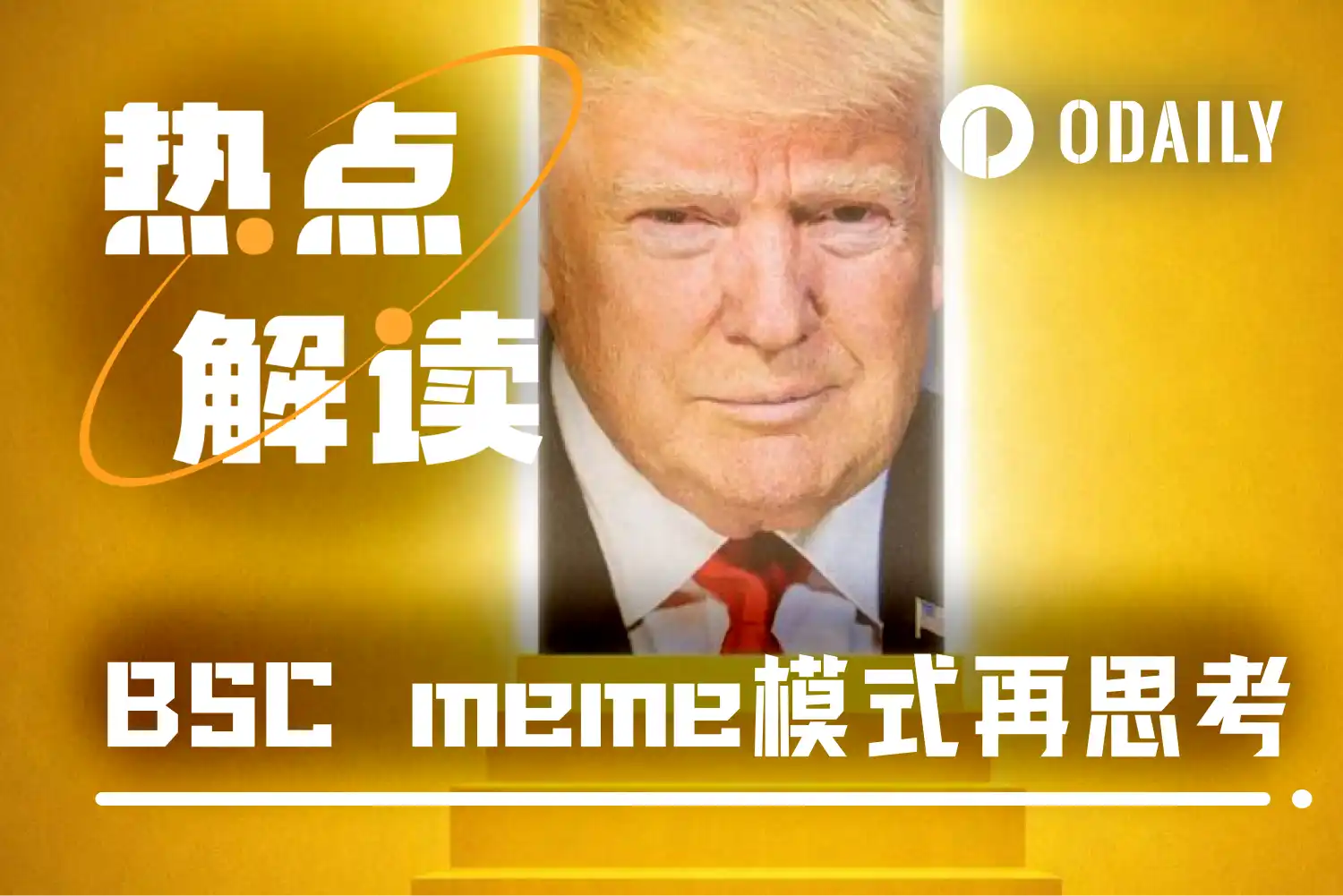
The Meme market today witnessed another legendary "golden dog" story.

On January 21st at 11:10, the official White House account posted on X platform mentioning "victory, eviction operations, and memes". One minute later, a Meme token of the same name, $memes, quickly appeared on the Solana chain; 20 minutes later, a version on the BSC chain was also born. An official Meme race between the two chains began.

From an empirical perspective, the Solana version should have the advantage—not only is the ecosystem active, but it also aligns with the "First is first" consensus. However, the result was surprising: the BSC chain version of $memes surpassed it in market capitalization. According to GMGN data, the BSC version's market cap reached a high of $28 million, with 7,300 holding addresses; while the Solana version's peak was only $3.6 million, with 3,900 holding addresses.

The focus of player attention can also be seen through GMGN's new feature: 3 hours after the token's birth, the number of simultaneous online users for the Solana version remained below 1,000, while the BSC version once approached 3,000.

Although some questioned whether the BSC version's market cap was due to "pump and dump schemes by big players aiming to harvest," the genuine market attention doesn't lie—this time, BSC truly won.

The community often joked that BSC's Meme model was like "Shandong Studies in the crypto circle," where only projects related to CZ and He Yi could succeed, raising concerns about the ecosystem's sustainability. However, BSC's victory in this Meme sprint not only sparked a wave of regret from those who missed out (FOMO), but also prompted the community to reconsider the evolution of its Meme model. As GMGN founder Haze stated: "The BSC 3.0 era has arrived." (Odaily Note: Haze holds 1.93% of BSC chain $memes, ranking second on the holdings list.)

CZ and He Yi Publicly State They Do Not Support "Word-Picking Memes"

I previously shared my thoughts on the BSC Meme model during an Odaily editorial meeting, suggesting that CZ and He Yi were essentially "held hostage" by the community. The current BSC model, which relies on "imperial decrees" for cold starts, feigns continuous interaction, lists on Binance Alpha, and finally gets "poured out" (a likely reference to a meme or specific outcome), is actually a consensus within the BSC community. Although this model started with CZ's unintentional actions in early 2025, they don't actually like it. However,发展到目前这个地步 (developed to this point), CZ and He Yi are powerless to change the situation.

When I published this view, it was merely a conjecture. Recent public statements from CZ and He Yi have proven it to be true. On January 13th, CZ posted saying that while he likes Meme coins, if players blindly follow the trend and buy Meme coins "picked" from his tweets, they are almost certain to lose money.

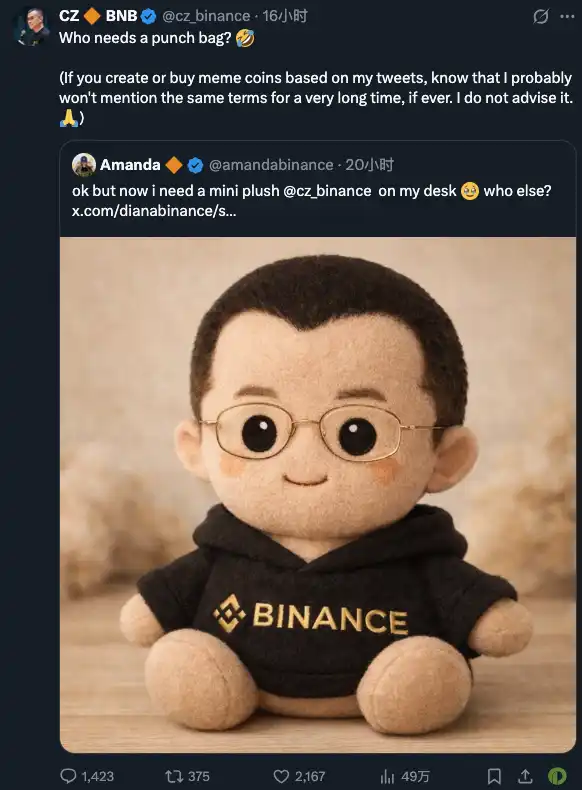
To prevent everyone from blindly chasing these "word-picking Memes," CZ's tweets have become more cautious. Yesterday, CZ reposted a plush toy created by a user based on his image, which was an ordinary thing, but CZ still specifically noted: If you create or buy Meme coins based on my tweets, please note that I may not mention the same words again for a long time, maybe never. I do not recommend you do this. He even added a 🙏 icon at the end, showing CZ's concern for the community.
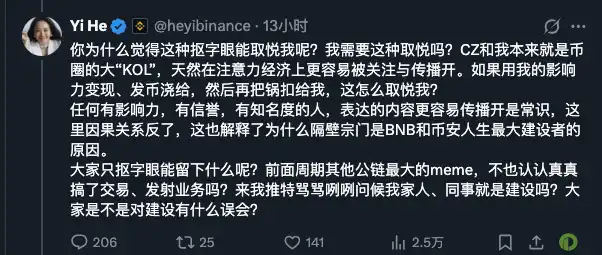
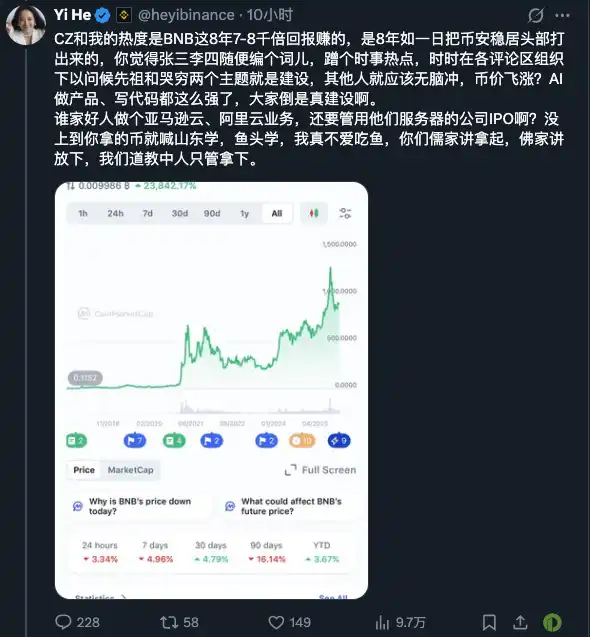
Compared to CZ's tactfulness, He Yi's attitude towards the community's "word-picking Memes" was more blunt. In the early hours of January 21st, under a user's post, He Yi not only stated that Binance would severely punish all internal insider trading and bribery, but also "assertively" said that she does not need to rely on Binance Alpha listing Memes that pick words from her tweets for pleasure, and also advised the community to focus on real development, not to mistake "word-picking and flattery" as genuine constructive effort and be self-satisfied. He Yi also mentioned that she doesn't like eating fish (a likely reference to a specific meme or context, perhaps '山东学 Shandong Studies'), and told players not to cry "Shandong Studies" just because Binance Alpha didn't list the tokens she supported.
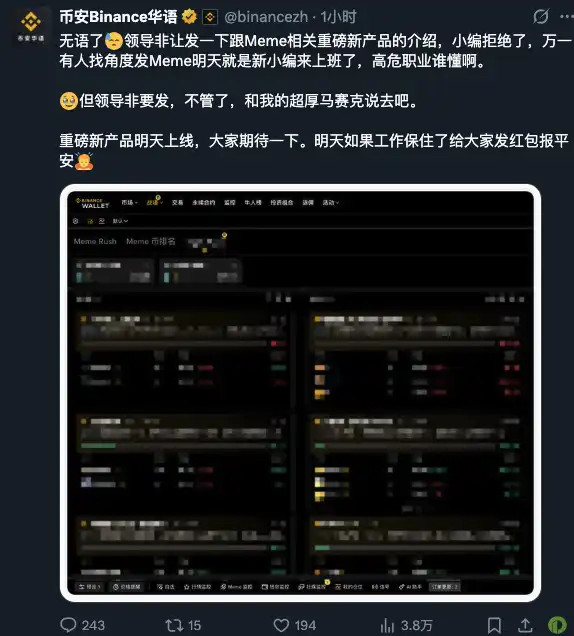
Under the influence of CZ and He Yi's public statements against "word-picking Memes," Binance's official announcements about Memes have also become cautious. On January 21st, Binance's Chinese-language account posted about launching a new Meme product feature, but to prevent the community from finding angles to launch Meme coins, the editor specifically added a very thick mosaic. Although somewhat戏谑 (playful/mocking), it sufficiently shows the cautious attitude of the entire Binance team, both towards Meme coins picking words from CZ and He Yi's tweets, and those picking words from Binance's official announcements.
Is BSC Meme Finally Going to Be Different?

Laymen watch the热闹 (excitement), experts watch the门道 ( intricacies). He Yi's remarks not only felt very "human" (活人感), but seasoned Meme players realized that the previous BSC Meme model is collapsing from the top down. The successful BSC chain $memes that outperformed on the morning of January 21st might be just an appetizer. Ironically, $memes was also born from the art of "word-picking," only this time it was the White House.

Additionally, after the White House posted the tweet, He Yi reposted it (now deleted). This repost, unrelated to Binance and He Yi herself, seemed slightly突兀 (abrupt/out of place) on her homepage timeline, and the community was confused about the reason for the repost. How much credit He Yi's repost deserves for the BSC version of $memes, launched 20 minutes later, outperforming Solana's $memes is also questionable.

Finally, we might still have to ask that unchanging question: Will BSC really be different this time?


Trend Kriptolar

İlgili Sorular

QWhat was the unexpected outcome in the meme coin race between Solana and BSC following the White House's post?

AContrary to expectations, the Solana version of the 'memes' coin did not dominate. The BSC version achieved a higher market cap, reaching a peak of $28 million with 7,300 holder addresses, compared to Solana's $3.6 million with 3,900 holders.

QWhat is the 'Saint Edict Mode' or 'Shandong Mode' that the community often associated with BSC meme coins?

AIt refers to a meme coin model on BSC where projects were believed to only find success if they were related to or endorsed by Binance executives like CZ and He Yi, often by 'extracting keywords' from their social media posts.

QHow did CZ and He Yi publicly express their stance on 'keyword extraction meme' coins?

ACZ stated that while he likes meme coins, buying ones created by extracting keywords from his tweets will almost certainly lead to losses and he does not recommend it. He Yi was more direct, stating she does not need meme coins based on her posts for pleasure and advised the community to focus on real development.

QWhat evidence suggests that Binance is being cautious to avoid sparking new 'keyword extraction' meme coins?

AThe official Binance Chinese account posted an announcement about a new meme product feature but heavily pixelated the text to prevent the community from finding angles to create new meme coins based on the post.

QWhat does the success of the BSC 'memes' coin in this event potentially signal for the future of BSC meme coins?

AThe event, coupled with the executives' statements, suggests a potential shift away from the old 'Saint Edict Mode.' The success of a meme coin not directly tied to Binance executives might indicate the arrival of a new, more community-driven 'BSC 3.0' era for memes.

İlgili Okumalar

After Three Consecutive Quarters of Decline, Can the Crypto Market Find a Window for Stabilization in Q3?

The cryptocurrency market has just concluded its worst-performing quarter since 2022, with total capitalization dropping 12.6% to $2.1 trillion. All core metrics indicate capital is leaving the sector, not just rotating within it. Bitcoin fell 14.2% and Ethereum dropped 25.4% in Q2, breaking their previous correlation with US tech stocks. A key driver is the reversal in US spot Bitcoin ETF flows, which saw a net outflow of approximately $4.67 billion in Q2, including a record monthly outflow near $4.5 billion in June. While recent data suggests long-term holders are accumulating again, sustained ETF outflows mean continued selling pressure. Market focus is now singularly on the Federal Reserve. The upcoming July FOMC meeting is seen as the most critical event for Q3. A dovish signal could support Bitcoin reclaiming a $68,000-$84,000 range, while a hawkish stance might establish a new trading band around $50,000-$56,000. Additionally, regulatory uncertainty persists, with the progress of the crucial *CLARITY Act* stalling in the Senate, reducing its perceived 2026 passage probability to 40-45%. Despite the broad downturn, a few sectors showed growth. Prediction markets saw nominal volume surge 48.7% year-over-year to $113.8 billion, and tokenized collectibles transaction volume rose 143% quarterly to $1.4 billion. The Real-World Asset (RWA) tokenization sector also continued steady growth, now representing ~$28.1 billion in on-chain value. The market's foundation for an extreme crash appears limited, with Bitcoin price hovering near its 200-week moving average. However, the trading paradigm has shifted from narrative-driven speculation to decisions based on price action, policy developments, and interest rate expectations, making a broad sentiment-driven rally unlikely in the near term.

marsbit1 saat önce

After Three Consecutive Quarters of Decline, Can the Crypto Market Find a Window for Stabilization in Q3?

marsbit1 saat önce

BIT Trading Moment: BTC Still Suppressed by Weekly 200 EMA, Rejection May Restart Decline; Storage and Semiconductors that Surged Last Night Begin Falling in Evening Trading

**Crypto & Stock Market Wrap: Bitcoin Tests Resistance, Stocks Retreat After AI Surge** Bitcoin consolidates around $66,000, facing key resistance near $68,000—an area seen as a major psychological and technical hurdle where previous rallies have failed. Analysts note the cryptocurrency is caught between its 200-week moving average (~$63,333) and 200-week EMA (~$68,328). A clear break above $68k is needed to signal a stronger bullish trend, while a rejection could lead to a retest of $63k support. Market sentiment remains cautious, with low futures open interest pointing to a low-liquidity rebound rather than a full bull market. Bitcoin spot ETFs saw another $203 million inflow. US stock futures pointed lower after a strong Tuesday session led by a massive rebound in semiconductors and memory stocks. The rally was fueled by renewed optimism about AI-driven hardware demand, with Micron, SanDisk, and SK Hynix surging. However, those gains reversed in pre-market trading. Super Micro Computer (SMCI) soared over 20% after hours on strong guidance and a record backlog. Other standouts included Rocket Lab and nuclear energy plays Oklo and X-Energy. Rising oil prices (Brent above $91) and climbing Treasury yields (10-year near 4.64%), however, are reigniting inflation concerns and acting as a headwind for equities. In Asia, markets were mixed. South Korea's KOSPI pared early gains to close slightly higher as semiconductor stocks like SK Hynix gave back initial surges. Japan's Nikkei edged lower as the yen hit a fresh 38-year low against the dollar, raising fears of potential market intervention. Key events to watch include the Samsung Galaxy launch, AMD's AI event, and a slew of major tech earnings from Alphabet, Tesla, and IBM after the close on Wednesday, followed by the ECB meeting and Intel's earnings on Thursday.

marsbit1 saat önce

BIT Trading Moment: BTC Still Suppressed by Weekly 200 EMA, Rejection May Restart Decline; Storage and Semiconductors that Surged Last Night Begin Falling in Evening Trading

marsbit1 saat önce

Former CFTC Chairman, Circle President Tarbert: Preaching Long-Termism While Cashing Out $30 Million Himself

Former CFTC Chairman and Circle President Heath Tarbert has consistently advocated for a long-term vision in public, urging patience from investors as Circle’s stock price has fallen significantly from its peak. However, it has been revealed that since Circle’s IPO, Tarbert has continuously sold his CRCL shares through pre-arranged trading plans, cashing out approximately $30 million, without making any public market purchases. This contrast between his public messaging and personal actions has drawn criticism. Tarbert joined Circle in July 2023 as Chief Legal Officer, leveraging his regulatory experience to help guide the company through its IPO and expansion. Despite promoting stablecoins as long-term infrastructure, he established a 10b5-1 trading plan just before Circle went public, leading to substantial stock sales over the following year. In March 2026, he initiated another plan to sell more shares. His career trajectory highlights a pattern of moving between high-level regulatory roles and influential positions in the financial sector. After resigning as CFTC Chairman in early 2021, he joined Citadel Securities as Chief Legal Officer just 27 days later, during a period of intense regulatory scrutiny for the firm. He later joined Circle, aiding its efforts to navigate regulatory challenges for its public listing. While Tarbert's expertise in policy and compliance is valuable to companies like Circle, his actions—advocating long-term confidence while personally divesting—raise questions about the alignment between his public statements and his private financial decisions, leaving investors who followed his advice to bear the market risks.

marsbit2 saat önce

Former CFTC Chairman, Circle President Tarbert: Preaching Long-Termism While Cashing Out $30 Million Himself

marsbit2 saat önce

Gate Research Institute: The 'Wall Street-ization' Wave of Crypto Financial Products – Competition or Integration?

The article titled "Gate Research Institute: Are Crypto Financial Products Sparking a 'Wall Street' Wave—Competition or Convergence?" explores the evolving relationship between the crypto ecosystem and traditional finance (TradFi). The piece begins by reflecting on Bitcoin's original 2009 vision of decentralization, disintermediation, and moving away from banks. It then contrasts this with the 2024 landscape, where key crypto assets like Bitcoin are increasingly held through Wall Street products like ETFs issued by giants like BlackRock. The article questions whether this signifies that TradFi is systematically taking over the rights to issue, price, custody, and distribute crypto financial assets. The core argument is that this is not a zero-sum takeover but rather a bidirectional convergence where each side addresses the other's weaknesses. Crypto offers 24/7 global markets, programmable settlement, and open access but lacks compliant channels, institutional-grade custody, deep fiat liquidity, and mainstream distribution. TradFi possesses these but is constrained by legacy systems, limited operating hours, and slow settlement. Two primary convergence paths are highlighted: * **Path A (CEX to TradFi):** Exemplified by Gate, which has progressed from offering tokenized stocks and CFDs to providing direct, real stock trading (US, Hong Kong, South Korea) within its platform, using USDT. * **Path B (TradFi to Crypto):** Exemplified by Robinhood, which has integrated crypto trading, acquired exchanges like Bitstamp, and is moving traditional assets like stocks onto the blockchain via tokenization and its own Layer 2. Both paths are ultimately competing to become the next-generation, unified financial account—a "super account" where users can seamlessly trade cryptocurrencies, stocks, ETFs, RWA (Real World Assets), and tokenized treasury products in one interface. The growth of RWA and tokenized treasuries (e.g., BlackRock's BUIDL) is presented as the asset-layer fusion, providing stable, yield-bearing assets on-chain and acting as a bridge between the two worlds. In conclusion, the "Wall Street-ization" of crypto is framed as a mutual transformation. Decentralized ideals persist in the protocol layer, while at the application layer, a more efficient, global, and accessible unified capital market is emerging from this convergence. The future competition lies not between crypto exchanges and stockbrokers, but between platforms vying to offer the most comprehensive asset coverage, liquidity, and user experience within a single account.

marsbit2 saat önce

Gate Research Institute: The 'Wall Street-ization' Wave of Crypto Financial Products – Competition or Integration?

marsbit2 saat önce

İşlemler

Spot

Popüler Makaleler

MEME 2.0 Nedir

Memecoin 2.0: Kripto Para Dünyasında $MEME 2.0'ın Yükselişi Giriş Kripto para dünyasının sürekli gelişen yapısında, yeni bir rakip olarak Memecoin 2.0 ortaya çıktı. $MEME 2.0 sembolüyle öne çıkan bu proje, meme coinlerinin kavramını heyecan verici bir yeni seviyeye taşıyor. Orijinal Memecoin'in bir yan ürünü olarak, bu proje, odağını geleneksel finansal teşviklerden, katılımcı ve eğlenceli bir deneyime kaydırarak kripto topluluğunun dikkatini çekmeyi başardı. Ethereum blockchain'inde faaliyet gösteren Memecoin 2.0, kripto alanında topluluk katılımını cesurca yeniden tanımlıyor. Memecoin 2.0, $MEME 2.0 Nedir? Memecoin 2.0, temelinde topluluk ruhunu ve meme kültürüyle ilişkilendirilen eğlenceyi öncelikli olarak benimseyen bir kripto para projesidir. Pratik kullanım alanlarına ve somut faydalara odaklanan geleneksel kripto paralardan farklı olarak, Memecoin 2.0 dijital para biriminin daha hafif yönünü benimseyerek kendini gösteriyor. Proje, herhangi bir fayda, yapılandırılmış bir yol haritası veya finansal getiri vaadi olmadan varlığını sürdürüyor ve bunun yerine memelere ve ortak keyfe odaklanmış canlı bir topluluk oluşturmayı hedefliyor. Bu sayede, çevrimiçi alanda meme kültürünün artan trendine hitap ederek dijital varlıklar dünyasında benzersiz bir oyuncu haline geliyor. Memecoin 2.0'ın Yaratıcısı, $MEME 2.0 Memecoin 2.0'ın kökenleri üzerine yapılan kapsamlı araştırmalara rağmen, yaratıcısının kimliği belirsizliğini koruyor. Bu anonimlik, birçok projenin sahne arkasında kalmayı tercih eden bireyler veya gruplar tarafından yönetildiği kripto topluluğunda alışılmadık bir durum değil. Yaratıcının kamuya açık bilgilere sahip olmaması, topluluk katılımına odaklanarak bireysel ünlülük yerine topluluğun önemini vurgulayan stratejik bir hamle olarak görülebilir. Memecoin 2.0 Yatırımcıları, $MEME 2.0 Memecoin 2.0 için yatırımcılar veya mali destek ile ilgili bilgiler sınırlıdır. Bu bilgi eksikliği projenin ya kendi kendini finanse ettiğini ya da geleneksel yatırım yapılarına kıyasla topluluğa odaklanmasının farklı bir destekçi türünü çektiğini öne sürebilir. Meme coinlerinin dünyası tipik olarak daha fazla taban katılımı içerdiği için bu yaklaşım, topluluk odaklı projelerin etikleriyle uyumlu bir yapı sergiliyor. Memecoin 2.0, $MEME 2.0 Nasıl Çalışır? Memecoin 2.0 tamamen Ethereum blockchain'inde faaliyet gösteriyor ve bu sayede güvenlik özelliklerinden ve ölçeklenebilirliğinden yararlanıyor. Ethereum'un güçlü yönlerinden faydalanarak, Memecoin 2.0 kullanıcı etkileşimleri için güvenli bir ortam sunarken, işlemlerin hem verimli hem de maliyet etkili olmasını sağlıyor. Memecoin 2.0'ın benzersiz özelliklerinden biri topluluk odaklı yapısıdır. $MEME 2.0 tokeninin değeri ve popülaritesi, kullanıcıların aktif katılımlarından geliyor, içsel faydadan ziyade. Bu tasarım, projenin kripto para biriminin eğlence yönüne odaklanmasını pekiştirerek, gülmenin ve topluluk etkileşiminin başarısını sağlayan gerçek para birimleri olduğunu ima eder. Ayrıca, proje, meme coinlerinin daha geniş ekosisteminin bir parçası olarak yer alıyor; burada her meme coininin değeri, kültür, trendler ve topluluk katılımına göre dalgalanıyor, geleneksel ekonomik prensiplerden ziyade. Memecoin 2.0'ın Zaman Çizelgesi, $MEME 2.0 Memecoin 2.0'ın evrimini ve kilometre taşlarını daha iyi anlamak için, tarihindeki önemli olayları vurgulayan bir zaman çizelgesi: 2024: Memecoin 2.0'ın ortaya çıkışı, orijinal Memecoin'in bir yan ürünü olarak kabul edilir ve Ethereum blockchain'inde faaliyet gösterirken meme coinlerinin gelişen bağlamında kendini konumlandırır. 13 Temmuz 2024: Memecoin 2.0, Ethereum ağında topluluk odaklı bir meme coin olarak resmi bir konum alır ve kullanıcıların katılımını ve büyümeye katkı sağlamasını teşvik eden eğlence odaklı yaklaşımını vurgular. Memecoin 2.0'a Dair Anahtar Noktalar, $MEME 2.0 Memecoin 2.0'ı tanımlayan birkaç kritik özellik: Topluluk Merkezli Yaklaşım: Memecoin 2.0'ın temel misyonu, memetik kültürden elde edilen ortak keyfi kullanarak eğlenceli ve katılımcı bir topluluk deneyimi yaratmaktır. Ethereum Üzerinde İnşa Edilmiş: Ethereum blockchain'inde faaliyet göstermek, projeye güvenlik ve ölçeklenebilirlik sağlayan temel bir altyapı sunar. Fayda veya Yol Haritası Yokluğu: Geleneksel kripto paralardan çarpıcı bir şekilde farklı olarak, Memecoin 2.0 herhangi bir faydalı özellik veya finansal getiri vaadinde bulunmamakta, topluluk katılımı ve sosyal etkileşime olan bağlılığını pekiştirmektedir. Memetik Kültüre Odağı: Mem fenomeninin mizahi ve kültürel yönlerini benimseyerek, Memecoin 2.0 kullanıcıların kripto ile çevrimdışı ve çevrimiçi etkileşimde bulunması için bir platform sağlar. Ek Bağlam: Meme Coinlerinin Önemi Meme coinler, kabaca mizah ve ticarete yönelik hafif bir yaklaşım tarafından yönlendirilen belirgin bir kripto para sınıfı olarak ortaya çıkmıştır. Bu paralar genellikle önemli bir fayda veya gelişim yol haritasından yoksundur ve kullanıcıları eğlence, topluluk etkileşimi ve kültürel relevans vaadiyle çeker. Daha geniş kripto ekosisteminde, meme coinler topluluk katılımının önemini yeniden canlandırırken, yalnızca kar odaklı yaklaşımlara karşı bir duruş sergiliyor. Memecoin 2.0 gibi projeler, eğlencenin finansal hedeflerle uyum sağlamasını sağlayarak, blockchain'i yaratıcılık ve sosyal etkileşim için bir oyun alanı haline getiriyor. Sonuç Memecoin 2.0, veya $MEME 2.0, topluluk katılımını katı finansal yapıların üzerinde önceliklendirerek yeni bir kripto para dalgasını temsil ediyor. Mizah ve sosyal etkileşime odaklanarak, meme kültürü etrafındaki ilgiden faydalanıyor. Ethereum blockchain'inde faaliyet göstererek, Memecoin 2.0, teknolojinin yeteneklerinden yararlanırken dijital para biriminin eğlence değerine olan bağlılığında kararlılığını koruyor. Kripto para alanı gelişmeye devam ederken, Memecoin 2.0, dijital varlıkların geleceğinin ortak deneyimlere, gülmelere ve sağlam topluluk bağlantılarına bağlı olabileceğinin bir kanıtı olarak hizmet ediyor. Kripto dünyası belirsiz olsa da, belki de neşe, geleneksel finansal kazanç kadar değerli olabilir.

196 Toplam GörüntülenmeYayınlanma 2024.04.04Güncellenme 2024.12.03

MEME 2.0 Nedir

MEME Nasıl Satın Alınır

HTX.com’a hoş geldiniz! Memeland (MEME) satın alma işlemlerini basit ve kullanışlı bir hâle getirdik. Adım adım açıkladığımız rehberimizi takip ederek kripto yolculuğunuza başlayın. 1. Adım: HTX Hesabınızı OluşturunHTX'te ücretsiz bir hesap açmak için e-posta adresinizi veya telefon numaranızı kullanın. Sorunsuzca kaydolun ve tüm özelliklerin kilidini açın. Hesabımı Aç2. Adım: Kripto Satın Al Bölümüne Gidin ve Ödeme Yönteminizi SeçinKredi/Banka Kartı: Visa veya Mastercard'ınızı kullanarak anında Memeland (MEME) satın alın.Bakiye: Sorunsuz bir şekilde işlem yapmak için HTX hesap bakiyenizdeki fonları kullanın.Üçüncü Taraflar: Kullanımı kolaylaştırmak için Google Pay ve Apple Pay gibi popüler ödeme yöntemlerini ekledik.P2P: HTX'teki diğer kullanıcılarla doğrudan işlem yapın.Borsa Dışı (OTC): Yatırımcılar için kişiye özel hizmetler ve rekabetçi döviz kurları sunuyoruz.3. Adım: Memeland (MEME) Varlıklarınızı SaklayınMemeland (MEME) satın aldıktan sonra HTX hesabınızda saklayın. Alternatif olarak, blok zinciri transferi yoluyla başka bir yere gönderebilir veya diğer kripto para birimlerini takas etmek için kullanabilirsiniz.4. Adım: Memeland (MEME) Varlıklarınızla İşlem YapınHTX'in spot piyasasında Memeland (MEME) ile kolayca işlemler yapın.Hesabınıza erişin, işlem çiftinizi seçin, işlemlerinizi gerçekleştirin ve gerçek zamanlı olarak izleyin. Hem yeni başlayanlar hem de deneyimli yatırımcılar için kullanıcı dostu bir deneyim sunuyoruz.

698 Toplam GörüntülenmeYayınlanma 2024.12.12Güncellenme 2026.06.02

MEME Nasıl Satın Alınır

Tartışmalar

HTX Topluluğuna hoş geldiniz. Burada, en son platform gelişmeleri hakkında bilgi sahibi olabilir ve profesyonel piyasa görüşlerine erişebilirsiniz. Kullanıcıların MEME (MEME) fiyatı hakkındaki görüşleri aşağıda sunulmaktadır.

活动图片













