White House Clears Review Of Rule To Allow Crypto In $10 Trillion 401(k) Market

bitcoinist2026-03-27 tarihinde yayınlandı2026-03-27 tarihinde güncellendi

Özet

The US Department of Labor's proposed rule to allow cryptocurrency investments in 401(k) retirement plans has cleared White House regulatory review. The rule, titled "Fiduciary Duties in Selecting Designated Investment Alternatives," would amend guidance under the Employee Retirement Income Security Act (ERISA), potentially enabling plan sponsors to include cryptocurrencies and private equity as investment options. This action rescinds a 2022 guidance that discouraged such investments due to perceived risks. The proposal, marked as "economically significant," follows a Trump executive order directing agencies to reduce barriers to alternative assets in retirement accounts. A public comment period is expected before a final rule is issued, opening access to the $10 trillion retirement market for crypto.

The Department of Labor’s (DOL) proposed rule to allow crypto investment options for 401(k) retirement plans has cleared the White House’s regulatory review, bringing digital assets closer to the US’s $10 trillion market.

White House Clears DOL’s Proposed 401(k) Rule

The White House’s Office of Information and Regulatory Affairs (OIRA) has concluded its review of a proposed rule submitted by the Department of Labor that could pave the way for crypto exposure in 401(k) retirement plans.

Notably, the Labor Department rescinded a 2022 guidance that discouraged fiduciaries from including crypto investments in 401(k) plans. The guidance followed a Biden-era executive order (EO) that required the government to assess the risks and benefits of digital assets.

As reported by Bitcoinist, it directed plan fiduciaries under the Employee Retirement Income Security Act (ERISA) to exercise extreme caution before incorporating crypto assets into their investment menus, asserting that the digital asset industry’s early stage could pose significant risks.

The DOL’s proposal, named “Fiduciary Duties in Selecting Designated Investment Alternatives,” could amend the fiduciary guidance for plans governed by the Employee Retirement Income Security Act (ERISA).
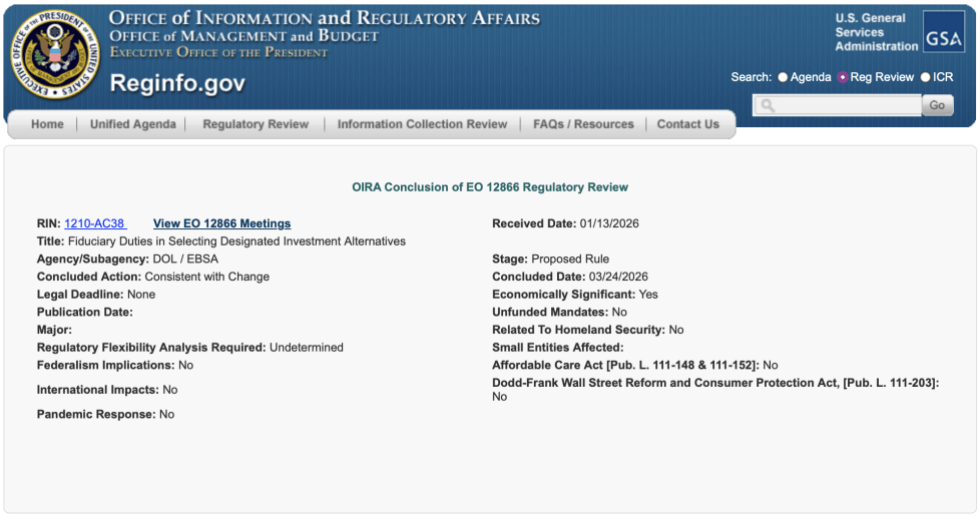
White House concludes regulatory review of DOL's proposed rule. Source: OIRA

This could potentially allow plan sponsors to include cryptocurrencies and private equity as designated investment alternatives. The federal agency marked the action as “consistent with change” and designed the proposal as an “economically significant” rule in its review, which concluded on March 24.

According to the OIRA website, the proposed rule carries no legal deadline for finalization. However, the DOL is expected to formally release the proposal in the coming weeks, allowing for a standard 60-day public comment period. Following this, revisions will be made, and a final rule will be issued.

US Push To Allow Crypto In Retirement Plants

The proposal follows an executive order signed by President Donald Trump last August seeking to allow more private equity, real estate, cryptocurrency, and other alternative assets in 401(k) retirement accounts.

The order directed the DOL, the Securities and Exchange Commission (SEC), the Treasury Secretary, and other federal agencies to reduce regulatory barriers that prohibited investments in alternative assets in their defined contribution retirement plans and explore ways to facilitate access to these assets.

In January, Bitwise’s CIO, Matt Hougan, discussed the possibility of 2026 being the year investors can own Bitcoin and other cryptocurrencies in 401(k) retirement plans, citing that the inclusion of digital assets is becoming more common in individual retirement accounts (IRAs).

The executive argued that providers are slow to adapt, but acknowledged that the Trump administration’s pro-crypto stance, which effectively removed the ban on crypto from 401(k)s, has opened the door to the multi-trillion-dollar market.

Recently, some US states have pushed to embed crypto into their public financial systems. In February, Indiana lawmakers advanced House Bill 1042 (HB 1042), also known as the Bitcoin Rights Bill, which requires several state-administered programs, including retirement plans for teachers, public employees, and legislators, to offer self-directed brokerage accounts with at least one digital asset investment option.

Multiple US lawmakers have backed the Trump Administration’s initiatives. In September, nine House members requested that the SEC Chairman, Paul Atkins, provide prompt assistance in implementing the president’s executive order and collaborate with the DOL to safeguard workers.

In addition, House of Representatives member Troy Downing introduced a bill to codify Trump’s directive and grant it the “force and effect of law.” This move aimed to facilitate investors’ access to Bitcoin and other alternative assets within their 401(k) retirement plans.
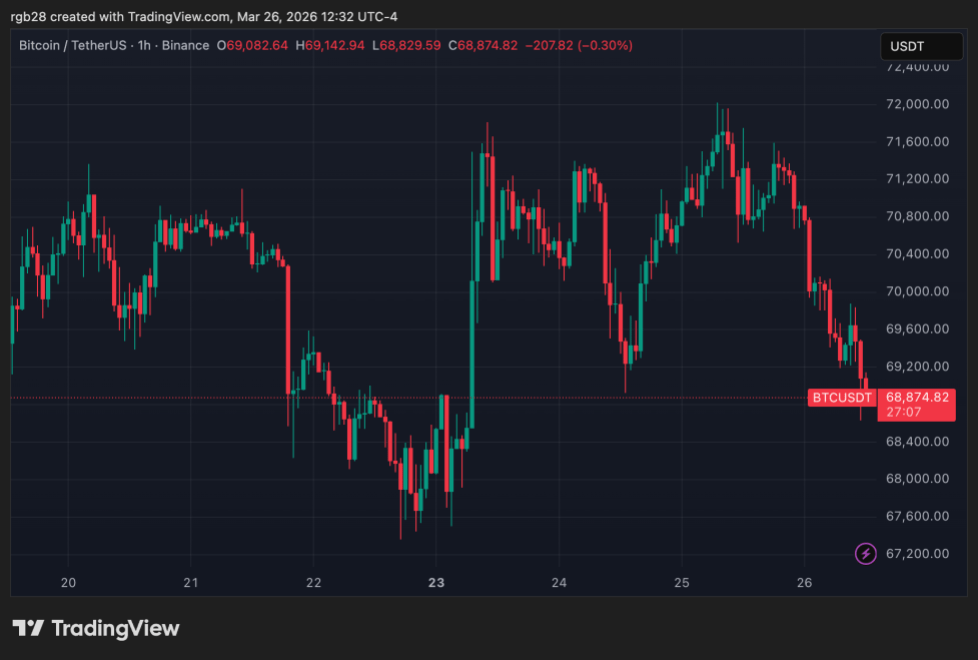
Bitcoin (BTC) trades at $68,874 in the one-week chart. Source: BTCUSDT on TradingView


Trend Kriptolar

İlgili Sorular

QWhat is the significance of the White House's Office of Information and Regulatory Affairs (OIRA) concluding its review of the DOL's proposed rule?

AIt signifies a major regulatory step forward, bringing digital assets closer to being allowed as investment options within the massive $10 trillion US 401(k) retirement market.

QWhich previous guidance did the Department of Labor rescind, and what was its stance on crypto in 401(k) plans?

AThe Labor Department rescinded its 2022 guidance, which had strongly discouraged plan fiduciaries from including cryptocurrency investments in 401(k) plans due to the significant risks posed by the early-stage digital asset industry.

QWhat specific types of alternative assets does the proposed rule aim to allow in 401(k) plans?

AThe proposed rule, named 'Fiduciary Duties in Selecting Designated Investment Alternatives,' could potentially allow plan sponsors to include cryptocurrencies and private equity as designated investment alternatives.

QWhich US President signed the executive order that initiated the push to allow alternative assets in retirement accounts, and what did it direct agencies to do?

APresident Donald Trump signed the executive order in August. It directed the DOL, SEC, Treasury, and other federal agencies to reduce regulatory barriers prohibiting investments in alternative assets and to explore ways to facilitate access to them in defined contribution retirement plans.

QBeyond federal action, how are some US states moving to integrate crypto into their financial systems, as mentioned in the article?

ASome states, like Indiana, are advancing legislation such as the 'Bitcoin Rights Bill' (HB 1042), which requires state-administered retirement plans for public employees and teachers to offer self-directed brokerage accounts with at least one digital asset investment option.

İlgili Okumalar

What's New in Ethereum's Roadmap: Privacy, Quantum Security, Native Rollup?

On August 10, 2024, Ethereum co-founder Vitalik Buterin revealed an updated technical roadmap, highlighting significant changes in priorities and new focus areas. Key new additions include: - **Strong Privacy Protection**: Elevated to a top-tier protocol concern. Proposals like EIP-8250 (keyed nonces for concurrency), EIP-8272 (recent roots for verification), and EIP-8182 (shared protocol-level privacy pools) aim to enable private transfers of ETH and ERC-20s, moving toward default private accounts. - **Quantum Resilience**: Priority increased. The plan addresses risks to ECDSA/BLS signatures, KZG commitments, and ZK systems, exploring solutions like leanSPHINCS signatures, STARK proofs (considered quantum-resistant), and streamlined verification processes. A full L1 upgrade is tentatively targeted for ~2029. - **Native Rollups**: A novel concept where rollups could reuse Ethereum's core validation infrastructure via a new EXECUTE precompile (EIP-8079 draft). This aims to reduce custom code and enhance security for certain L2s, while specialized chains will continue to exist. - **Protocol Simplification & Formal Verification**: Leveraging AI tools to make full-protocol formal verification feasible, aiming for more rigorous and machine-verifiable specifications. Other notable shifts: - State storage is evolving from Verkle trees to a Partitioned Binary Tree (PBT, EIP-8347 draft). - Some 2023 items like VDFs and certain EVM improvements were deprioritized. - Long-term discussions include blob/gas futures and non-EVM instruction sets (e.g., RISC-V). The "Strawmap" outlines potential upgrades through ~2029 but is a directional guide, not a firm timeline. Key milestones to watch include the Glamsterdam (Q4 2026) and Hegotá (2027) forks. Many proposals remain in draft or research phases.

marsbit22 dk önce

What's New in Ethereum's Roadmap: Privacy, Quantum Security, Native Rollup?

marsbit22 dk önce

Hyperliquid Trading Volume Soars, So Why Are Profits Falling?

Hyperliquid, a leading decentralized perpetuals trading platform, has seen its open interest surge to a record high above $11 billion, capturing roughly 9% of the global market share. Trading volume remains robust, nearing $178 billion over 30 days, driven largely by the explosive growth of third-party markets offering tokenized real-world assets (RWAs) like stocks and commodities. Despite this growth, the platform's protocol revenue has declined for four consecutive quarters, falling 43% from its Q3 2025 peak of $357 million to approximately $202 million in Q2 2026. This divergence is primarily attributed to the HIP-3 governance proposal, which allows external developers to launch their own markets and keep up to half of the generated fees. These third-party markets now account for nearly 50% of total volume. Consequently, the share of revenue redistributed to developers, market makers, and the treasury has tripled from 6% to 18% in a year. This directly reduces the funds allocated to the platform's buyback-and-burn mechanism for its native HYPE token, weakening a key price support. HYPE's price has fallen 28% from its all-time high. The platform's growth is also heavily concentrated, with a single entity, Trade.xyz, responsible for over 90% of HIP-3 open interest, introducing systemic risk. Additionally, the ecosystem lacks diversity beyond HYPE, faces ongoing token unlocks adding sell pressure, and is encountering increased regulatory scrutiny and new competition from platforms like Robinhood Chain. While still a major revenue generator in crypto, Hyperliquid's model of sharing fees to fuel expansion is currently compressing its own earnings and token economics.

marsbit22 dk önce

Hyperliquid Trading Volume Soars, So Why Are Profits Falling?

marsbit22 dk önce

Citi Research Report Analysis: U.S. Proposed Ban on Chinese Optical Modules Has No Substantial Progress, Short-term Enforcement Faces Supply Constraints

Citi Report Analysis: U.S. Proposed Ban on Chinese Optical Modules Lacks Substantive Progress, Faces Supply Bottlenecks in Short Term. Reuters reported on August 4th that the U.S. government and FCC are considering a ban on Chinese optical modules. Citi's August 9th report clarifies that optical modules are not listed on any effective FCC ban. The FCC's Order 26-50 established two restricted list mechanisms (based on manufacturer and production location), but optical modules were only mentioned once, as an example in a disclosure requirement, not as a restricted product. The reported ban remains at a proposal stage. Citi estimates Chinese suppliers provide 60-70% of high-speed optical modules for U.S. hyperscalers. Non-Chinese suppliers cannot fill this gap in the short term, making the immediate implementation of a genuine ban unlikely. Future regulatory paths could be manufacturer-based (least likely), location-based covering all offshore production (strictest), or location-based covering only China (more feasible but with unresolved definitions). A ban would pressure U.S. AI infrastructure, conflicting with stated policy goals. Citi sees low near-term implementation probability, with the issue potentially becoming a negotiation chip in bilateral talks. U.S. domestic capacity build-out is a key long-term variable. Among Chinese companies, XSENS and Dongshan Precision have the highest U.S. exposure, while Tianfu Communication, as a passive component supplier, is relatively insulated. Citi maintains Buy ratings on all three with respective price targets. The conclusion is that Chinese modules are currently irreplaceable in the U.S. AI supply chain, creating a longer timeline for potential restrictions than the market may expect.

marsbit1 saat önce

Citi Research Report Analysis: U.S. Proposed Ban on Chinese Optical Modules Has No Substantial Progress, Short-term Enforcement Faces Supply Constraints

marsbit1 saat önce

İşlemler

Spot

Popüler Makaleler

HOUSE Nasıl Satın Alınır

HTX.com’a hoş geldiniz! Housecoin (HOUSE) satın alma işlemlerini basit ve kullanışlı bir hâle getirdik. Adım adım açıkladığımız rehberimizi takip ederek kripto yolculuğunuza başlayın. 1. Adım: HTX Hesabınızı OluşturunHTX'te ücretsiz bir hesap açmak için e-posta adresinizi veya telefon numaranızı kullanın. Sorunsuzca kaydolun ve tüm özelliklerin kilidini açın. Hesabımı Aç2. Adım: Kripto Satın Al Bölümüne Gidin ve Ödeme Yönteminizi SeçinKredi/Banka Kartı: Visa veya Mastercard'ınızı kullanarak anında Housecoin (HOUSE) satın alın.Bakiye: Sorunsuz bir şekilde işlem yapmak için HTX hesap bakiyenizdeki fonları kullanın.Üçüncü Taraflar: Kullanımı kolaylaştırmak için Google Pay ve Apple Pay gibi popüler ödeme yöntemlerini ekledik.P2P: HTX'teki diğer kullanıcılarla doğrudan işlem yapın.Borsa Dışı (OTC): Yatırımcılar için kişiye özel hizmetler ve rekabetçi döviz kurları sunuyoruz.3. Adım: Housecoin (HOUSE) Varlıklarınızı SaklayınHousecoin (HOUSE) satın aldıktan sonra HTX hesabınızda saklayın. Alternatif olarak, blok zinciri transferi yoluyla başka bir yere gönderebilir veya diğer kripto para birimlerini takas etmek için kullanabilirsiniz.4. Adım: Housecoin (HOUSE) Varlıklarınızla İşlem YapınHTX'in spot piyasasında Housecoin (HOUSE) ile kolayca işlemler yapın.Hesabınıza erişin, işlem çiftinizi seçin, işlemlerinizi gerçekleştirin ve gerçek zamanlı olarak izleyin. Hem yeni başlayanlar hem de deneyimli yatırımcılar için kullanıcı dostu bir deneyim sunuyoruz.

485 Toplam GörüntülenmeYayınlanma 2025.04.27Güncellenme 2026.06.02

HOUSE Nasıl Satın Alınır

Tartışmalar

HTX Topluluğuna hoş geldiniz. Burada, en son platform gelişmeleri hakkında bilgi sahibi olabilir ve profesyonel piyasa görüşlerine erişebilirsiniz. Kullanıcıların HOUSE (HOUSE) fiyatı hakkındaki görüşleri aşağıda sunulmaktadır.

活动图片