While Wall Street Debates, Digital Yuan Starts 'Distributing Money' to Users First

marsbit2026-01-21 tarihinde yayınlandı2026-01-21 tarihinde güncellendi

Özet

China's digital yuan (e-CNY) has entered a new phase with its 2.0 upgrade, transitioning from a non-interest-bearing digital cash (M0) to an interest-bearing currency (M1). Users can now earn interest on balances in verified wallets at the current demand deposit rate (0.05% annually, paid quarterly), making it more competitive against existing payment tools like Alipay and WeChat Pay. This shift also allows commercial banks to use e-CNY deposits for lending and financial products, increasing their incentive to promote it. The upgrade enhances e-CNY’s functionality through programmable smart contracts, enabling use cases like controlled payments for pre-paid services, family budgeting, and government subsidies. It supports offline transactions via NFC and offers hardware wallets for broader accessibility. Additionally, e-CNY is expanding into cross-border payments, with significant adoption in projects like mBridge, where it facilitates efficient international settlements. Backed by state security and deposit insurance, e-CNY aims to become a foundational digital financial infrastructure beyond just a payment alternative.

Author: Nancy, PANews

Historically, in financial customer acquisition battles, "distributing money to users" has always been the simplest and most effective weapon.

Over a decade ago, products like Yu'ebao used visible, calculable yields to pry open the average person's understanding of financial products and launched a direct assault on traditional finance.

A similar contest is replaying across the ocean. These days, Wall Street elites and crypto-native giants are arguing fiercely over market structure bills related to stablecoin yields. One side attempts to use regulation to maintain the high walls of traditional finance, while the other tries to compete for the market with real money.

Shifting the focus back to China, the digital yuan is undergoing a critical upgrade. As is well known, after several years of pilot programs involving red envelope incentives, scenario promotion, and policy pushes, the digital yuan has struggled to become commonplace in ordinary households.

With the digital yuan entering its 2.0 phase this year, it has gained the ability to accrue interest, giving users for the first time an intuitive, practical reason to hold it: earning interest on holdings. Simultaneously, the digital yuan is transitioning from M0 to M1, charting a longer-term path through smart contracts to become an underlying digital payment infrastructure.

Entering the Interest-Bearing Era, Upgrading to a "Yield-Bearing Stablecoin"

If judged solely by scale, the progress of the digital yuan hasn't been slow.

After a decade of R&D, exploration, and pilot promotion, the digital yuan has reached a considerable size. As of the end of November 2025, it had cumulatively processed 3.48 billion transactions, with a transaction value of 16.7 trillion yuan; 230 million personal wallets and 18.84 million corporate wallets were opened, with pilot coverage extending to 26 regions across 17 provinces (autonomous regions, municipalities).

From building infrastructure and technical verification to payment scenario implementation, the digital yuan has achieved the phased goal of moving from usable to practical. This progress benefits from both the continuous improvement of underlying technology and strong policy support, which has persistently created usage opportunities for the digital yuan through red envelope subsidies, consumption rebates, and other methods.

But is the digital yuan commonly seen in daily life? The answer is unfortunately not optimistic.

Placed within the larger payment system, the contrast is particularly stark. In the third quarter of 2025 alone, Chinese non-bank payment institutions handled online payment business volume amounting to 85.28 trillion yuan, with 338.019 billion transactions. This doesn't even include commercial payment networks like Alipay and WeChat Pay, which have long penetrated high-frequency scenarios such as daily expenses, transportation, and living. Whether in terms of transaction volume, user stickiness, or fund settlement capacity, they far surpass what the digital yuan currently offers.

For most ordinary users and businesses, the digital yuan is just renminbi in a different guise. It remains essentially idle funds in an account that do not earn interest, making it no different from the balance in a WeChat or Alipay wallet from the user's perspective. Naturally, users lack the motivation to change their long-established habits.

This situation finally saw a turning point on January 1, 2026, when the digital yuan officially upgraded to a "yield-bearing stablecoin".

According to the latest policy, users can download the digital yuan App from official app stores and have funds in Tier 1, Tier 2, and Tier 3 real-name wallets accrue interest based on the listed demand deposit interest rate. The current annual interest rate is 0.05%, with interest settlement dates on March 20, June 20, September 20, and December 20 each year; it's important to note that anonymous wallets (Tier 4 wallets) opened solely with mobile number verification do not currently accrue interest.

This means users now have a channel for their short-term idle funds to appreciate, with automatic interest accrual and zero operational cost. Although this interest rate is not particularly high, it provides a reason for users to keep funds within the system and gives the digital yuan a competitive advantage compared to traditional financial products.

In the crypto world, stablecoin yield is not new, typically achieved through DeFi, staking, or shadow interest rate mechanisms. However, these mechanisms also come with challenges such as smart contract vulnerabilities, de-pegging risks, and regulatory uncertainty.

In contrast, the yield of the digital yuan is established within a secure and controllable framework under central bank supervision, ensuring fund stability and security. The digital yuan is included in the deposit insurance scope, enjoying the same security guarantees as ordinary deposits, with coverage for repayments up to a limit of 500,000 yuan. This safety structure, backed by national credit, is fundamentally different from the crypto world's reliance on code and consensus mechanisms.

With this upgrade, China has become the first economy globally to pay interest on a central bank digital currency.

Farewell to 100% Reserves, Banks Finally Have Motivation

Besides insufficient user motivation, bank participation and incentive were also major challenges in the promotion of the digital yuan.

Initially, the digital yuan was positioned as M0 (digital cash). This design limited its application scenarios and prevented it from generating yield for users. More importantly, it operated under a 100% reserve requirement system. This meant that commercial banks could not utilize the digital yuan deposited by users for funding operations or lending; every unit of digital yuan received by a bank had to be fully surrendered to the central bank and frozen in its account.

Consequently, banks could not generate income from these funds while bearing significant operational costs for wallet opening, scenario expansion, anti-money laundering, customer service, etc. Therefore, banks lacked sufficient motivation to actively promote the digital yuan.

"The traditional account system has little room for innovation left. With the digital yuan positioned as M1, it is becoming a piece of financial infrastructure, giving market institutions more space," according to a bank source cited by Caixin.

As the digital yuan gradually ascends to an M1 form, the situation has changed.

Under the new M1 model, the digital yuan balance in a customer's real-name wallet at a bank becomes a liability of the commercial bank. The bank only needs to deposit a portion of these funds at the central bank according to the statutory reserve requirement ratio. The remaining funds can be used to autonomously develop value-added services, such as launching exclusive wealth management products for digital yuan.

This institutional adjustment provides banks with more profit potential, incentivizing their active participation in building the digital yuan ecosystem. It also transforms banks from cost centers gradually into profit centers, thereby enhancing their motivation to promote the digital yuan.

Currently, banks such as Industrial and Commercial Bank of China (ICBC), Agricultural Bank of China (ABC), Bank of China (BOC), China Construction Bank (CCB), Bank of Communications, China Postal Savings Bank, and China Merchants Bank offer digital wallet services.

It is important to note that non-bank payment institutions (like Alipay and WeChat Pay) still need to maintain 100% reserves and cannot enjoy the relatively flexible fund operation space that banks do.

Shedding the Payment Label, Smart Contracts Become New Financial Infrastructure

The digital yuan is gradually shedding its label as a "payment substitute" and transforming towards a stickier digital financial infrastructure.

Unlike WeChat and Alipay, which are essentially payment tools storing traditional currency, the digital yuan is itself a form of money, used like handing over electronic cash. Also, the digital yuan is not built on a blockchain but based on a newly designed account system. However, programmability based on smart contracts is its core competitive advantage, enabling it to be embedded into more complex performance and regulatory scenarios.
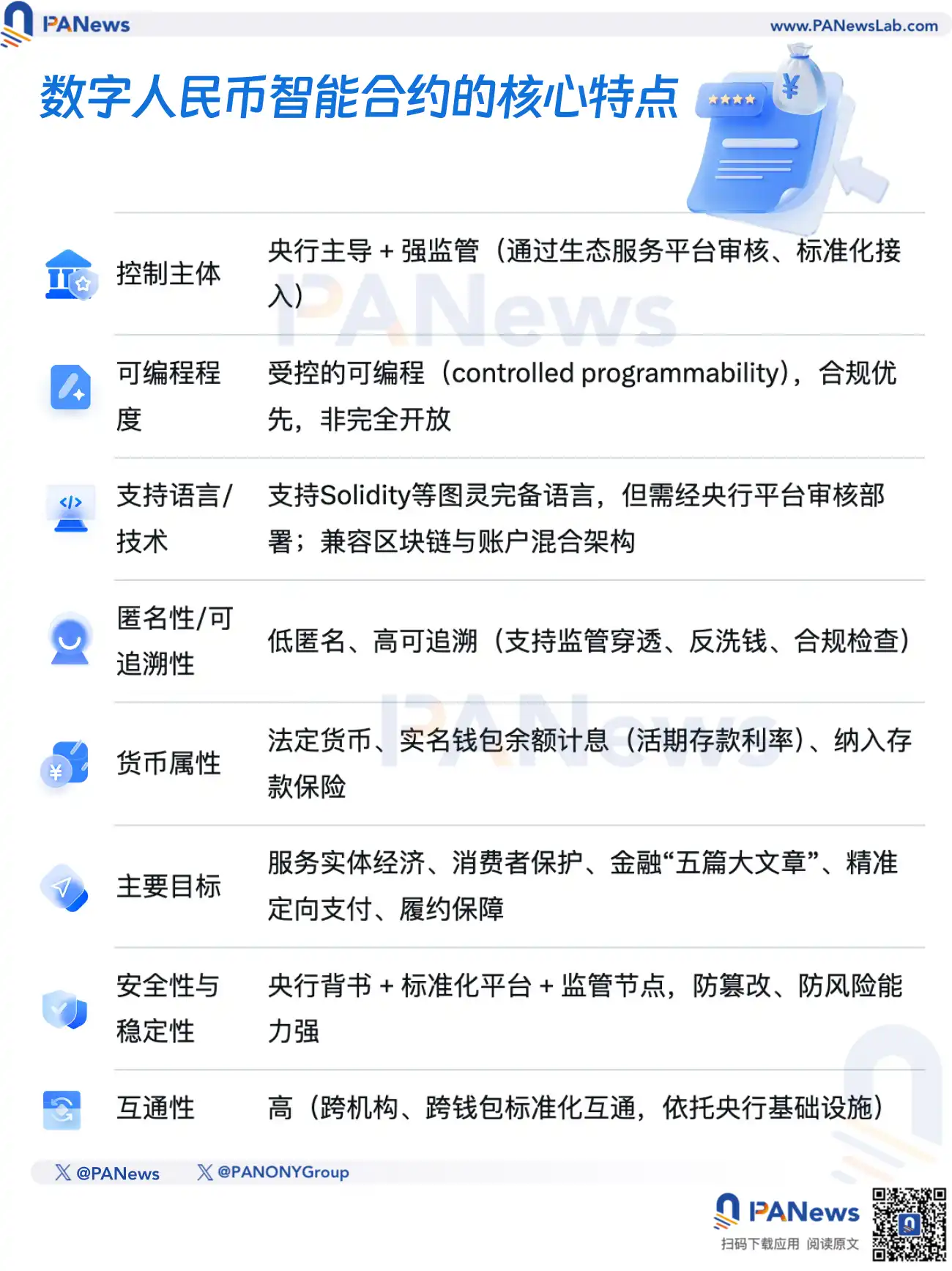
For example, in the pre-paid sector, the digital yuan can achieve a fund management mode of "thawing in installments, paying per use"; in family and campus scenarios, parents can restrict their children's accounts to specific consumption ranges; in government subsidy areas, the use of funds can also be precisely controlled.

In terms of technical implementation, according to disclosures by Caixin, the digital yuan adopts a restricted Turing-complete design, only supporting templated scripts permitted by the central bank. While this design limits certain functionalities, it effectively ensures system security and controllability. Compared to the fully Turing-complete smart contracts in the crypto world, this design of the digital yuan avoids common risks like vulnerabilities, attacks, and governance failures associated with smart contracts. It is worth mentioning that the development of digital yuan smart contracts supports multiple programming languages, including fully Turing-complete languages compatible with Ethereum like Solidity. Therefore, the development potential is not limited.

Furthermore, the digital yuan has demonstrated payment resilience. Its dual-offline payment function allows transacting parties to complete transactions via NFC on their phones in a no-network environment. This capability is irreplaceable in emergency scenarios or special environments. In contrast, within crypto systems, whether Bitcoin or stablecoin payments, they almost always rely on continuous internet connection for ledger synchronization and final settlement.

To bridge the "digital divide" and adapt to the usage habits of different groups like the elderly, students, and overseas visitors to China, the digital yuan also offers various hard wallet forms, including IC cards, wearable devices (e.g., watches), SIM cards, and mobile terminals. This is distinct from crypto hard wallets, which are primarily used for "cold storage" of private keys as a defense against hackers. Digital yuan hard wallets focus more on the inclusivity of high-frequency payments. However, currently limited by the cost of deploying merchant acceptance terminals and the willingness to upgrade, the actual usage scope of digital yuan hard wallets remains limited, and their practical penetration effect still requires further observation.

Currently, the digital yuan is accelerating its evolution into an all-scenario currency. Its applications have broken through the retail sphere, forming replicable and promotable application models in wholesale payments, public services, social governance, and even cross-border settlement, covering both online and offline scenarios. It is expected to further become an indispensable infrastructure in the digital economy.

Cross-border payment is a particularly important direction post-upgrade, supporting three-level transfers: national, merchant/individual. As stablecoins rapidly penetrate the global cross-border payment field, the digital yuan is accelerating its "going global" efforts, becoming a significant driving force for the internationalization of the renminbi. Through cross-border payment, the digital yuan can not only improve payment efficiency and reduce costs but also secure a place in the global payment system. For instance, when overseas tourists consume in China, they don't need to exchange foreign currency; they can simply use the digital yuan App to scan a code and complete payment in their local currency at the real-time exchange rate. Currently, cross-border transfers via mBridge have cumulatively exceeded $55 billion, with 95% settled using the digital yuan.

In summary, for the digital yuan to truly complete the leap from a policy tool to a mass-market product, the real test may have just begun. But its path and potential are clearer than ever before.


İlgili Sorular

QWhat is the key upgrade that digital yuan (e-CNY) underwent on January 1, 2026?

ADigital yuan officially upgraded to an 'interest-bearing stablecoin,' allowing users to earn interest on funds held in their实名钱包 (real-name wallets) at the current demand deposit interest rate of 0.05% per year.

QHow did the initial M0 (digital cash) designation of the digital yuan limit its adoption by commercial banks?

AAs M0 currency, it used a 100% reserve requirement. This meant commercial banks had to fully deposit all user funds with the central bank, could not use them for lending or other profitable activities, and bore high operational costs, giving them little incentive to promote it.

QWhat major change occurred when the digital yuan transitioned from M0 to M1?

AThe transition to M1 meant that the digital yuan balances in users' real-name wallets became a liability of the commercial banks. Banks now only need to deposit a portion of these funds as required reserves with the central bank and can use the remaining funds to develop their own value-added services, turning the digital yuan from a cost center into a potential profit center.

QWhat is a core technological advantage of the digital yuan mentioned in the article, compared to cryptocurrencies?

AIts core technological advantage is its programmable nature based on smart contracts, albeit with a 'restricted Turing-complete' design for safety. This allows for complex, controlled use cases like pre-paid funds that unlock in installments, parental controls on child spending, and precise management of government subsidies.

QBesides retail payments, in what other significant area is the digital yuan being actively developed for use?

AIt is being developed for cross-border payments and settlements. It supports three-level transfers (national, merchant/individual) and is a key driver for the internationalization of the renminbi. For example, projects like mBridge have already facilitated over $55 billion in cross-border transfers, with 95% settled in digital yuan.

İlgili Okumalar

The "Impossible Triad" Is Fundamentally a Pseudo-Problem

The article argues that blockchain's fundamental limitation is not the scalability trilemma (decentralization, scalability, security), which has been largely solved, but the lack of **privacy** and, until recently, clear **legitimacy**. Blockchain is described as a slow, expensive, globally shared computer whose core value is censorship resistance and verifiability. While ideal for native digital assets like money (e.g., stablecoins), its default transparency acts as a **tax**, exposing all transactions and enabling MEV extraction, which deters serious institutional capital. Simultaneously, its permissionless nature created regulatory ambiguity. The piece contends that **privacy** is the missing critical feature. It rejects the false choice between total transparency and complete anonymity. Modern cryptography (like zero-knowledge proofs) enables **compliant privacy**: users can prove facts (solvency, KYC status, compliance) without revealing the underlying sensitive data (specific holdings, identities). This preserves auditability for regulators and eliminates the leak of financial information. With recent regulatory progress (e.g., the GENIUS Act) addressing legitimacy, adding default, provably compliant privacy becomes a pure upgrade. It transforms blockchain from a costly, public ledger into a confidential settlement layer, finally bridging the gap to mainstream institutional and individual adoption of on-chain finance.

链捕手5 saat önce

The "Impossible Triad" Is Fundamentally a Pseudo-Problem

链捕手5 saat önce

Optical Chips: Collective Capacity Expansion

The global optical chip industry is experiencing a massive wave of expansion driven by surging AI data center demand. Major players across the US, Japan, Europe, and China are aggressively investing to ramp up production capacity. In the US, Coherent is expanding its 6-inch Indium Phosphide (InP) semiconductor fab in Texas, supported by CHIPS Act funding and a $2 billion strategic investment from NVIDIA. Lumentum is building a new factory for InP optical devices, and Nokia is scaling its advanced photonic chip packaging and testing capabilities. NVIDIA's investments aim to secure future supply of critical lasers and optical interconnect products for AI infrastructure. Japan's JX Advanced Metals, a leading InP substrate supplier, plans a multi-billion yen investment to increase its capacity 7-10 times, strengthening its grip on the crucial upstream materials market. In Europe, IQE and Tower Semiconductor settled a patent dispute and signed a multi-year InP epitaxial wafer supply agreement, highlighting that next-generation silicon photonics platforms will integrate high-performance InP components. STMicroelectronics and Sivers Semiconductors are also expanding silicon photonics production and partnerships. China is rapidly building out its domestic supply chain. Dongshan Precision's subsidiary, Source Photonics, announced a $12 billion project to expand optical chip and module production. Companies like Sanan Optoelectronics and Yunnan Germanium are scaling up InP chip manufacturing and substrate production, moving towards vertical integration from materials to modules. While debate continues around the exact future architecture—whether CPO (Co-Packaged Optics), NPO, or pluggables will dominate—analysts like Morgan Stanley argue the underlying driver is unchangeable: the explosive growth in bandwidth demand. This will inevitably increase the volume of optical engines, lasers, and related content per GPU, regardless of the final technical path. The competition for "more light" in the AI era has intensified into a global, full-chain capacity race.

marsbit7 saat önce

Optical Chips: Collective Capacity Expansion

marsbit7 saat önce

Stablecoins Finally Find Real Yield: An In-Depth Look at On-Chain Reinsurance Re | A Conversation with Re Founder Karan Saroya

Stablecoin Real Yield Found: A Deep Dive into On-Chain Reinsurance with Re's Karan Saroya As stablecoin supply exceeds $170 billion, the search for sustainable, non-speculative yield intensifies. Re, an on-chain reinsurance platform, provides an answer: connecting stablecoin capital to the trillion-dollar traditional reinsurance market. Re operates as a regulated reinsurer, accepting stablecoin deposits as collateral to back US insurance companies. These insurers pay premiums, generating yield that flows back to on-chain depositors. Currently supporting 35 insurers and underwriting $500 million, Re projects scaling to over $1 billion soon. Key insights from a Bankless podcast with founder Karan Saroya and investor Avichal of Electric Capital: 1. **Uncorrelated, Real-World Yield:** Re offers stablecoin holders access to reinsurance returns (targeting 12-14%+), an asset class entirely separate from crypto or equity markets. 2. **Operational Efficiency via Smart Contracts:** Re replaces traditional, labor-intensive capital fundraising with smart contracts, allowing a ~12-person team to compete with industry giants. 3. **Regulatory Leverage:** For every $1 of collateral, regulations allow backing $5-7 in written premiums. This leverage amplifies returns from the underlying risk-free rate. 4. **DeFi Integration:** Depositors receive receipt tokens, which can be used in protocols like Morpho for "looping," potentially pushing yields to 18-20%+. 5. **The "DeFi Mullet" Model:** A compliant front-end (regulated reinsurer) paired with a decentralized back-end (smart contracts, DeFi capital markets). 6. **RE Governance Token:** Modeled on Lloyd's of London, the token governs the central capital pool's allocation, counterparty acceptance, and parameters. 7. **Real Economic Impact:** Capital funds real-world productivity (factories, clinics, businesses) via insurance, moving beyond crypto's internal loops. The discussion highlights a pivotal moment: DeFi's supply-side infrastructure is now met by real demand for productive yield, potentially kickstarting a flywheel where vast on-chain stablecoin capital seeks these real-world returns.

链捕手9 saat önce

Stablecoins Finally Find Real Yield: An In-Depth Look at On-Chain Reinsurance Re | A Conversation with Re Founder Karan Saroya

链捕手9 saat önce

1996 or 1999? Walsh's First Test is 'How to View AI'

"1996 or 1999? Wall's First Big Test Is 'How to View AI'" Federal Reserve Chairman Wall's initial challenge is not whether to raise or cut rates, but a more fundamental judgment: what kind of boom is the current AI boom? This will determine the Fed's policy path and define his legacy. Economics is split between two opposing views, according to reporter Nick Timiraos. One sees imminent productivity gains that will increase supply and cool inflation, allowing the Fed to hold steady. The other argues that while productivity benefits are distant, demand shocks are here now, and waiting for data confirmation risks missing the intervention window, forcing sharper rate hikes later. Wall has signaled a leaning toward the first view, echoing 1996-era Alan Greenspan, who embraced strong, productivity-driven growth without fear of inflation. However, Wall faces a different macro environment than Greenspan did, with tariff pressures, expanding fiscal deficits, and diminishing globalization benefits, which could force more significant inflation pressures even if AI benefits materialize. Wall's logic, expressed before taking office, is that AI-driven productivity gains won't show in official data for years. If the Fed waits for confirmation, it might mistakenly tighten policy and choke off the very growth that could suppress inflation. This argues for using forward-looking narratives over lagging data. Chicago Fed President Austan Goolsbee presents a key counter-argument. He distinguishes between expected and unexpected productivity booms. A widely anticipated boom, like the current AI wave, can cause people to spend future wealth gains in advance, overheating the economy before productivity actually rises, thus requiring preemptive rate hikes. He cites rising costs for AI data centers as evidence of such overheating. Fed Governor Christopher Waller offers a rebuttal to Goolsbee, noting the "expected spending" mechanism only works if people can borrow against future income, which many households cannot do due to borrowing constraints. Wall also faces a paradox related to his desire to reduce the Fed's use of "forward guidance" (pre-announcing policy moves). This practice was established in 1999 when Greenspan began signaling hikes to avoid market shocks. If the economy follows a less optimistic path, Wall may be forced to choose between using the guidance he wants to abolish or risking market volatility by staying silent. The ultimate question defining Wall's first major test remains: Is this 1996 or 1999?

marsbit10 saat önce

1996 or 1999? Walsh's First Test is 'How to View AI'

marsbit10 saat önce

İşlemler

Spot
Futures
活动图片