Which Way the Fish Head Points, There's Also Shandong-Style Learning in the Crypto World

marsbit2026-01-08 tarihinde yayınlandı2026-01-08 tarihinde güncellendi

Özet

The article "Where the Fish Head Points: The 'Shandong Rule' in Crypto" uses the metaphor of a Shandong dining custom — where the fish head is oriented towards the guest of honor — to critique the culture of influence and favor-seeking in the crypto industry, particularly around Binance. It highlights how a casual New Year’s tweet by Binance co-founder He Yi, saying “我踏马来了” (I’ve arrived), quickly led to the creation and listing of a meme token with the same name on Binance Alpha — without any direct instruction from her. The author argues that this reflects a deeper cultural issue: instead of transparent, rule-based processes, success increasingly depends on anticipating and pleasing key decision-makers. The piece contrasts this with sectors like AI, where technical merit drives advancement, and suggests that crypto’s reliance on insider access and social signaling — rather than innovation — may signal industry decline. While He Yi may not be directly involved, the system incentivizes sycophancy and information asymmetry, making “reading the room” more valuable than building value.

Written by: Curry, Deep Tide TechFlow

There's a rule at Shandong banquet tables: when the fish is served, the head must point toward the seat of honor.

Whoever it points to is the main guest and must drink first. This isn't written down anywhere, but everyone in Shandong knows it. No one teaches it; you just pick it up.

Recently, someone drew a picture called "Crypto Circle Shandong-Style Learning." A group of people sit around a table eating fish, with Yi He in the seat of honor, and KOLs, the listing team, and editors gathered on either side.

The caption: When Binance lists a coin, the fish head must point toward Yi He.

On January 1, Yi He posted a New Year's tweet. Riding a white horse by the sea, with a caption:

I'm fucking coming.

A fine New Year's greeting—"fucking coming," the Year of the Horse, with a bit of homophonic wit.

Today, Binance Alpha listed a new coin called "I'm Fucking Coming." It was community-made, with no direct connection to Yi He.

But look at this chain: Sister Yi posts a tweet, the community creates a coin, Alpha lists it.

No one needs to give any orders in between.

Last year, Binance was chased and criticized over "girlfriend coins," accused of shady listing practices and利益输送 (interest transfer). Yi He responded several times, saying they were reflecting, adjusting, and even created Alpha as a screening pool.

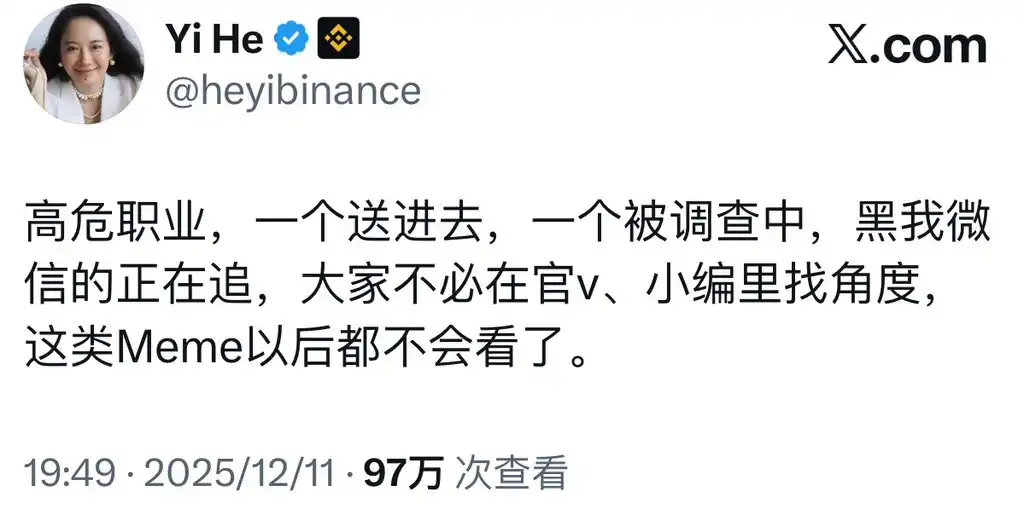
In December, she also tweeted saying, don't try to find angles in our official tweets, we won't pay attention to these kinds of Memes anymore.

Twenty-eight days later, her New Year's tweet became a new coin on Alpha.
What was the problem with girlfriend coins? It was about backdoor deals, favoritism,利益输送 (interest transfer).

These require evidence, a trail, a specific "girlfriend."

But "I'm Fucking Coming" doesn't need any of that.

No backdoor, no favoritism, no利益输送. Sister Yi posted a picture, and the people below just started moving on their own.

This perhaps touches on the essence of Shandong-style learning: The leader doesn't need to say anything; you have to figure it out yourself.

Some in the community commented that Alpha is now just a tool for currying favor, its purpose is to make Sister Yi happy.

Crude wording, but it describes an atmosphere.

When a platform's direction starts revolving around someone's social media, when "which coin to list" becomes "guess what she likes," rules cease to matter.

What matters is揣摩 (speculation/figuring out).

Some put it more harshly: If you want to know if an industry has a future, ask one question—In this industry, do people who are good at flattery succeed more easily than people who are good at doing things?

If the answer is "yes," then this industry is on the decline.

In the crypto world, this trick really works. And the most successful ones, everyone knows who the flattery should be directed toward.
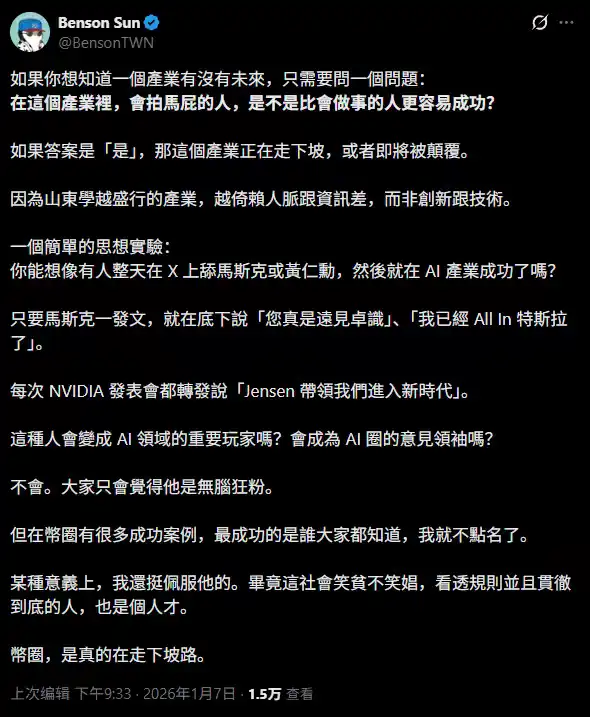
The core resources in the AI circle are technology and products; you have to deliver. Jensen Huang won't give you GPUs just because you call him daddy every day.

The core resources in the crypto circle are listing rights, traffic, who knows the news first. These things aren't in the code; they're in people's hands.

Things in people's hands must be obtained through human methods.

The more prevalent Shandong-style learning is, the more it relies on connections and information asymmetry, not innovation and technology.

Yi He might not even know about this. A small MEME worth a few million market cap isn't enough to bother the Co-CEO.

But that's precisely the problem.

She doesn't need to know. The fish head will turn by itself.

This is really much more efficient than girlfriend coins.

Girlfriend coins at least required a girlfriend. Shandong-style learning only requires an atmosphere.

And those who see through this set of rules and implement them thoroughly are, in a sense, also talented.

After all, in this society, people laugh at the poor, not the prostitute.

İlgili Sorular

QWhat is the core concept of 'Shandong Study' in the crypto world as described in the article?

AThe core concept of 'Shandong Study' in the crypto world refers to an unwritten rule where individuals or groups instinctively align their actions to please key figures in power, such as Binance's He Yi, without explicit instructions. It emphasizes intuition and揣摩 (speculation) over formal rules, particularly in contexts like token approvals on platforms.

QHow did the meme token '我踏马来了' (I'm Coming on Horseback) get listed on Binance Alpha according to the article?

AThe meme token '我踏马来了' was created by the community after He Yi, Binance's co-CEO, posted a New Year's tweet with the phrase '我踏马来了' and an image of herself on a horse. The community independently developed and listed the token on Binance Alpha, without direct involvement or instructions from He Yi, demonstrating the 'Shandong Study' phenomenon.

QWhat criticism does the article level against the crypto industry's reliance on 'Shandong Study' dynamics?

AThe article criticizes that such dynamics prioritize flattery and connections over innovation and technology, suggesting that an industry where 'bootlicking' is more rewarded than actual work is in decline. It highlights how resources like token listing privileges and information asymmetry are controlled by people rather than code, leading to a culture of揣摩 (speculation) rather than merit-based success.

QHow does the 'Shandong Study' approach differ from the previous '闺蜜币' (close-friend coin) issue at Binance?

AThe '闺蜜币' issue involved alleged backdoor dealings and explicit利益输送 (benefit transfers) through personal relationships, requiring evidence of specific connections. In contrast, 'Shandong Study' operates implicitly—no direct orders or relationships are needed; instead, participants intuitively act to align with the preferences of powerful figures like He Yi, creating a self-driven culture of compliance without formal corruption.

QWhat broader implication does the article suggest about power and decision-making in crypto platforms like Binance?

AThe article implies that decision-making in crypto platforms can become overly centralized around key individuals, where informal influence and social media activity shape outcomes like token listings. This shifts focus from transparent, rule-based systems to a culture of揣摩 (speculation) and alignment with personal whims, potentially undermining innovation and fairness in the industry.

İlgili Okumalar

After Three Consecutive Quarters of Decline, Can the Crypto Market Find a Window for Stabilization in Q3?

The cryptocurrency market has just concluded its worst-performing quarter since 2022, with total capitalization dropping 12.6% to $2.1 trillion. All core metrics indicate capital is leaving the sector, not just rotating within it. Bitcoin fell 14.2% and Ethereum dropped 25.4% in Q2, breaking their previous correlation with US tech stocks. A key driver is the reversal in US spot Bitcoin ETF flows, which saw a net outflow of approximately $4.67 billion in Q2, including a record monthly outflow near $4.5 billion in June. While recent data suggests long-term holders are accumulating again, sustained ETF outflows mean continued selling pressure. Market focus is now singularly on the Federal Reserve. The upcoming July FOMC meeting is seen as the most critical event for Q3. A dovish signal could support Bitcoin reclaiming a $68,000-$84,000 range, while a hawkish stance might establish a new trading band around $50,000-$56,000. Additionally, regulatory uncertainty persists, with the progress of the crucial *CLARITY Act* stalling in the Senate, reducing its perceived 2026 passage probability to 40-45%. Despite the broad downturn, a few sectors showed growth. Prediction markets saw nominal volume surge 48.7% year-over-year to $113.8 billion, and tokenized collectibles transaction volume rose 143% quarterly to $1.4 billion. The Real-World Asset (RWA) tokenization sector also continued steady growth, now representing ~$28.1 billion in on-chain value. The market's foundation for an extreme crash appears limited, with Bitcoin price hovering near its 200-week moving average. However, the trading paradigm has shifted from narrative-driven speculation to decisions based on price action, policy developments, and interest rate expectations, making a broad sentiment-driven rally unlikely in the near term.

marsbit4 dk önce

After Three Consecutive Quarters of Decline, Can the Crypto Market Find a Window for Stabilization in Q3?

marsbit4 dk önce

BIT Trading Moment: BTC Still Suppressed by Weekly 200 EMA, Rejection May Restart Decline; Storage and Semiconductors that Surged Last Night Begin Falling in Evening Trading

**Crypto & Stock Market Wrap: Bitcoin Tests Resistance, Stocks Retreat After AI Surge** Bitcoin consolidates around $66,000, facing key resistance near $68,000—an area seen as a major psychological and technical hurdle where previous rallies have failed. Analysts note the cryptocurrency is caught between its 200-week moving average (~$63,333) and 200-week EMA (~$68,328). A clear break above $68k is needed to signal a stronger bullish trend, while a rejection could lead to a retest of $63k support. Market sentiment remains cautious, with low futures open interest pointing to a low-liquidity rebound rather than a full bull market. Bitcoin spot ETFs saw another $203 million inflow. US stock futures pointed lower after a strong Tuesday session led by a massive rebound in semiconductors and memory stocks. The rally was fueled by renewed optimism about AI-driven hardware demand, with Micron, SanDisk, and SK Hynix surging. However, those gains reversed in pre-market trading. Super Micro Computer (SMCI) soared over 20% after hours on strong guidance and a record backlog. Other standouts included Rocket Lab and nuclear energy plays Oklo and X-Energy. Rising oil prices (Brent above $91) and climbing Treasury yields (10-year near 4.64%), however, are reigniting inflation concerns and acting as a headwind for equities. In Asia, markets were mixed. South Korea's KOSPI pared early gains to close slightly higher as semiconductor stocks like SK Hynix gave back initial surges. Japan's Nikkei edged lower as the yen hit a fresh 38-year low against the dollar, raising fears of potential market intervention. Key events to watch include the Samsung Galaxy launch, AMD's AI event, and a slew of major tech earnings from Alphabet, Tesla, and IBM after the close on Wednesday, followed by the ECB meeting and Intel's earnings on Thursday.

marsbit12 dk önce

BIT Trading Moment: BTC Still Suppressed by Weekly 200 EMA, Rejection May Restart Decline; Storage and Semiconductors that Surged Last Night Begin Falling in Evening Trading

marsbit12 dk önce

Former CFTC Chairman, Circle President Tarbert: Preaching Long-Termism While Cashing Out $30 Million Himself

Former CFTC Chairman and Circle President Heath Tarbert has consistently advocated for a long-term vision in public, urging patience from investors as Circle’s stock price has fallen significantly from its peak. However, it has been revealed that since Circle’s IPO, Tarbert has continuously sold his CRCL shares through pre-arranged trading plans, cashing out approximately $30 million, without making any public market purchases. This contrast between his public messaging and personal actions has drawn criticism. Tarbert joined Circle in July 2023 as Chief Legal Officer, leveraging his regulatory experience to help guide the company through its IPO and expansion. Despite promoting stablecoins as long-term infrastructure, he established a 10b5-1 trading plan just before Circle went public, leading to substantial stock sales over the following year. In March 2026, he initiated another plan to sell more shares. His career trajectory highlights a pattern of moving between high-level regulatory roles and influential positions in the financial sector. After resigning as CFTC Chairman in early 2021, he joined Citadel Securities as Chief Legal Officer just 27 days later, during a period of intense regulatory scrutiny for the firm. He later joined Circle, aiding its efforts to navigate regulatory challenges for its public listing. While Tarbert's expertise in policy and compliance is valuable to companies like Circle, his actions—advocating long-term confidence while personally divesting—raise questions about the alignment between his public statements and his private financial decisions, leaving investors who followed his advice to bear the market risks.

marsbit35 dk önce

Former CFTC Chairman, Circle President Tarbert: Preaching Long-Termism While Cashing Out $30 Million Himself

marsbit35 dk önce

Gate Research Institute: The 'Wall Street-ization' Wave of Crypto Financial Products – Competition or Integration?

The article titled "Gate Research Institute: Are Crypto Financial Products Sparking a 'Wall Street' Wave—Competition or Convergence?" explores the evolving relationship between the crypto ecosystem and traditional finance (TradFi). The piece begins by reflecting on Bitcoin's original 2009 vision of decentralization, disintermediation, and moving away from banks. It then contrasts this with the 2024 landscape, where key crypto assets like Bitcoin are increasingly held through Wall Street products like ETFs issued by giants like BlackRock. The article questions whether this signifies that TradFi is systematically taking over the rights to issue, price, custody, and distribute crypto financial assets. The core argument is that this is not a zero-sum takeover but rather a bidirectional convergence where each side addresses the other's weaknesses. Crypto offers 24/7 global markets, programmable settlement, and open access but lacks compliant channels, institutional-grade custody, deep fiat liquidity, and mainstream distribution. TradFi possesses these but is constrained by legacy systems, limited operating hours, and slow settlement. Two primary convergence paths are highlighted: * **Path A (CEX to TradFi):** Exemplified by Gate, which has progressed from offering tokenized stocks and CFDs to providing direct, real stock trading (US, Hong Kong, South Korea) within its platform, using USDT. * **Path B (TradFi to Crypto):** Exemplified by Robinhood, which has integrated crypto trading, acquired exchanges like Bitstamp, and is moving traditional assets like stocks onto the blockchain via tokenization and its own Layer 2. Both paths are ultimately competing to become the next-generation, unified financial account—a "super account" where users can seamlessly trade cryptocurrencies, stocks, ETFs, RWA (Real World Assets), and tokenized treasury products in one interface. The growth of RWA and tokenized treasuries (e.g., BlackRock's BUIDL) is presented as the asset-layer fusion, providing stable, yield-bearing assets on-chain and acting as a bridge between the two worlds. In conclusion, the "Wall Street-ization" of crypto is framed as a mutual transformation. Decentralized ideals persist in the protocol layer, while at the application layer, a more efficient, global, and accessible unified capital market is emerging from this convergence. The future competition lies not between crypto exchanges and stockbrokers, but between platforms vying to offer the most comprehensive asset coverage, liquidity, and user experience within a single account.

marsbit39 dk önce

Gate Research Institute: The 'Wall Street-ization' Wave of Crypto Financial Products – Competition or Integration?

marsbit39 dk önce

İşlemler

Spot
活动图片





