Which Way the Fish Head Points, There's Also Shandong-Style Learning in the Crypto World

marsbit2026-01-08 tarihinde yayınlandı2026-01-08 tarihinde güncellendi

Özet

The article "Where the Fish Head Points: The 'Shandong Rule' in Crypto" uses the metaphor of a Shandong dining custom — where the fish head is oriented towards the guest of honor — to critique the culture of influence and favor-seeking in the crypto industry, particularly around Binance. It highlights how a casual New Year’s tweet by Binance co-founder He Yi, saying “我踏马来了” (I’ve arrived), quickly led to the creation and listing of a meme token with the same name on Binance Alpha — without any direct instruction from her. The author argues that this reflects a deeper cultural issue: instead of transparent, rule-based processes, success increasingly depends on anticipating and pleasing key decision-makers. The piece contrasts this with sectors like AI, where technical merit drives advancement, and suggests that crypto’s reliance on insider access and social signaling — rather than innovation — may signal industry decline. While He Yi may not be directly involved, the system incentivizes sycophancy and information asymmetry, making “reading the room” more valuable than building value.

Written by: Curry, Deep Tide TechFlow

There's a rule at Shandong banquet tables: when the fish is served, the head must point toward the seat of honor.

Whoever it points to is the main guest and must drink first. This isn't written down anywhere, but everyone in Shandong knows it. No one teaches it; you just pick it up.

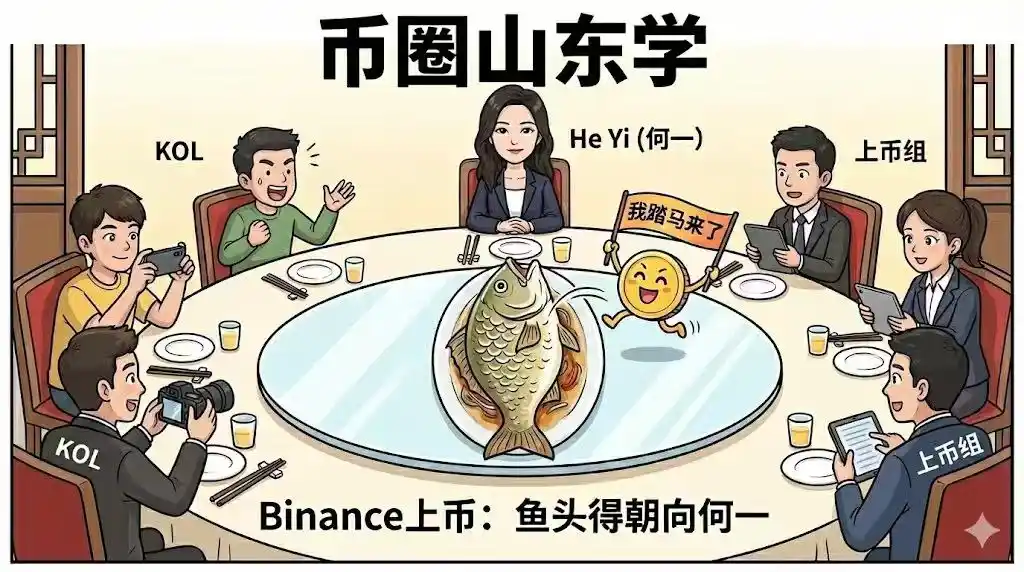
Recently, someone drew a picture called "Crypto Circle Shandong-Style Learning." A group of people sit around a table eating fish, with Yi He in the seat of honor, and KOLs, the listing team, and editors gathered on either side.

The caption: When Binance lists a coin, the fish head must point toward Yi He.
On January 1, Yi He posted a New Year's tweet. Riding a white horse by the sea, with a caption:

I'm fucking coming.

A fine New Year's greeting—"fucking coming," the Year of the Horse, with a bit of homophonic wit.

Today, Binance Alpha listed a new coin called "I'm Fucking Coming." It was community-made, with no direct connection to Yi He.

But look at this chain: Sister Yi posts a tweet, the community creates a coin, Alpha lists it.

No one needs to give any orders in between.

Last year, Binance was chased and criticized over "girlfriend coins," accused of shady listing practices and利益输送 (interest transfer). Yi He responded several times, saying they were reflecting, adjusting, and even created Alpha as a screening pool.

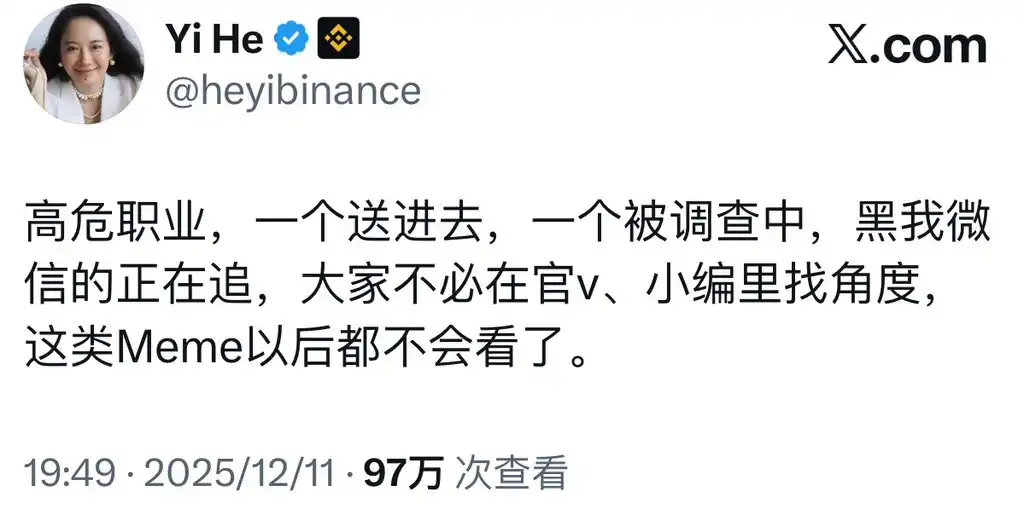
In December, she also tweeted saying, don't try to find angles in our official tweets, we won't pay attention to these kinds of Memes anymore.

Twenty-eight days later, her New Year's tweet became a new coin on Alpha.
What was the problem with girlfriend coins? It was about backdoor deals, favoritism,利益输送 (interest transfer).

These require evidence, a trail, a specific "girlfriend."

But "I'm Fucking Coming" doesn't need any of that.

No backdoor, no favoritism, no利益输送. Sister Yi posted a picture, and the people below just started moving on their own.

This perhaps touches on the essence of Shandong-style learning: The leader doesn't need to say anything; you have to figure it out yourself.

Some in the community commented that Alpha is now just a tool for currying favor, its purpose is to make Sister Yi happy.

Crude wording, but it describes an atmosphere.

When a platform's direction starts revolving around someone's social media, when "which coin to list" becomes "guess what she likes," rules cease to matter.

What matters is揣摩 (speculation/figuring out).

Some put it more harshly: If you want to know if an industry has a future, ask one question—In this industry, do people who are good at flattery succeed more easily than people who are good at doing things?

If the answer is "yes," then this industry is on the decline.

In the crypto world, this trick really works. And the most successful ones, everyone knows who the flattery should be directed toward.
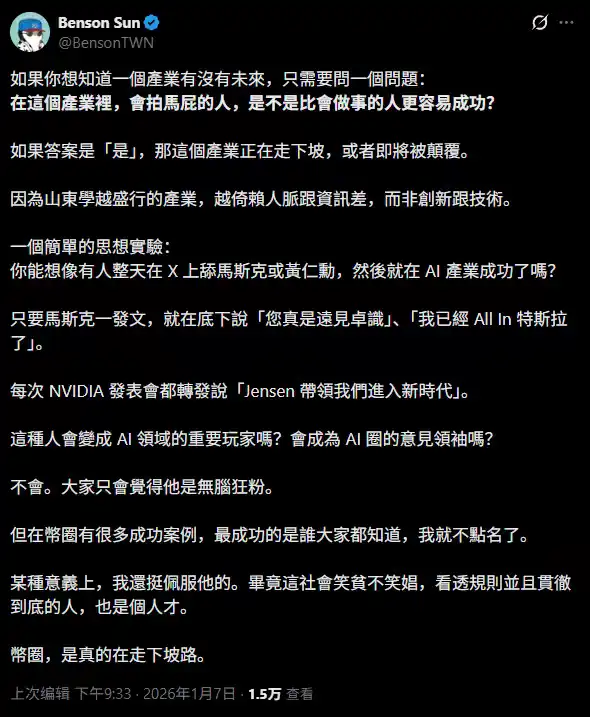
The core resources in the AI circle are technology and products; you have to deliver. Jensen Huang won't give you GPUs just because you call him daddy every day.

The core resources in the crypto circle are listing rights, traffic, who knows the news first. These things aren't in the code; they're in people's hands.

Things in people's hands must be obtained through human methods.

The more prevalent Shandong-style learning is, the more it relies on connections and information asymmetry, not innovation and technology.

Yi He might not even know about this. A small MEME worth a few million market cap isn't enough to bother the Co-CEO.

But that's precisely the problem.

She doesn't need to know. The fish head will turn by itself.

This is really much more efficient than girlfriend coins.

Girlfriend coins at least required a girlfriend. Shandong-style learning only requires an atmosphere.

And those who see through this set of rules and implement them thoroughly are, in a sense, also talented.

After all, in this society, people laugh at the poor, not the prostitute.

İlgili Sorular

QWhat is the core concept of 'Shandong Study' in the crypto world as described in the article?

AThe core concept of 'Shandong Study' in the crypto world refers to an unwritten rule where individuals or groups instinctively align their actions to please key figures in power, such as Binance's He Yi, without explicit instructions. It emphasizes intuition and揣摩 (speculation) over formal rules, particularly in contexts like token approvals on platforms.

QHow did the meme token '我踏马来了' (I'm Coming on Horseback) get listed on Binance Alpha according to the article?

AThe meme token '我踏马来了' was created by the community after He Yi, Binance's co-CEO, posted a New Year's tweet with the phrase '我踏马来了' and an image of herself on a horse. The community independently developed and listed the token on Binance Alpha, without direct involvement or instructions from He Yi, demonstrating the 'Shandong Study' phenomenon.

QWhat criticism does the article level against the crypto industry's reliance on 'Shandong Study' dynamics?

AThe article criticizes that such dynamics prioritize flattery and connections over innovation and technology, suggesting that an industry where 'bootlicking' is more rewarded than actual work is in decline. It highlights how resources like token listing privileges and information asymmetry are controlled by people rather than code, leading to a culture of揣摩 (speculation) rather than merit-based success.

QHow does the 'Shandong Study' approach differ from the previous '闺蜜币' (close-friend coin) issue at Binance?

AThe '闺蜜币' issue involved alleged backdoor dealings and explicit利益输送 (benefit transfers) through personal relationships, requiring evidence of specific connections. In contrast, 'Shandong Study' operates implicitly—no direct orders or relationships are needed; instead, participants intuitively act to align with the preferences of powerful figures like He Yi, creating a self-driven culture of compliance without formal corruption.

QWhat broader implication does the article suggest about power and decision-making in crypto platforms like Binance?

AThe article implies that decision-making in crypto platforms can become overly centralized around key individuals, where informal influence and social media activity shape outcomes like token listings. This shifts focus from transparent, rule-based systems to a culture of揣摩 (speculation) and alignment with personal whims, potentially undermining innovation and fairness in the industry.

İlgili Okumalar

In Conversation with Ray Dalio: We Are Currently in an AI Bubble, with 1% of My Portfolio in Bitcoin

Ray Dalio, founder of Bridgewater Associates, warns in an interview that the current AI boom shows classic bubble characteristics, which could lead to significant economic downturns as seen in past cycles like 1929 or 2000. He explains that speculative enthusiasm, fueled by debt and overvaluation, often precedes a crash when rising rates or taxation force asset sales, causing widespread losses and recession. Dalio also outlines his "Big Cycle" theory, describing an approximate 80-year pattern where widening wealth gaps, massive government deficits, and shifting geopolitical power (like China's rise) create internal conflict and global instability. He emphasizes that we are in a late-cycle, transitional phase where traditional powers like the US and UK face decline. For personal wealth protection, Dalio advises diversification beyond cash into assets like stocks, bonds, real estate, and particularly gold, which he prefers over Bitcoin. While he holds about 1% of his portfolio in Bitcoin as a non-printable hard asset, he views gold as more secure from technological or governmental threats. Regarding AI's impact, Dalio believes it will disproportionately benefit capital owners, worsening inequality by replacing both physical and cognitive labor. He suggests that human intuition and emotional intelligence, combined with AI, will be key for future workers. On taxation, Dalio argues that wealth taxes are impractical and risk triggering asset sell-offs, reducing productive investment. He points to the UK as a cautionary example of debt, low productivity, and political strife. Geopolitically, Dalio foresees a more regionalized world, with the US showing weakness in prolonged conflicts like with Iran, akin to past imperial declines. The ideal outcome, he suggests, is coexisting powerful blocs (e.g., Americas, China-Asia Pacific) without major war.

marsbit6 dk önce

In Conversation with Ray Dalio: We Are Currently in an AI Bubble, with 1% of My Portfolio in Bitcoin

marsbit6 dk önce

Daily 7.2 Trillion KRW: Foreign Capital's Record Net Buying on Friday! Wall Street Says Headwinds for Korean Stock Fund Flows Have Subsided

South Korean stock market sees a dramatic shift in fund flows. On July 31, foreign investors made a record net purchase of approximately KRW 7.2 trillion in KOSPI stocks, marking a fundamental reversal from the persistent large-scale net outflows seen in previous months. This contributed to a significant narrowing of foreign net selling in July to KRW 9.8 trillion, down sharply from KRW 48.4 trillion in June and KRW 44.5 trillion in May. Simultaneously, domestic institutional pressure eased. South Korean pension funds and asset managers turned to a net buying position in July, purchasing KRW 1.0 trillion worth of KOSPI shares, contrasting with net sales in May and June. Market volatility is expected to be dampened by new financial regulations. Effective July 31, the Financial Services Commission tightened access for retail investors to single-stock leveraged ETFs by raising the minimum cash deposit requirement. Trading volumes for these products subsequently dropped to about 50% of their monthly average. Citigroup Research maintains its year-end KOSPI target of 10,000 points. The firm cites several supportive factors: the substantial easing of headwinds from capital outflows, a robust fundamental outlook for the semiconductor sector, historically low market valuations, strong economic fundamentals, and the potential for policy support from financial authorities if needed.

marsbit6 dk önce

Daily 7.2 Trillion KRW: Foreign Capital's Record Net Buying on Friday! Wall Street Says Headwinds for Korean Stock Fund Flows Have Subsided

marsbit6 dk önce

Thanks to Dice Rolls, Bitcoin Keys Are Stored Offline, But Not Everyone Will Do It

The article discusses using dice rolls to generate secure Bitcoin wallet seeds, providing entropy independent of potentially flawed hardware random number generators. It explains that each fair dice roll offers about 2.585 bits of entropy, with around 50 rolls needed for a standard 12-word seed phrase and 99+ recommended for higher security. This method gained attention after a vulnerability was revealed in some Coldcard hardware wallets, where a faulty firmware RNG (dating back to 2021) compromised generated keys. The analysis notes that while a dice-generated main seed was safe from this specific flaw, other Coldcard functions (like creating paper wallets, backup keys, or passwords) could still be vulnerable if they used the defective RNG. The piece argues that while dice-based entropy is technically robust, the manual process is error-prone, tedious, and unrealistic for most new users, who might make mistakes in recording or inputting rolls. It concludes that while manual entropy generation should remain an option for advanced users, the long-term goal is to develop reliable, user-friendly hardware and software that securely generates randomness without requiring specialized knowledge. Coldcard users are advised to check their firmware version and replace any secondary secrets (like paper wallet keys) created with vulnerable devices, while also considering multi-signature setups with devices from different manufacturers for added security.

cryptonews.ru5 saat önce

Thanks to Dice Rolls, Bitcoin Keys Are Stored Offline, But Not Everyone Will Do It

cryptonews.ru5 saat önce

İşlemler

Spot
活动图片





