When Top Crypto VCs Are Shrinking Across the Board, Why Has This Firm Grown by 150%?

marsbit2026-04-20 tarihinde yayınlandı2026-04-20 tarihinde güncellendi

Özet

In a declining crypto market where top venture capital firms like Paradigm, Pantera, a16z crypto, and Multicoin saw significant reductions in assets under management (AUM), Haun Ventures stood out with a 150% growth, increasing its AUM from $1 billion to $2.5 billion by 2025. Founded by Katie Haun, a former federal prosecutor and a16z crypto veteran, the firm combines regulatory insight with investment discipline. Initially investing heavily in NFTs during the 2022 hype, Haun Ventures quickly pivoted as the bubble burst, adopting a cautious approach with only six investments over the following 18 months. The firm balanced its portfolio between digital tokens and traditional equity, allocating about 30% to liquid tokens like Bitcoin and Ethereum, which contributed significantly to returns as Bitcoin’s price surged. By 2024, Haun Ventures shifted focus to B2B solutions in payments and developer infrastructure, leading over 56% of its investment rounds—the highest rate among top VCs. This strategy paid off with several high-multiple exits via acquisitions, such as Bridge (acquired at $1.1 billion from a $200 million valuation) and BVNK (acquired at $1.8 billion from a $750 million valuation). The firm’s success is attributed to its regulatory foresight, adaptive strategy, high-conviction lead investments, and emphasis on real-world utility and exit efficiency—making it a standout performer during the crypto downturn.

Author: Gu Yu, ChainCatcher

As the crypto market overall declines, the assets under management (AUM) of almost all crypto VC firms are shrinking with it, and the industry is entering a brutal clearing cycle. But against this backdrop, a crypto venture capital fund established less than five years ago has become a clear exception, charting an independent growth trajectory amidst widespread contraction.

According to a batch of undisclosed financial disclosure documents from U.S. SEC obtained by a Fortune reporter last week, data shows that the AUM of leading firms like Paradigm, Pantera, a16z crypto, and Multicoin shrank across the board in 2025, with Multicoin's AUM shrinking by more than half.

The only one that grew against the trend was Haun Ventures, a venture capital fund established just four years ago. Its AUM grew from an initial $1 billion逐年 (year by year) to $2.5 billion in 2025.
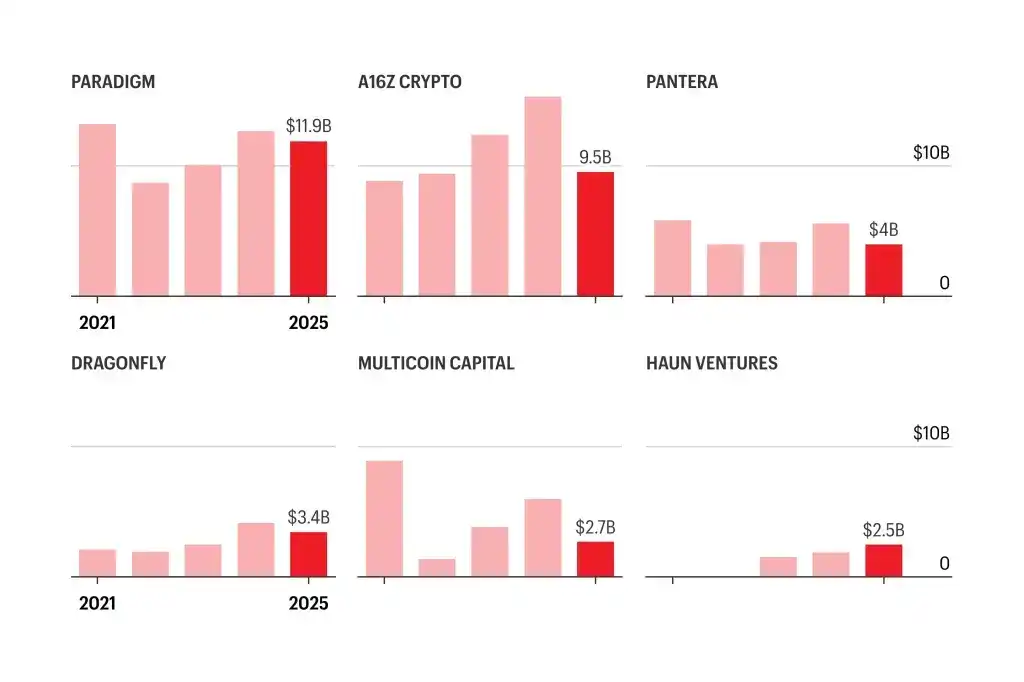
In the bleak crypto market, this is by no means just luck. Last year, market news indicated that Haun Ventures was close to completing a new round of fundraising for a $1 billion fund. All of this reflects that Haun Ventures and its founder Katie Haun's unique investment strategy has passed the test of the market and LPs, propelling them into the ranks of top VCs.

Distinct Founder Style and Background

The difference of Haun Ventures was foreshadowed from the very start.

Founder Katie Haun is not a typical crypto investor. She was a long-serving federal prosecutor in the U.S., working on financial crime investigations for over a decade, and created the U.S. government's first cryptocurrency task force. In 2018, she became a16z's first female general partner and co-led the firm's cryptocurrency fund. She also joined the Coinbase board, thus combining policy vision, institutional resources, and practical experience.

This experience means her understanding of the crypto industry does not stem purely from "technological potential" or "market size," but rather from compliance boundaries, systemic risks, and institutional embedding capabilities. The influence of this background is not obvious, but it is profound enough.

It is worth noting that Haun Ventures is one of only two crypto funds named after their founder, reflecting the fund's distinct founder-driven style. The other VC named after its founder is a16z.

In its early days, Haun Ventures was not flawless and also stepped into pitfalls during market frenzies. Looking back at its investment record, Haun Ventures once focused heavily on NFT as a key investment area, investing in at least 4 NFT projects including Opensea, Autograph, ZORA, and Highlight in the first half of 2022 alone.

However, as the bubble for NFTs and similar concepts burst quickly, Haun Ventures demonstrated a strong ability to correct mistakes and iterate. From the second half of 2022 onwards, it rapidly contracted its efforts, significantly decreasing its investment frequency, responding to the market downturn with extreme prudence.

According to RootData, in the 18 months spanning the second half of 2022 and the entirety of 2023, Haun Ventures publicly disclosed participation in only 6 funding rounds, averaging one investment every three months.

As of June 2023, Haun Ventures partner Rosenblum stated in an interview that the firm's investments were almost evenly split between digital tokens and traditional equity, and that it had already deployed about 30% of its capital into roughly twenty-plus projects, including publicly traded, liquid tokens. These tokens included well-known cryptocurrencies like Bitcoin and Ethereum, as well as smaller market cap tokens related to projects.

At that time, Bitcoin's price hovered for a long time in the $15,000-$30,000 range, before subsequently rising to a high of $126,000 in 2025. This also brought Haun Ventures very substantial investment returns, largely offsetting the investment losses in areas like NFTs and becoming a crucial foundation for its growth in scale.

Key Shift

Starting in 2024, Haun Ventures' investment strategy began to show a clear shift, with its focus turning towards B2B solution companies in areas like payments and developer platforms.

At the time, these directions were not particularly 'sexy.' They lacked explosive growth narratives and were difficult to generate market hype in a short time, yet they恰好 (exactly) hit the key node of the industry's transition from speculation to utility.

In that year, Haun Ventures invested in nearly ten B2B companies, including the stablecoin payment platform Bridge, crypto-native infrastructure platform Conduit, crypto protocol economic security solution Chaos Labs, Solana development platform Helius, and crypto payment platform BVNK.

In terms of investment style, Haun Ventures particularly favors leading investment rounds. According to RootData statistics, among its publicly disclosed participation in 39 funding rounds, it led the round 22 times, with a lead investment rate exceeding 56%, ranking first among top-tier VCs. This demonstrates that Haun Ventures has an unusual level of conviction in its portfolio, willing to support high-potential early-stage projects with substantial capital.

Looking back now, payments have become the sector with the highest valuation premiums and the clearest exit paths in the crypto space. Haun Ventures' early布局 (layout/positioning), combined with its consistent lead investment style, has yielded very considerable exit returns.
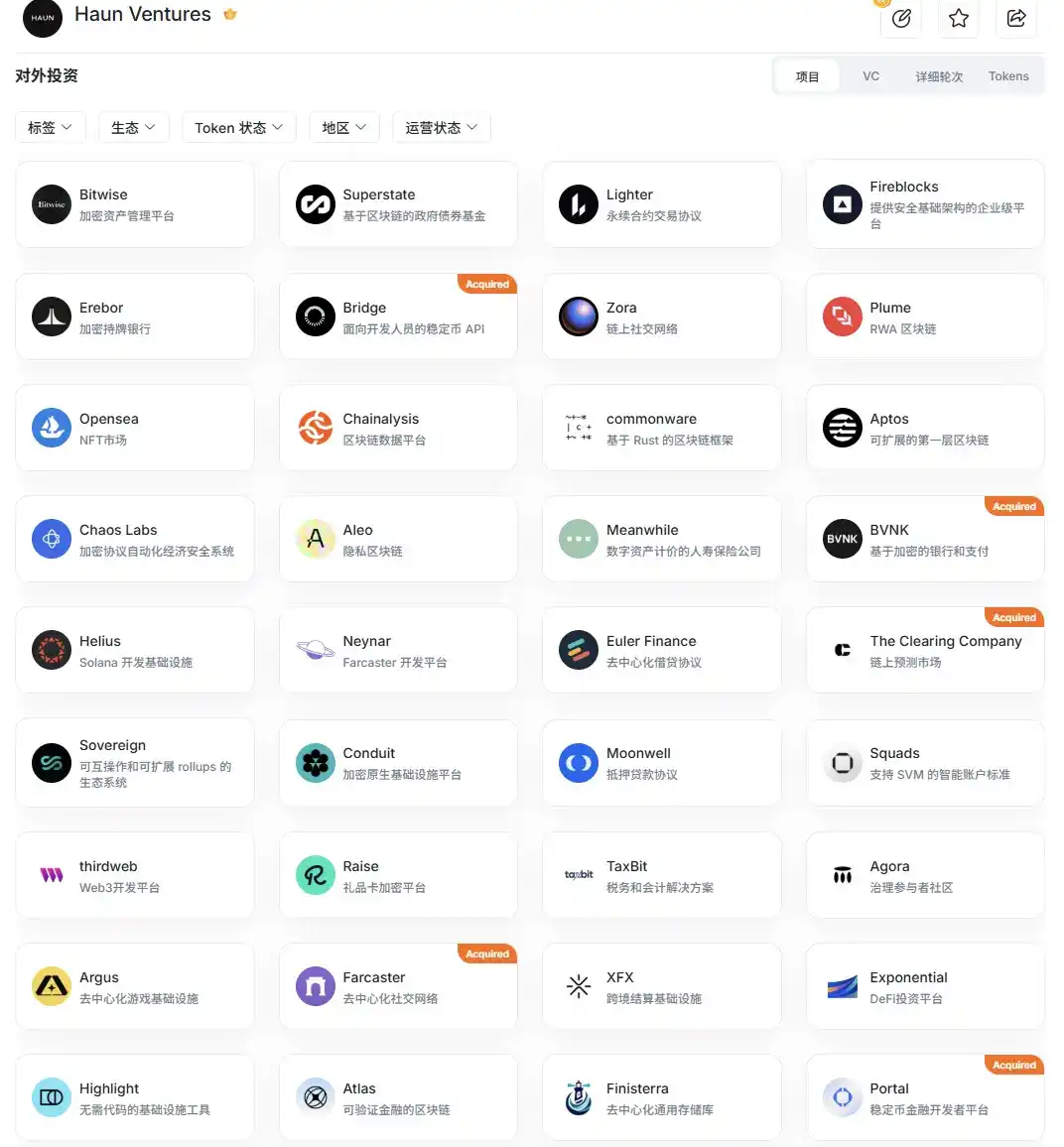
Since October 2024, over 5 of Haun Ventures' portfolio companies have been acquired, with several payment companies achieving high-multiple returns. For example, Haun Ventures once led an investment in the stablecoin development platform Bridge at a $200 million valuation, and it was eventually acquired for a valuation exceeding $1.1 billion. Haun Ventures also led an investment in the crypto payment platform BVNK at a $750 million valuation, which was eventually acquired for a valuation exceeding $1.8 billion.

In an environment where crypto asset exit channels are increasingly narrow and secondary market liquidity is highly concentrated towards the top, Haun Ventures has proven the viability of another path: investing via equity in companies that solve real payment pain points and possess compatibility with traditional finance, achieving high-multiple exits through acquisitions, which is more capital-efficient than holding a pile of highly illiquid tokens.

From chasing the hot trend of NFTs, to a balanced allocation of tokens and equity, and then to focusing on B2B payments and infrastructure, the evolution path of Haun Ventures is precisely an epitome of crypto VCs shifting from speculation-oriented to value-oriented. Katie Haun's compliance experience, the fund's rapid error-correction ability, prudent investment pace, high lead-investment ratio heavy allocation strategy, combined with precise grasp of real-world applications and exit paths, together build a moat for weathering cycles.

As industry泡沫 (bubbles) recede, institutions that expanded依靠 (relying on) narratives and leverage are shrinking one after another. Haun Ventures, with compliance and stability as its foundation, has become the most certain winner in the crypto winter, also pointing out the survival and growth logic for the next phase of the entire VC industry.

İlgili Sorular

QAccording to the article, which crypto VC firm was the only one to experience growth in AUM during the market downturn, and what was its growth?

AHaun Ventures was the only crypto VC firm to experience growth. Its assets under management (AUM) grew from an initial $1 billion to $2.5 billion in 2025, representing a 150% increase.

QWhat unique background does Katie Haun, the founder of Haun Ventures, have that differentiates her from typical crypto investors?

AKatie Haun is a former U.S. federal prosecutor who worked on financial crime investigations for over a decade and created the U.S. government's first cryptocurrency task force. She later became a16z's first female general partner, co-leading their crypto fund, and served on the board of Coinbase.

QHow did Haun Ventures' investment strategy change after the NFT market bubble burst in 2022?

AAfter the NFT bubble burst, Haun Ventures significantly reduced its investment frequency, becoming extremely cautious. It shifted its focus from consumer-facing NFTs to a more balanced portfolio, splitting investments almost evenly between digital tokens and traditional equity, and later pivoting to B2B solutions like payment and developer platforms.

QWhat is a key characteristic of Haun Ventures' investment style in terms of its participation in funding rounds?

AA key characteristic is its high lead-investment rate. Haun Ventures led over 56% of the funding rounds it participated in, which is the highest rate among top-tier VCs, demonstrating strong conviction and a willingness to commit significant capital to early-stage projects.

QWhat type of companies did Haun Ventures focus on starting in 2024, and how did this strategy lead to successful exits?

AStarting in 2024, Haun Ventures focused on B2B solutions, particularly payment and developer infrastructure companies. This strategy led to successful high-multiple exits through acquisitions. For example, its portfolio company Bridge was acquired for over $1.1 billion after a lead investment at a $200 million valuation, and BVNK was acquired for over $1.8 billion after a lead investment at a $750 million valuation.

İlgili Okumalar

Analyzing the Impact of AI on Economic Growth and Productivity

**Title: Analyzing AI's Impact on Economic Growth and Productivity** This article examines three contrasting views on AI's influence on economic growth and productivity. **The Optimistic View** posits that AI, especially through automating R&D ("recursive self-improvement"), could dramatically accelerate growth, even triggering a technological "singularity" with explosive, potentially infinite, economic expansion. **The Moderate/Mainstream View** acknowledges AI's productivity benefits but emphasizes significant real-world constraints that could limit its impact. These include: limited cost savings per task, structural ceilings on which jobs and industries are "exposed" to AI, adoption bottlenecks (e.g., compute, energy, regulatory hurdles), and the "weak link" effect where non-automatable tasks cap overall gains. Consequently, the realized AI dividend may be far lower than optimistic projections, with estimates typically ranging from 0.1% to 1.3% annual productivity growth. **The Pessimistic View** stems from two strands. The first aligns with the moderate view but applies extremely conservative assumptions about task exposure and efficiency gains, yielding minimal projected impact. The second introduces a demand-side critique: if AI primarily replaces rather than augments labor, it could depress labor's share of income, weaken consumer demand, and create a "demand trap" that ultimately stifles growth, unless offset by redistribution policies. **The authors' assessment** is nuanced: * **Short-term (1-2 years):** AI will support growth primarily through investment spending, not significant productivity gains. * **Medium-term (3-5 years):** Three potential paths emerge based on AI demand and bottleneck severity: 1. **"Optimistic Path":** High demand, few bottlenecks. Rapid productivity gains but risk of major job displacement and social conflict without redistribution. 2. **"Moderate Path" (most likely):** High demand but significant, surmountable bottlenecks. Leads to moderate productivity gains, financial market volatility (K-shaped returns), and sectoral job losses. 3. **"Pessimistic Path":** Low demand or severe bottlenecks. Minimal productivity and growth impact, triggering financial market corrections but allowing a smoother societal transition with less labor disruption. * **Long-term:** AI holds potential for a major productivity revolution and prosperity. The conclusion stresses that no path is smooth. Technologically "optimistic" outcomes could be socially detrimental, while "pessimistic" technological diffusion might be more socially stable. Policymakers must monitor developments and prepare balanced responses to manage economic, financial, and social sustainability.

marsbit1 dk önce

Analyzing the Impact of AI on Economic Growth and Productivity

marsbit1 dk önce

The New Cold War is a Tech Stock War

The New Cold War is a Tech Stock War The article argues that the contemporary geopolitical and economic rivalry between the US and China represents a "New Cold War," but one fundamentally fought through technology and financial markets, not physical barriers or conventional trade. Historically, US dominance was secured through financial systems. The Soviet Union, reliant on the rigid "Transferable Ruble," was ultimately undermined by its dependency on the US dollar for oil trade. Later, Japan's semiconductor challenge was countered not just by tariffs (e.g., Plaza Accord, 301 investigations) but by binding it to US Treasury bonds. China presents a more complex, "embedded" challenger. While it holds vast dollar reserves and US debt like Japan, its industrial base is stronger and more diversified than the Soviet Union's. Surviving the initial 2018 trade war phase, the conflict has evolved into a "tech-financial war." The core battlefield is now the stock market. US tech stocks (AI, semiconductors) are treated as sovereign assets, buoyed by bipartisan national will. China is pushing to strengthen its own financial markets to convert industrial strength into financial power and fund its tech ambitions. Companies like ChangXin (semiconductors), Moonshot AI, and DJI compete not just for market share but as financial proxies for their respective systems. The new paradigm is moving from globally efficient monopolies (Apple, Google) towards companies that achieve monopolistic profits within their respective geopolitical spheres. This competition over "pricing power" and financial valuation in segmented markets defines the current era, making the stock market the primary arena for this tech-centric struggle.

marsbit10 dk önce

The New Cold War is a Tech Stock War

marsbit10 dk önce

RWA Weekly: Ten European Financial Institutions Establish Tokenized Asset Cooperative; Ondo Launches New Execution Network Ondo Network

RWA Weekly: European Banks Form Tokenized Asset Cooperative; Ondo Launches New Execution Network Ondo Network Covering July 24-31, 2026, the RWA sector saw a steady on-chain total value locked (TVL) of $36.8 billion, with holder count hitting a record high. However, stablecoin transfer volumes fell sharply (~30%), indicating low on-chain settlement demand. Key regulatory moves include South Korea advancing stablecoin legislation and a push to scrap crypto taxes, Kenya lowering capital requirements for stablecoin issuers, and Zimbabwe approving seven projects for its crypto sandbox. In project developments, BIS-led Project Agorá successfully tested cross-border payments with tokenized funds across six currencies. Ten major European financial institutions formed the RL1 blockchain cooperative to build tokenized asset infrastructure. Other notable updates: Aviva launched a tokenized dollar liquidity fund on XRPL, POSCO International tokenized commercial invoices on Injective, and a Brazilian farmer used tokenized cattle as collateral for a loan. Additional progress includes BNY Mellon migrating its core transfer agent operations to blockchain, Securitize gaining SEC investment advisor registration, and Tether’s compliant stablecoin USA₮ launching on Celo. Ondo Finance introduced Ondo Network, a new execution layer focused on speed and privacy, moving away from its initial chain plans. An analysis highlights that despite the growing scale of on-chain RWAs (~$32B), approximately 90% remain underutilized in DeFi, pointing to a critical challenge in unlocking liquidity and fostering real-world application beyond mere issuance.

marsbit11 dk önce

RWA Weekly: Ten European Financial Institutions Establish Tokenized Asset Cooperative; Ondo Launches New Execution Network Ondo Network

marsbit11 dk önce

South Korean Stock Market Sees Sharp Rebound After Forceful De-leveraging, SK Hynix Rises 30%

On July 31, South Korean stocks staged a historic rebound. The benchmark KOSPI index surged 18.27%, with chipmaker SK Hynix hitting a 30% gain limit. This followed a brutal, near-40% decline in the KOSPI over the previous month, driven largely by a deleveraging spiral involving leveraged ETFs. Analysts attributed the sharp sell-off to structural liquidity issues rather than deteriorating corporate fundamentals. The rally was triggered by a confluence of positive catalysts. Firstly, strong earnings from U.S. cloud giants Microsoft and Amazon alleviated fears of an "AI bubble burst," boosting global tech sentiment. Secondly, SK Group Chairman Chey Tae-won made a rare personal purchase of SK Hynix shares, seen as a strong vote of confidence. Thirdly, the South Korean government announced a 20 trillion won ($139 billion) AI investment fund. In response to the market turmoil, South Korean regulators are tightening controls on leveraged ETFs, admitting oversight shortcomings. Measures include raising minimum cash保证金 requirements for散户 investors and suspending new product launches. While the rebound signals eased liquidity pressure, analysts note deep structural issues remain. The market's future stability is seen as dependent on global tech capital expenditure trends and memory chip price cycles, with some viewing the surge as a technical correction rather than a definitive trend reversal.

marsbit31 dk önce

South Korean Stock Market Sees Sharp Rebound After Forceful De-leveraging, SK Hynix Rises 30%

marsbit31 dk önce

İşlemler

Spot
活动图片