When Tokens Cost More Than People, 'AI Narrative' Runs Into Trouble

marsbit2026-05-29 tarihinde yayınlandı2026-05-29 tarihinde güncellendi

Özet

Title: When Tokens Cost More Than People, the "AI Narrative" Hits Trouble The economic sustainability of corporate AI adoption is under scrutiny as token consumption soars while measurable business value remains elusive. Major companies like Uber and Microsoft report struggling to justify rising AI costs, with executives coining terms like "tokenmaxxing" to describe wasteful usage. Data reveals a stark picture: for every dollar spent on AI tokens, only 18 cents translates to user-facing value, with the rest consumed by bug fixes, rework, and friction. The debate splits into bullish and bearish camps. Bulls, like Goldman Sachs analysts, see current inefficiencies as growing pains, predicting a 24-fold increase in token demand by 2030 and a shift towards healthier metrics like "cost per effective action." They point to indicators of real productivity gains and argue current tech valuations are not in bubble territory. Bears, however, highlight an unsustainable model where value is heavily concentrated in semiconductor companies like Nvidia, funded by cloud giants taking on massive debt. Studies show 95% of firms investing in generative AI see zero return. A deeper concern is the circular financial structure between cloud providers (hyperscalers) and AI labs like OpenAI and Anthropic. Billions in cloud service commitments are tied to these labs, which are partly funded by the hyperscalers' own investment. This creates a loop where cloud revenue depends on labs securing contin...

Author: Bao Yilong

Source: Wall Street News

The justification for corporate AI spending is facing a severe test, as Token consumption continues to climb, yet quantifiable commercial value remains elusive.

On May 22, Uber's Chief Operating Officer Andrew Macdonald, whose company is valued at over $200 billion, stated publicly on a podcast that the link between the growth in token consumption and substantial product improvement "doesn't exist yet."

Macdonald pointed out that companies are finding it increasingly difficult to rationalize the continuously rising AI expenditures. He even coined a term for the wasteful phenomenon within engineering teams: "tokenmaxxing."

Earlier in mid-May, Microsoft began cutting internal Claude Code licenses, citing token bills as "unsustainable."
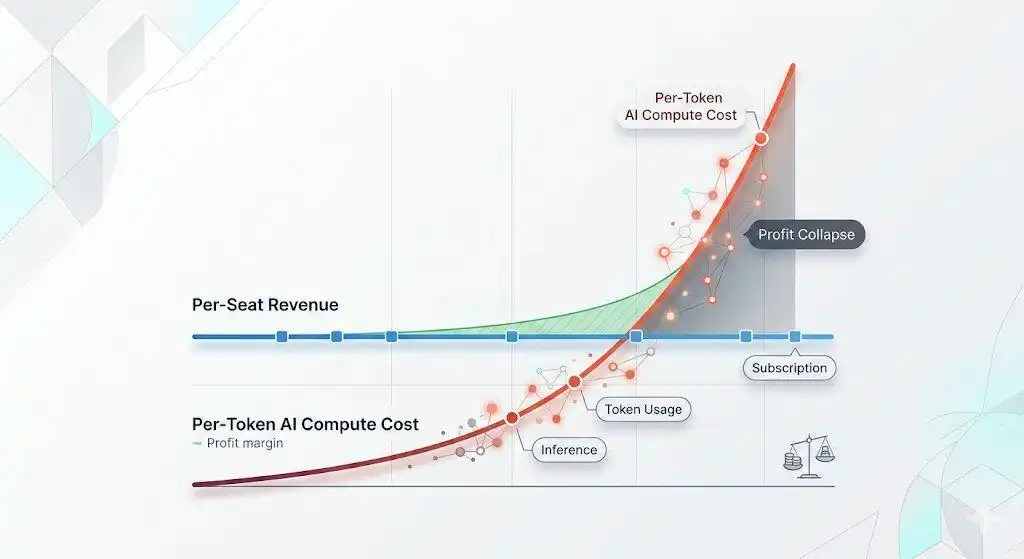
The combination of these two events forces the market to confront a previously overlooked variable. Token economics, specifically the unit economics of token consumption at enterprise scale, has evolved from a peripheral issue to the central load-bearing pillar of the entire AI investment thesis.

Five Data Points, Painting a New Picture

Since April, multiple data points have emerged successively, collectively sketching an alarming picture.

In April this year, Uber's Chief Technology Officer publicly stated that the company had burned through its annual Claude Code budget in just four months.

Among 5,000 engineers, monthly usage rates ranged from 84% to 95%, with individual monthly bills varying from $150 to $2,000. The CTO himself reportedly consumed $1,200 worth of tokens during a two-hour internal demonstration.

Macdonald described being "speechless" upon hearing this number.

Regarding Microsoft, according to a report in The Verge's Tom Warren's Notepad newsletter, Claude Code quickly became popular among Microsoft's internal engineering teams. However, the token-based billing model made scaled spending unsustainable, prompting Microsoft to proceed with cutting related licenses.

GitHub announced that starting June 1, all Copilot plans would shift from a fixed subscription model to usage-based billing.

The official discussion thread garnered nearly 900 downvotes, as users calculated that a single AI programming session typically consumes $30 to $40, meaning a $10 monthly subscription could be exhausted in a single use.

Developer productivity platform Entelligence.AI aggregated data from 2,444 companies and found:

  • For every $1 spent on AI token costs, only 18 cents generated actual value reaching users.
  • 44 cents were used to fix bugs introduced by the AI itself; 27 cents went to rework; 11 cents were consumed by review friction.

According to Bloomberg's Silicon Data LLM Token Expenditure Index, token prices have risen about 65% since the end of February this year, and US AI software prices have increased by 20% to 37% cumulatively over the past year.

Bull vs. Bear Debate: One Fact, Two Interpretations

The same data points to starkly different conclusions under different analytical frameworks.

The bullish view argues that the current chaos is merely the growing pains of a successful transformation.

According to Goldman Sachs' Jim Schneider in early May, by 2030, agentic AI will drive a 24-fold increase in token consumption, reaching approximately 120 sextillion tokens per month. The gross margins of hyperscale cloud providers and model vendors will turn positive within the next 3 to 12 months.

Goldman's Rich Privorotsky believes that Q1 2026 might have been the peak for "token maximization" as a KPI. The industry is shifting from pursuing consumption volume to the healthier metric of "cost per effective action."

JP Morgan's economic research also found a jump in new and updated Python packages on PyPI in early 2026, a trend not seen when ChatGPT launched in 2022, indicating that real productivity gains are occurring.

Furthermore, the Magnificent 7 currently trades at about 20 times forward earnings, far below the 52 times at the peak of the 2000 tech bubble, 67 times for Japan in 1989, and 34 times during the "Nifty Fifty" era. By historical bubble standards, this does not constitute a bubble.

The bearish view was most systematically articulated by Goldman Sachs semiconductor analyst Jim Covello in an April report.

He pointed out that almost all value in the AI supply chain flows to semiconductor companies, a phenomenon unprecedented and unsustainable in history. Chip companies should benefit when their customers benefit, but in this cycle, their prosperity comes at the expense of consumption across the entire upstream industry chain.

Nvidia's net profit has grown about 20-fold since ChatGPT's launch; major hyperscale cloud providers have burned through their operating cash flow and are turning to debt—data center-related debt issuance in 2025 was approximately $182 billion, doubling from 2024.

MIT Nanda research shows 95% of enterprises investing in generative AI see zero return. This decoupling may persist for a while, but cannot last forever.

Concerns of the Circular Financing Structure

This discussion touches on a more complex level: the financial loop between hyperscale cloud providers and AI labs.

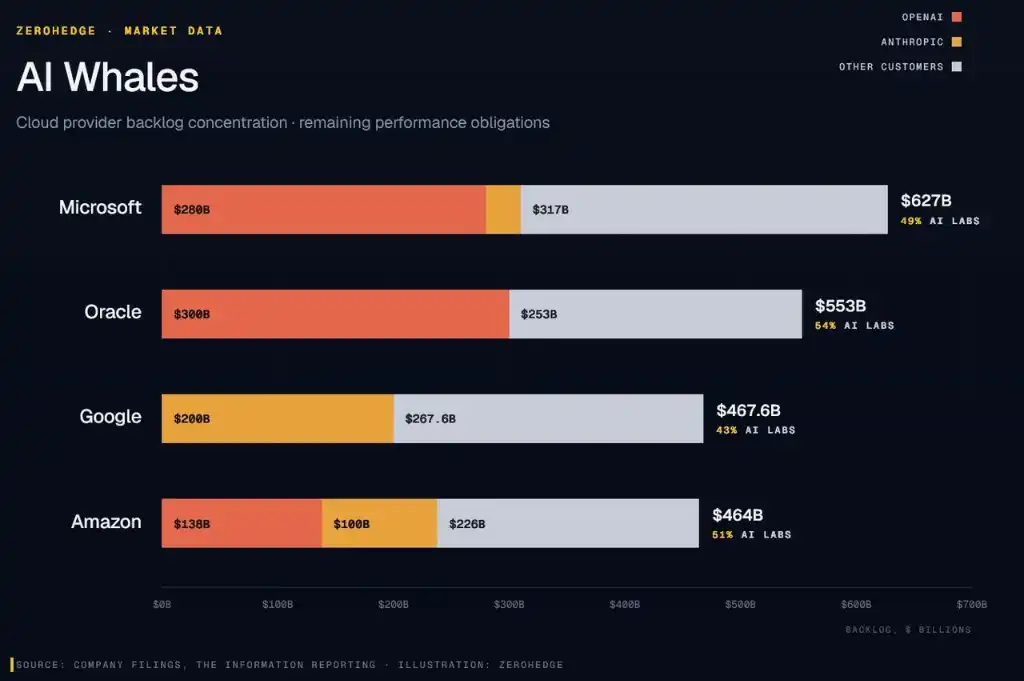
According to corporate disclosure documents compiled by The Information, OpenAI and Anthropic account for more than half of the approximately $2 trillion in future cloud service commitments from Microsoft, Oracle, Google, and Amazon. Specifically:

  • Of Microsoft's $627 billion cloud service backlog, $280 billion is tied to OpenAI;
  • Of Oracle's $553 billion pipeline business, 54% (approx. $300 billion) is committed by OpenAI;
  • Of Google's $467.6 billion, Anthropic accounts for 43% (approx. $200 billion);
  • Amazon's corresponding exposure also reaches 51% of its $464 billion backlog.
This financing structure is inherently circular. Microsoft's $13 billion investment in OpenAI was largely delivered in the form of Azure credits, which OpenAI used to purchase Azure compute. Microsoft then booked this as cloud revenue.

The same hyperscale cloud providers are both equity investors in the AI labs and service providers collecting compute bills.

This structure is also reflected in profit data. Alphabet reported a record Q1 profit of $62.6 billion, of which about $28.7 billion, nearly half, came from the paper appreciation of its Anthropic stake.

Amazon's Q1 profit of $30.3 billion included $16.8 billion in pre-tax unrealized gains from Anthropic, while its free cash flow plummeted 95% to $1.2 billion due to data center capital expenditures of $44.2 billion in the same period.
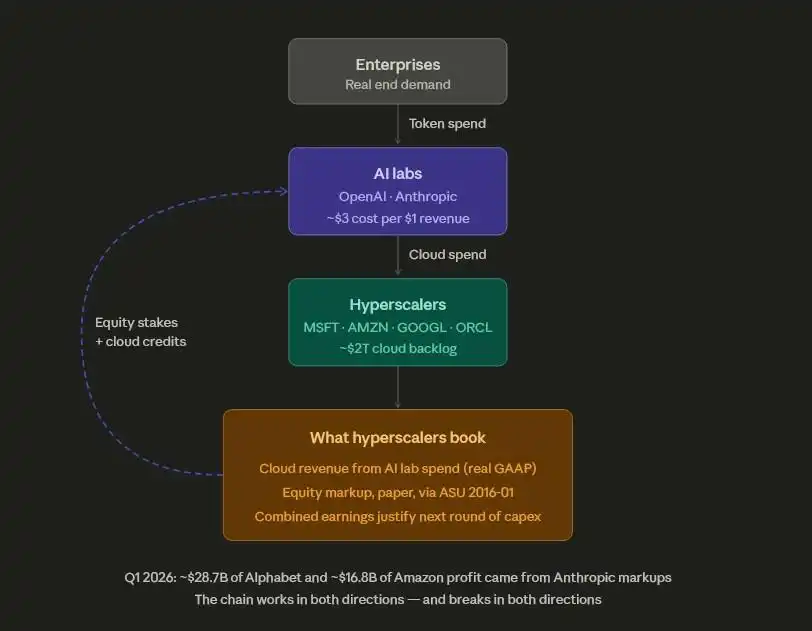
The sustainability of this system depends on AI labs' continued ability to secure external financing to fulfill cloud computing commitments, which in turn relies on enterprise customers' continued willingness to pay rising token bills.

It is reported that Anthropic currently incurs costs of $3 for every $1 of revenue. Once the pace of financing slows, the credibility of cloud revenue projections will decline, and the valuation multiples of hyperscale cloud vendors will also face re-evaluation pressure.

This chain transmits in both directions and will break in both directions.

This Isn't 1999, But the Problem is Real

The current situation does not constitute a typical bubble setup.

From a valuation multiple perspective, the Tech 7 currently trades at about 20 times forward price-to-earnings, far below the 52 times at the peak of the 2000 tech bubble, 67 times for the Japanese market in 1989, or the 34 times during the "Nifty Fifty" era.

AI technology itself is real. For heavy user groups, data on productivity gains is verifiable. OpenAI has an annualized revenue of about $20 billion, Anthropic about $4.3 billion; these two labs are not going to disappear.

Today, token cost (compute expense) has become the key determinant of AI success or failure. Six months ago, people weren't even discussing this topic.

Back then, people only cared about "whether the technology works." Now the answer is clear: in the eyes of specific jobs and specific people, the technology indeed works.

But a new question arises: Can the money saved by downstream companies using AI be transmitted upward in time to outrun the valuation window the capital market has left for AI labs and cloud giants?

Those bullish on AI believe that as long as the technology continues to mature, corporate ROI (Return on Investment) will turn positive within 1 to 1.5 years.

The bearish believe more executives will follow Macdonald's lead, publicly complaining about low AI ROI and starting to cut budgets.

Both scenarios are playing out; the outcome is undecided. The only certainty is that the old lie—"as long as token consumption is rising, it means the AI transformation is successful"—has been shattered.

High token consumption does not equal commercial value; this bubble must eventually be squeezed out. The bill for AI has come due, but who will ultimately pay for it? That remains an unknown for now.


İlgili Sorular

QAccording to the article, what is the major problem that enterprise AI spending is currently facing?

AThe major problem is that token consumption is rapidly increasing, but quantifiable business value is hard to find. The article states that 'the line between the growth of token consumption and substantive product improvement... does not yet exist.' Executives are finding it difficult to justify the escalating costs.

QWhat key finding did the developer platform Entelligence.AI discover regarding the value generated from AI token spending?

AEntelligence.AI found that for every dollar spent on AI token fees, only 18 cents generated tangible value that reached end-users. The rest was consumed by other costs: 44 cents for fixing AI-introduced bugs, 27 cents for rework, and 11 cents for review friction.

QWhat is the critical concern regarding the financial structure between hyperscale cloud providers and AI labs, as described in the article?

AThe concern is a potentially unsustainable, cyclical financing structure. Hyperscale cloud providers (like Microsoft, Amazon) are both equity investors in and service providers for AI labs (like OpenAI, Anthropic). The labs use cloud credits from the investments to purchase cloud compute, which the providers book as revenue. This structure depends on continuous external funding for the labs, which itself relies on enterprise clients' willingness to pay rising token bills.

QBased on the bull argument presented, what metric is the AI industry supposedly shifting towards from 'tokenmaxxing'?

AAccording to the bull argument, the industry is shifting from focusing on 'tokenmaxxing' (maximizing token consumption as a KPI) towards a healthier metric: the 'cost per effective action' or the return on investment (ROI) of AI deployments.

QWhat does the article conclude is the 'new question' now that the technical capability of AI is proven for specific tasks?

AThe new question is: 'Can the money saved by downstream companies using AI be transmitted upwards quickly enough to outpace the valuation window that capital markets have left for AI labs and cloud giants?' In other words, can the business value and cost savings materialize fast enough to justify the high costs and valuations before investor patience runs out?

İlgili Okumalar

ByteDance Adopts Arm CPUs, Jensen Huang: So Sad I Didn't Buy Arm

**Summary:** At Computex 2026, Arm CEO Rene Haas announced that ByteDance and Oracle have adopted Arm's self-designed Arm AGI data center CPU. The company expects significant revenue growth from this product, projecting $20 billion in demand for the 2027/2028 fiscal years. Haas noted that restricting AI-capable CPUs from the US to China is nearly impossible due to their widespread applications. Arm's stock has surged dramatically this year, notably rising 16% after NVIDIA's Arm-based Vera CPU and RTX Spark announcements. A highlight was the informal, humorous on-stage conversation between Haas and NVIDIA CEO Jensen Huang. Huang joked about NVIDIA's failed attempt to acquire Arm and playfully lamented selling his Arm shares. Both executives showed a clear sense of camaraderie and shared regret over the missed merger. Key technical topics were discussed: 1. **AI PC Design:** Huang explained NVIDIA's RTX Spark superchip (with a 20-core Arm CPU) is designed for future AI agents that will autonomously run and use tools on PCs, blending local and cloud processing. 2. **Agent vs. OS:** Huang emphasized the operating system remains crucial, as AI agents rely on its APIs and tools to function. 3. **Growth Constraints:** He identified the shift to "useful AI" that generates profitable tokens as a primary driver for immense, almost limitless, computational demand. Haas outlined Arm's strategy across PC and data centers. For PCs, Arm collaborates with partners like NVIDIA and MediaTek, offering its compute subsystem (CSS) for custom SoCs. In data centers, its Arm AGI CPU (built on TSMC's 3nm process) has gained major partners including OpenAI, Meta, and now ByteDance and Oracle. Arm presented a multi-year roadmap for its in-house CPU line. The article concludes that while GPUs dominated the AI training race, the explosion of AI agents is shifting significant focus to CPUs for inference, state management, and tool orchestration. The industry is trending towards vertical integration, with companies like cloud providers designing chips and chip/IP firms offering full solutions, all competing to deliver more efficient computing per watt.

marsbit16 dk önce

ByteDance Adopts Arm CPUs, Jensen Huang: So Sad I Didn't Buy Arm

marsbit16 dk önce

New Wall Street Play: Yen Shorts Still Adding, But Japan Stocks Don't Rely on Carry Trade Unwinding

On June 3rd, USD/JPY hit 160.44, its highest level since July 2024, while the Nikkei 225 surged past 68,000 points. Contrary to popular narratives of an imminent "carry trade unwind" akin to August 2024, data reveals a more complex picture. Speculative net short positions in yen futures have actually increased, reaching -114,667 contracts by late May, suggesting traders are doubling down rather than retreating. Meanwhile, Japan's Finance Ministry conducted its largest-ever single-round FX intervention (11.73 trillion yen) in April-May but failed to hold the 160 yen line. The Nikkei's rally is not driven by carry trade dynamics. Foreign investors are aggressively buying Japanese stocks, with net purchases in 2026 running nearly 16 times higher than 2025 levels. This inflow is concentrated in AI and semiconductor-related stocks like SoftBank and Socionext, fueled by positive sector outlooks, rather than being a flight from unwinding yen shorts. Furthermore, the Nikkei has continued climbing despite the Bank of Japan's (BOJ) rate hikes to 0.75%. This disconnect exists because the current equity boom is fueled by AI-driven foreign investment, not reliant on cheap yen funding. However, this relationship remains fragile. Should the BOJ hike rates further (e.g., to 1.0%) while dollar weakness increases carry trade costs, the trajectories of the yen and Japanese stocks could reconverge, potentially triggering volatility.

marsbit20 dk önce

New Wall Street Play: Yen Shorts Still Adding, But Japan Stocks Don't Rely on Carry Trade Unwinding

marsbit20 dk önce

Broadcom's Q3 Guidance Misses Expectations by $12 Billion, After-Hours Trading Plummets Over 13%, AI Narrative "Cooling"?

On June 3, Broadcom released record Q2 FY26 results with revenue of $22.19B, up 48% YoY, and AI chip sales of $10.8B, up 143%. Adjusted EPS of $2.44 beat estimates. However, its Q3 AI semiconductor revenue guidance of $16B, while up over 200% YoY, fell roughly $1.2B (7%) short of analyst consensus expectations of $17.2B. This miss, coupled with slightly weaker-than-expected software revenue, triggered a severe market reaction. CEO Hock Tan maintained the FY26 AI revenue outlook of over $100B but did not raise it, disappointing investors who had priced in more robust growth. The stock plummeted over 13% in after-hours trading, erasing roughly $270B in market cap. The sell-off extended to peers like Marvell. A key concern for markets, particularly for Chinese optical module suppliers, was Tan's comment that the contribution of AI networking (e.g., Ethernet switches, optical interconnect chips) to AI revenue, currently near 40%, is expected to normalize to around 30% over time, signaling a potential peak in growth for that segment. Despite the guidance shortfall, Tan reiterated that AI demand remains "insatiable" and reaffirmed the long-term target of exceeding $100B in AI revenue by FY27. The reaction highlights the heightened sensitivity and premium valuation placed on AI-exposed stocks, where anything less than stellar guidance can prompt significant profit-taking. The broader question is whether this represents a cooling AI narrative or a correction in overstretched valuations.

marsbit21 dk önce

Broadcom's Q3 Guidance Misses Expectations by $12 Billion, After-Hours Trading Plummets Over 13%, AI Narrative "Cooling"?

marsbit21 dk önce

İşlemler

Spot
Futures

Popüler Makaleler

PEOPLE Nasıl Satın Alınır

HTX.com’a hoş geldiniz! ConstitutionDAO (PEOPLE) satın alma işlemlerini basit ve kullanışlı bir hâle getirdik. Adım adım açıkladığımız rehberimizi takip ederek kripto yolculuğunuza başlayın. 1. Adım: HTX Hesabınızı OluşturunHTX'te ücretsiz bir hesap açmak için e-posta adresinizi veya telefon numaranızı kullanın. Sorunsuzca kaydolun ve tüm özelliklerin kilidini açın. Hesabımı Aç2. Adım: Kripto Satın Al Bölümüne Gidin ve Ödeme Yönteminizi SeçinKredi/Banka Kartı: Visa veya Mastercard'ınızı kullanarak anında ConstitutionDAO (PEOPLE) satın alın.Bakiye: Sorunsuz bir şekilde işlem yapmak için HTX hesap bakiyenizdeki fonları kullanın.Üçüncü Taraflar: Kullanımı kolaylaştırmak için Google Pay ve Apple Pay gibi popüler ödeme yöntemlerini ekledik.P2P: HTX'teki diğer kullanıcılarla doğrudan işlem yapın.Borsa Dışı (OTC): Yatırımcılar için kişiye özel hizmetler ve rekabetçi döviz kurları sunuyoruz.3. Adım: ConstitutionDAO (PEOPLE) Varlıklarınızı SaklayınConstitutionDAO (PEOPLE) satın aldıktan sonra HTX hesabınızda saklayın. Alternatif olarak, blok zinciri transferi yoluyla başka bir yere gönderebilir veya diğer kripto para birimlerini takas etmek için kullanabilirsiniz.4. Adım: ConstitutionDAO (PEOPLE) Varlıklarınızla İşlem YapınHTX'in spot piyasasında ConstitutionDAO (PEOPLE) ile kolayca işlemler yapın.Hesabınıza erişin, işlem çiftinizi seçin, işlemlerinizi gerçekleştirin ve gerçek zamanlı olarak izleyin. Hem yeni başlayanlar hem de deneyimli yatırımcılar için kullanıcı dostu bir deneyim sunuyoruz.

466 Toplam GörüntülenmeYayınlanma 2024.12.12Güncellenme 2026.06.02

PEOPLE Nasıl Satın Alınır

Tartışmalar

HTX Topluluğuna hoş geldiniz. Burada, en son platform gelişmeleri hakkında bilgi sahibi olabilir ve profesyonel piyasa görüşlerine erişebilirsiniz. Kullanıcıların PEOPLE (PEOPLE) fiyatı hakkındaki görüşleri aşağıda sunulmaktadır.

活动图片