When 'Stability' Begins to Fluctuate: A Complete Review and Structural Analysis of the USD1 Depegging Incident

marsbit2026-02-25 tarihinde yayınlandı2026-02-25 tarihinde güncellendi

Özet

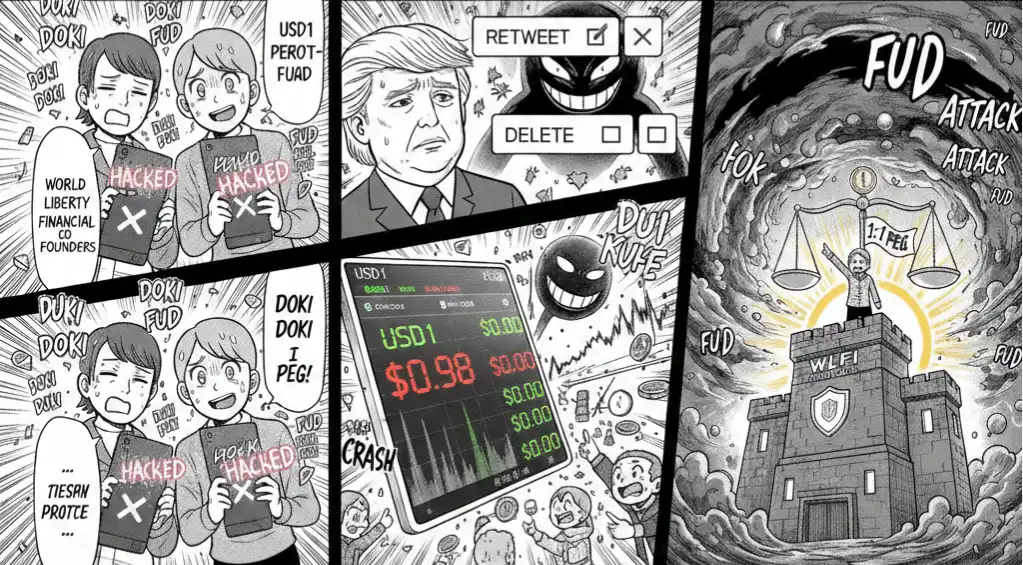
USD1, a stablecoin issued by World Liberty Financial (WLFI), experienced a brief depegging event on February 23, with its secondary market price dropping to around $0.98. WLFI attributed the incident to a "coordinated attack," claiming reserves and redemption mechanisms remained unaffected, and the price quickly recovered. The event raised questions about whether the depegging was a liquidity issue or a solvency crisis. Unlike TerraUSD's algorithmic collapse in 2022, USD1’s price dip appeared more related to temporary market liquidity stress rather than fundamental reserve failures. However, the incident highlighted that stablecoin stability relies not only on assets but also on market trust. USD1 operates under a centralized reserve model, where risks involve reserve transparency, asset liquidity, and market depth. In a low-liquidity, risk-averse market environment, even minor instability can trigger concerns about collateral devaluation, liquidations, and broader financial contraction. While the rapid price recovery suggests no systemic solvency issue, the event underscores how stablecoin depegging—even if temporary—can amplify market anxiety, reduce leverage, and increase funding costs. Trust, once questioned, takes time to restore, and credit repricing often precedes price changes in stressed markets.

Author: 137Labs

On February 23, a stablecoin named USD1 suddenly showed a significant discount in the secondary market.

On-chain quotes once fell to around 0.98 USDT, and social media quickly amplified the news.
The project team, World Liberty Financial (WLFI), subsequently stated publicly that this was a "coordinated attack" and emphasized that the reserve and redemption mechanisms were unaffected.

The price then recovered.

But the problem had already emerged——

When a "stablecoin" begins to trade at a discount, is it merely a liquidity friction, or a precursor to a crack in the credit structure?

I. Timeline: From the Wicking to the "Attack" Narrative

Based on reports from CoinDesk, The Block, Decrypt, WuBlockchain, PANews, ChainCatcher, and others, the sequence of events is roughly as follows:

1️⃣ Abnormal Volatility in the Secondary Market

  • USD1 quickly fell to around 0.98 in some trading pairs

  • The discount lasted for a short time

  • The price subsequently recovered

Unlike the brief depegging of USD Coin in 2023 due to banking risks, no clear systemic banking shock occurred this time.

2️⃣ WLFI's Official Response

WLFI stated externally:

  • This was an organized short attack coupled with a public opinion coordination attack

  • Reserve assets showed no abnormalities

  • Redemption function is normal

  • The 1:1 peg structure remains unchanged

This explanation was subsequently reported by Chinese media including WuBlockchain and ChainCatcher.

3️⃣ Social Media Amplification Effect

The event spread rapidly on platform X.

Some related tweets were deleted, fueling further market speculation.
In the current emotionally charged market environment, "deletion behavior" is often interpreted as a signal, not a random operation.

Thus, the question shifted from "Is the price depegged?" to:

  • Is there a reserve risk?

  • Is there a concentrated bank run?

  • Is there insufficient information disclosure?

II. The Nature of Depegging: A Liquidity Problem or a Solvency Problem?

Judging a stablecoin depegging event hinges on distinguishing between two completely different risk structures.

The first is a liquidity shock.
In this case, reserves are still sufficient, the redemption mechanism remains unimpeded, but due to insufficient trading depth, market maker withdrawal, or concentrated selling pressure, the secondary market experiences a brief imbalance. Once the arbitrage mechanism kicks in, the price usually recovers quickly.

The second is a solvency crisis.
If the reserve assets themselves are problematic, or if the assets suffer from maturity mismatches and cannot be liquidated immediately, then the depegging is no longer a trading-level fluctuation but a repricing of the balance sheet. In this case, the discount often widens persistently, accompanied by redemption delays or a collapse in trust.

Based on the information disclosed so far, USD1 is closer to the former.

It is completely different from the algorithmic death spiral of TerraUSD (UST) in 2022. UST's collapse stemmed from mechanism failure, while USD1's wicking更像 (more like) a liquidity tilt within a short period.

But even so, this event still holds significance.

Because the true anchor of a stablecoin is not just the reserve assets, but market trust.

Once trust is questioned, the price reacts ahead of the fundamentals.

III. The Credit Structure of Stablecoins: Where Exactly is Their "Stability"?

Stablecoins are essentially the "base money" of the crypto market.

Their credit support generally comes from three models:

  1. Algorithmic

  2. Collateralized

  3. Centrally Custodied Reserve-backed

USD1 belongs to a more centralized reserve structure.

The risk of this model lies not in the algorithm, but in:

  • Reserve Transparency

  • Asset Liquidity

  • Maturity Structure

  • Market Making Depth

Once the market suspects that reserves are discounted or face liquidation risks, the price often falls first.
This is highly similar to a "shadow bank run" in traditional finance—as soon as depositors start to doubt, the act of withdrawal itself amplifies the risk.

IV. Why Was the Market Reaction Particularly Sensitive This Time?

The fear index was already at an extreme low that day.

In an environment where liquidity was already tight:

  • Leverage levels decreased

  • Risk appetite weakened

  • The market became highly sensitive to uncertainty

Stablecoins are not just trading tools; they are the cornerstone of lending and liquidity.

Once a discount appears, the chain reaction may include:

  • Decrease in collateral ratios

  • Triggering of liquidations

  • Further compression of leverage

  • Capital outflow from the market

Therefore, even though the price recovered quickly, the psychological shock did not disappear simultaneously.

V. Is the "Attack" Narrative Valid?

WLFI attributed this volatility to a "coordinated attack".

Short attacks and public opinion resonance are not uncommon in the crypto market.
When trading depth is insufficient and market sentiment is fragile, prices are easily subject to amplified volatility.

But whether an attack can be sustained depends on one core factor:

Does the market believe the reserves are real, redeemable, and sustainable?

If the reserve structure is transparent and redemptions remain smooth, attacks often find it difficult to be effective in the long term;
If reserve disclosure is insufficient, panic is more easily self-reinforcing.

VI. The Differences Between USD1, USDC, USDT, and the True Meaning of This Depegging

Historically, USDC fell to $0.88 in 2023 due to banking risks; its problem stemmed from exposure to custodian bank risks and limitations on the pace of reserve liquidation.

Meanwhile, Tether has experienced minor depegging multiple times, usually during extreme panic phases or under concentrated withdrawal pressure, but the key to its eventual recovery lies in the continuous availability of the redemption mechanism and the verification of reserve redemption capability.

USD1 currently seems to be in the midst of a "trust stress test".

This event is closer to a liquidity shock than a solvency crisis.
The rapid price recovery indicates that a systemic bank run has not yet formed.

But what is truly worth paying attention to is not that single price of 0.98, but whether the market has begun to reassess the risk premium of "stability".

Stablecoins are the monetary base of the crypto market.

When the market questions their safety, the impact transmits outward along the credit chain:

  • Leverage decreases

  • Lending contracts

  • Collateral assets are repriced

  • Capital flows back to mainstream assets or exits the market

Even if the event itself is just short-term volatility, it will increase the cost of future financing and liquidity.

Depegging is never just a price problem; it is a credit pricing problem.

The price can recover quickly,
but trust takes time to repair.

USD1's depegging may not necessarily evolve into a systemic risk,
but it reminds the market——

During periods of liquidity contraction,
credit always changes before the price.

And once credit begins to be revalued,
the entire risk structure也随之 (also随之 -也随之) changes accordingly.


İlgili Sorular

QWhat was the main event described in the article regarding the USD1 stablecoin?

AOn February 23rd, the USD1 stablecoin experienced a significant discount, with its price dropping to approximately 0.98 USDT on secondary markets.

QHow did the issuer, World Liberty Financial (WLFI), characterize the price drop of USD1?

AWLFI characterized the event as a 'coordinated attack,' stating that the reserve and redemption mechanisms were unaffected and the 1:1 peg structure remained intact.

QWhat is the fundamental difference between a liquidity shock and a solvency crisis for a stablecoin, as explained in the article?

AA liquidity shock involves sufficient reserves and a functioning redemption mechanism, with the price drop caused by temporary market imbalances like insufficient trading depth. A solvency crisis involves problems with the reserve assets themselves, where the de-pegging is a repricing of the balance sheet due to issues like asset quality or maturity mismatches.

QAccording to the article, what are the key risk factors for a centralized reserve-backed stablecoin like USD1?

AThe key risk factors are reserve transparency, asset liquidity, maturity structure, and market-making depth.

QWhat broader market implication does the article suggest from the USD1 de-pegging event, even if it was temporary?

AThe event suggests that market trust, the true anchor of a stablecoin, can be shaken. This can lead to a re-evaluation of risk premiums, resulting in decreased leverage, contracted lending, repricing of collateral assets, and potential capital outflows, thereby increasing future financing and liquidity costs.

İlgili Okumalar

As Consensus Accelerates, What Are Young Investors Betting On?

Title: As Consensus Forms Faster, What Are Young Investors Betting On? In the rapid evolution of tech investment, a new generation of young investors is navigating a landscape where AI, robotics, commercial aerospace, and quantum computing are advancing simultaneously. Traditional investment logic based on financial models is giving way to a need for deep technical understanding and the ability to act before industry consensus forms. An analysis of trends from the "WAIC FUTURE TECH" list of young investment leaders reveals key shifts in focus. The first major trend is the movement of AI from the digital screen into the physical world. Investment is shifting from large language models and chatbots towards embodied AI, robotics, AI hardware, and edge computing. While demonstrations generate excitement, the real challenge lies in achieving scalable, reliable, and cost-effective delivery in complex real-world environments like factories and logistics. Success depends not just on algorithms but on the integration of sensors, actuators, and control systems. Second, the competitive focus for large models is moving beyond raw capability toward building an "intelligence flywheel." The goal is to create self-reinforcing systems where user interaction generates data, improving the model, which in turn enhances the user experience and attracts more engagement. Companies that successfully embed AI into workflows to create these closed-loop systems can build lasting value that isn't easily erased by the next model upgrade. Third, facing a potential bottleneck in high-quality human-generated data, investors are looking at new underlying technologies. Reinforcement learning and self-play, as demonstrated by AlphaGo Zero, offer paths for AI to generate its own experience. Scientific foundation models, which aim to build general AI capabilities for fields like life sciences and materials discovery, represent a non-consensus direction that could unlock new frontiers of knowledge and data. Finally, in deep-tech areas like quantum computing, commercial aerospace, and space-based infrastructure, patient capital is essential. These fields have long, uncertain development and validation cycles involving complex engineering, supply chains, and regulations. Investment here requires a long-term view, focusing on foundational team capabilities and the eventual emergence of market demand, even if commercial returns are distant. Collectively, these trends illustrate how young investors are adapting to a new era. They are learning to make earlier, technically-informed judgments, balance hype with real-world viability, and provide the patient capital needed to build the deep-tech foundations of the future.

marsbit24 dk önce

As Consensus Accelerates, What Are Young Investors Betting On?

marsbit24 dk önce

Can Japan Buy Growth with AI? Will the Bond Market Believe It?

Japan's cabinet has introduced the 2026 Basic Policy on Economic and Fiscal Management and Reform, shifting its primary fiscal target. The new framework moves away from the traditional annual primary balance goal and instead prioritizes a stable reduction of the debt-to-GDP ratio. This change is tied to a strategy of increased "responsible proactive fiscal" spending, aiming to boost long-term growth through investments in strategic sectors like AI, semiconductors, energy, and robotics. The government estimates total public and private investment in 62 key technologies could exceed 370 trillion yen by 2040. The market reaction has been mixed and cautious. While equity markets may respond to policy signals, bond markets are focused on fiscal credibility. Concerns center on whether the weakening of the clear primary balance anchor could lead to looser fiscal discipline. If investors doubt that these strategic investments will generate sufficient productivity gains, tax revenue, and nominal growth to outpace rising interest costs, they may demand higher yields on Japanese Government Bonds (JGBs). Recent volatility in the yen and JGB yields, with the 10-year yield briefly reaching 2.9%, reflects this skepticism. The success of this new framework hinges on two factors: whether Japan can achieve a nominal growth rate consistently higher than its long-term interest rates, and whether future budgets demonstrate disciplined control over bond issuance. The government's narrative is that strategic investment is essential to break Japan's cycle of low growth, aging, and labor shortages. However, the bond market will continuously assess the credibility of this plan, pricing the risk that it may represent fiscal expansion rather than a viable growth strategy.

marsbit1 saat önce

Can Japan Buy Growth with AI? Will the Bond Market Believe It?

marsbit1 saat önce

Misjudged A-Shares: Resilience, Expectations, and Confidence

China's A-share market recently faced selling pressure, especially in tech sectors, initially triggered by a global tech sell-off that began in South Korea. However, the article argues this is a case of "mistaken injury" and highlights the market's underlying resilience. This resilience stems from three main pillars: **1) Tech Sector Fundamentals:** Unlike Korea's market dominated by a few memory chip stocks, China's tech sector is diversified across computing, communications, electronics, and semiconductors, supported by dual narratives of global AI supply chains and domestic substitution. Core areas like optical modules and fiber optics continue to show strong earnings growth. **2) "National Team" Support:** State-backed institutions and large corporations have made significant market purchases and announced buybacks, providing liquidity and signaling confidence. This is seen as a stabilizing policy signal, often associated with market bottoms. **3) Broader Market Pillars:** Other major sectors are showing endogenous recovery momentum. Consumer stocks benefit from stabilizing CPI and signs of sector recovery (e.g., liquor price hikes). Cyclical sectors like aluminum have high earnings, potential price increases due to tight supply, and low valuations. The financial sector offers stable dividends and low valuations. The conclusion is that the sell-off was driven by external contagion, not a collapse in fundamentals. With strong policy support and recovering momentum across key sectors, the A-share market possesses the toughness to regain stability.

marsbit1 saat önce

Misjudged A-Shares: Resilience, Expectations, and Confidence

marsbit1 saat önce

İşlemler

Spot
活动图片




