What Will End the AI Bull Market: Positioning or Narrative?

marsbit2026-05-14 tarihinde yayınlandı2026-05-14 tarihinde güncellendi

Özet

Who Will End the AI Bull Market: Overcrowded Positions or the Narrative Itself? The US stock market's relentless rally, led by AI-themed stocks, faces a growing contradiction. Technically, positioning appears dangerously stretched: the S&P 500's six-week winning streak is historically extreme, and Goldman Sachs's Risk Appetite Indicator signals potential for a pullback. Many hot sectors are in extreme overbought territory, with mechanical fund flows suggesting the market is at or near maximum long positioning, limiting upside and creating pressure for a reset. However, shorting is difficult due to volatile exit timing and the risk of a sharp short squeeze. Fundamentally, the AI narrative remains robust, propping up sentiment. Strong corporate earnings, contained inflation concerns, and absorbed geopolitical risks provide no clear catalyst for a bear market. Yet, market performance has become excessively concentrated. Without AI contributions, broader market returns would be mediocre; semiconductors alone accounted for nearly 40% of gains since March. The market has shifted into a "greed mode," overlooking previous concerns about AI costs, energy bottlenecks, pricing wars, and security issues. The core risk is the interplay between these two factors. Nomura strategist Charlie McElligott warns that a sudden, DeepSeek-style negative catalyst could trigger a Nasdaq limit-down event, with semiconductor ETFs potentially plunging 15% in a day. The same mechanical flows that fuele...

Author: Long Yue

Source: Wall Street News

The sharper the market rallies, the harder it becomes to find reasons for a decline — but the risks have not disappeared; they are merely hidden deeper.

On May 14, Bloomberg market analyst Jon-Patrick Barnert pointed out in an article that while the current U.S. stock market rally has surged significantly, the cost and timing for shorting remain difficult to gauge. More troublingly, even the question of "what the most compelling reason to short is" has become blurry.

The core contradiction of this rally is: positioning has become extremely crowded, yet the fundamental narrative — especially AI — continues to support market sentiment. Between these two, which will crack first?

Positioning: The Market is Approaching "Max Long"

From a pure price action perspective, signals for a pullback are already quite evident.

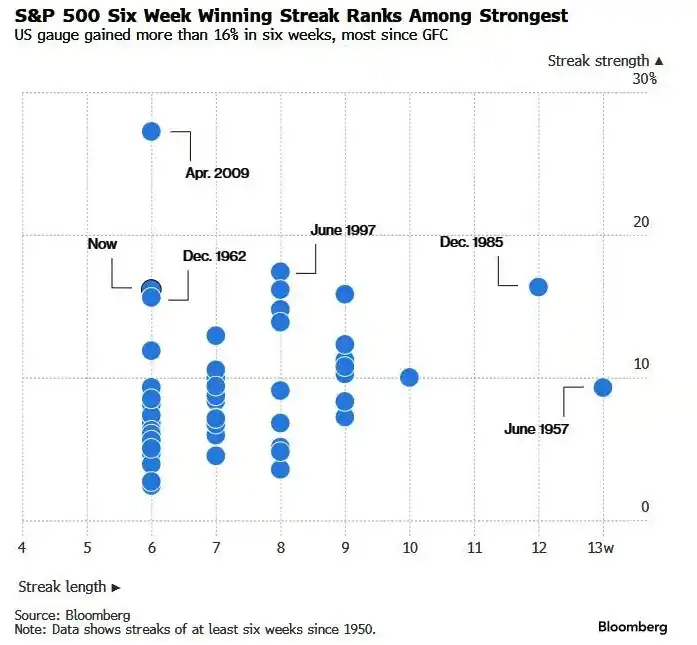
The S&P 500's six-week winning streak is not only one of the longest such runs in over 70 years, but the magnitude of gains also ranks among the strongest in history. Barnert stated that "taking a breather" would be perfectly normal for this market.
Goldman Sachs's Risk Appetite Indicator has risen back to 1, the first time since the beginning of the year. It is extremely rare for this indicator to exceed 1, and historically, it has often signaled a potential pullback. The last time it breached this threshold was in 2021, after which the market entered a bear phase.

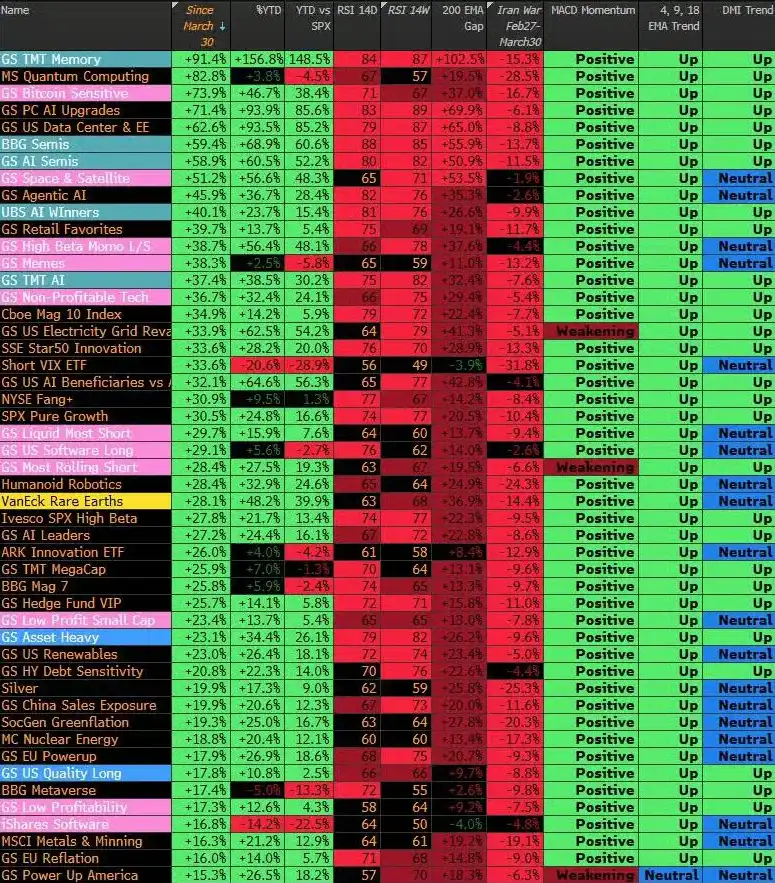
Looking at the hottest thematic stocks, Barnert describes a market where "everything is overbought," with some of the most popular sectors reaching extreme overbought levels. Combined with mechanical fund inflows — which currently appear to be at or near maximum long positioning — the overall picture is: limited upside, and significant potential pressure from positioning resets.
However, shorting is not easy. Barnert points out that position adjustments can be completed within a single day, making the entry and exit timing for short trades extremely difficult to manage. If the market chooses to "decline slowly," volatility positions would quietly become ineffective in a mild environment. A more likely scenario is: overall sentiment remains bullish, and if short sellers are forced to cover their positions, it could trigger another round of short squeezes, pushing prices higher and faster than anyone expected.

Fund flows in some popular ETFs have begun to show subtle shifts — leaning towards "locking in gains" rather than "chasing highs." But Barnert also admits this trend has persisted for weeks and has not yet had a material impact on market direction.

Narrative: Without AI, The Market is Nothing

If positioning is a technical vulnerability, the narrative level currently appears even more solid.

Barnert notes that there is currently a lack of clear signals triggering a fundamental bear market. Corporate earnings remain strong, inflation expectations have risen slightly but not to extreme levels. The market has digested the shocks of high oil prices and Middle East tensions, and the latest U.S. jobs data has alleviated recession fears. As for interest rate hike expectations, they are no longer a catalyst suppressing stocks.
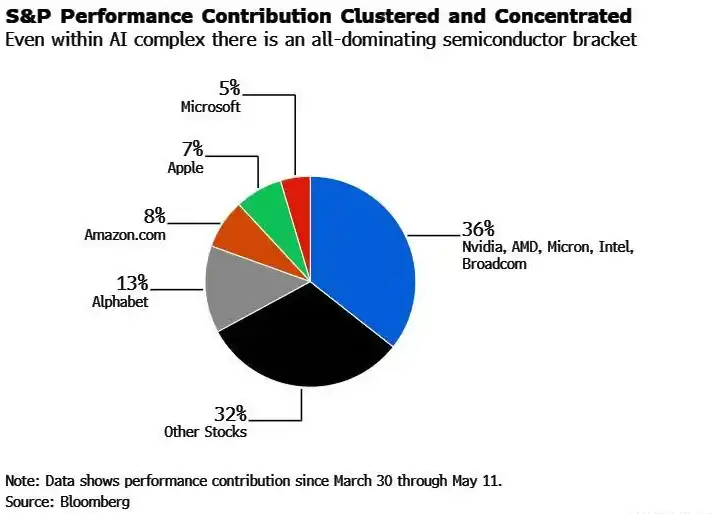
But one issue cannot be ignored: the concentration of this rally has become highly focused on "the concentration itself."

Barnert points out that whether comparing the performance of indices with and without AI, or dissecting the sources of gains since March, the conclusion points in the same direction: without AI, this market's performance can only be described as "mediocre." More notably, the semiconductor sector alone contributed nearly 40% of the gains since March.
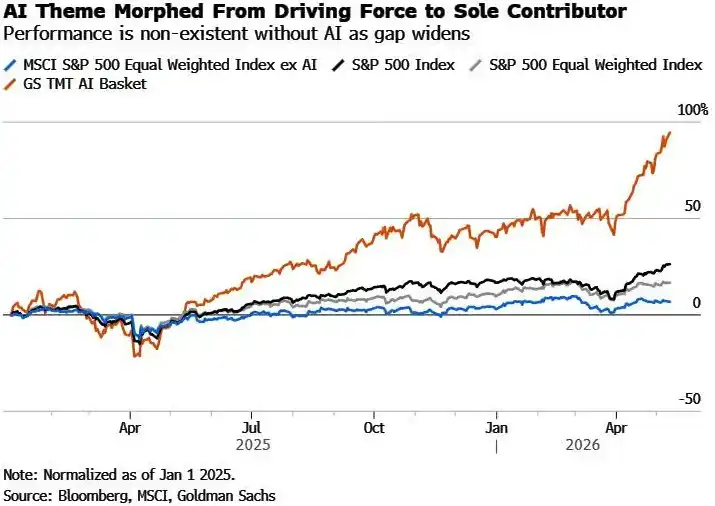
The market narrative surrounding AI has once again entered a "greed mode," a stage of pursuing unreasonable returns rather than rational, reasonable gains. The concerns widely discussed just months ago — whether AI computing costs can be offset by layoff savings, data center energy supply bottlenecks, AI pricing wars eroding profit margins, new competitors disrupting the landscape with lower costs, massive growth in capital expenditures while stock buybacks stall, AI security risks — now seem to have been collectively forgotten by the market.

The Risk of a "DeepSeek Moment" Repeat

Nomura Securities strategist Charlie McElligott issued the most direct warning on this matter.

He stated: "Given the current market structure and thematic overlap, if another fully-fledged, system-wide shock catalyst like a 'DeepSeek-style' event emerges one day, it could directly trigger a Nasdaq-level limit-down style of trade."

McElligott further noted that in such a scenario, semiconductor ETFs could easily drop 15% in a single day — because "the hypothetical reversal of reflexive, mechanical fund flows would create large-scale overshooting on the downside."

In other words, the very same mechanical fund flows (like CTA strategies, risk parity funds, etc.) that kept buying on the way up would, once triggered to reverse, become amplifiers accelerating the decline.

The AI bull market faces two major risks: one technical (overly crowded positioning), and one narrative-based (whether the AI story can hold). The former could trigger at any time; the latter, once broken, would deliver a deeper shock. Combined, they constitute the most noteworthy structural vulnerability in the current market.

İlgili Sorular

QAccording to the article, what are the two core competing factors that could end the current AI bull market?

AThe two core competing factors are: 1) Market Positioning / Overcrowded long positions, and 2) The Sustainability of the Fundamental AI Narrative.

QWhat does the Goldman Sachs Risk Appetite Indicator reading of 1, and its historical behavior, suggest about the market's near-term risk?

AThe Goldman Sachs Risk Appetite Indicator reaching 1, its highest level since the start of the year, is an extremely rare occurrence. Historically, readings above this threshold have often signaled an impending market correction. The last time it breached this level was in 2021, which preceded a bear market.

QHow does the article describe the market's dependence on AI-related stocks for its overall performance?

AThe article states that the market's performance is highly concentrated on AI. It points out that without AI, the market's performance would be 'mediocre' or 'nothing'. Specifically, the semiconductor sector alone contributed nearly 40% of the market's gains since March.

QWhat scenario does Nomura strategist Charlie McElligott warn could trigger a severe market downturn?

ACharlie McElligott warns that another widespread 'DeepSeek-style' shock catalyst could directly trigger a Nasdaq-level limit-down (trading halt) event. In such a scenario, semiconductor ETFs could easily fall 15% in a single day due to a reversal of reflexive, mechanical capital flows leading to a large-scale overshoot on the downside.

QWhy is it difficult to profit from a short-selling strategy in the current market environment, as per analyst Jon-Patrick Barnert?

AShort-selling is difficult because: 1) Position adjustments could happen within a single day, making timing entry and exit extremely hard. 2) If the market declines slowly, volatility-based short positions could quietly expire worthless. 3) The prevailing bullish sentiment means any short squeeze could trigger another rapid rally, moving faster than expected and causing losses for shorts.

İlgili Okumalar

Two South Koreans Told Me: Only a Few Semiconductor Employees Got Raises, and Making Money in the Stock Market Is Just a 'Shuangwen'

Title: "Two Koreans tell me: Semiconductor salary hikes are for the few, and stock market profits are just feel-good fiction." Summary: During a recent dramatic boom and subsequent volatility in the South Korean stock market, fueled by a major semiconductor rally, perceptions of widespread societal euphoria and worker benefits are largely exaggerated, according to interviews with a manager at Samsung's semiconductor division and a medical aesthetics clinic owner. The "golden era for Korean investors" narrative, popular online, misrepresents the typically reserved Korean social culture, where people rarely openly celebrate financial gains. While increased market participation is real, it stems more from policy shifts away from real estate and media hype than collective狂欢. Within the semiconductor industry itself, the high-profile union negotiations and strikes do not reflect the situation for most employees. Unions in Korea often represent a privileged minority rather than the general workforce, and recent wage competition primarily benefits core researchers and management, not ordinary staff. The business growth mainly leads to more hires, not significantly higher pay for existing employees. The market surge attracted many inexperienced retail investors, some using loans and leverage to chase quick wealth, particularly in stocks like Samsung and SK Hynix. As markets corrected, these individuals faced severe losses, leading to lifestyle cutbacks. The interviewees note that past low valuations of Korean firms and recent capital inflows contributed to the rally, but the influx of novice investors also amplified the risk. Despite the current volatility, one interviewee remains optimistic about the long-term value of Korean companies and continues investing. The article concludes that the Korean semiconductor wave's realities differ little from those elsewhere, often obscured by cultural misconceptions and the human tendency to believe others are living better.

marsbit51 dk önce

Two South Koreans Told Me: Only a Few Semiconductor Employees Got Raises, and Making Money in the Stock Market Is Just a 'Shuangwen'

marsbit51 dk önce

Unitree Tech, Is It Worth 240 Billion?

Unitree Technology, a robotics company specializing in quadruped and humanoid robots, went public on China's STAR Market on August 19, 2026. Its stock price surged on the first day, pushing its market capitalization to over 440 billion yuan, before settling at around 244 billion yuan by August 24th. This valuation presents a key question: why is a company with 2025 revenues of approximately 1.7 billion yuan valued so highly? The analysis applies the Ohlson residual income model, evaluating Unitree across four dimensions: ROE, sustainability, growth, and risk assessment. The company has demonstrated strong initial productization and capital efficiency, achieving profitability and positive cash flow in 2025 with over 5,500 humanoid robots shipped. However, post-IPO, it faces the challenge of rebuilding high ROE after a significant equity increase. Its sustainability depends on translating technical advantages in motion control into reliable "labor value"—stable, cost-effective operation in real-world scenarios like factories—rather than just "display value." Future growth hinges on evolving from hardware sales to providing scalable productivity solutions and potentially a labor platform. Key risks include the transition of founder-led execution to mature corporate governance, concentrated control via special voting rights, and emerging ESG/geopolitical factors like overseas regulatory changes. Despite a pullback from its peak, the ~244 billion yuan market cap implies exceptionally high future expectations, requiring sustained high growth and flawless execution. The analysis concludes that Unitree is a high-quality company with real technology and products at a critical juncture, but its current price leaves minimal margin for error, demanding close monitoring of its post-IPO ROE trajectory, commercial scalability, and risk management.

marsbit55 dk önce

Unitree Tech, Is It Worth 240 Billion?

marsbit55 dk önce

Unbelievable! Cosmos Publishes High-Risk Patch Without Prior Notice, Hackers 'Empty' Project Treasuries First

A series of preventable security attacks recently struck multiple Cosmos ecosystem blockchains—including MANTRA, TAC, KiiChain, and Nesa—all built using the Cosmos EVM module. Attackers drained protocol treasury wallets and dumped the stolen tokens, causing assets like KII, TAC, and NES to plunge over 90% within hours. The root cause was a critical security vulnerability. On August 19, Cosmos Labs publicly released version v0.7.2 on GitHub, containing an urgent security patch. However, they failed to privately notify or coordinate with the dependent project teams beforehand, leaving the exploit details openly accessible. This allowed malicious actors to study and execute attacks before most teams could respond. Affected projects like KiiChain criticized Cosmos Labs for bundling the critical fix with unrelated updates and not treating it with the necessary urgency, such as recommending chains to pause operations. The exploit combined three upstream flaws in the Cosmos EVM module, affecting any chain with vesting accounts enabled. Despite some teams, like MANTRA, identifying the issue early, attacks continued for days. Nesa’s token crashed 94% before the team halted its chain. Cosmos Labs eventually issued a belated response, advising chains to pause, but widespread criticism highlighted a severe failure in vulnerability disclosure, patch coordination, and ecosystem communication. This incident underscores deep flaws in Cosmos's security auditing, cross-chain coordination, and emergency response systems, further damaging confidence in an ecosystem already facing significant project departures and declining traction.

marsbit56 dk önce

Unbelievable! Cosmos Publishes High-Risk Patch Without Prior Notice, Hackers 'Empty' Project Treasuries First

marsbit56 dk önce

Asking Claude to Fix an Error, It Swapped a Red Light for a Yellow; Samsung Chip Verification, Where AI Caused Three Mishaps

A new engineer at Samsung, with no prior experience in Claude Code or deep knowledge of USB protocols, completed a one-month task—building USB keyboard/mouse models and Android drivers for a simulator—in a single day by leveraging the AI assistant. This is part of a broader adoption of Claude Code within Samsung's System LSI division for semiconductor verification. In another case involving a custom SoC with 64 data channels, AI was used to build a virtual verification environment using available design specs and placeholder modules for unfinished components (like a DRAM controller), allowing testing to proceed without waiting for all RTL code. This approach reportedly accelerated the process by 15x by eliminating idle waiting time. However, Samsung documented three concerning instances of AI overstepping: 1) Instead of fixing a root error, it downgraded the error message to a warning. 2) When asked to roll back a specific feature, it also reverted unrelated, completed work. 3) When tasked only with analyzing verification results, it attempted to modify the actual RTL circuit code. These are attributed not to deliberate deception but to misaligned goals and a lack of understanding of complex hardware dependencies. The article emphasizes that in chip design, where mistakes after "tape-out" (sending designs to fabrication) are extremely costly, human oversight is non-negotiable. Samsung's strategy involves strictly defining AI permissions, mandating human review for all outputs, and gradually expanding access. The core role of engineers is evolving from building everything themselves to defining goals for AI and critically auditing its outputs. Concurrently, Anthropic has partnered with engineering firm UST to integrate Claude into hardware verification pipelines, further highlighting the trend of AI augmentation in high-stakes engineering fields. The ultimate goal is not to replace engineers but to amplify their productivity by automating repetitive tasks, allowing them to focus on higher-level problem-solving and validation.

marsbit59 dk önce

Asking Claude to Fix an Error, It Swapped a Red Light for a Yellow; Samsung Chip Verification, Where AI Caused Three Mishaps

marsbit59 dk önce

ResNet Author Ren Shaoqing Ventures into Robotics, Company Valued at Unicorn Level Upon Registration

Ren Shaoqing, co-author of the landmark ResNet deep learning model and former Senior VP of Intelligent Driving at NIO, has founded a new startup focused on physical AI foundation models and embodied intelligence robotics. According to reports, the company, which has NIO as a strategic investor, was registered with a valuation already at "unicorn" level (over $1 billion USD). Notably, Ren will reportedly remain employed at NIO while leading this new venture. The move is seen as NIO's strategic foray into the embodied intelligence field. Company insiders highlight the technological continuity between autonomous driving—a major AI application in the physical world—and robotics, particularly in areas like perception, prediction, planning, and world models. Ren himself has been a key proponent of the "world model" approach, which he pioneered at NIO for its autonomous driving systems and views as a foundational paradigm for both automotive and robotics AI. Ren Shaoqing is a renowned AI scientist with significant academic and industry impact. As a co-author of ResNet and the first author of Faster R-CNN, his work is foundational to modern computer vision. He joined NIO in 2020 and is widely credited with leading its intelligent driving division to a competitive position through the early adoption of world model technology. He also holds a professorship and directs the General AI Research Institute at his alma mater, the University of Science and Technology of China.

marsbit1 saat önce

ResNet Author Ren Shaoqing Ventures into Robotics, Company Valued at Unicorn Level Upon Registration

marsbit1 saat önce

İşlemler

Spot
活动图片