What Ripple CEO Garlinghouse Said At WEF Davos 2026

bitcoinist2026-01-22 tarihinde yayınlandı2026-01-22 tarihinde güncellendi

Özet

Ripple CEO Brad Garlinghouse advocated for the pragmatic adoption of tokenization at the World Economic Forum 2026, highlighting stablecoins as the leading use case with transaction volumes growing from $19 trillion in 2024 to $33 trillion in 2025. He emphasized building bridges between traditional and decentralized finance rather than displacing existing systems, noting a significant positive shift in U.S. regulatory and political attitudes toward crypto. Garlinghouse stressed that tokenization must deliver real efficiency and transparency, not just novelty, and called for clear and practical regulations over theoretical perfection. He also addressed energy efficiency, noting the industry's move toward more sustainable blockchains, and reframed tokenization's value as democratizing investment access rather than encouraging speculation.

Ripple CEO Brad Garlinghouse used a Davos stage at the World Economic Forum’s 2026 annual meeting to make a pragmatic case for tokenization: stablecoins are already the lead use case, momentum has shifted sharply in the US, and the industry’s job now is to deliver measurable benefits rather than tokenize assets for novelty.

Why Ripple Is Building Bridges Between TradFi and DeFi

Garlinghouse’s remarks came on a panel titled “Is Tokenization the Future?” after the moderator cited Ripple-linked traction: tokenized assets on the XRP Ledger surged more than 2,200% last year. From there, Garlinghouse largely aligned with the panel’s theme that tokenization is moving from pilots toward mainstream financial plumbing, while drawing a clear boundary around monetary sovereignty.

“I do think the first poster child of tokenization is really stablecoins,” Garlinghouse said, arguing that usage growth has been decisive. He cited stablecoin transaction volumes rising from “$19 trillion of transactions on stablecoins in 2024” to “33 trillion in 2025,” describing that as “about 75% growth” and adding that “many in our industry would say that’s going to continue.”

Where the discussion turned to a “Bitcoin standard” framing, Garlinghouse emphasized the political reality of state money. “Sovereignty of fiat currencies, I believe, is for many countries sacrosanct,” he said, before invoking a line he attributed to Ben Bernanke from a prior Ripple event: “Governments will roll tanks into the street before giving up monetary supply, giving up the control of monetary supply, which stuck with me as yeah, that makes sense.”

That worldview shaped how Garlinghouse positioned Ripple’s strategy. “At Ripple, we very much focused on building the bridges between traditional finance and decentralized finance,” he said, describing work “with a lot of the banks around the world” as the practical path to scale rather than attempting to displace existing monetary regimes.

Garlinghouse also framed 2026 as a momentum year, not just a technology year. He argued that the political climate in the US has turned materially more constructive after a period he described as open hostility. “The US, the largest economy in the world, has been pretty openly hostile towards facets of crypto and blockchain technologies,” he said. “And that has shifted dramatically, you know, starting with the White House... [and] helped elect a much more pro-crypto pro-innovation Congress, and you’re seeing that play out.”

But the Ripple CEO repeatedly cautioned that narrative tailwinds are not enough. “Part of the tokenization topic [...] is like we shouldn’t tokenize everything just to tokenize something,” Garlinghouse said. “There has to be a positive outcome of efficiency or transparency [...] otherwise it’s just like okay it’s a nice science experiment.”

On regulation, Garlinghouse reiterated his pragmatic tone, arguing that the push for US crypto legislation should prioritize workable clarity over theoretical perfection. “What’s going on in the US right now is a classic dynamic of when you create new law, it’s never going to be perfect,” he said. “I subscribe to the idea that perfection is the enemy of good.”

He pointed to Ripple’s own history: “a five-year battle with the US government being sued because of the lack of clarity” to underline the stakes, adding: “We are very much an advocate of clarity is better than chaos.”

When pressed on whether stablecoins should pay rewards, one of the live fault lines in US policy debate, Garlinghouse positioned Ripple as less directly exposed than some peers, while still endorsing competitive symmetry. “Ripple doesn’t have as much of a dog in that fight as others in the industry,” he said, but added that a “level playing field goes two ways,” arguing that crypto firms and banks should face comparable standards when competing for the same activity.

Garlinghouse also addressed energy concerns around blockchain-based infrastructure, pushing back on a one-size-fits-all critique. “Not all layer 1 blockchains are created equal,” he said, contrasting proof-of-work systems with proof of stake and other consensus models, and arguing that stablecoin activity is already skewing toward “more power efficient blockchains.”

On tokenization’s social and market impact, Garlinghouse reframed a question about speculation as a question about access. He said he sees the opportunity in “the democratization of access to investment less so on the speculation side,” pointing to the idea that smaller investors could gain exposure to assets that are effectively inaccessible at modest ticket sizes today.

At press time, XRP traded at $1.9554.
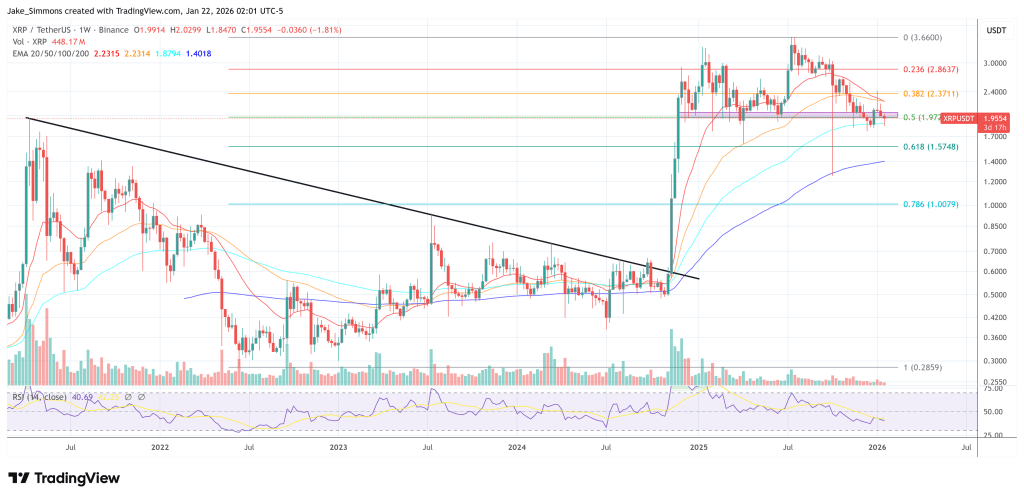
XRP holds above the 100-week EMA, 1-week chart | Source: XRPUSDT on TradingView.com

İlgili Sorular

QWhat did Ripple CEO Brad Garlinghouse identify as the 'first poster child of tokenization' at the WEF 2026 panel?

ABrad Garlinghouse identified stablecoins as the 'first poster child of tokenization'.

QAccording to Garlinghouse, what was the key reason for the dramatic shift in the US political climate towards crypto and blockchain technologies?

AHe stated that the shift started with the White House and was helped by the election of a much more pro-crypto, pro-innovation Congress.

QWhat pragmatic approach did Garlinghouse advocate for regarding US crypto legislation?

AHe argued that the push for legislation should prioritize workable clarity over theoretical perfection, stating that 'perfection is the enemy of good' and 'clarity is better than chaos'.

QHow did Garlinghouse position Ripple's core strategy in relation to traditional and decentralized finance?

AHe stated that Ripple is 'focused on building the bridges between traditional finance and decentralized finance,' working with banks worldwide as a practical path to scale.

QWhat was Garlinghouse's response to the concern about energy consumption in blockchain, and how did he differentiate between systems?

AHe pushed back on one-size-fits-all critiques, stating 'Not all layer 1 blockchains are created equal.' He contrasted energy-intensive proof-of-work systems with more efficient models like proof-of-stake, noting that stablecoin activity is already skewing towards more power-efficient blockchains.

İlgili Okumalar

How to Do Research Well: Deliberately Practice the Real Skills That Matter

No one truly teaches you how to do research. You're often given a desk, a pre-selected problem, and vague instructions to "create something new." Consequently, many people reverse-engineer the job based on visible outputs—papers, posts, announcements—learning only how to *appear* like a researcher rather than how to *become* one. True research capability is built from stacking small, trainable skills, nearly all of which can be developed through deliberate practice. **Pick Your Own Problem:** Most researchers absorb problems from advisors or trends, lacking the underlying reasoning. Choosing a problem you genuinely care about, as John Schulman advises, leads to original work. Develop "taste" like a muscle: predict experiment outcomes, guess paper results from methods, and track which findings remain important over time. **Upgrade Your Inputs:** Relying on shared reading lists (arXiv hot lists, filtered group chats) leads to unoriginal conclusions. Undervalued old literature often holds crucial insights (e.g., MoE, LSTM, backpropagation). Richard Sutton's "The Bitter Lesson" or Claude Shannon's 1952 talk on creative thinking are more predictive than lengthy modern surveys. Breadth matters as much as depth: draw from neuroscience, mechanism design, hardware knowledge, and honest statistics. Read papers directly, especially appendices and limitations sections. **Write Everything Down:** As Paul Graham noted, writing exposes flaws in seemingly mature ideas. Writing is the cheapest defense against self-deception. Following Feynman's principle, Darwin programmatically wrote down facts contradicting his theory to combat memory bias. Maintain a detailed log of hypotheses, setups, predictions, results, and updated understandings. Reviewing past logs fosters essential humility.

marsbit48 dk önce

How to Do Research Well: Deliberately Practice the Real Skills That Matter

marsbit48 dk önce

Following US Ban on Fable 5, Zhipu AI's Stock Soars 47%

On June 15th, shares of Zhipu AI surged dramatically on the Hong Kong stock market, peaking at a 47.6% gain before closing 32.82% higher. This sharp increase was directly triggered by two recent industry events. On June 12th, Anthropic announced it was suspending global access to its latest flagship models, Claude Fable 5 and Claude Mythos 5, to comply with a U.S. government export control order. The next day, Zhipu AI announced it would open access to its latest open-source flagship model, GLM-5.2, under the permissive MIT license. The Anthropic incident highlighted a critical issue beyond raw model capability: the risk of sudden, unpredictable loss of access to advanced AI models, especially for developers and enterprises deeply integrated with them. This has shifted industry and market focus toward factors like stability, sustainable access, and controllability. Zhipu's move, promoting "frontier intelligence for all," positions its openly available model as a reliable and accessible alternative. The GLM-5.2 model emphasizes "Long Horizon Task" capabilities with a 1M context window, targeting complex, multi-step coding and engineering workflows where maintaining context is crucial. Analysts note this event exposes the risk of dependency on closed-source models subject to single jurisdictional controls, potentially accelerating a shift toward domestic base models and localized deployments. The market's reaction signals a new valuation dimension in AI: providers who can offer stable, long-term, and sustainably accessible AI capabilities are gaining strategic importance.

marsbit1 saat önce

Following US Ban on Fable 5, Zhipu AI's Stock Soars 47%

marsbit1 saat önce

Fully Entering the AI Era: Alipay Bets on Conversation, WeChat Holds Fast to Social

In May 2026, Alipay announced over 300 million AI payment transactions. Shortly after, WeChat opened its mini-programs for AI integration, sparking controversy by requiring developer source code access. This highlights their diverging approaches to AI integration. Alipay is testing "Project Treasure," an optional AI-native interface replacing traditional app grids with a conversational window. Users can command complex tasks (e.g., "book a ride and order coffee") handled end-to-end by AI. This shift follows an abandoned standalone AI app, focusing instead on enhancing its existing user base. For unmodified mini-programs, Alipay's AI uses "screen-reading" to simulate user interactions, bypassing the need for developer overhaul. It also introduced "Token Pay" for micro-transactions and "AI Wallets" for autonomous agent spending. WeChat, prioritizing its core social function, is taking an embedded approach. Its AI agent will operate within existing contexts like group chats and official accounts, assisting without a separate interface. To enable this, WeChat offers developers two paths: granting source code access for direct AI control ("Automatic Mode") or manually encapsulating services into standardized "Skills." Both place significant burden on developers. Key differences emerge in handling legacy services: WeChat demands developer cooperation (code or labor), while Alipay's screen-reading offers immediate, if potentially less stable, compatibility. Alipay's 3 billion AI transactions demonstrate user acceptance of AI-driven commercial actions. The divergent strategies may reshape mini-program ecosystems—Alipay passively "AI-fying" services, WeChat potentially favoring resource-rich developers—and set competing technical standards. Ultimately, the competition centers on where users entrust the command to "help me get things done."

marsbit1 saat önce

Fully Entering the AI Era: Alipay Bets on Conversation, WeChat Holds Fast to Social

marsbit1 saat önce

İşlemler

Spot
Futures
活动图片