Whale Opens $203 Million Short Position Against Tokenized SpaceX Stock

cryptonews.ru2026-08-14 tarihinde yayınlandı2026-08-14 tarihinde güncellendi

Özet

An analysis account noted a major short position against SPCX, the tokenized version of SpaceX stock, with a "whale" placing limit short orders worth approximately $203.47 million, betting the price would fall from levels around $141-$142 per token. This large, singular position is unusual and suggests either major institutional hedging or a high-confidence directional bet against the stock's short-term momentum. The short was placed amid high volatility for SPCX, following a period of heavy trading volume in early August as traders anticipated a large share unlock on August 6. Contrary to some expectations of a price drop, the stock rose 6.1% after the unlock, leaving earlier short sellers at a loss. This new whale short indicates at least one large trader believes the stock has risen too high, too fast. Overall positioning in SPCX futures and options remains active, with significant open interest and mixed large-scale long and short activity, highlighting intense battle among major traders. The short position follows Elon Musk's disclosure of his full beneficial ownership in SpaceX, amounting to 48.4% of the company. This includes shares with super-voting rights, giving him over 82% of voting control. A significant portion of his stake consists of unvested, performance-linked shares and options tied to ambitious company milestones. Whether this massive short position proves profitable will depend on SPCX's price action following the news cycle around Musk's ownership di...

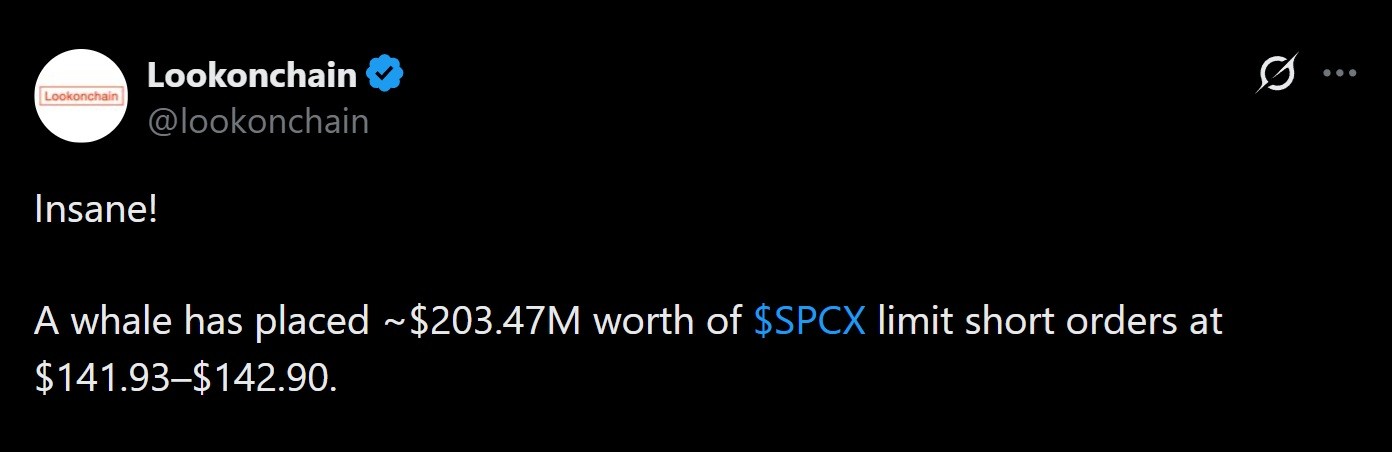
The on-chain analytics account Lookonchain highlighted a large short position in SPCX—the tokenized version of SpaceX stock trading on cryptocurrency platforms. The "whale" placed limit short orders worth approximately $203.47 million at prices ranging from $141.93 to $142.90 per token, betting that the stock price will fall from these levels. Limit short orders of this size are unusual for a single wallet and typically signal either large institutional hedging or a high-conviction directional bet against short-term momentum.
This short bet was placed during a period of particularly high volatility for SPCX stock: in early August, trading volume for SPCX on the tokenized trading platform Gate reached approximately $700 million over two days, with $332 million worth of stock sold on August 4th alone (as traders prepared for the unlock of 911.5 million shares scheduled for August 6th).

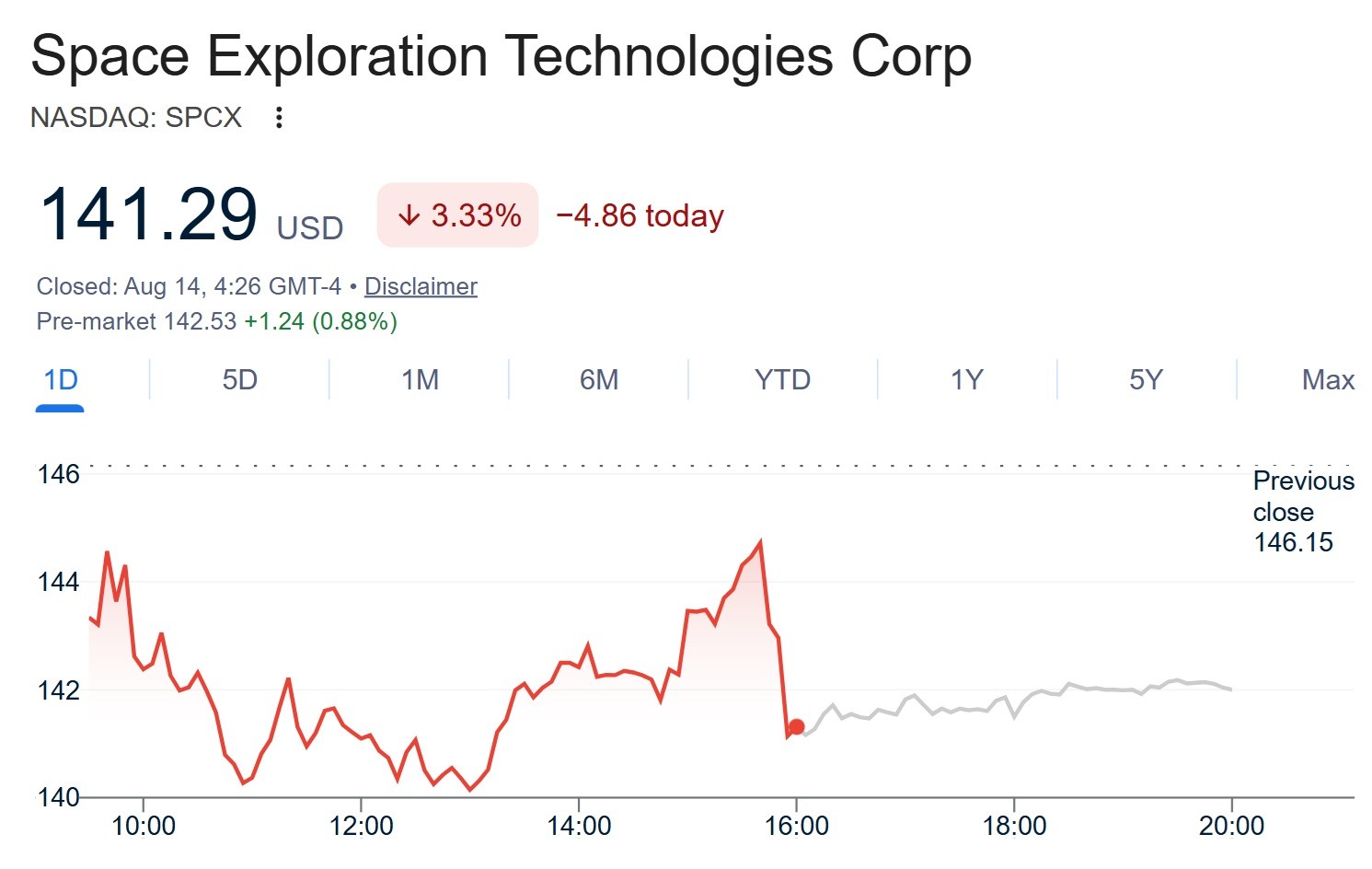
Instead of crashing in price due to the unlock, as some investors feared, the stock rose 6.1% and closed that day at $114.92—a move that left short sellers who had bet on weakness from the unlock in the red. The new whale short position, opened about a week later at levels above $140, indicates that at least one large trader believes the stock has risen too high, too fast.
Overall positioning in SPCX options and futures has also been active. Total open interest in SPCX futures stood at around $203 million (as of mid-August), somewhat lower than levels seen immediately before the company's earnings report in early August but significantly higher than where it was before large whales began building positions in early August.

Separately tracked large player activity showed a mix of new million-dollar long and short positions during the same period, illustrating how fierce the battle over the stock has become among large traders since its market debut.

Musk's Ownership Disclosure Adds to the Picture

The short position was also opened just a day after Elon Musk disclosed the full extent of his ownership stake in SpaceX itself. A Form 13G filed with the Securities and Exchange Commission (SEC) showed Musk owns a 48.4% beneficial interest in the company, equivalent to more than 6.4 billion shares valued at over $900 billion at current prices.

The filing breaks down the stake into 849.5 million Class A shares and 3.92 billion Class B shares held in trust, where Musk serves as trustee, another 1.3 billion restricted Class B shares owned directly, and 350 million Class B shares issuable upon stock option exercise. Class B shares carry ten votes each versus one vote per Class A share, giving Musk exclusive voting control over more than 82% of SpaceX's total voting shares.

However, not all of this stake is currently liquid, and a significant portion consists of unvested performance-based shares and options tied to achieving certain milestones, including company valuation targets in the trillions of dollars and progress toward Mars colonization goals, meaning Musk's fully diluted economic interest will constantly shift based on hitting or missing these targets. SpaceX went public on June 12th following an $85.7 billion IPO—one of the largest in history—propelling the company's market capitalization above $2 trillion.

Nevertheless, whether the whale's short position pays off will largely depend on how SPCX shares trade in the days following the news cycle related to Musk's ownership disclosure, as well as the aftermath of the August 6th share unlock.

end-content

İlgili Sorular

QWhat significant short position did a 'whale' take against the tokenized SpaceX stock SPCX, according to Lookonchain?

AAccording to the analytical account Lookonchain, a 'whale' placed limit short orders worth approximately $203.47 million against the tokenized SpaceX stock SPCX at price levels between $141.93 and $142.90 per token.

QWhat was the unusual trading volume for SPCX on the Gate platform around early August, and what event was it related to?

AAround early August, the trading volume for SPCX on the tokenized trading platform Gate reached approximately $700 million over two days, with $332 million traded on August 4th alone. This surge was due to traders positioning themselves ahead of a planned $911.5 million share unlock on August 6th.

QHow did the SPCX stock price react on August 6th, the day of the major share unlock, and what was the impact on short sellers betting on a price drop?

AContrary to fears of a price drop, the SPCX stock price actually rose by 6.1% on August 6th, closing at $114.92. This upward movement left short sellers who had bet on a price decline due to the unlock at a loss.

QWhat details about Elon Musk's stake in SpaceX were revealed in an SEC filing shortly before the whale's short position was opened?

AAn SEC Form 13G filing revealed that Elon Musk holds a 48.4% beneficial ownership stake in SpaceX, equivalent to over 6.4 billion shares valued at over $900 billion at current prices. This includes shares with super-voting rights (Class B), giving him control over more than 82% of the total voting power.

QWhat are the two main factors mentioned in the article that will determine the outcome (success or failure) of the whale's large short position on SPCX?

AThe article states that the outcome of the whale's short position will largely depend on: 1) how SPCX shares trade in the days following the news cycle related to Musk's stake disclosure, and 2) the ongoing market impact of the major share unlock that occurred on August 6th.

İlgili Okumalar

Staking Inflation Reforms Trap Ethereum and Solana

The article discusses the "Morton's Fork" dilemma facing both Ethereum and Solana, where both blockchains must choose between two paths that lead to the same outcome: increased centralization of their validator networks. Ethereum researchers have proposed EIP-8363, a "Progressive Issuance Burn" plan. It would gradually increase the proportion of validator rewards burned as the total staked ETH rises, aiming to reduce new token issuance. If staking reaches 50% of the supply, rewards would drop to zero. This proposal has faced strong opposition from major staking service providers and DeFi platforms (e.g., Aave, ether.fi), as staking yields form a crucial base rate for DeFi leverage strategies. Critics argue slashing rewards would first hurt small, individual node operators due to fixed operational costs, accelerating centralization. Solana faces a similar challenge. Its validators have fixed costs but rely heavily on token issuance for rewards (only ~13% of validator income comes from fees). Two current proposals, SIMD-0550 and SIMD-0553, aim to accelerate the reduction of its inflation rate and increase fee burns, respectively. A vote concludes on August 18th. The core conflict is between large token holders (whose assets are diluted by issuance) and the concentrated staking industry that depends on high yields. While reducing issuance could curb the influx of capital into centralized staking services, it could also force out smaller validators first. The article concludes that as blockchains grow into large financial systems, underlying economic forces—yields, leverage, and operational costs—ultimately constrain their original design visions and push them toward centralization, regardless of the specific policy path chosen.

marsbit31 dk önce

Staking Inflation Reforms Trap Ethereum and Solana

marsbit31 dk önce

İşlemler

Spot
活动图片