WEEX Completes $2 Million WXT Buyback, Rewarding User Support for 'Futures Mining'

marsbit2025-12-16 tarihinde yayınlandı2025-12-16 tarihinde güncellendi

Özet

Global cryptocurrency exchange WEEX has completed a $2 million buyback of its native token WXT, repurchasing 72,571,028 WXT tokens. The move is part of the platform’s effort to reward users for their participation in the "Futures Mining" campaign, which offers up to 30% trading fee rebates in WXT. The campaign, originally scheduled to end on December 15, has been extended by 10 days to December 25 due to high user demand. Participants receive real-time WXT rewards for each futures trade, with higher trading volumes unlocking greater rebate tiers, ranging from Bronze to King Miner levels. To prevent inflation and support token value, WEEX used its own funds for the buyback, maintaining WXT’s scarcity. Since its launch in July 2024, WXT has seen significant growth, with year-to-date gains of around 70%, making it one of the top-performing exchange tokens. WEEX has conducted four buybacks to date, burning 41.24% of WXT’s total supply. Additional token utility includes fee discounts, airdrops, and membership benefits, offering holders an estimated annualized return of 660.61%.

On December 16, globally leading cryptocurrency trading platform WEEX announced the completion of a new round of WXT buyback worth $2 million, totaling 72,571,028 WXT tokens repurchased.

This WXT buyback aims to reward global users for their support of WEEX's 'Futures Mining' campaign. The event offers up to 30% trading fee rebate rewards for users participating in futures trading, with rewards distributed in real-time via WXT tokens.

In other words, 'Futures Mining' transforms users' daily futures trading into a novel, fully trading volume-driven 'mining' model—the higher the trading volume, the higher the fee rebate ratio, with all WXT rewards credited instantly.

'Futures Mining' Continues to Boom, Event Extended by 10 Days

WEEX 'Futures Mining' aims to return platform growth dividends to users through the innovative incentive model of 'trading is mining'. During the event, users receive real-time WXT-based fee rebates for each futures open/close order, with rebates up to 30%.

Since its launch on November 26, the event has attracted active participation from global users, with trading heat continuously rising. According to WEEX official data, as of 18:00 on December 16 (UTC+8), the top 100 users on the 'Futures Mining' leaderboard have accumulated a total futures trading volume of $9.172 billion, with total mining rewards of 3,015,047.7 WXT (data updating in real-time).
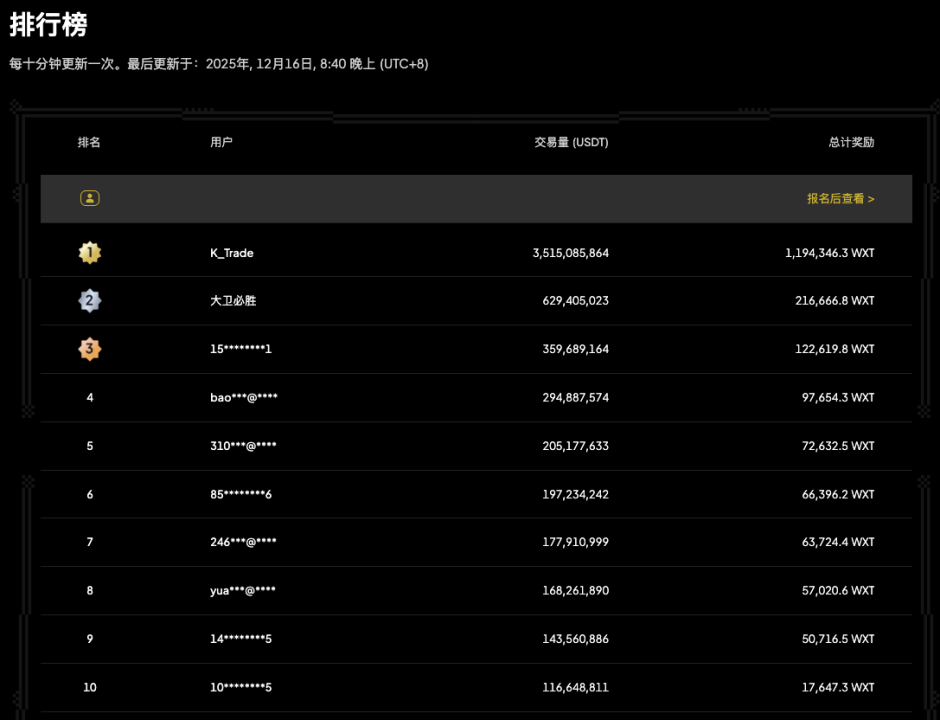
Due to the novel mechanism, generous rewards, and support for second-level settlement with instant rewards, the event has seen daily new participants and trading volumes repeatedly hit record highs after launch, with many users requesting an extension. Therefore, WEEX has extended the event by 10 days, moving the deadline from the original December 15 to December 25, allowing more users sufficient time to participate and continue enjoying mining rebate benefits.
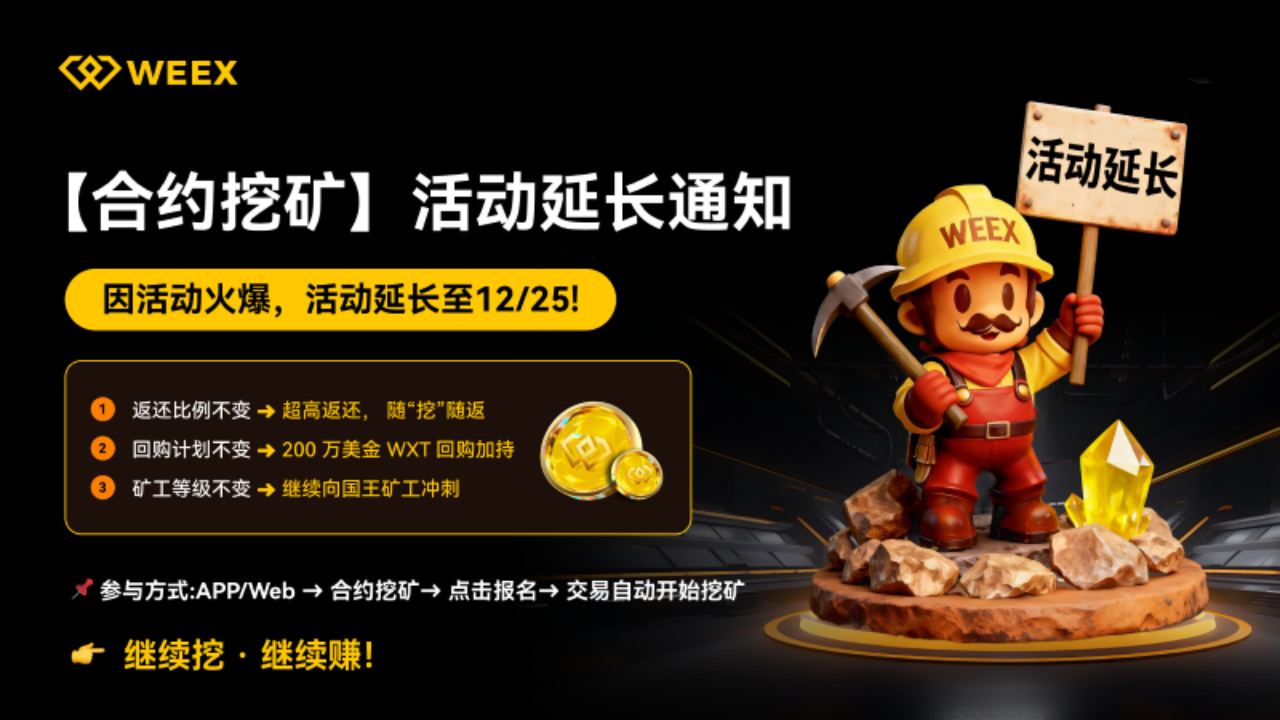
This adjustment only extends the event duration; the rules remain unchanged: users click to register and participate in futures trading to receive WXT-based fee rebates, with WXT rewards credited in real-time after each open/close order.

Based on the miner tier mechanism of the 'Futures Mining' event, users start at the 'Copper Miner' tier. After trading begins, they can unlock Copper, Silver, Gold, Platinum, Diamond, and King tiers sequentially based on cumulative trading volume. The higher the trading volume, the higher the miner tier and fee rebate ratio, up to 30%. After the extension, users' unlocked miner tiers and rebate ratios remain effective. Trading fees generated during the extension will still be rebated in real-time at the corresponding ratio. Users can check their reward amounts and status in real-time via the WEEX App or official website.

72.57 Million WXT Buyback Completed, Ensuring Deflationary Effect

Unlike the token inflation issues faced by trading mining launched by other CEXs or liquidity mining on DeFi platforms, WEEX 'Futures Mining' not only maintains WXT's deflation but also genuinely demonstrates 'user rewards' sincerity through the $2 million WXT buyback supporting mechanism.

As previously announced, WEEX used platform funds to conduct a WXT buyback on the open market on December 16. By 17:00 (UTC) on December 16, the buyback plan was completed as scheduled, totaling 72,571,028 WXT repurchased at an average price of 0.027559 USDT/WXT.

Thus, the circulating supply of WXT will not increase due to the 'Futures Mining' event, maintaining WXT's scarcity and value stability, ensuring users' mining收益. Long-term, as WEEX's user base and trading volume continue to grow, the platform can invest more resources to further empower the WXT ecosystem, enhancing WXT's long-term appreciation potential.

Since its launch in July 2024, WXT has seen a maximum increase of over 358%, with a cumulative increase of over 180% to date. According to CMC data, WXT has risen about 70% year-to-date, ranking among the top 5 CEX platform tokens for yearly gains.

This outstanding performance is attributed to WEEX's long-term empowerment of the WXT ecosystem. To date, WEEX has completed 4 WXT buybacks via open market operations, cumulatively repurchasing 4,196,774,851 WXT tokens. The first three buybacks have been burned, with the burned amount accounting for 41.24% of WXT's total issuance, fully demonstrating WEEX's long-term support and confidence in the WXT token ecosystem.

In addition to buyback and burn, WEEX continues to empower WXT through various mechanisms such as WE-Launch new token listing airdrops, trading fee discounts, and trader权益 upgrades, resulting in a comprehensive annualized yield of up to 660.61% for WXT holders.

As the core of the WEEX ecosystem, WXT is dedicated to incentivizing partners, contributors, and active users of the exchange community. Through the 'Futures Mining' event and WXT buyback mechanism, WEEX not only creates more profit opportunities for users but also further consolidates WXT's market position.

Join WEEX now to experience the new 'Futures Mining' model and easily unlock more profits: https://www.weex.com/zh-CN/events/futures-trading/trade-to-earn


İlgili Sorular

QWhat is the total amount and value of WXT tokens repurchased by WEEX in this round?

AWEEX repurchased a total of 72,571,028 WXT tokens, valued at $2 million.

QWhat is the main purpose of the 'Futures Mining' event launched by WEEX?

AThe main purpose of the 'Futures Mining' event is to reward users for their contract trading by providing up to 30% fee rebates, distributed in real-time with WXT tokens.

QHow does the miner ranking system work in the 'Futures Mining' event?

AUsers start as 'Copper Miners' and can unlock higher ranks (Silver, Gold, Platinum, Diamond, King) based on their cumulative trading volume. A higher rank grants a higher fee rebate percentage, up to 30%.

QHow does WEEX ensure the WXT token remains deflationary despite the mining rewards?

AWEEX uses its own funds to repurchase WXT tokens from the open market, which offsets the new tokens issued as mining incentives, thus maintaining the token's scarcity and deflationary nature.

QWhat is the cumulative amount of WXT tokens that WEEX has repurchased and burned to date?

AWEEX has repurchased a cumulative total of 4,196,774,851 WXT tokens, with the first three batches already burned, accounting for 41.24% of the total WXT issuance.

İlgili Okumalar

BIT Research: Liquidity is Disappearing, Will Bitcoin Replay the Bottoming Pattern of 2022?

The crypto market is currently in an adjustment phase driven by policy expectations and liquidity shifts. Despite a brief rebound fueled by geopolitical easing and SpaceX's strong IPO performance, unexpectedly hawkish signals from new Fed Chair Kevin Warsh have removed anticipated easing support. Concurrently, stablecoin liquidity is shrinking, with insufficient new capital inflows, pushing the market into a typically quiet summer period. Pricing lacks catalysts for a sustained rally. Daily trading volume has significantly contracted, stablecoin growth has slowed markedly, and the supportive effect of Strategy's (formerly MicroStrategy) STRC preferred stock-financed Bitcoin purchases is fading. Amid policy uncertainty, seasonal weakness, and liquidity contraction, Bitcoin faces near-term downward pressure. Warsh's hawkish pivot and refusal to provide a clear policy outlook have increased risk premiums, historically unfavorable for Bitcoin. Technically, the trend remains bearish below $73,700, with $62,446 as critical support. A break below could accelerate declines, though a prolonged consolidation phase, similar to 2022's bottoming process, is possible. Liquidity is a core constraint. Current daily volume is around $500 billion, roughly 25% of the peak during the July-Oct 2025 rally. The 12-month growth rates for USDT and USDC have fallen to ~20%, with 6-month growth near zero, indicating weak new inflows. Bitcoin ETF and Strategy-driven inflows have also weakened, with a 30-day rolling net outflow. With inflation at 4.2% above the Fed's target, combined hawkish policy, seasonal factors, and liquidity shortages challenge Bitcoin's ability to hold above $60,000. However, this adjustment phase may be forming a cyclical low this summer, potentially setting the stage for the next bull cycle.

marsbit28 dk önce

BIT Research: Liquidity is Disappearing, Will Bitcoin Replay the Bottoming Pattern of 2022?

marsbit28 dk önce

Who Makes the Best Use of Claude Code? The Answer Might Not Be Programmers

Claude Code Usage Report Summary (Based on ~400k sessions) Core Finding: In agentic programming with Claude Code, a clear division of labor has emerged: humans primarily decide *what* to build (planning decisions), while Claude decides *how* to build it (execution decisions). Key Insights: 1. **Effectiveness is not limited to programmers.** In code-generation tasks, success rates for users in non-technical fields (law, finance, management, research) are nearing those of software engineers. What matters most is the user's domain expertise and understanding of the problem to be solved. 2. **Domain expertise drives success and efficiency.** Sessions where users exhibited "expert" proficiency in the task's domain saw verified success rates double compared to "novice" sessions. Experts also delegated more work per instruction, with Claude executing more actions and producing more output. 3. **AI is amplifying, not replacing, domain knowledge.** Claude Code lowers the *implementation* barrier, not the *judgment* barrier. The value of knowing the "what" and "why" is increasing relative to just knowing the "how" to code. 4. **Usage is evolving.** Over a 7-month period (Oct '25 - Apr '26), the share of sessions for debugging halved, while use for software operations, data analysis, and non-code writing roughly doubled. The estimated economic value of typical tasks increased by ~25%. Conclusion: The data suggests coding agents are making programming background less critical for completing technical tasks. However, they reward and amplify deep domain understanding. The ability to successfully direct an AI agent stems more from mastery of a specific field than from coding skill itself. The primary gains come from being competent in a domain; deep specialization adds only marginal additional advantage. This may signal a shift where software creation becomes integrated into various professions.

marsbit1 saat önce

Who Makes the Best Use of Claude Code? The Answer Might Not Be Programmers

marsbit1 saat önce

İşlemler

Spot
Futures
活动图片