Web3 Fund Global Expansion Guide: Deconstructing the Compliance Frameworks of Six Major Global Crypto Funds

marsbit2026-03-20 tarihinde yayınlandı2026-03-20 tarihinde güncellendi

Özet

A Guide to Web3 Fund Structures: Analyzing Six Major Global Crypto Fund Compliance Frameworks As crypto assets evolve from simple trading to professional asset management, Web3 projects, quantitative teams, and high-net-worth individuals increasingly adopt fund structures. The choice of legal framework is a foundational decision impacting risk isolation, tax treatment, and long-term compliance. This article analyzes six major fund structures suited for different strategies and investor profiles: - **Cayman SPC**: An umbrella company structure allowing multiple segregated portfolios under one entity. Ideal for multi-strategy teams seeking risk isolation and rapid product iteration. - **Cayman ELP**: A limited partnership form common in VC/PE, offering flexible profit distribution, tax transparency, and investor privacy. - **BVI Approved Fund**: A low-cost, fast-setup solution for early-stage teams managing under $100M, with simplified compliance and up to 20 investors. - **Singapore VCC**: An onshore structure with regulatory credibility, umbrella fund options, and potential tax exemptions (13O/13U), suitable for family offices and teams establishing a local presence. - **Hong Kong LPF**: A localized limited partnership offering convenience for Asian-based operations, banking, and legal services, with potential profit tax exemption. - **Hong Kong OFC**: An open-ended corporate structure ideal for liquid strategies, ETFs, or public offerings, supported by government subsidie...

Original Authors: Zhang Qianwen, Cheng Chuying

Introduction

As crypto assets evolve from simple trading activities to professional asset management, an increasing number of Web3 project teams, quantitative teams, and high-net-worth individuals are adopting fund structures to manage crypto assets. In this process, the choice of a fund's legal structure is no longer a matter of formality; it is a fundamental decision directly impacting risk isolation, tax treatment, and long-term compliant operations.

From a regulatory practice perspective, differences in fund establishment systems, regulatory requirements, and tax arrangements across various jurisdictions determine the investment strategies and fundraising targets they are suited for. Whether it's multi-strategy quantitative trading, primary market investments, or family office asset allocation, there is no "optimal structure," only a "suitable structure" that matches the business model.

This article deconstructs six major global crypto fund structures, analyzing their core mechanisms and applicable scenarios to provide reference for managers' compliance planning.

Cayman SPC: The "Umbrella Company" Suitable for Multi-Strategy Operations

The SPC (Segregated Portfolio Company) is a corporate form in the Cayman Islands. Its key feature is the ability to establish multiple, legally independent investment portfolios (SPs) under a single legal entity.

  • Core Mechanism: Risk Segregation

The assets and liabilities of each SP are legally separate. For example, if Strategy A loses money, its creditors can only claim against A's assets and cannot touch the funds of Strategy B. This is crucial in the highly volatile crypto market, effectively preventing one strategy's "meltdown" from dragging down the entire operation.

  • Applicable Scenarios:

When a manager simultaneously runs both high-risk and low-risk strategies, an SPC ensures that accounts are kept separate and do not interfere with each other. Additionally, launching a new product simply involves creating a new sub-fund under the existing SPC, eliminating the need to register a new company. This offers low cost and high speed, making it suitable for teams looking to quickly incubate new strategies.

Cayman ELP: The "Partnership Structure" Suitable for Primary Market Investments

Unlike the corporate structure of an SPC, the ELP (Exempted Limited Partnership) is a partnership structure established under the Exempted Limited Partnership Law. It does not have independent legal personality but is a contractual relationship between a General Partner (GP) and Limited Partners (LPs). ELPs are widely used in venture capital (VC) and private equity (PE).

  • Core Mechanism: Clear Division of Roles

The GP (General Partner) is responsible for managing the money and making investments, bearing unlimited liability (in practice, a limited company is often used as the GP to isolate risk). The LP (Limited Partner) provides capital, does not participate in management, and their liability is limited to their contribution.

  • Applicable Scenarios:

Primary market investments involve complex profit distribution. The Partnership Agreement allows for flexible terms on how and when profits are shared. Furthermore, ELPs are tax-transparent, meaning the fund itself does not pay tax, and the list of LPs does not need to be publicly disclosed, balancing tax efficiency and privacy protection.

BVI Approved Fund: The "Entry-Level Compliance Solution" for Small Teams

For smaller, early-stage teams, the BVI (British Virgin Islands) Approved Fund offers a compliant option with low barriers to entry and controllable costs.

  • Core Mechanism: Filing-Based, Simplified Regulation

Establishment is fast, typically approved within two to three days of submitting materials. It is not mandatory to hire an auditor or a local custodian, significantly reducing operational costs.

  • Applicable Scenarios

Suitable for teams with assets under management below $10 million who are still in the strategy validation phase. It allows for establishing a compliant entity at a lower cost to build a track record. The investor cap is 20 persons, and the asset size cap is $100 million, making it suitable for fundraising within a familiar circle or community.

Singapore VCC: The "Onshore Fund Structure" Balancing Compliance and Practicality

The VCC (Variable Capital Company) is a fund vehicle introduced by Singapore that retains the flexibility of offshore funds while having the regulatory backing of the Monetary Authority of Singapore (MAS).

  • Core Mechanism: Umbrella Structure + Tax Incentives

The VCC also supports the establishment of multiple sub-funds with asset segregation. Most importantly, it can apply for the 13O/13U tax exemption scheme, where qualifying investment income is tax-exempt, and dividends are not subject to withholding tax.

  • Applicable Scenarios

Suitable for teams looking to set up an office in Singapore, obtain work visas, or establish a family office. It offers an internationally recognized compliant identity while protecting investor privacy (the shareholder register is not public), making it attractive to capital seeking long-term stability.

Hong Kong LPF: The "Cross-Border Fund Channel" Connecting Asian Markets

The LPF (Limited Partnership Fund) is a localized fund structure launched by Hong Kong, modeled on the Cayman ELP. It is registered and managed in Hong Kong and governed by Hong Kong law.

  • Core Mechanism: Localized Limited Partnership

Structurally similar to the Cayman ELP, but all legal matters and bank communication are handled locally in Hong Kong, with no time zone or language barriers.

  • Applicable Scenarios

If the team is primarily based in Asia, the LPF offers convenience in lawyer liaison, bank account opening, and daily maintenance. Coupled with Hong Kong's Unified Fund Exemption (UFE) regime, qualifying funds can enjoy profits tax exemption, offering a friendly tax environment.

Hong Kong OFC: The "Open-Ended Fund Structure" Suitable for Public Offerings or ETF Issuance

The OFC (Open-ended Fund Company) is a corporate-type open-ended fund with independent legal personality, allowing flexibility in handling investor subscriptions and redemptions.

  • Core Mechanism: Variable Capital, Flexible Structure

An OFC can increase or decrease shares based on subscription and redemption demands, bypassing the restrictions of capital reduction in traditional companies. It can be used for private placements or apply for public offerings (requires SFC authorization).

  • Applicable Scenarios:

To encourage OFC development, the Hong Kong government offers a subsidy covering up to 70% of the establishment costs (capped at HKD 1 million per company), effectively reducing startup costs. Additionally, the OFC is currently one of the mainstream structures in Hong Kong for issuing virtual asset ETFs and fundraising from the public, making it suitable for highly liquid trading strategies.

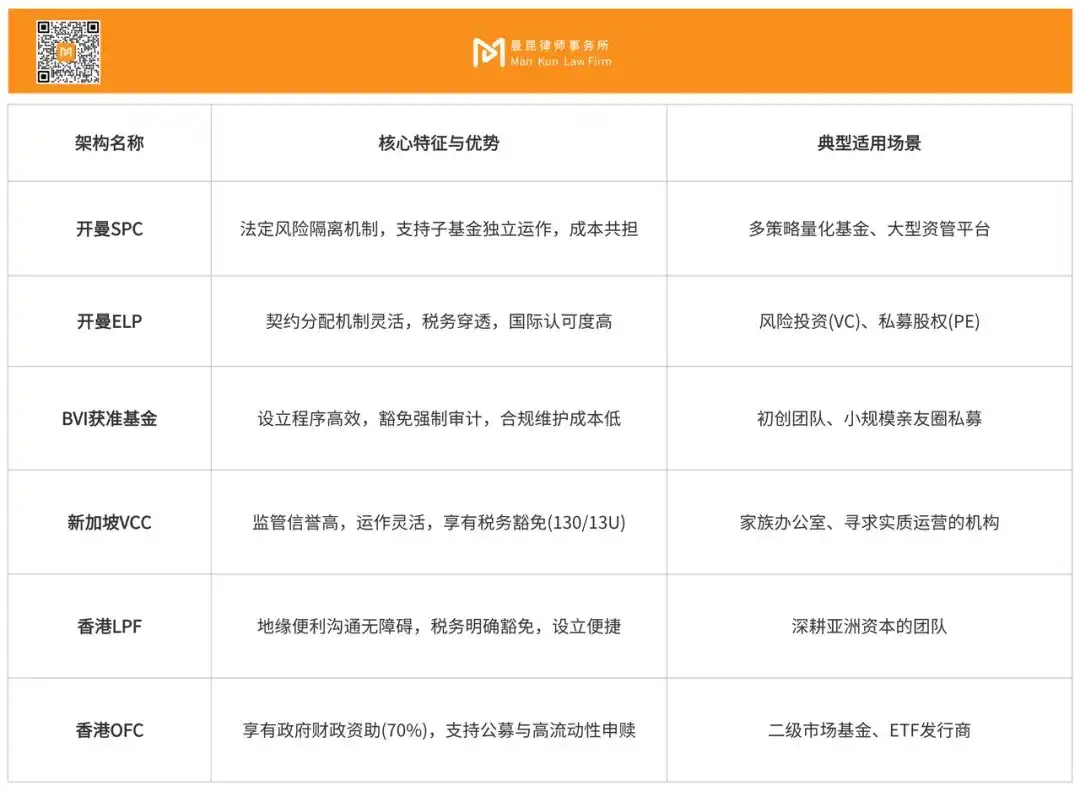
Overview of Core Characteristics of the Six Structures

Based on the above analysis, the legal characteristics and applicable scenarios of the six mainstream fund structures are summarized below:
Conclusion

In the field of crypto assets, the question regarding fund structures is never "whether to establish one," but rather "when to establish it and in what form." Different legal structures correspond not only to how taxes are paid and how regulations are applied but also to how risks are borne, how investors participate, and how the future operational model will succeed.

The fund structures introduced in this article are neither good nor bad in themselves; the key is whether they match your business model, investment strategy, and target investors. For managers who are already operating or plan to operate crypto assets in a fund format, thinking through and finalizing the structure early is itself an important form of risk control.


İlgili Sorular

QWhat is the main advantage of using a Cayman Islands SPC structure for a crypto fund?

AThe main advantage is its ability to provide risk isolation through multiple segregated portfolios (SPs) within a single legal entity, ensuring that the assets and debts of one strategy do not affect others.

QWhich fund structure is most suitable for early-stage teams with smaller assets under management (AUM) and why?

AThe BVI Approved Fund is most suitable because it has a low compliance threshold, fast setup (approved in 2-3 days), reduced operational costs (no mandatory auditor or local custodian), and is designed for teams with AUM below $100 million and up to 20 investors.

QHow does the Singapore VCC structure benefit teams looking to establish a presence in Singapore?

AThe Singapore VCC offers regulatory backing from the Monetary Authority of Singapore (MAS), allows for multiple sub-funds with asset segregation, and provides tax exemptions (e.g., under 13O/13U schemes) on qualifying investment income, making it attractive for setting up offices, obtaining work visas, or establishing family offices.

QWhat makes the Hong LPF a convenient option for teams primarily based in Asia?

AThe Hong Kong LPF is convenient because all legal matters, banking communication, and daily maintenance are handled locally in Hong Kong, eliminating language and time zone barriers, and it benefits from tax exemptions under the Unified Fund Exemption (UFE) regime.

QWhich fund structure is ideal for issuing public offerings or virtual asset ETFs, and what support does it receive?

AThe Hong Kong OFC (Open-ended Fund Company) is ideal for public offerings or ETF issuance due to its flexible capital structure that allows for share redemptions and subscriptions. It also receives government support, including up to 70% subsidy on setup costs (capped at HKD 1 million per company).

İlgili Okumalar

North Korean Hackers Loot $500 Million in a Single Month, Becoming the Top Threat to Crypto Security

North Korean hackers, particularly the notorious Lazarus Group and its subgroup TraderTraitor, have stolen over $500 million from cryptocurrency DeFi platforms in less than three weeks, bringing their total theft for the year to over $700 million. Recent major attacks on Drift Protocol and KelpDAO, resulting in losses of approximately $286 million and $290 million respectively, highlight a strategic shift: instead of targeting core smart contracts, attackers are now exploiting vulnerabilities in peripheral infrastructure. For instance, the KelpDAO attack involved compromising downstream RPC infrastructure used by LayerZero's decentralized validation network (DVN), allowing manipulation without breaching core cryptography. This sophisticated approach mirrors advanced corporate cyber-espionage. Additionally, North Korea has systematically infiltrated the global crypto workforce, with an estimated 100 operatives using fake identities to gain employment at blockchain companies, enabling long-term access to sensitive systems and facilitating large-scale thefts. According to Chainalysis, North Korean-linked hackers stole a record $2 billion in 2025, accounting for 60% of all global crypto theft that year. Their total historical crypto theft has reached $6.75 billion. Post-theft, they employ specialized money laundering methods, heavily relying on Chinese OTC brokers and cross-chain mixing services rather than standard decentralized exchanges. Security experts, while acknowledging the increased sophistication, emphasize that many attacks still exploit fundamental weaknesses like poor access controls and centralized operational risks. Strengthening private key management, limiting privileged access, and enhancing coordination among exchanges, analysts, and law enforcement immediately after an attack are critical to improving defense and fund recovery chances. The industry's challenge now extends beyond secure smart contracts to safeguarding operational security at the infrastructure level.

marsbit29 dk önce

North Korean Hackers Loot $500 Million in a Single Month, Becoming the Top Threat to Crypto Security

marsbit29 dk önce

Circle CEO's Seoul Visit: No Korean Won Stablecoin Issuance, But Met All Major Korean Banks

Circle CEO Jeremy Allaire's recent activities in Seoul indicate a strategic shift for the company, moving away from issuing a Korean won-backed stablecoin and instead focusing on embedding itself as a key infrastructure provider within Korea’s financial and crypto ecosystem. Despite Korea accounting for nearly 30% of global crypto trading volume—with a market characterized by high retail participation and altcoin dominance—Circle has chosen not to compete for the role of stablecoin issuer. Instead, Allaire met with major Korean banks (including Shinhan, KB, and Woori), financial groups, leading exchanges (Upbit, Bithumb, Coinone), and tech firms like Kakao. This approach reflects a broader industry transition: the core of stablecoin competition is shifting from issuance rights to systemic positioning. With Korean regulators still debating whether banks or tech companies should issue stablecoins, Circle is avoiding regulatory uncertainty by strengthening its role as a service and technology partner. The company is deepening integration with trading platforms, building connections, and promoting stablecoin infrastructure. This positions Circle to benefit regardless of which entity eventually issues a won stablecoin. Allaire also noted the potential for a Chinese yuan stablecoin in the next 3–5 years, underscoring a regional trend of stablecoins becoming more regulated and integrated with traditional finance. Ultimately, Circle’s strategy highlights that future influence in the stablecoin market will belong not necessarily to the issuers, but to the foundational infrastructure layers that enable cross-system transactions.

marsbit56 dk önce

Circle CEO's Seoul Visit: No Korean Won Stablecoin Issuance, But Met All Major Korean Banks

marsbit56 dk önce

SpaceX Ties Up with Cursor: A High-Stakes AI Gambit of 'Lock First, Acquire Later'

SpaceX has secured an option to acquire AI programming company Cursor for $60 billion, with an alternative clause requiring a $10 billion collaboration fee if the acquisition does not proceed. This structure is not merely a potential acquisition but a strategic move to control core access points in the AI era. The deal is designed as a flexible, dual-path arrangement, allowing SpaceX to either fully acquire Cursor or maintain a binding partnership through high-cost collaboration. This "option-style" approach minimizes immediate regulatory and integration risks while ensuring long-term alignment between the two companies. At its core, the transaction exchanges critical AI-era resources: SpaceX provides its Colossus supercomputing cluster—one of the world’s most powerful AI training infrastructures—while Cursor contributes its AI-native developer environment and strong product adoption. This synergy connects compute power, models, and application layers, forming a closed-loop AI capability stack. Cursor, founded in 2022, has achieved rapid growth with over $1 billion in annual revenue and widespread enterprise adoption. Its value lies in transforming software development through AI agents capable of coding, debugging, and system design—positioning it as a gateway to future software production. For SpaceX, this move is part of a broader strategy to evolve from a aerospace company into an AI infrastructure empire, integrating xAI, supercomputing, and chip manufacturing. Controlling Cursor fills a gap in its developer tooling layer, strengthening its AI narrative ahead of a potential IPO. The deal reflects a shift in AI competition from model superiority to ecosystem and entry-point control. With programming tools as a key battleground, securing developer loyalty becomes crucial for dominating the software production landscape. Risks include questions around Cursor’s valuation, technical integration challenges, and potential regulatory scrutiny. Nevertheless, the deal underscores a strategic bet: controlling both compute and software development access may redefine power dynamics in the AI-driven future.

marsbit1 saat önce

SpaceX Ties Up with Cursor: A High-Stakes AI Gambit of 'Lock First, Acquire Later'

marsbit1 saat önce

İşlemler

Spot
Futures
活动图片