Web3 and DApps in 2026: A utility-driven year ahead for crypto

cointelegraph2025-12-24 tarihinde yayınlandı2025-12-24 tarihinde güncellendi

Özet

By 2026, the crypto industry is shifting from speculative hype toward a utility-driven focus. Decentralized applications (DApps) are increasingly built for real-world use, with developers prioritizing polished user experience, interoperability, and sustainable monetization rather than short-term gains. Key improvements include account abstraction, gas sponsorships, and faster blockchain performance, narrowing the gap with Web2 applications. Ecosystems like Ethereum, Solana, and TON are competing not just on scalability but also on distribution and practical relevance. The emergence of super-apps and AI agents may further simplify user interaction. The year will test whether DApps can retain users without speculative incentives—making actual utility the defining metric for success.

As the crypto space headed into the last month of 2025, the mood was different from previous cycles. The year didn’t bring another decentralized finance (DeFi) summer or non-fungible token (NFT) euphoria, but instead ushered in a slow and sober pivot toward utility.

Decentralized applications (DApps) are software programs that run on blockchain networks, rather than centralized servers. By using smart contracts, DApps allow users to interact directly with apps for payments, finance, gaming or social media while retaining greater control over identities and assets.

Active builders held steady in 2025 but shifted their priorities to a longer-term outlook. According to Electric Capital’s Developer Report, the number of full-time crypto developers — defined as contributors committing code at least 10 days per month — rose 5% year-on-year, even as total developer counts dipped slightly.

The divergence suggests that speculative “tourist” participation has waned, while more builders are pursuing crypto as a full-time profession. In practice, that points to a smaller but more committed developer base, with sustained development effort increasingly concentrated among long-term teams rather than short-term projects.
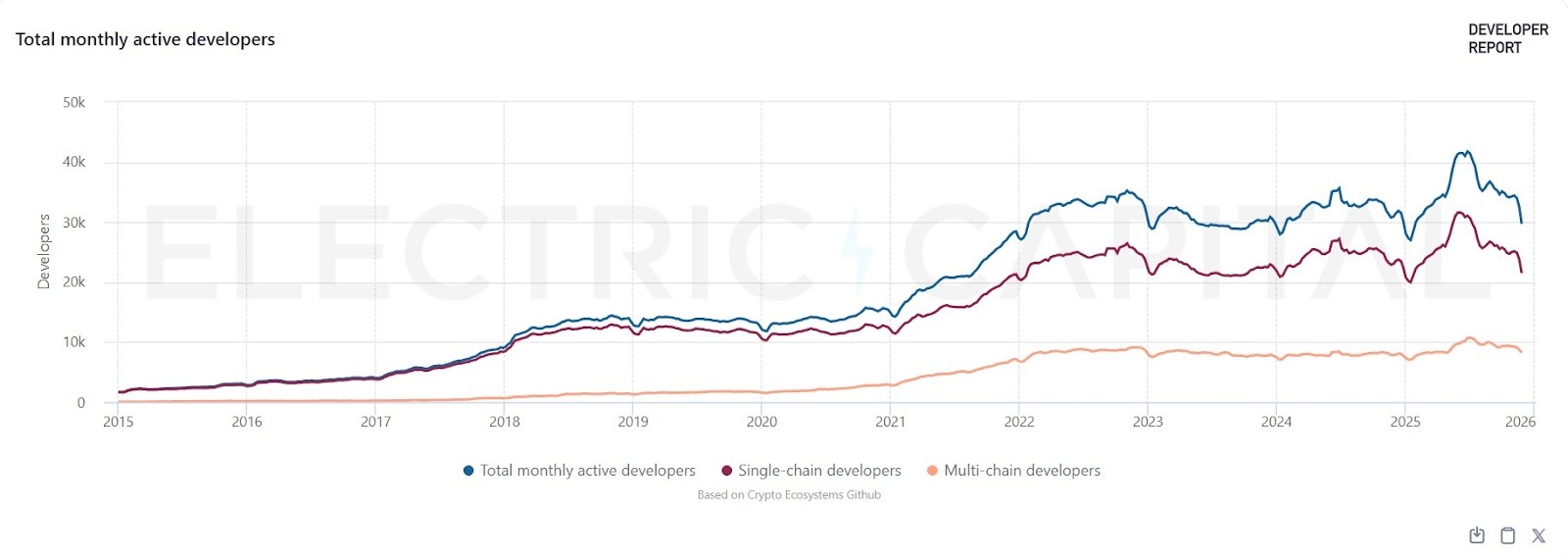
Total monthly active developers. Source: Electric Capital

Web3 gaming developers are also identifying different drivers of success for gaming DApps. According to a survey by the Blockchain Gaming Alliance (BGA), Web3 game developers are tying success to polished gameplay, sustainable monetization and infrastructure that supports spending.

This means that builders are depending less on external forces like traditional gaming giants coming into Web3 and instead focusing on controllable factors such as implementing interoperability, integrating artificial intelligence and creating player-driven economies.
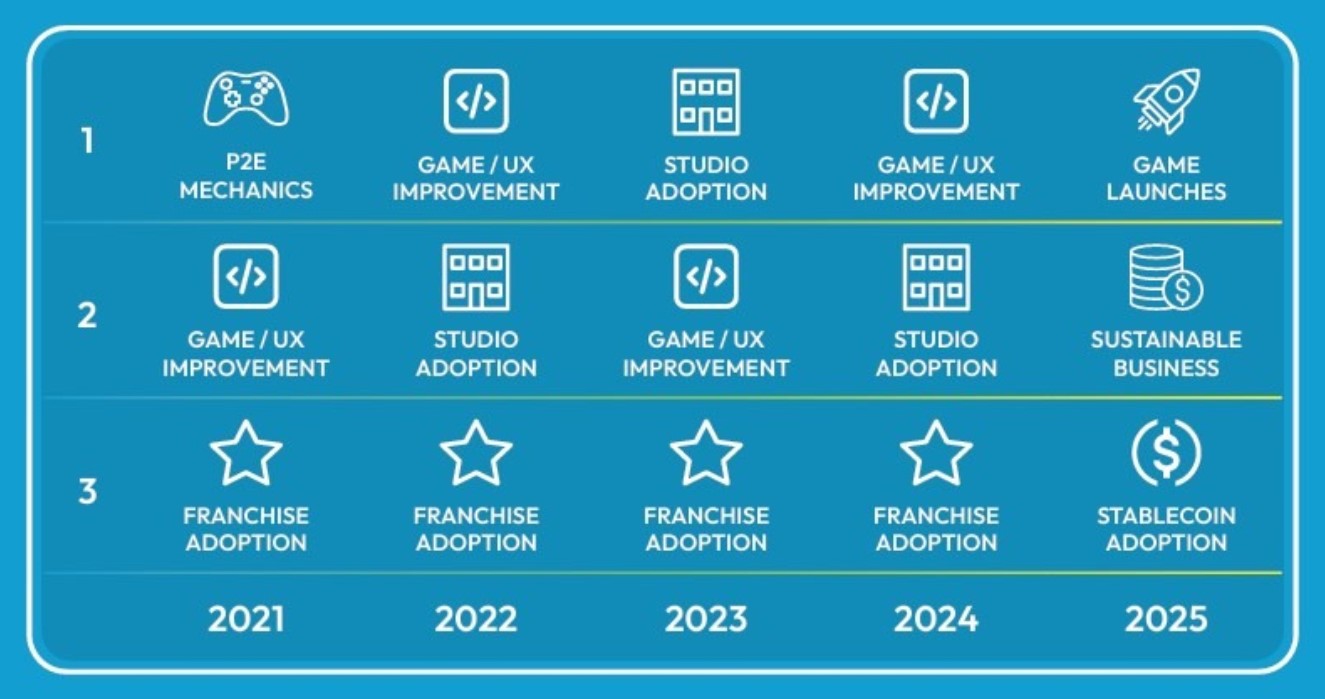
Key factors that are perceived to drive the growth of the blockchain gaming industry. Source: BGA Survey

If 2024 was defined by layer-2 scaling paths, 2025 became a year of preparation. Builders focused on making crypto usable, pushing account abstraction into production, tightening wallet UX and building mobile distribution channels through ecosystems like Solana’s Saga and The Open Network’s deep integration with Telegram.

At the same time, regulators across major jurisdictions like the United States, Europe and Asia have drawn clearer boundaries around stablecoins, custody and reporting, giving developers a framework to build within. The result was a year spent building the groundwork instead of chasing breakout apps.

The groundwork now sets up 2026 as a decisive test of relevance. With tooling largely in place and compliance streamlined, DApps will need to address the challenging question of whether they can attract and retain users without relying on speculative incentives.

The industry spent much of 2025 talking about a pivot to utility, but 2026 is where this claim would have to meet reality. If everyday users don’t stay once yields fade and rewards disappear, the problem will no longer be the technology, but the applications themselves.

How DApps can compete with Web2 in 2026

While DApps focused on competing with each other for user attention in previous years, 2026 may become the year when they must stand against Web2 applications and their scale.

For DApps to stand a chance, they must erase barriers that historically caused friction for mainstream users — and the shift is already underway. Account abstraction is moving closer to becoming the default experience across major ecosystems, enabling smart accounts that behave more like familiar log-in mechanisms than cryptographic tooling.

Gas sponsorships, where apps pay gas on behalf of users, reduced one of the biggest pain points, while social logins and MPC wallets removed the need for seed phrases. Moreover, sub-second finality on high-performance blockchains like Solana and modular rollups on Ethereum have narrowed the latency gap.

The emerging layer of AI agents capable of interacting with smart contracts could make DApp usage feel less like managing a wallet and more like a regular application.

Related: Tether deepens AI bet, backs Italian firm’s humanoid robots

This highlights the stark contrast between 2025 and 2026. This year showed fragmentation fatigue, where thousands of isolated DApps, each with separate accounts, assets and user journeys, created a high cognitive load for new users.

Because of this, the next leap for the sector may come from modular, interoperable super apps that bundle multiple needs in one interface, similar to how WeChat and Grab built dominance in the Web2 space.

Payments, savings and stablecoin rails could sit alongside NFT creator tools, gaming assets, loyalty tokens and social identity, allowing users to move across experiences inside a single ecosystem.

If 2025 was the year protocols built the foundation, 2026 may be the year to test whether these actually work in daily use.
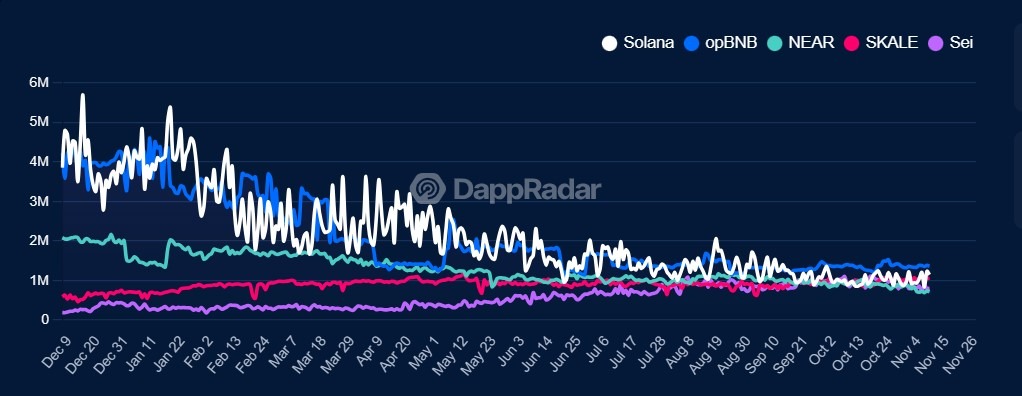
Solana and opBNB dominate in unique active wallets in 2025. Source: DappRadar

Related: Web3 gaming, DeFi lead sector activity in October despite market decline: Report

Which ecosystems are positioned to win in 2026?

Several ecosystems enter 2026 with distinct advantages, not only in throughput or developer tools, but also in distribution, user funnels and real-world relevance.

Ethereum remains the center of smart contract development, but its 2025 upgrades were incremental in nature. Improvements tied to the Fusaka upgrade focused on advancing Ethereum's data availability and zero-knowledge roadmap.

It includes early steps toward more efficient proof systems and shared sequencing concepts rather than immediate fee reductions on the mainnet. Together with the continued maturation of rollups, these changes position Ethereum to support cheaper and faster settlement over time, without compromising its security model.

Related: Vitalik Buterin pitches ZK-proofs to audit X algorithm and rankings

Solana continues to carve out the consumer lane, powering sub-second transactions for payments, in-app micro-purchases and mobile-native experiences that feel more Web2 than Web3.

On the other hand, TON stands out with arguably the strongest user funnel in the crypto space. Telegram's massive user base, Mini Apps and seamless wallet integrations created a distribution channel that would be difficult to replicate.
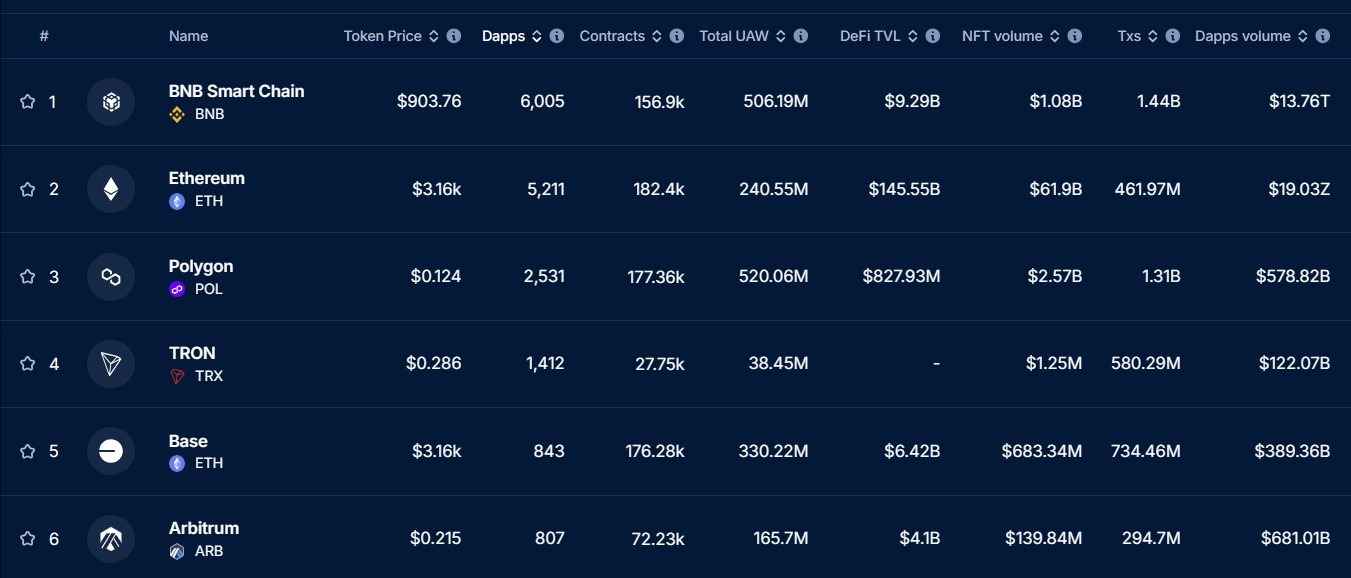
DappRadar integrated data showed that BNB Chain has over 6,000 DApps. Source: DappRadar

Beyond chains, thematic sectors could also define what could dominate the sector in 2026. Decentralized physical infrastructure networks (DePIN) gained traction in 2025 by anchoring crypto to real-world workflows like bandwidth, compute markets, mobility networks and energy credits.

These provided revenue paths that are not dependent on yield farming. In June, a World Economic Forum (WEF) report predicted that the sector could grow to $3.5 trillion by 2028, driven by the adoption of blockchain and artificial intelligence.

Meanwhile, creator-focused DApps are also maturing beyond NFTs and speculation toward micro-IP ownership, music royalties and fan-powered monetization models.

If these trends hold, the ecosystems best placed to succeed in 2026 will likely be the ones that combine distribution, scalability and clearer everyday use cases — not just the fastest network, but the one with the most active users.

2026 will be a turning point for utility

Crypto has already spent years building, scaling networks, tightening security, refining user experiences and building regulatory foundations to support its developments.

With infrastructure reaching consumer-grade readiness, the next phase may be less about which chain processes transactions faster and more about which products we are willing to return to without the usual token incentives.

If 2025 was a year spent in construction, 2026 is shaping up to be a year to evaluate — one where DApps must deliver practical value and not just promises. The winners will be those that feel similar to everyday applications, with simple onboarding, invisible gas and stable cost structures.

Magazine: Ethereum’s Fusaka fork explained for dummies: What the hell is PeerDAS?

Trend Kriptolar

İlgili Sorular

QWhat was the main shift in the crypto space during 2025 according to the article?

AThe main shift in 2025 was a slow and sober pivot toward utility, moving away from speculative trends like DeFi summers and NFT euphoria, with builders focusing on long-term development and making crypto usable.

QHow did the developer landscape change in 2025 based on Electric Capital's Developer Report?

AAccording to Electric Capital's Developer Report, the number of full-time crypto developers (those committing code at least 10 days per month) rose 5% year-on-year, while total developer counts dipped slightly, indicating a smaller but more committed developer base focused on long-term projects.

QWhat are the key factors that Web3 game developers believe drive success for gaming DApps, as per the Blockchain Gaming Alliance survey?

AWeb3 game developers tie success to polished gameplay, sustainable monetization, and infrastructure that supports spending, focusing on controllable factors like interoperability, AI integration, and player-driven economies rather than relying on external forces like traditional gaming giants.

QWhat technological and UX improvements are helping DApps compete with Web2 applications in 2026?

AImprovements include account abstraction becoming the default experience, gas sponsorships where apps pay gas fees for users, social logins, MPC wallets eliminating seed phrases, sub-second finality on high-performance blockchains, and AI agents that make DApp usage feel like regular applications, all reducing friction for mainstream users.

QWhich ecosystems are positioned to win in 2026, and what advantages do they have?

AEthereum remains the center of smart contract development with incremental upgrades focused on data availability and zero-knowledge proofs. Solana excels in consumer applications with sub-second transactions for payments and mobile-native experiences. TON has a strong user funnel through Telegram's massive user base and seamless wallet features. Additionally, ecosystems supporting DePIN and creator-focused DApps with real-world utility are well-positioned.

İlgili Okumalar

9.42 Million Retail Investors Compete for Changxin Technology, Who Got Allotted?

Evergreen Technology's IPO subscription results are now available. On July 20, the domestic memory chip giant announced the offline preliminary allotment results and online lottery results for its IPO. A total of approximately 9.43 million retail investors participated in the online subscription, generating 770,000 winning lots with a final winning rate of about 0.4714%, setting a record for new shares on the STAR Market. After triggering a clawback mechanism from institutional to retail investors, the online retail allocation was significantly increased to 3.851 billion shares. Simultaneously, 285 institutional investors participated in the offline subscription, ultimately receiving 2.173 billion shares at an allotment rate of approximately 0.1756%. Leading insurers and public funds were among the major recipients. Notably, Liang Wenfeng, founder of the major AI model company DeepSeek, through his quantitative investment firms Ningbo Huanfang Quantitative and Zhejiang Jiuzhang Asset, secured the largest share among private funds, with a total allotment worth approximately 175 million yuan. Estimates suggest potential profits could reach 730 million yuan if Evergreen Technology's market capitalization reaches 3 trillion yuan post-listing. The company is expected to list on July 27 and could become the highest-valued tech stock on the A-share market, with various brokerages providing valuations ranging from 1 trillion to over 4 trillion yuan. However, recent significant corrections in global tech stocks may impact its post-listing performance. (Character count: 1,196)

marsbit45 dk önce

9.42 Million Retail Investors Compete for Changxin Technology, Who Got Allotted?

marsbit45 dk önce

L2 'Recalibration': When L1 Becomes Its Own Rollup, What Is Ethereum's Endgame?

The article discusses the evolving relationship between Ethereum's Layer 1 (L1) and Layer 2 (L2) solutions, moving beyond the initial "L2 for scaling" model. As Ethereum L1 itself scales (increasing Gas Limit, statelessness, zkEVM), the unique value proposition of L2s shifts from merely providing cheap execution to offering differentiated features like application-specific optimization, privacy, and flexible governance. The piece explores three key themes: 1. **L2's New Role:** L2s are transitioning from a pure scaling technology to a spectrum of execution environments with varying degrees of security inheritance from Ethereum L1. 2. **Interoperability as State Trust:** Solving L2 fragmentation is less about cross-chain bridges and more about enabling faster, trust-minimized state verification between environments. This involves initiatives like faster L1 finality, intent-based architectures (Open Intents Framework), and native account abstraction. 3. **Blurring Layers:** With the potential integration of zk-proofs into L1 validation (making L1 akin to its own "Rollup") and the concept of "Native Rollups," the rigid boundary between L1 and L2 may fade. The future could be a unified system with multiple execution domains (for DeFi, gaming, privacy, etc.) sharing a common security, settlement, and state framework. In conclusion, Ethereum's goal is not to abandon L2s or re-centralize everything on L1, but to re-integrate the fragmented user experience—liquidity, accounts, applications—while preserving the scaling benefits of a multi-environment ecosystem. The endgame is a cohesive "one chain" feeling for users, powered by diverse but securely interconnected execution layers.

marsbit1 saat önce

L2 'Recalibration': When L1 Becomes Its Own Rollup, What Is Ethereum's Endgame?

marsbit1 saat önce

İşlemler

Spot

Popüler Makaleler

O Nasıl Satın Alınır

HTX.com’a hoş geldiniz! O1 exchange (O) satın alma işlemlerini basit ve kullanışlı bir hâle getirdik. Adım adım açıkladığımız rehberimizi takip ederek kripto yolculuğunuza başlayın. 1. Adım: HTX Hesabınızı OluşturunHTX'te ücretsiz bir hesap açmak için e-posta adresinizi veya telefon numaranızı kullanın. Sorunsuzca kaydolun ve tüm özelliklerin kilidini açın. Hesabımı Aç2. Adım: Kripto Satın Al Bölümüne Gidin ve Ödeme Yönteminizi SeçinKredi/Banka Kartı: Visa veya Mastercard'ınızı kullanarak anında O1 exchange (O) satın alın.Bakiye: Sorunsuz bir şekilde işlem yapmak için HTX hesap bakiyenizdeki fonları kullanın.Üçüncü Taraflar: Kullanımı kolaylaştırmak için Google Pay ve Apple Pay gibi popüler ödeme yöntemlerini ekledik.P2P: HTX'teki diğer kullanıcılarla doğrudan işlem yapın.Borsa Dışı (OTC): Yatırımcılar için kişiye özel hizmetler ve rekabetçi döviz kurları sunuyoruz.3. Adım: O1 exchange (O) Varlıklarınızı SaklayınO1 exchange (O) satın aldıktan sonra HTX hesabınızda saklayın. Alternatif olarak, blok zinciri transferi yoluyla başka bir yere gönderebilir veya diğer kripto para birimlerini takas etmek için kullanabilirsiniz.4. Adım: O1 exchange (O) Varlıklarınızla İşlem YapınHTX'in spot piyasasında O1 exchange (O) ile kolayca işlemler yapın.Hesabınıza erişin, işlem çiftinizi seçin, işlemlerinizi gerçekleştirin ve gerçek zamanlı olarak izleyin. Hem yeni başlayanlar hem de deneyimli yatırımcılar için kullanıcı dostu bir deneyim sunuyoruz.

175 Toplam GörüntülenmeYayınlanma 2026.06.19Güncellenme 2026.06.29

O Nasıl Satın Alınır

PROS Nasıl Satın Alınır

HTX.com’a hoş geldiniz! Pharos (PROS) satın alma işlemlerini basit ve kullanışlı bir hâle getirdik. Adım adım açıkladığımız rehberimizi takip ederek kripto yolculuğunuza başlayın. 1. Adım: HTX Hesabınızı OluşturunHTX'te ücretsiz bir hesap açmak için e-posta adresinizi veya telefon numaranızı kullanın. Sorunsuzca kaydolun ve tüm özelliklerin kilidini açın. Hesabımı Aç2. Adım: Kripto Satın Al Bölümüne Gidin ve Ödeme Yönteminizi SeçinKredi/Banka Kartı: Visa veya Mastercard'ınızı kullanarak anında Pharos (PROS) satın alın.Bakiye: Sorunsuz bir şekilde işlem yapmak için HTX hesap bakiyenizdeki fonları kullanın.Üçüncü Taraflar: Kullanımı kolaylaştırmak için Google Pay ve Apple Pay gibi popüler ödeme yöntemlerini ekledik.P2P: HTX'teki diğer kullanıcılarla doğrudan işlem yapın.Borsa Dışı (OTC): Yatırımcılar için kişiye özel hizmetler ve rekabetçi döviz kurları sunuyoruz.3. Adım: Pharos (PROS) Varlıklarınızı SaklayınPharos (PROS) satın aldıktan sonra HTX hesabınızda saklayın. Alternatif olarak, blok zinciri transferi yoluyla başka bir yere gönderebilir veya diğer kripto para birimlerini takas etmek için kullanabilirsiniz.4. Adım: Pharos (PROS) Varlıklarınızla İşlem YapınHTX'in spot piyasasında Pharos (PROS) ile kolayca işlemler yapın.Hesabınıza erişin, işlem çiftinizi seçin, işlemlerinizi gerçekleştirin ve gerçek zamanlı olarak izleyin. Hem yeni başlayanlar hem de deneyimli yatırımcılar için kullanıcı dostu bir deneyim sunuyoruz.

181 Toplam GörüntülenmeYayınlanma 2026.06.22Güncellenme 2026.06.29

PROS Nasıl Satın Alınır

VERONA Nedir

I. Proje Tanıtımı VERONA, zincir soyutlaması aracılığıyla herkes için, her yerde inşa edilmiş bir blok zinciridir. Genel Soyutlama katmanını kullanarak, VERONA, hesaplar, imzalar ve birlikte çalışabilirlik gibi karmaşık blok zinciri işlevlerini doğrudan protokol seviyesinde entegre ederek kendini ayırt eder. Bu yaklaşım, temel teknolojileri anlamaya gerek kalmadan blok zinciri uygulamalarıyla etkileşimde bulunmayı sağlar.1) Temel Bilgiler İsim: VERONA (VERONA)III. İlgili Bağlantılar Resmi web sitesi bağlantısı: https://xion.burnt.com/ Whitepaper: https://xion.burnt.com/whitepaper.pdf Keşif Araçları: https://explorer.burnt.com/ Sosyal Medya: https://x.com/burnt_xion Not: Proje tanıtımı, resmi proje ekibi tarafından yayımlanan veya sağlanan materyallerden alınmıştır, yalnızca referans içindir ve yatırım tavsiyesi teşkil etmez. HTX, ortaya çıkan doğrudan veya dolaylı kayıplardan sorumluluk kabul etmez.

171 Toplam GörüntülenmeYayınlanma 2026.06.22Güncellenme 2026.06.22

VERONA Nedir

Tartışmalar

HTX Topluluğuna hoş geldiniz. Burada, en son platform gelişmeleri hakkında bilgi sahibi olabilir ve profesyonel piyasa görüşlerine erişebilirsiniz. Kullanıcıların A (A) fiyatı hakkındaki görüşleri aşağıda sunulmaktadır.

活动图片














