War Won or Lost? Trump: Profited

Odaily星球日报2026-03-24 tarihinde yayınlandı2026-03-24 tarihinde güncellendi

Özet

Former President Trump claimed on Truth Social that productive U.S.-Iran talks had led to a 5-day delay in military strikes, causing immediate market reactions: gold rebounded over $200, oil dropped 14%, and S&P 500 futures rose nearly 4%. However, Iranian media denied any talks occurred, calling it a "psychological operation." Just before Trump’s post, large trades were detected—a $1.5 billion S&P 500 buy order and a $580 million crude oil sell-off—suggesting possible insider trading or sophisticated market anticipation of Trump’s pattern. This isn’t the first time Trump’s statements have moved markets; similar tactics were used during tariff policy shifts in 2025, where rumors and official posts created multiple market swings. Trump’s market influence may serve dual purposes: creating trading opportunities and using stock market gains as a proxy for economic success to bolster political support. Despite accusations, lack of direct evidence shields him from legal consequences. His actions highlight the intersection of financial markets, media, and political strategy.

Original | Odaily Planet Daily (@OdailyChina)

Author | Golem (@web 3_golem)
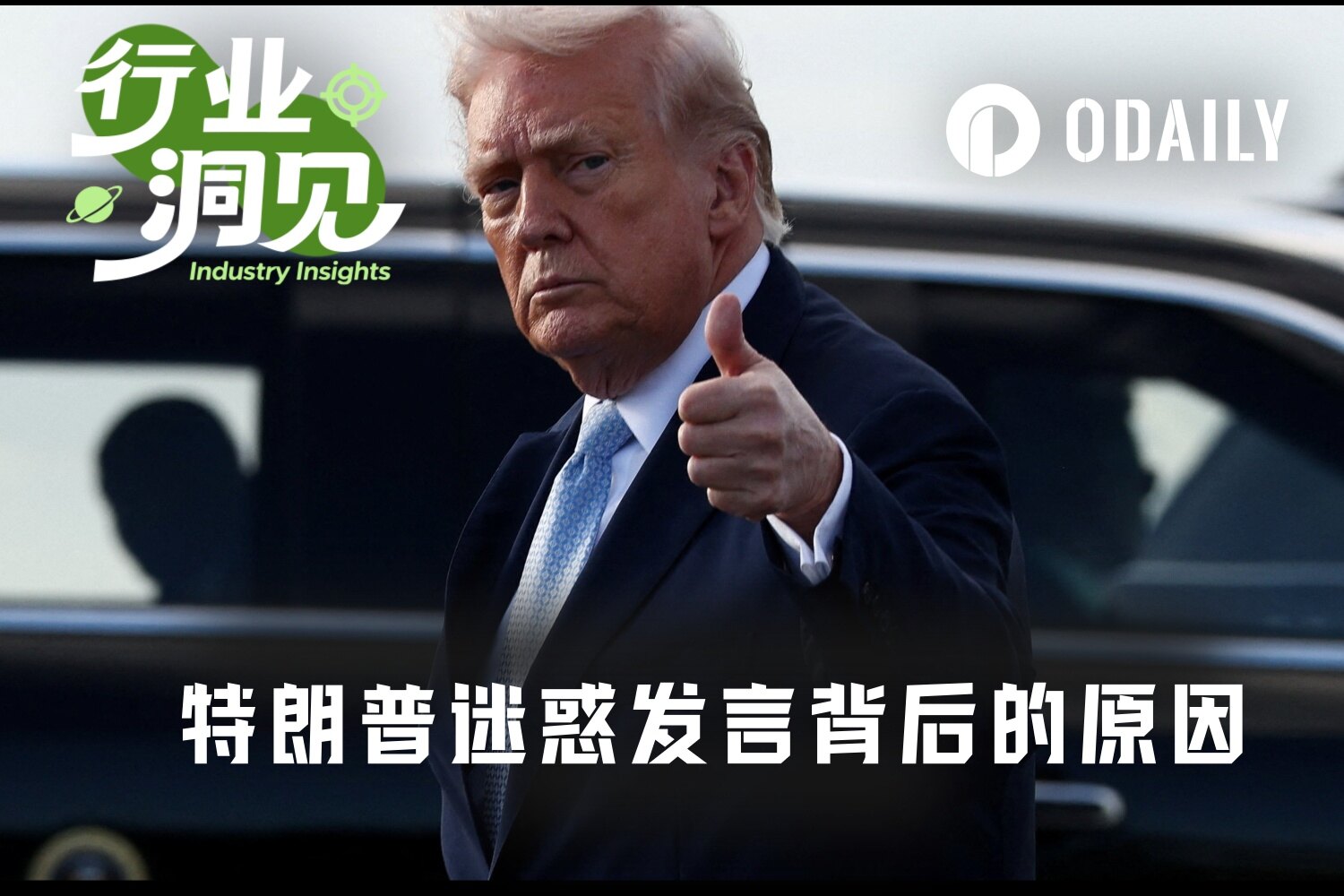
Whether Trump is a competent president is hard to say, but he is definitely an excellent financial market manipulator.

On March 23, Trump started his antics again regarding the US-Iran conflict. At 19:05 Beijing time, he posted on Truth Social, stating that the US and Iran had productive discussions over the past two days and that all military strikes targeting Iranian power plants and energy infrastructure have been delayed for five days.

As soon as these words were out, gold, which had been dropping for days due to inflation concerns and rising global interest rate hike expectations, instantly rebounded. According to Gate data, after Trump's post, gold that had fallen all day rebounded over $200, and S&P 500 index futures also rose nearly 4% in response. Meanwhile, Brent crude oil fell from a high of $113 per barrel to a low of $97, a drop of over 14%.

But less than an hour later, Iranian media came out to "debunk" this, saying there had been no direct or indirect contact between the US and Iran. Iran's Tasnim News Agency even quoted a senior Iranian security official stating that Trump's related remarks were "psychological warfare."

Faced with this rebuttal, Trump tried to brush it off with a simple "I don't know what Iranian media is talking about." To casual observers, this might just seem like another instance of T.A.C.O. (Trump Always Chickens Out), but for traders, it was a mix of joy and sorrow. Because this series of events caused market fluctuations exceeding trillions of dollars within just a few hours.

According to The Kobeissi Letter, 15 minutes before Trump's post, a large buy order for S&P 500 futures with a notional value of $1.5 billion inexplicably appeared in the market. The order was so large that it directly pushed the S&P index up about 0.3% in one minute. And 15 minutes later, this trader/institution who opened the $1.5 billion position pocketed $60 million.
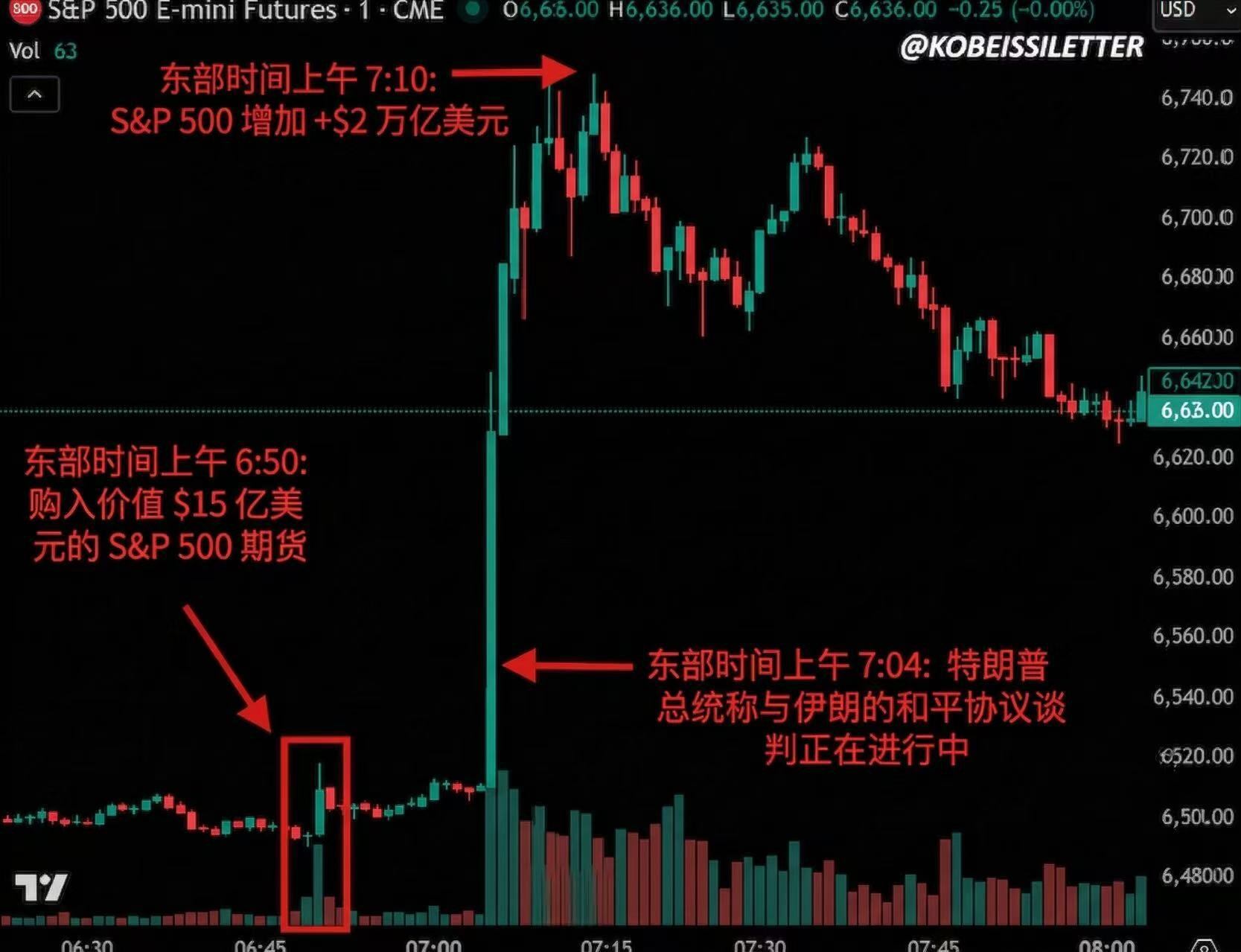
Besides this one who maximized gains, there were also traders who perfectly timed the market top. According to the Financial Times, also 15 minutes before Trump's post, approximately 6,200 Brent crude and West Texas Intermediate (WTI) crude oil futures contracts were sold, with a notional value of $580 million.

Placing large buy or sell orders just before major market news is announced—this looks less like news trading and more like classic insider trading. But whether the source can be traced back to Trump is hard to say. After all, it's not the first time Trump has done something like this. Iranian scholar Seyed Mohammad Marandi posted on platform X, "Trump makes these kinds of statements every week when the market opens to suppress oil prices. Even the five-day deadline he set coincidentally aligns with the energy market's closing time."

This means those trades that seem like insider trading could also be top-tier traders who have figured out Trump's pattern. It wouldn't be strange at all if Wall Street started studying Trump himself as a separate market trading indicator, because this method of his to influence the market isn't the first time he's played it, and it's been remarkably effective every time.

Last year's tariff turmoil was the most typical example. On April 7, 2025, US stocks were being battered by Trump's reciprocal tariff policy when news suddenly emerged that the White House was preparing to suspend tariffs for 90 days for most countries except China. The news caused the Dow Jones to surge about 800 points, but later the White House came out to debunk it as "fake news," and the Dow eventually closed down 629 points that day.

Not many people suspected that this rumor might have been spread by interests related to Trump, but the answer soon appeared.

On April 9, Trump first promoted his own stock on Truth Social, saying verbatim "THIS IS A GREAT TIME TO BUY!!! DJT". A few hours later, he announced a new tariff policy, which was no different from the "fake news" the market heard 2 days earlier—suspending "reciprocal tariffs" for 90 days for countries that did not take retaliatory measures, but raising tariffs on China to 125%. The market took off again instantly, with the three major US stock indices all rising, marking a large single-day rally not seen for many days.

A mediocre manipulator can only use one piece of good news to create one wave of rises, but Trump can use one piece of good news to create two.

Now, against the backdrop of war, every statement from leaders and official media of the conflicting parties naturally carries a price lever. A tough statement can send gold soaring on the spot; a conciliatory statement can also cause risk assets to rebound immediately,上演 "words becoming reality" in the financial markets.

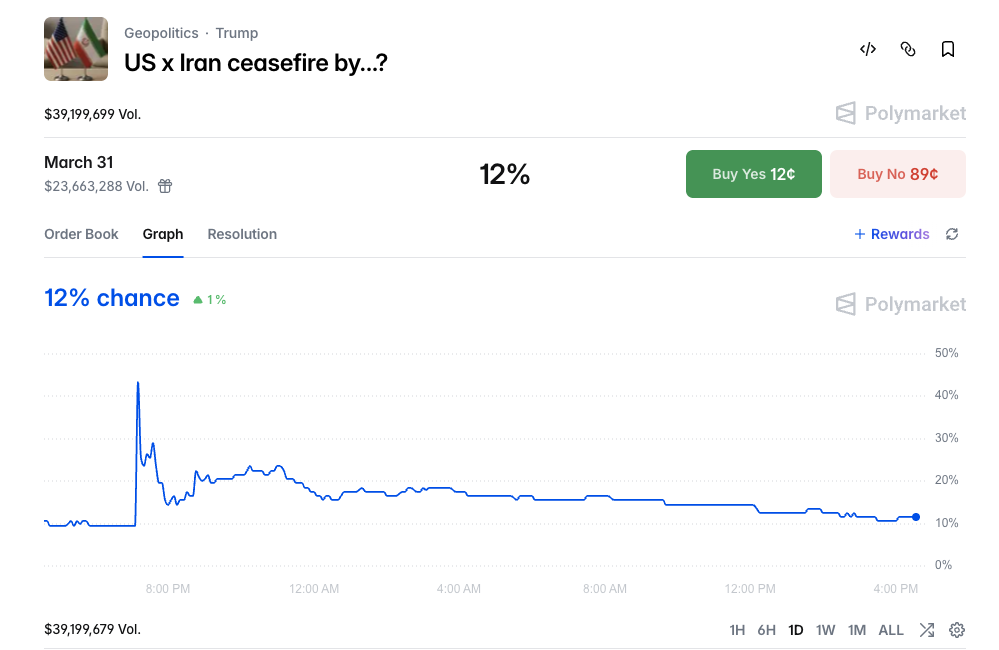
Meeting a master like Trump, even prediction markets that claim to get ahead of the truth of events can be spun in circles. According to monitoring by Odaily Seer先知频道, after Trump posted that US-Iran discussions had made good progress, the probability of the event "US and Iran will cease fire before March 31" on Polymarket quickly rose to 54%. After it was discovered to be a farce, the probability of this event quickly fell back to 16%, and has now dropped to 12%.
Does Trump intentionally manipulate the market? The answer is certainly yes. But is it just for making money? If you think so, you are ignoring another, more cost-effective business—the political dividends behind a rising stock market. Trump, coming from a business background, calculates this economic account clearer than anyone else.

During the 2024 presidential campaign, Trump promised that if he won the election, he would usher in a brand new era of Trump economic prosperity. But economic construction also takes time, and economic prosperity is itself a subjective concept for ordinary people—having money to spend is prosperity, not having money is not. Therefore, Trump urgently needed an immediate indicator to prove to voters that he was delivering results, so stock market prosperity became the best "substitute" for economic prosperity.

During his first term, Trump repeatedly touted new highs in the Dow Jones and S&P, almost treating the stock market as his personal governance scorecard. But every time Trump talks up the market, he aims to please not just stockholders, but also the capital and business owners behind them, because they are often either already or will eventually become Trump's political donors.

This script has already been played out in the crypto field. Trump was previously called the first "Crypto President" of the United States because during the 2024 US election year and early 2025 after Trump was elected president, he frequently extended olive branches to the crypto industry, such as participating in crypto industry conferences, making various crypto promises, and enacting crypto-friendly decrees. Each time, it brought upward momentum to the crypto market. In return, the crypto industry gave Trump support from tens of millions of US voters and hundreds of millions of dollars in political donations from crypto companies.

Manipulating the market without the purpose of making money also allows Trump to find loopholes in the law. Previously, countless US lawmakers and regulatory officials have accused Trump of manipulating the crypto market for profit, but these accusations ultimately came to nothing because there is no direct evidence that Trump obtained economic benefits from the market.

After the March 23 farce, some also accused Trump of涉嫌 insider trading. White House spokesperson Kush Desai stated that the White House does not tolerate any officials using insider information for illegal profit, provided there is evidence. But the "profit" referred to here mostly means economic benefit. And Trump? He has long withdrawn from his family business and moved behind the scenes,施展 intricate political and commercial手段 within the gaps of the law.

This is where Trump's true "brilliance" lies. He knows that in this world, power trumps money; but he also understands how money, in turn, influences the power structure.


Trend Kriptolar

İlgili Sorular

QWhat was the immediate market reaction to Trump's post on Truth Social about productive talks with Iran?

AGold rebounded by over $200, and S&P 500 futures rose nearly 4%, while Brent crude oil fell by over 14% to as low as $97 per barrel.

QHow did some traders allegedly profit from Trump's statement before it was publicly known?

AA large buy order of $1.5 billion in S&P 500 futures was placed 15 minutes before Trump's post, netting a profit of $60 million, and approximately $580 million worth of oil futures were sold around the same time.

QWhat does the article suggest is Trump's broader motive for influencing markets, beyond financial gain?

ATrump uses market manipulation to create a perception of economic prosperity, which serves as a political tool to gain voter support and secure donations from industries and capitalists.

QHow did the prediction market on Polymarket react to Trump's claims about U.S.-Iran talks?

AThe probability of a ceasefire between the U.S. and Iran by March 31 initially surged to 54% but quickly dropped to 12% after Iranian media denied the talks.

QWhy has it been difficult to legally prove Trump's involvement in insider trading or market manipulation?

AThere is no direct evidence linking Trump to financial gains from these actions, as he has distanced himself from family businesses and operates within legal loopholes, focusing on political rather than personal profit.

İlgili Okumalar

After Three Consecutive Quarters of Decline, Can the Crypto Market Find a Window for Stabilization in Q3?

The cryptocurrency market has just concluded its worst-performing quarter since 2022, with total capitalization dropping 12.6% to $2.1 trillion. All core metrics indicate capital is leaving the sector, not just rotating within it. Bitcoin fell 14.2% and Ethereum dropped 25.4% in Q2, breaking their previous correlation with US tech stocks. A key driver is the reversal in US spot Bitcoin ETF flows, which saw a net outflow of approximately $4.67 billion in Q2, including a record monthly outflow near $4.5 billion in June. While recent data suggests long-term holders are accumulating again, sustained ETF outflows mean continued selling pressure. Market focus is now singularly on the Federal Reserve. The upcoming July FOMC meeting is seen as the most critical event for Q3. A dovish signal could support Bitcoin reclaiming a $68,000-$84,000 range, while a hawkish stance might establish a new trading band around $50,000-$56,000. Additionally, regulatory uncertainty persists, with the progress of the crucial *CLARITY Act* stalling in the Senate, reducing its perceived 2026 passage probability to 40-45%. Despite the broad downturn, a few sectors showed growth. Prediction markets saw nominal volume surge 48.7% year-over-year to $113.8 billion, and tokenized collectibles transaction volume rose 143% quarterly to $1.4 billion. The Real-World Asset (RWA) tokenization sector also continued steady growth, now representing ~$28.1 billion in on-chain value. The market's foundation for an extreme crash appears limited, with Bitcoin price hovering near its 200-week moving average. However, the trading paradigm has shifted from narrative-driven speculation to decisions based on price action, policy developments, and interest rate expectations, making a broad sentiment-driven rally unlikely in the near term.

marsbit21 dk önce

After Three Consecutive Quarters of Decline, Can the Crypto Market Find a Window for Stabilization in Q3?

marsbit21 dk önce

BIT Trading Moment: BTC Still Suppressed by Weekly 200 EMA, Rejection May Restart Decline; Storage and Semiconductors that Surged Last Night Begin Falling in Evening Trading

**Crypto & Stock Market Wrap: Bitcoin Tests Resistance, Stocks Retreat After AI Surge** Bitcoin consolidates around $66,000, facing key resistance near $68,000—an area seen as a major psychological and technical hurdle where previous rallies have failed. Analysts note the cryptocurrency is caught between its 200-week moving average (~$63,333) and 200-week EMA (~$68,328). A clear break above $68k is needed to signal a stronger bullish trend, while a rejection could lead to a retest of $63k support. Market sentiment remains cautious, with low futures open interest pointing to a low-liquidity rebound rather than a full bull market. Bitcoin spot ETFs saw another $203 million inflow. US stock futures pointed lower after a strong Tuesday session led by a massive rebound in semiconductors and memory stocks. The rally was fueled by renewed optimism about AI-driven hardware demand, with Micron, SanDisk, and SK Hynix surging. However, those gains reversed in pre-market trading. Super Micro Computer (SMCI) soared over 20% after hours on strong guidance and a record backlog. Other standouts included Rocket Lab and nuclear energy plays Oklo and X-Energy. Rising oil prices (Brent above $91) and climbing Treasury yields (10-year near 4.64%), however, are reigniting inflation concerns and acting as a headwind for equities. In Asia, markets were mixed. South Korea's KOSPI pared early gains to close slightly higher as semiconductor stocks like SK Hynix gave back initial surges. Japan's Nikkei edged lower as the yen hit a fresh 38-year low against the dollar, raising fears of potential market intervention. Key events to watch include the Samsung Galaxy launch, AMD's AI event, and a slew of major tech earnings from Alphabet, Tesla, and IBM after the close on Wednesday, followed by the ECB meeting and Intel's earnings on Thursday.

marsbit29 dk önce

BIT Trading Moment: BTC Still Suppressed by Weekly 200 EMA, Rejection May Restart Decline; Storage and Semiconductors that Surged Last Night Begin Falling in Evening Trading

marsbit29 dk önce

Former CFTC Chairman, Circle President Tarbert: Preaching Long-Termism While Cashing Out $30 Million Himself

Former CFTC Chairman and Circle President Heath Tarbert has consistently advocated for a long-term vision in public, urging patience from investors as Circle’s stock price has fallen significantly from its peak. However, it has been revealed that since Circle’s IPO, Tarbert has continuously sold his CRCL shares through pre-arranged trading plans, cashing out approximately $30 million, without making any public market purchases. This contrast between his public messaging and personal actions has drawn criticism. Tarbert joined Circle in July 2023 as Chief Legal Officer, leveraging his regulatory experience to help guide the company through its IPO and expansion. Despite promoting stablecoins as long-term infrastructure, he established a 10b5-1 trading plan just before Circle went public, leading to substantial stock sales over the following year. In March 2026, he initiated another plan to sell more shares. His career trajectory highlights a pattern of moving between high-level regulatory roles and influential positions in the financial sector. After resigning as CFTC Chairman in early 2021, he joined Citadel Securities as Chief Legal Officer just 27 days later, during a period of intense regulatory scrutiny for the firm. He later joined Circle, aiding its efforts to navigate regulatory challenges for its public listing. While Tarbert's expertise in policy and compliance is valuable to companies like Circle, his actions—advocating long-term confidence while personally divesting—raise questions about the alignment between his public statements and his private financial decisions, leaving investors who followed his advice to bear the market risks.

marsbit52 dk önce

Former CFTC Chairman, Circle President Tarbert: Preaching Long-Termism While Cashing Out $30 Million Himself

marsbit52 dk önce

Gate Research Institute: The 'Wall Street-ization' Wave of Crypto Financial Products – Competition or Integration?

The article titled "Gate Research Institute: Are Crypto Financial Products Sparking a 'Wall Street' Wave—Competition or Convergence?" explores the evolving relationship between the crypto ecosystem and traditional finance (TradFi). The piece begins by reflecting on Bitcoin's original 2009 vision of decentralization, disintermediation, and moving away from banks. It then contrasts this with the 2024 landscape, where key crypto assets like Bitcoin are increasingly held through Wall Street products like ETFs issued by giants like BlackRock. The article questions whether this signifies that TradFi is systematically taking over the rights to issue, price, custody, and distribute crypto financial assets. The core argument is that this is not a zero-sum takeover but rather a bidirectional convergence where each side addresses the other's weaknesses. Crypto offers 24/7 global markets, programmable settlement, and open access but lacks compliant channels, institutional-grade custody, deep fiat liquidity, and mainstream distribution. TradFi possesses these but is constrained by legacy systems, limited operating hours, and slow settlement. Two primary convergence paths are highlighted: * **Path A (CEX to TradFi):** Exemplified by Gate, which has progressed from offering tokenized stocks and CFDs to providing direct, real stock trading (US, Hong Kong, South Korea) within its platform, using USDT. * **Path B (TradFi to Crypto):** Exemplified by Robinhood, which has integrated crypto trading, acquired exchanges like Bitstamp, and is moving traditional assets like stocks onto the blockchain via tokenization and its own Layer 2. Both paths are ultimately competing to become the next-generation, unified financial account—a "super account" where users can seamlessly trade cryptocurrencies, stocks, ETFs, RWA (Real World Assets), and tokenized treasury products in one interface. The growth of RWA and tokenized treasuries (e.g., BlackRock's BUIDL) is presented as the asset-layer fusion, providing stable, yield-bearing assets on-chain and acting as a bridge between the two worlds. In conclusion, the "Wall Street-ization" of crypto is framed as a mutual transformation. Decentralized ideals persist in the protocol layer, while at the application layer, a more efficient, global, and accessible unified capital market is emerging from this convergence. The future competition lies not between crypto exchanges and stockbrokers, but between platforms vying to offer the most comprehensive asset coverage, liquidity, and user experience within a single account.

marsbit56 dk önce

Gate Research Institute: The 'Wall Street-ization' Wave of Crypto Financial Products – Competition or Integration?

marsbit56 dk önce

İşlemler

Spot

Popüler Makaleler

WAR Nasıl Satın Alınır

HTX.com’a hoş geldiniz! WAR (WAR) satın alma işlemlerini basit ve kullanışlı bir hâle getirdik. Adım adım açıkladığımız rehberimizi takip ederek kripto yolculuğunuza başlayın. 1. Adım: HTX Hesabınızı OluşturunHTX'te ücretsiz bir hesap açmak için e-posta adresinizi veya telefon numaranızı kullanın. Sorunsuzca kaydolun ve tüm özelliklerin kilidini açın. Hesabımı Aç2. Adım: Kripto Satın Al Bölümüne Gidin ve Ödeme Yönteminizi SeçinKredi/Banka Kartı: Visa veya Mastercard'ınızı kullanarak anında WAR (WAR) satın alın.Bakiye: Sorunsuz bir şekilde işlem yapmak için HTX hesap bakiyenizdeki fonları kullanın.Üçüncü Taraflar: Kullanımı kolaylaştırmak için Google Pay ve Apple Pay gibi popüler ödeme yöntemlerini ekledik.P2P: HTX'teki diğer kullanıcılarla doğrudan işlem yapın.Borsa Dışı (OTC): Yatırımcılar için kişiye özel hizmetler ve rekabetçi döviz kurları sunuyoruz.3. Adım: WAR (WAR) Varlıklarınızı SaklayınWAR (WAR) satın aldıktan sonra HTX hesabınızda saklayın. Alternatif olarak, blok zinciri transferi yoluyla başka bir yere gönderebilir veya diğer kripto para birimlerini takas etmek için kullanabilirsiniz.4. Adım: WAR (WAR) Varlıklarınızla İşlem YapınHTX'in spot piyasasında WAR (WAR) ile kolayca işlemler yapın.Hesabınıza erişin, işlem çiftinizi seçin, işlemlerinizi gerçekleştirin ve gerçek zamanlı olarak izleyin. Hem yeni başlayanlar hem de deneyimli yatırımcılar için kullanıcı dostu bir deneyim sunuyoruz.

288 Toplam GörüntülenmeYayınlanma 2024.12.11Güncellenme 2026.06.02

WAR Nasıl Satın Alınır

Tartışmalar

HTX Topluluğuna hoş geldiniz. Burada, en son platform gelişmeleri hakkında bilgi sahibi olabilir ve profesyonel piyasa görüşlerine erişebilirsiniz. Kullanıcıların WAR (WAR) fiyatı hakkındaki görüşleri aşağıda sunulmaktadır.

活动图片












