Wall Street 'Withdraws' from Bitcoin Basis Arbitrage: CME Falls Out of Favor, the Golden Age of Arbitrage Comes to an End

marsbit2026-01-22 tarihinde yayınlandı2026-01-22 tarihinde güncellendi

Özet

Wall Street is retreating from the once-lucrative Bitcoin basis trade, as narrowing spreads between spot and futures prices have made the strategy barely profitable. The cash-and-carry trade, which involved buying Bitcoin spot (often via ETFs) and selling futures to capture the premium, has seen annualized returns drop to around 5%, down from nearly 17% a year ago, barely covering funding and execution costs. This compression has led to a significant shift in market structure: CME's Bitcoin futures open interest has fallen below Binance's for the first time since 2023, indicating a withdrawal of hedge funds and large US accounts from this specific arbitrage strategy. While CME was the preferred venue for this institutional trade, Binance's dominance in perpetual futures has remained steady. The approval of spot Bitcoin ETFs initially fueled the trade's popularity but also accelerated its decline by attracting capital that quickly eroded the arbitrage opportunity. The market is now maturing, with participants shifting from simple leveraged directional bets to using options, hedges, and expressing views through diverse instruments like ETFs. This increased efficiency has naturally narrowed price disparities between venues. As the era of easy, high returns from basis trading ends, participants are expected to seek more complex strategies in decentralized markets and other crypto assets.

Original Title: Wall Street Pulls Back From Bitcoin』s Money-Spinning Basis Trade

Original Author: Sidhartha Shukla, Bloomberg

Original Compilation: Peggy, BlockBeats

Editor's Note: The once considered 'surefire' Bitcoin basis arbitrage is quietly losing its appeal: the open interest between CME and Binance is shifting, and the spread has narrowed to the point where it barely covers funding and execution costs.

On the surface, this is a squeeze in arbitrage opportunities; at a deeper level, the crypto derivatives market is maturing. Institutions no longer need to rely on 'arbitrage' for returns, and traders are shifting from leverage to options and hedging. The era of high returns through simple strategies is fading, and new competition will emerge in more complex and refined strategies.

Below is the original text:

The crypto derivatives market is undergoing a quiet yet significant change: one of the most stable and profitable trading strategies is showing signs of faltering.

The 'cash-and-carry' trade, commonly used by institutions—buying Bitcoin spot while selling futures to profit from the spread—is collapsing. This not only signals a rapid compression of arbitrage opportunities but also releases a deeper message: the structure of the crypto market is changing. The open interest of Bitcoin futures on the Chicago Mercantile Exchange (CME) has fallen below that of Binance for the first time since 2023, further indicating that the highly profitable arbitrage opportunities of the past are being rapidly eroded as spreads narrow and market access becomes more efficient.

After the launch of spot Bitcoin ETFs in early 2024, CME once became the preferred venue for Wall Street trading desks to execute such strategies. This operation is highly similar to the 'basis trade' in traditional markets: buying Bitcoin spot through ETFs while selling futures contracts to profit from the spread between the two.

In the months following the ETF approval, the annualized return of this so-called 'delta-neutral strategy' often reached double digits, attracting billions of dollars in capital—capital that was indifferent to the direction of Bitcoin's price movement, focusing solely on capturing the returns. However, it was precisely the ETF that drove the rapid expansion of this trade that also sowed the seeds of its demise: as more trading desks rushed in, the arbitrage spread was quickly erased. Today, the returns from this trade are barely enough to cover funding costs.
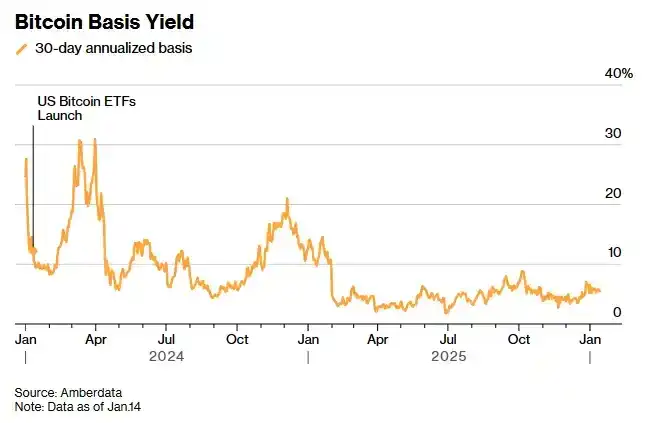
According to data compiled by Amberdata, the current annualized return for a one-month period is hovering around 5%, near its lowest level in recent years. Greg Magadini, Director of Derivatives at Amberdata, noted that around this time last year, the basis was close to 17%, but has now fallen to about 4.7%, barely enough to cover the threshold of funding and execution costs. Meanwhile, the one-year U.S. Treasury yield is around 3.5%, making the trade increasingly less attractive.

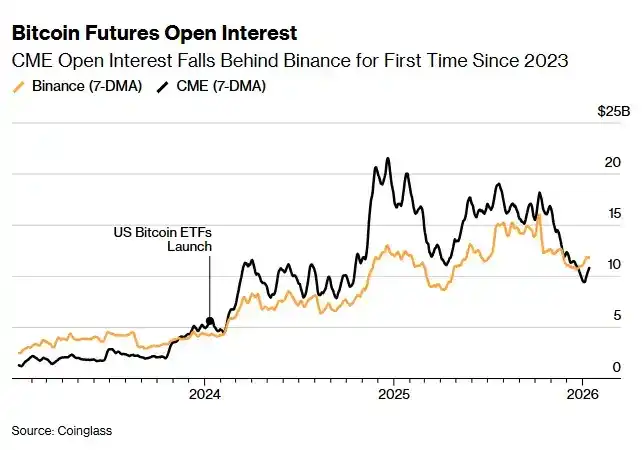
Against the backdrop of narrowing spreads, the open interest of CME Bitcoin futures has fallen from a peak of over $21 billion to below $10 billion, according to data compiled by Coinglass. In contrast, Binance's open interest has remained relatively stable, at around $11 billion. James Harris, CEO of digital asset management firm Tesseract, stated that this change reflects more of a pullback by hedge funds and large U.S. accounts, rather than a broad retreat from crypto assets after Bitcoin prices peaked in October.

Exchanges like Binance are the primary venues for perpetual contracts. These contracts are settled, priced, and margin-calculated continuously, often updated multiple times a day. Perpetual contracts, commonly referred to as 'perps,' account for the largest share of crypto trading volume. Last year, CME also launched smaller-sized, longer-term futures contracts covering crypto assets and equity indices, offering futures positions close to the spot market, allowing investors to hold contracts for up to five years without frequent rollovers.

Harris of Tesseract noted that historically, CME has been the preferred venue for institutional capital and 'cash-and-carry' trades. He added that CME's open interest being overtaken by Binance is 'a significant signal that the market participation structure is shifting.' He described the current situation as a 'tactical reset,' driven by lower returns and thinning liquidity, rather than a loss of market confidence.

According to a statement from CME Group, 2025 is a key inflection point for the market: as regulatory frameworks become clearer and investor expectations for the sector improve, institutional capital is expanding from single bets on Bitcoin to tokens like Ethereum, Ripple's XRP, and Solana.

CME Group stated: 'Our average daily nominal open interest for Ethereum futures in 2024 was about $1 billion, and by 2025, this number has grown to nearly $5 billion.'
Although the Federal Reserve's interest rate cuts have reduced funding costs, this has not driven a sustained rebound in the crypto market since the collective crash of various tokens on October 10. Current borrowing demand is weak, decentralized finance (DeFi) yields are low, and traders are more inclined to use options and hedging tools rather than directly leveraging directional bets.

Le Shi, Managing Director of market maker Auros in Hong Kong, stated that as the market matures, traditional participants now have more channels to express directional views, from ETFs to direct access to exchanges. This increase in choice has narrowed the price differences between trading venues, naturally compressing the arbitrage opportunities that once drove the growth of CME's open interest.

Le said: 'There is a self-balancing effect here.' He believes that as market participants continue to flock to the lowest-cost trading venues, the basis narrows, and the motivation to engage in cash-and-carry trades diminishes accordingly.

On Wednesday, Bitcoin fell by 2.4% at one point to $87,188 before paring losses. This decline briefly erased all gains for the year.

Bohumil Vosalik, Chief Investment Officer of 319 Capital, stated that the era of nearly risk-free high returns may be over, forcing traders to turn to more complex strategies in decentralized markets. For high-frequency and arbitrage-focused institutions, this means they need to look elsewhere for opportunities.

Original Link

İlgili Sorular

QWhat is the main reason for the decline in the profitability of Bitcoin basis trades according to the article?

AThe main reason is the rapid compression of arbitrage spreads due to increased market efficiency and massive inflows from Wall Street trading desks after the launch of spot Bitcoin ETFs, which has pushed returns down to levels that barely cover funding and execution costs.

QHow has the open interest in Bitcoin futures on CME changed compared to Binance, and what does this shift indicate?

AThe open interest in Bitcoin futures on CME has fallen below that of Binance for the first time since 2023, dropping from a peak of over $21 billion to under $10 billion. This shift indicates a tactical reset where hedge funds and large US accounts are pulling back from basis trades due to lower yields, rather than a broad retreat from crypto assets.

QWhat specific trading strategy used by institutions is discussed in the article, and how does it work?

AThe strategy discussed is the 'cash-and-carry' trade, also known as basis trade. It involves buying Bitcoin spot (often through ETFs) and simultaneously selling Bitcoin futures contracts to profit from the price difference (basis) between the spot and futures markets.

QWhat does the article suggest about the future of trading opportunities in the crypto derivatives market?

AThe article suggests that the era of easy, high returns from simple arbitrage strategies is ending. Future opportunities will require more complex and sophisticated strategies, as traders move towards options, hedging, and seeking alpha in decentralized markets.

QAccording to the article, what broader market development is contributing to the maturation of the crypto derivatives landscape?

AThe broader market development is the increasing clarity and improved regulatory framework, which has encouraged institutional capital to expand beyond Bitcoin into other tokens like Ethereum, XRP, and Solana, as evidenced by the growth in CME's Ethereum futures open interest.

İlgili Okumalar

Is the Sharp Decline Over? Let the Data Speak

**Has the Sharp Decline Ended? Let Data Speak** Bitcoin's recent significant drop has placed short sellers in a precarious position. Three concurrent pressures—sustained outflows from ETFs, miners offloading coins to exchanges, and short-term holders capitulating—pushed the price near $63k. The asset fell 13% this week and 21% this month, roughly halving from its all-time high. A critical data point is the extremely crowded short positioning, with a short-to-long ratio reaching 8:1, representing nearly $100 billion in short interest overhead. This creates conditions for a potential short squeeze if selling pressure merely pauses, similar to the event in November 2022 which triggered a 24% rally. The selling pressures are real: spot Bitcoin ETFs have seen a record $5.4 billion outflow over 20 days. Short-term holders moved 53k loss-held BTC to exchanges in a day, and miners sent 24k BTC to Binance, a six-month high. Capital is also rotating towards AI and tech stocks like SpaceX, with $400 billion invested in AI infrastructure recently. However, on-chain data shows accumulation by long-term holders, who added 200k BTC in a month, and institutions/miners have absorbed 1.24 million BTC since 2023. This indicates strong buying beneath the surface. Key levels to watch are the $67k-$70k zone (2021 high & 2024 breakout point). A swift recovery above it suggests a leverage washout; failure could test $60k-$55k. The direction also hinges on ETF flow reversal. Currently, the S&P 500 hits new highs driven by AI, while Bitcoin and DeFi (TVL down from $173b to $73.9b) lag. The most probable path is a grinding basing process between $60k-$58k with continued ETF outflows. A less likely but explosive scenario involves a sudden flow reversal, a surge above $70k triggering a short squeeze, and a rally back above $76k. The immediate trigger depends on when the relentless selling pauses. A final cautionary note questions Bitcoin's correlation: if the high-flying U.S. stock market corrects, will Bitcoin once again miss the rally but not the decline?

foresightnews_api5 dk önce

Is the Sharp Decline Over? Let the Data Speak

foresightnews_api5 dk önce

Single-Day Plunge of 30%, Arthur Hayes Suddenly Liquidates: Why Did ZEC Get Exploded by Security Issues?

On June 5th, Zcash founder Zooko Wilcox disclosed a critical soundness vulnerability in the project's latest Orchard privacy pool. This flaw, found in the elliptic curve multiplication constraints, could allow an attacker to create unlimited counterfeit ZEC within the shielded pool, with transactions appearing valid. The vulnerability was discovered in late May by security researcher Taylor Hornby, who utilized Anthropic's new Opus 4.8 AI model for a targeted audit. The Zcash ecosystem had already performed an emergency network upgrade to patch the issue. However, the detailed disclosure triggered severe market panic, causing ZEC's price to plummet over 30% in a single day. Notably, prominent investor Arthur Hayes announced he had sold his entire ZEC position following the news. The incident starkly challenges the "technological trust" narrative central to privacy coins. Despite years of top-tier cryptographic audits, the bug persisted until uncovered with advanced AI-assisted research. This highlights the growing gap between theoretical perfection and practical implementation in privacy technology. The event serves as a industry-wide warning: in an AI-driven security landscape, the assumption that "undiscovered equals safe" is obsolete. It underscores the urgent need for continuous, proactive security practices combining AI audits, formal verification, and rapid response mechanisms.

foresightnews_api1 saat önce

Single-Day Plunge of 30%, Arthur Hayes Suddenly Liquidates: Why Did ZEC Get Exploded by Security Issues?

foresightnews_api1 saat önce

Breaking the Curse of DeFi Cascading Liquidations, Vitalik Proposes a New Solution

**Vitalik Buterin Proposes New DeFi Design to Eliminate Forced Liquidations** Ethereum co-founder Vitalik Buterin has published a proposal for a new decentralized finance (DeFi) architecture aimed at removing the automatic liquidation mechanisms prevalent in current lending protocols. The core idea involves creating synthetic assets using options as building blocks, fundamentally avoiding the抵押借贷结构 that triggers forced sell-offs. The proposal responds to a recurring flaw in DeFi: during sharp market downturns, mass自动清算 of under-collateralized positions can exacerbate price declines, creating systemic selling pressure and market instability, as evidenced by recent crypto market volatility. Buterin's model would split an asset like 1 ETH into two option-like derivatives, P and N, pegged to a price index with a set strike price and expiration. At expiry, an oracle determines the settlement price to allocate the underlying ETH between P and N holders. This design eliminates the "cliff" of instant liquidation. Instead, a position's value would gradually drift from its target peg if not actively rebalanced by the user, transferring the rebalancing decision from the protocol to the user or automated tools. A key advantage is the reduced reliance on high-frequency, real-time oracle price feeds, which are vulnerable to manipulation and errors in current systems. The delayed settlement in the options model allows for more robust, fault-tolerant oracle designs. However, significant challenges remain for practical adoption. High transaction costs (slippage) from frequent rebalancing on automated market makers (AMMs) could erode user funds. The model may not be suitable for stablecoins requiring a strict 1:1 dollar peg, as it inherently allows for value drift. Success would depend on developing new liquidity provisioning models and deep markets for these synthetic assets. The proposal represents a fundamental rethinking of DeFi risk management, challenging the industry to explore alternatives to被动集中平仓 rather than merely optimizing existing liquidation processes. It remains a theoretical framework awaiting implementation and testing by development teams.

foresightnews_api1 saat önce

Breaking the Curse of DeFi Cascading Liquidations, Vitalik Proposes a New Solution

foresightnews_api1 saat önce

Bitcoin's Decline Marks the Transformation of Crypto

Title: The Decline of Bitcoin Marks the Transformation of Crypto While Bitcoin's price recently fell below $70,000, down approximately 45% from its peak, the broader crypto industry is not following it into decline. Instead, crypto is maturing and evolving beyond its dependence on Bitcoin's price movements. Two of Bitcoin's core functions are being usurped. First, AI has captured its role as the primary speculative asset. AI, with its tangible revenue, explosive demand, and massive capital inflows ($700-830 billion in 2024), is siphoning off the speculative "hot money" that once drove Bitcoin. It also contributes to a sustained high-interest-rate environment, further tightening liquidity for assets like Bitcoin. Second, dollar-pegged stablecoins like USDC and USDT have replaced Bitcoin as the crypto market's foundational currency and primary on/off-ramp. Most trading pairs and on-chain transactions are now settled in stablecoins, severing the historical link where all capital inflows had to pass through Bitcoin first. This decoupling allows projects to thrive based on their own fundamentals rather than Bitcoin's price. Examples include Hyperliquid, an on-chain derivatives exchange with annual revenues of $8-13 billion, and prediction market platform Polymarket, valued at $200 billion with $3.65 billion in annual fees. These projects are evaluated on traditional metrics like revenue and user growth. New opportunities are emerging, particularly around privacy. Privacy coins like Zcash (ZEC) are seeing surging demand, while infrastructure like NEAR enables private, cross-chain asset transfers without requiring users to hold a specific token—privacy becomes a universal service layer. In this new paradigm, stablecoins are the universal cash, various project tokens represent equity, and privacy-enabled cross-chain coordination layers (like NEAR) act as the critical infrastructure connecting a fragmented, multi-chain ecosystem. Bitcoin is now just one asset among many. The era where the entire crypto market moved in lockstep with Bitcoin is over. The industry's health should now be judged by project fundamentals—real revenue, active users, and tokenomics that capture value—and the development of the underlying infrastructure enabling a mature, dollar-denominated crypto economy.

foresightnews_api1 saat önce

Bitcoin's Decline Marks the Transformation of Crypto

foresightnews_api1 saat önce

İşlemler

Spot
Futures
活动图片





