Wall Street Is Calculating the 'AI Apocalypse', While Justin Sun Is Betting on Web4.0

marsbit2026-03-04 tarihinde yayınlandı2026-03-04 tarihinde güncellendi

Özet

Wall Street research firm Citrini Research released a thought experiment report, "2028 Global Intelligence Crisis," predicting that AI agents will eliminate friction in human interactions, destroying traditional business models built on information asymmetry and intermediation. Meanwhile, Justin Sun, a prominent Web3 figure, declared 2026 as a "year of miracles" and urged people to embrace AI-driven futures, framing it as the dawn of Web4.0. The report argues that AI agents will enable near-zero-cost, instant service delivery and transaction execution, dismantling industries reliant on human cognitive limitations—such as finance, advertising, law, and consulting. This aligns with blockchain’s core mission of decentralization but takes it further by reducing the need for trust intermediaries altogether. Both AI and crypto are fundamentally rooted in physical resources: compute power and electricity. AI inference consumes computational energy, while blockchain transactions rely on energy-intensive mining or validation. Tokens, whether AI-generated or crypto-based, are digital representations of energy consumption. A critical challenge for AI agents is financial interoperability. Traditional payment systems are designed for humans, not machines. At Level 5 automation, AI agents will transact autonomously, requiring programmable, near-instant, low-cost settlement—conditions that blockchain networks like Solana or Ethereum L2s, with stablecoins, are uniquely suited to provide. ...

Recently, Wall Street research firm Citrini Research released a thought experiment report titled "2028 Global Intelligence Crisis," which has sparked widespread discussion in the market. The core deduction of the report points to an extremely冷酷的商业洗牌 logic: AI Agents will completely eliminate the "friction" in human interactions, thereby destroying all old商业 empires built on information asymmetry and intermediary models.

Coincidentally, just as this Wall Street "apocalypse report" went viral online, Justin Sun, a iconic figure in the Web3 industry, also made quite eye-catching remarks on social media. He declared 2026 as the "time for miracles to happen" and even urged young people: "If you can chat with AI, don't chat with humans... fully embrace the future!"

In the eyes of the general public, this may be yet another highly personal-style "traffic狂欢" by Justin Sun. However, if we strip away the emotional surface and compare these remarks with the macro deductions of the "2028 Global Intelligence Crisis," we discover a thought-provoking truth: the "collapse of the old order" that Wall Street fears in its macro models is precisely the "Web4.0 new era" that Justin Sun极力推崇 in his micro actions and attempts to加速拥抱.

Facing the same future, pessimists see an abyss, while Justin Sun sees a ladder to the singularity.

Computing Power, Electricity, and Token: The Inevitable Convergence of AI and Crypto

The scene of "friction消亡" depicted in the "2028 Global Intelligence Crisis" is essentially an极其冷酷的去中介化 revolution driven by AI.

The report sharply points out that when omniscient and omnipotent AI Agents can complete supply-demand matching, execute transactions, and provide services instantly at near-zero cost, the moats upon which modern business survival depends will be彻底击穿.

For a long time, countless business models, from traditional financial intermediaries and advertising distribution platforms to law firms and consulting agencies that charge high fees, have essentially been寄生於人类的认知局限、决策延迟与信息盲区. Once AI erases these artificially created "frictions," these old empires will inevitably collapse like dominoes.

This trend恰恰与区块链自诞生之初便高举的“去中心化”旗帜,形成了惊人的历史共振.

If the Web3 movement that emerged over a decade ago attempted to瓦解中心化机构的“信任垄断” from the underlying architecture through cryptography and distributed ledgers; then the rise of AI Agents today is a more thorough and efficient way to directly erase the necessity of "trust" itself in many scenarios—because智能体不仅能自动验证事实,还能自主完成价值交换.

The deeper契合 lies in the fact that the material foundation supporting this dual revolution is完全同源的.

Whether it's the推理 Token generated by AI or the加密 Token in the blockchain network, they all hide a long-underestimated yet incredibly坚硬 physical truth: they are both digital incarnations of electricity.

Every inference of an AI large model consumes real computing power; the confirmation of every on-chain transaction, the execution of every smart contract, also relies on the continuous energy consumption burned by miners or validator nodes. Token is not magic; it is a credential of energy conversion, the value projection of electricity穿越芯片、算法与协议后 in the digital world. In this view, this forms a perfect闭环 with Justin Sun's previous assertion that "short-term lack of chips, long-term lack of energy,永远缺存储."

Thus, we see two seemingly opposing yet同源 forces converging: on one side, capital elites foresee the collapse of their own power structures in model deductions; on the other side, crypto natives actively welcome a new文明协议 of no intermediaries, no friction, and no redundancy in code and slogans. This "post-intermediary era" narrative jointly written by AI and blockchain has perhaps just begun.

Why is AI Destined to Choose Crypto for Settlement?

However, this grand historical convergence is not仅仅停留在哲学与物理层面的共鸣. When the narrative lands on specific business operations, an极其现实的问题横亘在了 AI 面前: in this new world about to be taken over by machine execution, who will provide financial services for these incorporeal "silicon-based life forms"?

Centralized payment networks are designed for "humans."

McKinsey divides AI-driven business automation into six levels. Among them, levels 0 to 4 can still operate within the existing financial system because transactions are always associated with human identities. But at level 5,智能体 begin to transact directly with other智能体 without human instruction. At this point, there is no "human identity" to inherit, nor can they rely on traditional KYC processes; payments must be programmatic, condition-triggered, settled in milliseconds, and the reputation of智能体 must be portable across platforms. Blockchain thus becomes indispensable.
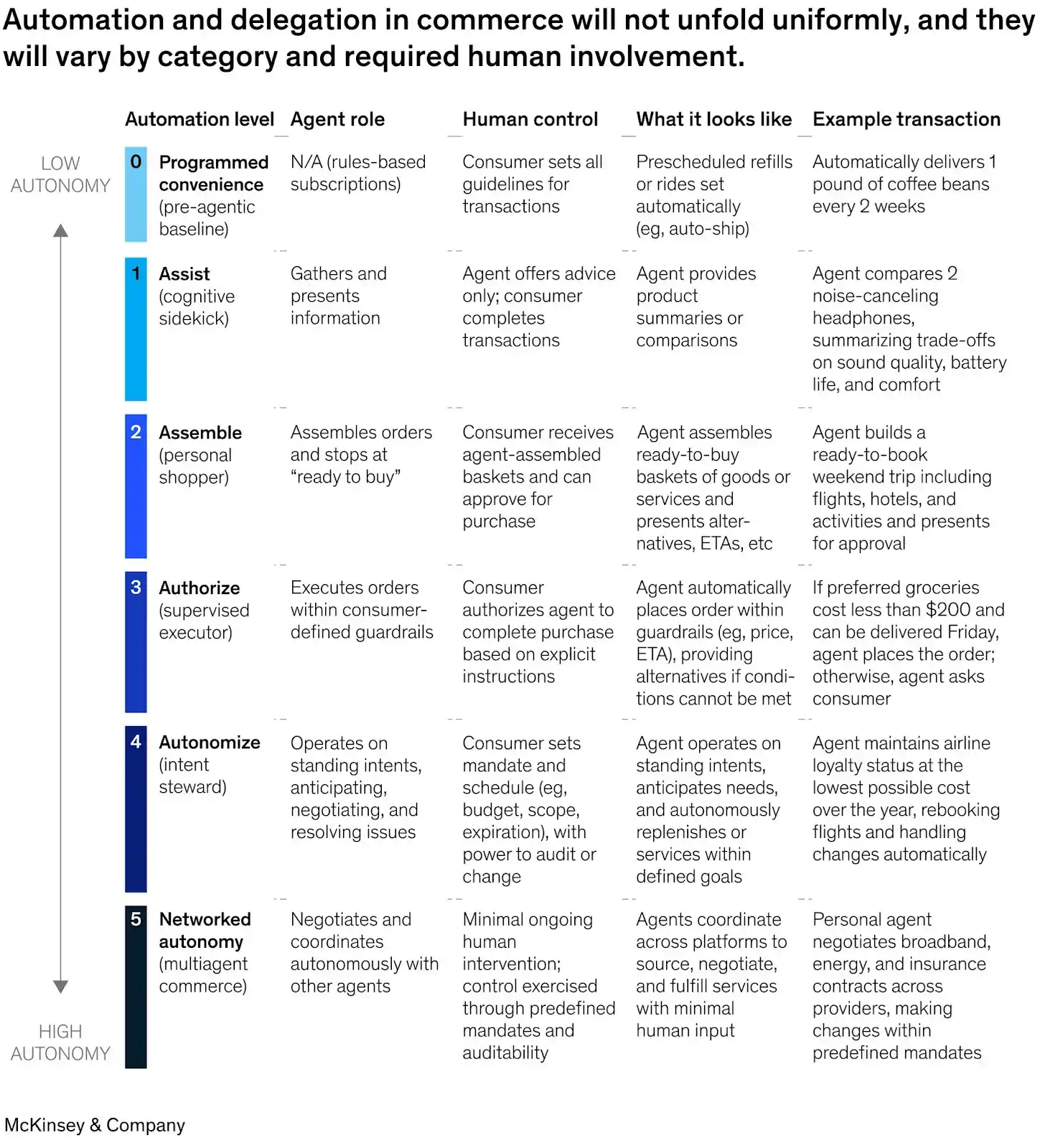
AI has no physical entity, let alone the ability to hold an ID card and queue for KYC. For them, a string of asymmetric encrypted private key is an account; a blockchain that can achieve second-level arrival, near-zero fees, and supports programmable smart contracts is the perfect清算中心.

There is a very realistic deduction in the "2028 Global Intelligence Crisis": The space for price matching and information aggregation is ultimately limited. When智能体 start trading with each other, the most direct and effective path is to eliminate various handling fees. They begin to寻找比信用卡更快、更低成本的支付方式. Most eventually choose to use stablecoins for settlement through Solana or Ethereum Layer 2 networks, where transactions are almost instant, with fees as low as a fraction of a cent.

Because of this, crypto wallets are destined to become the "native bank" of AI Agents.

This also彻底打破了外界长期以来对 Crypto 的刻板认知: issuing Token is not just for secondary market speculation and circulation. In an AI-dominated future,加密 Token and peer-to-peer payments will truly settle as the underlying financial infrastructure for high-frequency collaboration between智能体.

Justin Sun's All-in Conspiracy: Where Does the Confidence and Ambition Come From?

Justin Sun's choice to bet on Web4.0 is backed by极其缜密的商业逻辑和战略诉求.

First, Tron's "stablecoin hegemony" is the natural settlement layer for Web 4.0.
As is well known, the Tron TRON network carries the largest circulation of USDT globally. As mentioned earlier, the core of Web4.0 is payment interaction between machines and machines. AI needs a payment network that is fast, has low fees, and has enormous liquidity. Tron's USDT payment network perfectly meets the underlying financial needs of AI Agents. Justin Sun only needs to build a set of payment APIs on the Tron network for AI to seamlessly call, and he can continue to躺赚 in the Web 4.0 era.

Second,寻找“后 Web3 时代”的破局点.
Traditional Web 3.0 has entered存量博弈, lacking new破圈 stories. AI has become the most certain and largest incremental track in the world today. Justin Sun极其敏锐地意识到 that the fate of Crypto must be bound to AI. By "All in Web4.0," he can divert the AI funds and attention from the traditional tech circle back to the加密 market. Tron previously set up an AI development fund as high as 100 million US dollars, which is already a clear signal of布局 for Web 4.0.

Third,建立“去中心化网络”的闭环.
Justin Sun holds BitTorrent (decentralized storage/transmission), the Tron public chain (underlying settlement), and Huobi's massive number of加密 users. If he further integrates decentralized computing power and AI models, he has the opportunity to build a full-stack Web4.0 infrastructure that does not rely on Amazon AWS or Google Cloud.

The诡谲 of history often lies in the fact that the night watchmen of the old order are still calculating the losses of the城墙倒塌, while the barbarians of the new world have already laid the foundation on the废墟.

This transformation jointly written by AI and encryption is not yet complete, but the direction is clear. The real question is no longer whether AI will reshape business, but who can提前占据基础设施的核心位置 in this restructuring.


İlgili Sorular

QWhat is the core argument of Citrini Research's '2028 Global Intelligence Crisis' thought experiment report?

AThe report argues that AI Agents will eliminate 'friction' in human interactions, destroying old business empires built on information asymmetry and intermediary models.

QHow does Sun Yuchen view the year 2026 in relation to AI and the future?

ASun Yuchen defines 2026 as 'a time for miracles to happen' and encourages young people to 'embrace the future fully by chatting with AI instead of humans.'

QWhy does the article suggest that AI is destined to choose Crypto for settlement?

AAI lacks human identity and cannot use traditional KYC processes. Crypto offers programmable, near-instant, low-cost settlements with cross-platform reputation portability, making it ideal for AI-to-AI transactions.

QWhat are the three strategic reasons behind Sun Yuchen's all-in bet on Web4.0?

A1) Tron's 'stablecoin hegemony' provides a natural settlement layer for Web4.0; 2) AI is a massive growth sector to attract capital and attention back to crypto; 3) To build a closed-loop decentralized network integrating storage, settlement, and compute without relying on centralized cloud providers.

QWhat fundamental physical truth underlies both AI inference tokens and blockchain crypto tokens according to the article?

ABoth are digital manifestations of electricity, representing value transformed through energy consumption in chips, algorithms, and protocols.

İlgili Okumalar

South Korean Exchanges 'Battle' Regulators, Challenging the Boundaries of Enforcement and Legislation

South Korea's cryptocurrency industry is engaged in a rare, direct confrontation with regulators. The Financial Intelligence Unit (FIU), the primary anti-money laundering (AML) watchdog, has recently imposed heavy penalties on major exchanges like Upbit and Bithumb for alleged violations involving unregistered overseas VASPs and AML procedures. However, exchanges are now actively challenging these actions in court and through industry associations. In a significant shift, the Seoul Administrative Court ruled in favor of Upbit's operator, Dunamu, overturning part of an FIU-ordered business suspension. The court found the FIU's penalty criteria and justification insufficiently clear. Similarly, the court suspended the enforcement of a six-month business suspension against Bithumb pending a final ruling, citing potential irreversible harm to the exchange. Beyond legal battles, the industry is contesting proposed legislative amendments. The Digital Asset eXchange Alliance (DAXA) strongly opposes a draft rule that would mandate Suspicious Transaction Reports (STRs) for all crypto transfers over 10 million KRW (~$6,800). DAXA argues this "poison pill" clause violates legal principles and would overwhelm the STR system, increasing reports from 63,000 to an estimated 5.45 million annually for major exchanges, thereby crippling effective AML monitoring. This conflict highlights a structural tension in South Korea's crypto governance: comprehensive digital asset laws are still developing, while regulators rely heavily on AML enforcement. The industry's move from passive compliance to active legal and legislative challenges signifies a new phase, pressing for clearer rules and more proportionate enforcement. While short-term disputes may intensify, this clash could ultimately lead to a more mature and sustainable regulatory framework for South Korea's vibrant crypto market.

marsbit30 dk önce

South Korean Exchanges 'Battle' Regulators, Challenging the Boundaries of Enforcement and Legislation

marsbit30 dk önce

After 50x Storage Surge, Justin Sun Always Looks to the Next Decade

Sun Yuchen, known for his controversial stunts like a $30 million lunch with Warren Buffett (canceled due to a kidney stone) and eating a $6.2 million duct-taped banana, is often overshadowed by a significant fact: his decade-long track record of spotting major investment trends. In 2016, he famously advised young people to invest in Bitcoin, Nvidia, Tesla, and Tencent instead of buying property. A hypothetical $20,000 investment in Nvidia and Tesla from that list would now be worth over 50 million RMB. His latest major call was on November 6, 2025, predicting a "50x storage opportunity" tied to the AI boom, which materialized with Sandisk's stock surging nearly 50-fold by 2026. Looking ahead, Sun now focuses on the next frontier: Physical AI. He identifies four key areas: 1. **Embodied AI/Robotics**: He sees this reaching its "iPhone moment," with companies like UBTech and Galaxy General leading in commercialization. 2. **Drones**: Viewed as the first commercially viable form of Physical AI, revolutionizing sectors from warfare (e.g., AeroVironment's Switchblade) to logistics. 3. **Spatial Computing**: Beyond VR, it's about AI understanding physical space, a foundational technology for robotics and autonomous systems, exemplified by Apple's Vision Pro. 4. **Space Exploration**: After a 2025 suborbital flight with Blue Origin, Sun advocates for space as the ultimate frontier, discussing blockchain's potential role in space asset management and data transactions. His investment philosophy involves betting on entire, inevitable trends rather than single companies. For robotics, he sees Tesla (the body/manufacturer) and Nvidia (the brain/AI platform) as complementary plays. In defense drones, he highlights companies making tanks obsolete (AeroVironment) and those augmenting fighter jets (Kratos). For space, he participated in Blue Origin's flight and anticipates SpaceX's potential IPO to redefine the sector's valuation. Sun Yuchen's vision frames the next two decades not as a revolution in information flow (like the internet), but in the fundamental operation of the physical world through AI-powered robots, autonomous systems, and spatial intelligence, ultimately extending human and AI activity into space. While many still focus on conventional assets, he continues to look toward the next technological horizon.

marsbit1 saat önce

After 50x Storage Surge, Justin Sun Always Looks to the Next Decade

marsbit1 saat önce

The Billionaires Behind the Most Expensive Midterm Election in History

"The Most Expensive Midterm Elections and Their Billionaire Backers" This analysis details the unprecedented scale of spending in the 2026 midterm elections, highlighting the key billionaire donors shaping the political landscape. Jeff Yass, founder of Susquehanna International Group, has contributed over $81 million, ranking third among individual donors behind George Soros ($102.6M) and Elon Musk ($84.8M). Yass is a major donor to Trump's MAGA Inc. and supports school choice and various candidates. Overall, federal committees have raised over $4.7 billion this cycle, with political ad spending projected to reach $10.8 billion. Republican-aligned groups are significantly out-raising their Democratic counterparts. "Dark money" from undisclosed sources continues to grow. The core stakes involve control of Congress and policy direction for Trump's final term. Donors are also motivated by specific issues: Sergey Brin and Chris Larsen are funding opposition to a proposed California wealth tax and supporting crypto-friendly policies. Other top donors include OpenAI's Greg Brockman and his wife Anna ($50M total to MAGA Inc. and an AI-focused PAC), Richard Uihlein ($45.3M to conservative causes), venture capitalists Marc Andreessen and Ben Horowitz (each over $44M to crypto/AI PACs and MAGA Inc.), Miriam Adelson ($42.6M to GOP leadership PACs), Paul Singer ($33.9M), and Diane Hendricks ($25.8M to MAGA Inc.). The article notes that the peak fundraising period is still ahead, with major primaries approaching.

marsbit1 saat önce

The Billionaires Behind the Most Expensive Midterm Election in History

marsbit1 saat önce

The Largest IPO in History Is Approaching, Surpassing SpaceX, 28 Years of AI Self-Iteration, Countdown to Intelligence Explosion

"Anthropic Nears Trillion-Dollar IPO, Fueled by Explosive Growth and 2028 'Intelligence Explosion' Warning Anthropic is considering a deal valuing the AI company near $1 trillion, potentially leading to one of the largest IPOs ever and surpassing SpaceX. Its revenue has skyrocketed, with Annual Recurring Revenue (ARR) reaching $45 billion in May 2026—a 500% increase in just five months. This vertical growth curve is attributed to its key products, Claude Code and Cowork, dominating AI coding and enterprise collaboration. Beyond commercial success, co-founder Jack Clark issued a pivotal warning in an interview: there is a greater than 50% chance that by the end of 2028, AI systems will achieve recursive self-improvement—the ability to autonomously build a 'better version' of themselves, initiating an 'intelligence explosion.' This prophecy underpins the company's astronomical valuation, as the market prices in the potential for transformative and disruptive AI. Further signaling its ambition, Anthropic formed a $1.5 billion joint venture with Goldman Sachs and Blackstone, aiming to disrupt traditional consulting firms like McKinsey by deploying Claude AI for complex strategic work. This move tests AI's capacity to replace high-level cognitive labor, a precursor to its predicted autonomous evolution. The narrative presents a dual future: unprecedented economic opportunity alongside significant risks like economic restructuring and security threats. Anthropic's meteoric rise and Clark's 2028 prediction frame the coming years as a countdown to a potential technological singularity."

marsbit1 saat önce

The Largest IPO in History Is Approaching, Surpassing SpaceX, 28 Years of AI Self-Iteration, Countdown to Intelligence Explosion

marsbit1 saat önce

İşlemler

Spot
Futures

Popüler Makaleler

SUN Nasıl Satın Alınır

HTX.com’a hoş geldiniz! SUN (SUN) satın alma işlemlerini basit ve kullanışlı bir hâle getirdik. Adım adım açıkladığımız rehberimizi takip ederek kripto yolculuğunuza başlayın. 1. Adım: HTX Hesabınızı OluşturunHTX'te ücretsiz bir hesap açmak için e-posta adresinizi veya telefon numaranızı kullanın. Sorunsuzca kaydolun ve tüm özelliklerin kilidini açın. Hesabımı Aç2. Adım: Kripto Satın Al Bölümüne Gidin ve Ödeme Yönteminizi SeçinKredi/Banka Kartı: Visa veya Mastercard'ınızı kullanarak anında SUN (SUN) satın alın.Bakiye: Sorunsuz bir şekilde işlem yapmak için HTX hesap bakiyenizdeki fonları kullanın.Üçüncü Taraflar: Kullanımı kolaylaştırmak için Google Pay ve Apple Pay gibi popüler ödeme yöntemlerini ekledik.P2P: HTX'teki diğer kullanıcılarla doğrudan işlem yapın.Borsa Dışı (OTC): Yatırımcılar için kişiye özel hizmetler ve rekabetçi döviz kurları sunuyoruz.3. Adım: SUN (SUN) Varlıklarınızı SaklayınSUN (SUN) satın aldıktan sonra HTX hesabınızda saklayın. Alternatif olarak, blok zinciri transferi yoluyla başka bir yere gönderebilir veya diğer kripto para birimlerini takas etmek için kullanabilirsiniz.4. Adım: SUN (SUN) Varlıklarınızla İşlem YapınHTX'in spot piyasasında SUN (SUN) ile kolayca işlemler yapın.Hesabınıza erişin, işlem çiftinizi seçin, işlemlerinizi gerçekleştirin ve gerçek zamanlı olarak izleyin. Hem yeni başlayanlar hem de deneyimli yatırımcılar için kullanıcı dostu bir deneyim sunuyoruz.

596 Toplam GörüntülenmeYayınlanma 2024.12.12Güncellenme 2025.03.21

SUN Nasıl Satın Alınır

Tartışmalar

HTX Topluluğuna hoş geldiniz. Burada, en son platform gelişmeleri hakkında bilgi sahibi olabilir ve profesyonel piyasa görüşlerine erişebilirsiniz. Kullanıcıların SUN (SUN) fiyatı hakkındaki görüşleri aşağıda sunulmaktadır.

活动图片












