Wall Street Capital Enters ARC, Circle Sparks a System-Level Competition for Stablecoins

marsbit2026-05-13 tarihinde yayınlandı2026-05-13 tarihinde güncellendi

Özet

Wall Street Capital Enters the ARC Arena as Circle Launches a System-Level Battle for Stablecoin Dominance On May 11, Circle successfully raised $222 million in a pre-sale funding round for its new blockchain and native token, ARC, giving the network a fully diluted valuation of $3 billion. The investor lineup, featuring Wall Street giants like BlackRock and Intercontinental Exchange alongside top-tier venture capital firms such as a16z and ARK Invest, signaled a collective strategic bet on future financial infrastructure. This move marks Circle's significant evolution from a stablecoin issuer (notably USDC) to a designer of financial systems. While USDC operates on external blockchains like Ethereum, making Circle dependent on their performance, ARC aims to create a dedicated infrastructure for the circulation, payment, and clearing of stablecoins. This would integrate currency issuance and circulation into one system, potentially shifting Circle's business model from asset management to infrastructure provision. The convergence of traditional finance and crypto-native capital in this funding round underscores a broader industry shift: stablecoins are transitioning from being mere trading tools to becoming core components of financial infrastructure. By controlling both the issuance (via USDC) and the流通 pathway (via ARC), Circle could establish a closed-loop system from issuance to settlement. If successful, this infrastructure could optimize costs, lower barriers for in...

Author: Winnie, CryptoPulse Labs

On May 11, Circle successfully raised $222 million in a pre-sale funding round for its new blockchain and native token ARC. Following the completion of the funding, the fully diluted valuation of the ARC network reached $3 billion.

While this figure itself is not staggering, what truly captured market attention was the investor lineup behind it. From the world's top venture capital firm a16z to Wall Street giants like BlackRock and Intercontinental Exchange, and further to crypto and tech capital like ARK Invest and General Catalyst, the consortium nearly covers key institutions across the global financial system.

This makes ARC more than just a blockchain project funding event; it resembles a collective bet on the future financial infrastructure. It also marks a new stage where the stablecoin industry is shifting from product competition to system competition.

I. Circle's Transformation: From Stablecoin Issuer to Financial System Architect

Looking back at Circle's development path, its core identity has long been very clear: it is a stablecoin issuing company, with USDC as its flagship product.
The logic of USDC is not complicated. Its core is to establish a credible digital dollar, providing a relatively stable medium of exchange in the crypto market through transparent reserves, a compliant structure, and a USD peg mechanism.

At this stage, Circle functioned more like an on-chain bank, responsible for issuing, custody, and maintaining user trust in the digital dollar.

However, the problem lies in the fact that this model is inherently dependent. Although USDC is important, it operates on external public chains like Ethereum and Solana. The performance, cost, and congestion of these chains directly impact the user experience of USDC. In other words, Circle controls the issuance of money but not the system through which it circulates.

The emergence of ARC is precisely a response to this structural problem.

From its design logic, ARC is not intended to become another general-purpose public chain, but rather a highly verticalized on-chain infrastructure. Its core objective is to specifically serve the circulation, payment, and settlement system for stablecoins.

In other words, if USDC is the digital dollar, then ARC aims to build the financial highway on which that digital dollar runs. In this system, a stablecoin is no longer just an asset flowing on a chain. It is integrated into a unified settlement network, forming a complete closed loop from issuance to transfer to settlement.

The key significance of this design is that, for the first time, Circle is attempting to integrate currency issuance and currency circulation within the same system, thereby breaking free from dependence on external public chains. At a deeper level, this transformation is essentially a restructuring of the business model.

In the past, Circle relied primarily on interest income from reserve assets, essentially operating as an asset management-style stablecoin company. If ARC successfully operates, it will have the opportunity to shift towards an infrastructure fee model, similar to a payment network or settlement system provider.

This suggests that Circle's role may evolve from issuing dollars to defining how dollars flow in the digital world. The significance of this change is not merely a product upgrade but a leap from the application layer to the protocol layer.

II. Top Investors Gather: A Mutual Embrace of Traditional Finance and Crypto Capital

The primary reason this funding round for ARC garnered widespread attention is not the amount raised, but the signal conveyed by the investor structure itself.

Leading this round is the renowned venture capital firm Andreessen Horowitz (a16z). Its $75 million investment not only provides financial support but, more importantly, confirms ARC's positioning as Web3 infrastructure.

In a16z's investment logic, ARC is clearly not an ordinary application project but appears more like a component of the future internet financial system.

However, what truly shocked the market was the collective entry of traditional financial institutions. Traditional financial giants, including BlackRock, Intercontinental Exchange (parent company of the NYSE), Apollo Funds, Standard Chartered Ventures, SBI Group, and Janus Henderson Investors, participated in various forms.

The commonality among these institutions is very clear: they essentially control or are deeply involved in the global flow of funds and settlement systems.

Simultaneously, crypto-native capital also participated, including institutions like ARK Invest, General Catalyst, Haun Ventures, and Bullish. This structure is quite rare because it signifies that two financial systems, long separate in the past, are reaching a consensus around a single infrastructure project.

If the logic of crypto investment over the past decade has been to find high-growth assets, then this round of funding for ARC is more like searching for the gateway to the future financial system.

Venture capital is betting on technological evolution, Wall Street is betting on settlement efficiency, crypto capital is betting on ecosystem dominance, and Circle happens to stand at the intersection of these three forces.

This kind of simultaneous betting by multiple parties is uncommon in financial history. It resembles more of a system-level alignment in advance: the future of finance may no longer be a fragmented system but may gradually converge towards a unified on-chain settlement layer.

III. From Trading Tool to Financial Infrastructure Reconstruction: Stablecoins Enter a New Era of Infrastructure

ARC's current fully diluted valuation of $3 billion, viewed in isolation, is just a funding figure. But placed within the industry structure, it actually represents a deeper shift: stablecoins are evolving from trading tools into the core layer of financial infrastructure.

In the past, discussions about blockchain focused more on public chain performance, DeFi ecosystems, or exchange liquidity. However, as stablecoins gradually become the unit of account for the on-chain economy, the entire competitive logic is changing.
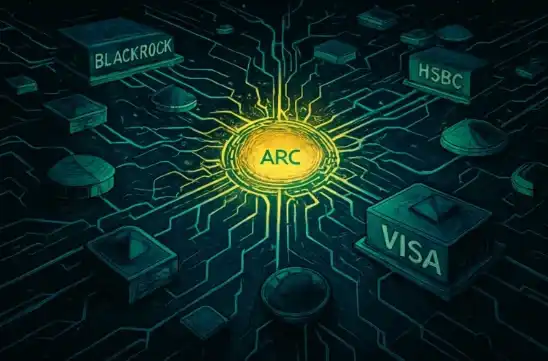
Whoever controls the circulation path of stablecoins holds the key gateway to on-chain finance.

Against this backdrop, Circle's strategy becomes very clear. First, solve the trust problem with USDC; then, solve the circulation problem with ARC; finally, form a complete closed-loop system from issuance to settlement.

If this structure is established, then Circle will no longer be just a stablecoin company but may evolve into an infrastructure operator for the on-chain financial system.

In terms of industry impact, this model could bring about changes at three levels. First, cost structure optimization: cross-chain transfers and settlement of stablecoins will be processed within a unified system, significantly reducing transaction costs and friction. Second, lower barriers for institutional access: banks, funds, and payment companies can directly connect to a unified on-chain system without needing to adapt to multi-chain ecosystems. Third, a strengthening trend of financial standardization: on-chain finance may gradually form foundational standards similar to internet protocol layers, and ARC has the opportunity to become one of the core participants.

More importantly, once such infrastructure is proven successful, its impact will no longer be confined to the crypto industry but may gradually touch the core links of traditional finance, especially cross-border payment and settlement systems.

The existing SWIFT system has operated for decades. If the on-chain stablecoin system establishes advantages in efficiency and cost, then the reconstruction of financial infrastructure is no longer a theoretical question but a matter of time.

Conclusion

The $222 million funding event for ARC is, in essence, not just a simple project funding story but a staged signal of financial system evolution.

When capital from different systems like BlackRock, Intercontinental Exchange, and ARK Invest simultaneously bets on the same chain, it indicates that the market has already begun to acknowledge a trend: stablecoins are no longer just trading tools but are becoming one of the candidate standards for global financial infrastructure.

What's truly worth watching is not how high ARC's valuation can go, but whether it will become one of the default paths for future global capital flow. And if this trend holds true, then today's $222 million may be just a small step in the prologue of the entire financial system's reconstruction.


İlgili Sorular

QWhat is the key strategic shift that Circle's launch of the ARC network represents, according to the article?

AThe launch of ARC represents Circle's strategic shift from being solely a stablecoin issuer (of USDC) to becoming a financial system designer. It marks a transition from an application layer company dependent on external public chains to a protocol layer infrastructure provider, aiming to integrate currency issuance and circulation into one unified, closed-loop system.

QWhy does the article consider the ARC funding round significant beyond the $222 million amount raised?

AThe significance lies in the composition of the investor consortium. It includes a rare convergence of top traditional financial giants (like BlackRock, Intercontinental Exchange), elite venture capital (a16z), and major crypto-native funds (ARK Invest, General Catalyst). This signals a collective bet by key players from different financial spheres on a shared future financial infrastructure, indicating a system-level alignment.

QHow does the ARC network aim to change the fundamental business model of Circle, as described in the article?

AARC aims to shift Circle's business model from reliance on interest income from reserve assets (an asset management model) to an infrastructure fee model. By controlling the dedicated network for stablecoin flow and settlement, Circle could become a payment network or clearing system provider, generating revenue from infrastructure usage.

QWhat are the three potential industry-wide impacts the article suggests ARC's model could bring about?

A1. Cost structure optimization: Lowering transaction costs and friction by unifying cross-chain transfers and settlements within one system. 2. Lowering institutional access barriers: Banks and payment companies could directly connect to a single on-chain system instead of adapting to multiple chains. 3. Strengthening financial standardization: Potentially establishing core foundational standards for on-chain finance, similar to internet protocols, with ARC as a key participant.

QWhat broader historical financial system does the article suggest ARC and stablecoins could potentially challenge or impact in the long term?

AThe article suggests that if successful and efficient, the on-chain stablecoin system, with infrastructures like ARC, could potentially challenge or impact the core of traditional cross-border payment and settlement systems, specifically referencing the decades-old SWIFT (Society for Worldwide Interbank Financial Telecommunication) system.

İlgili Okumalar

Agent Race Ends, Super Workbench Takes Over

The era of fragmented AI agents is ending. Over the past month, China's tech giants—Tencent, Alibaba, and ByteDance—have simultaneously shifted strategy: instead of launching new, standalone AI agents, they are consolidating their various agent projects into unified "super workbenches." Tencent integrated its QClaw teams into WorkBuddy, a strategic product hailed as a potential third flagship after QQ and WeChat. Alibaba is merging its QoderWork, Wukong, and MuleRun agents into a new "Qianwen Office" platform under DingTalk's leadership. ByteDance rebranded its TRAE SOLO coding agent to TRAE Work, signaling a broader focus on workflow collaboration. This convergence marks a pivotal industry consensus. The initial exploration phase, where companies rapidly built numerous overlapping agents for different scenarios, proved costly and inefficient. With open-source tools eroding technical barriers, competition has shifted from agent creation to resource consolidation and cost control. Historically, platform wars are won not by creating more products, but by simplifying them—as seen with browsers unifying web access and super-apps consolidating services. Now, the "super workbench" aims to become the unified AI entry point for work. This reflects a deeper market realization: the primary audience for AI is no longer just programmers (a market in the tens of millions) but all knowledge workers (a market of billions). The real opportunity lies in augmenting everyday tasks—managing emails, documents, data, and meetings—across the entire workday. The core battleground is becoming control over the primary AI entry point that employees use daily. Tencent's WorkBuddy leverages WeChat and Tencent Docs; Alibaba's Qianwen Office taps into DingTalk's organizational data; ByteDance's TRAE Work integrates with Feishu's workflows. Whoever owns this "super workbench" gains strategic control over orchestrating enterprise data and APIs. This shift is redefining enterprise software. Traditional SaaS applications, valued for their user interfaces, will recede into the background. Their core functionalities will be exposed as standardized "Skills" or APIs for the super workbench's agents to invoke. Software value will shift from selling user seats to charging based on API calls and outcomes delivered. The evolution of agents is moving through clear stages: first as novel standalone products, then as consolidated primary work entry points, and finally as pervasive, invisible capabilities embedded into the digital fabric. The recent moves by major tech firms signal the transition from the first stage into the second, accelerating toward the third. In the end, the most successful agent technology may become invisible—like electricity or the HTTP protocol—a fundamental, unnamed infrastructure powering work itself.

marsbit2 dk önce

Agent Race Ends, Super Workbench Takes Over

marsbit2 dk önce

Michael Saylor: 110 Reasons to Oppose BIP-110

Michael Saylor presents 110 arguments against Bitcoin Improvement Proposal (BIP) 110, a soft fork aimed at restricting certain non-monetary data storage uses (like inscriptions) on the Bitcoin blockchain. He acknowledges the proponents' valid concerns—such as node costs, fee pressure, and preserving Bitcoin's monetary focus—but fundamentally disagrees with the proposed solution. Saylor argues that BIP 110 represents a dangerous precedent of using consensus rules to enforce value judgments on transaction validity, moving away from Bitcoin's core principles of neutrality and permissionless innovation. His key objections are organized into eleven categories: 1) It violates neutrality and hard consensus by banning currently valid transactions. 2) It fails to meet the high burden of proof required for a consensus change, lacking concrete data on the alleged crisis. 3) Its seven bundled technical restrictions are overly broad, targeting generic script functionalities and blocking future upgrade paths. 4) It sacrifices compatibility and future optionality by closing off designed upgrade hooks. 5) Its temporary rules add significant complexity (grandfathering, expiry states) without sufficient justification. 6) The economic and security impacts, particularly on miner revenue and fee markets, are uncertain and unmodeled. 7) Superior, market-based tools (fee markets, relay/mining policies) already exist to manage blockchain load. 8) It stifles innovation by creating a chilling effect for developers. 9) Its modified activation mechanism (55% threshold, forced signaling) is aggressive and risks network splits. 10) The precedent it sets—using consensus to suppress disliked but legal uses—is more dangerous than the problem it aims to solve. 11) A better path exists: improving measurements, refining resource-based policies, and allowing market forces to work. Saylor concludes that Bitcoin's strength lies in its neutral rules, open markets, and hard consensus. Changing these foundational elements to target specific use cases is an unnecessary and risky "iatrogenic" intervention. He advocates for guarding Bitcoin's neutrality rather than acting as its redeemer.

marsbit18 dk önce

Michael Saylor: 110 Reasons to Oppose BIP-110

marsbit18 dk önce

İşlemler

Spot
活动图片

