Valentine’s Day Crypto Warning: US Attorney Issues Crypto-Fueled Romance Scam Alert

ccn.com2026-02-14 tarihinde yayınlandı2026-02-14 tarihinde güncellendi

Özet

The US Department of Justice has issued a Valentine’s Day warning about cryptocurrency-fueled romance scams. Fraudsters typically approach victims on dating sites or social media, using fake profiles and stolen photos to build emotional trust over weeks or months. They then fabricate emergencies and request payments in crypto, gift cards, or wire transfers—methods that are difficult to reverse. Recent cases include a Colorado man who lost $1.4 million after meeting a woman on a dating app who persuaded him to invest in crypto. According to Chainalysis, crypto scams received at least $14 billion in 2025, with impersonation scams surging by 1,400% compared to the previous year. Authorities advise conducting reverse image searches, consulting trusted friends before sending money, and reporting suspicious activity to the FBI.

Key Takeaways

  • The Department of Justice has issued a crypto warning as Valentine’s Day hits.
  • Real-world losses are escalating.
  • Crypto scam activity surged in 2025.

U.S. federal prosecutors are warning Americans not to let Valentine’s Day turn into a costly heartbreak, as romance scammers increasingly demand payment in cryptocurrency.

The U.S. Attorney’s Office for the Northern District of Ohio on Thursday urged the public to remain vigilant against online crypto romance scams that exploit victims’ trust and emotions.

Try Our Recommended Crypto Exchanges
Sponsored
Disclosure
We sometimes use affiliate links in our content, when clicking on those we might receive a commission at no extra cost to you. By using this website you agree to our terms and conditions and privacy policy.
"}' data-trk="6970dbafcbd599f15ce64045" href="https://links.ccn.com/links?code=6985b71f73f50d4865cba0f2" rel="nofollow" target="_blank">
ChangeNow<\/h3>"}' data-trk="6970dbafcbd599f15ce64045" href="https://links.ccn.com/links?code=6985b71f73f50d4865cba0f2" rel="nofollow" target="_blank">

ChangeNow

promotions
Receive 0.4% of the volume from each transaction with your referral link.<\/strong>"}' data-trk="6970dbafcbd599f15ce64045" href="https://links.ccn.com/links?code=6985b71f73f50d4865cba0f2" rel="nofollow" target="_blank"> Receive 0.4% of the volume from each transaction with your referral link.
Coins
217
Claim Offer
"}' data-trk="6899b9831836d97539c51aa6" href="https://links.ccn.com/links?code=693293fa4a5bcb6231949c97" rel="nofollow" target="_blank">
Bitunix<\/h3>"}' data-trk="6899b9831836d97539c51aa6" href="https://links.ccn.com/links?code=693293fa4a5bcb6231949c97" rel="nofollow" target="_blank">

Bitunix

promotions
Receive up to $100,000 worth of exclusive gifts for newcomers upon registration.<\/strong>"}' data-trk="6899b9831836d97539c51aa6" href="https://links.ccn.com/links?code=693293fa4a5bcb6231949c97" rel="nofollow" target="_blank"> Receive up to $100,000 worth of exclusive gifts for newcomers upon registration.
Coins
151
Claim Offer
"}' data-trk="67adf8d4f12aaec7e4808bf5" href="https://links.ccn.com/links?code=693291aa4a5bcb62319448b2" rel="nofollow" target="_blank">
Bitget<\/h3>"}' data-trk="67adf8d4f12aaec7e4808bf5" href="https://links.ccn.com/links?code=693291aa4a5bcb62319448b2" rel="nofollow" target="_blank">

Bitget

promotions
New user rewards up to 6,200 USDT.<\/strong>"}' data-trk="67adf8d4f12aaec7e4808bf5" href="https://links.ccn.com/links?code=693291aa4a5bcb62319448b2" rel="nofollow" target="_blank"> New user rewards up to 6,200 USDT.
Coins
89
Claim Offer
Explore All Offers

DOJ Flags Valentine’s Day Crypto Warning

Federal prosecutors said fraudsters typically approach victims on dating websites, social media platforms, and messaging apps, posing as romantic partners.

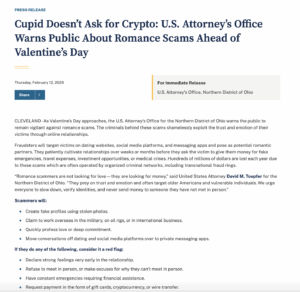
In a stark warning , titled “Cupid Doesn’t Ask for Crypto,” the DOJ explained how bad actors cultivate relationships over weeks or months before fabricating emergencies, travel needs, or medical crises.

Among the clearest warning signs, according to the Justice Department, are requests for payment in crypto, gift cards, or wire transfers, methods favored by scammers because they are hard to reverse.

The office said scammers frequently create fake profiles using stolen photos, claim to work overseas in the military or international business, and profess deep affection quickly.

The DOJ has issued a Valentine’s Day warning about crypto. | Source: DOJ

They often move conversations off mainstream dating platforms to private messaging apps and avoid meeting in person.

“Romance scammers are not looking for love — they are looking for money,” said U.S. Attorney David M. Toepfer for the Northern District of Ohio.

Adding: “They prey on trust and emotion and often target older Americans and vulnerable individuals. We urge everyone to slow down, verify identities, and never send money to someone they have not met in person.”

Regional Cases Underscore Growing Threat

Victims are advised to conduct reverse image searches of profile photos, consult trusted friends before sending funds, and report suspicious activity to the FBI’s Internet Crime Complaint Center (IC3).

In the report, authorities cited recent regional cases, including a Ghanaian national charged in an alleged scheme that took more than $8 million from elderly victims.

Last September, a Colorado man was also reported to have lost $1.4 million after falling victim to a crypto-linked romance scam.

The man, who first spoke to 9News , said he met a woman on Ashley Madison, a website marketed to married people seeking affairs.

After weeks of video chatting and exchanging photos, their conversations shifted to the woman’s interest in crypto and her view of it as a good opportunity for him.

Over roughly six weeks, the man said he made four separate cryptocurrency transfers, ultimately losing $1.4 million in retirement funds and life savings.

Crypto Scams Surge in 2025

The warning comes amid a broader surge in cryptocurrency-related fraud.

Blockchain analytics firm Chainalysis said in its 2026 report that crypto scams received at least $14 billion in on-chain funds last year, up sharply from initial 2024 estimates of $9.9 billion.

Based on historical trends, the firm projected that the 2025 total could exceed $17 billion as more illicit wallets are identified.

The average scam payment rose to $2,764 in 2025 from $782 in 2024, a 253% year-on-year increase, according to Chainalysis.

Impersonation scams, also known as Pig Butchering scams, recorded a 1,400% surge in inflows compared with the previous year.

Top Trending Crypto Articles
  • Best Exchanges Check Out Our Recommended Exchanges Here
  • Buy Crypto Fast How To Buy Crypto with a Credit Card Now
  • Safe Crypto Gambling See Our Picks for the Best Crypto Gambling Sites

İlgili Sorular

QWhat is the main warning issued by the U.S. Department of Justice regarding Valentine's Day?

AThe U.S. Department of Justice has issued a warning about romance scammers who increasingly demand payment in cryptocurrency, urging the public to remain vigilant against online crypto romance scams that exploit victims' trust and emotions.

QWhat are some of the red flags mentioned by the DOJ to identify crypto romance scams?

ARed flags include requests for payment in cryptocurrency, gift cards, or wire transfers; scammers creating fake profiles using stolen photos; claiming to work overseas in the military or international business; professing deep affection quickly; and moving conversations off mainstream platforms to private messaging apps while avoiding in-person meetings.

QHow much did crypto scams receive in on-chain funds in 2025 according to Chainalysis?

AAccording to Chainalysis, crypto scams received at least $14 billion in on-chain funds in 2025, with projections that the total could exceed $17 billion as more illicit wallets are identified.

QWhat was the average scam payment in 2025 compared to 2024?

AThe average scam payment rose to $2,764 in 2025, which is a 253% increase from the $782 average in 2024.

QWhat advice does the DOJ give to avoid falling victim to these scams?

AThe DOJ advises victims to conduct reverse image searches of profile photos, consult trusted friends before sending funds, and report suspicious activity to the FBI’s Internet Crime Complaint Center (IC3). They also emphasize never sending money to someone they have not met in person.

İlgili Okumalar

Has the 'Digital Gold' Narrative for BTC Failed?

**Title: Has the "Digital Gold" Narrative for Bitcoin Failed?** The article argues that Bitcoin's "digital gold" narrative remains valid despite a recent sharp price decline (from a peak near $126k in Oct 2025 to briefly under $61k in Feb 2026). It presents a long-term investment framework based on three core points: **1. Viewing Bitcoin as an Asset:** Bitcoin is presented as a superior potential store of value compared to gold. Key arguments are its absolute scarcity (21 million cap), superior portability, and transparent auditability via its public ledger. While acknowledging its current use in early, volatile stages (~3-4% global adoption), the author draws parallels to the early, disruptive phases of the internet and e-commerce. **2. Understanding the Recent Downturn:** The current ~50% correction is framed as a predictable, consensus-driven cycle following its post-halving peak (the 2024 halving preceded the Oct 2025 high). A crucial factor is a historic "changing of hands": the influx of new institutional buyers via ETFs allowed early, low-cost holders (miners, OG believers) to take profits. The author notes that while severe, Bitcoin's historical drawdowns (e.g., 93% in 2011, 77% in 2021-22) have been progressively smaller, suggesting maturing holder structure and decreasing volatility over time. **3. The Long-Term Perspective:** The long-term thesis hinges on Bitcoin capturing a portion of gold's market value. With Bitcoin's market cap at ~$1.4 trillion (at $70k) versus gold's ~$20 trillion, significant upside potential exists if the "digital gold" narrative is partially realized. However, the author strongly cautions that short-term risks remain, the bottom is unpredictable, and high volatility is inherent. The real risk is not Bitcoin failing but poor personal position management (over-leverage, wrong capital) and a lack of deep understanding, which can force investors out during severe downturns. The conclusion uses Amazon's 95% crash post-2000 dot-com bubble and subsequent 42x recovery as an analogy. The ultimate question is not if Bitcoin's price will rise, but if an investor's strategy and conviction can withstand the volatility to see the long-term play out. The recent divergence (gold up, Bitcoin down) is posed not as a narrative failure, but as potential evidence of this ongoing, painful transition from a speculative asset to a mainstream allocation.

marsbit7 saat önce

Has the 'Digital Gold' Narrative for BTC Failed?

marsbit7 saat önce

Has BTC's 'Digital Gold' Narrative Failed?

The article discusses Bitcoin's "digital gold" narrative, its recent price drop, and long-term outlook through the perspective of "Jason". It argues the narrative is not a failure but that Bitcoin represents a superior, new asset class due to its fixed supply (21 million), portability, and auditability. The piece compares its current ~3-4% global adoption rate to early internet/e-commerce, suggesting significant growth potential. Regarding the 2025-2026 price decline (from ~$126k to briefly under $61k), the author views it as a predictable, consensus-driven sell-off within Bitcoin's ~4-year cycle post-halving, exacerbated by a major "handover" from early, low-cost holders to new institutional buyers via ETFs. A key observation is that historical peak-to-trough drawdowns have lessened over time (e.g., 93% in 2011 to ~50% in 2026), indicating maturing volatility as holder structure changes. For the long term, the author uses a simple framework: Bitcoin's total market cap (~$1.4T at $70k) is only about 7% of gold's (~$20T). Even capturing 30-50% of gold's value would imply substantial upside. However, the article strongly cautions against viewing this as investment advice, emphasizing extreme volatility and the critical importance of risk management, position sizing, and deep fundamental understanding to survive severe drawdowns. It concludes by drawing a parallel to Amazon's 95% crash in 2000 and subsequent 42x recovery, stressing that the key is surviving market cycles to realize long-term potential.

链捕手7 saat önce

Has BTC's 'Digital Gold' Narrative Failed?

链捕手7 saat önce

From Code to Cognition: A Ten-Thousand-Word Guide to the Evolution of the Robot Brain

"From Code to Cognition: The Evolution of Robot Brains" The journey of robotic intelligence has shifted dramatically from manually coded systems to AI-driven brains. For decades, robots relied on layered software stacks—perception, state estimation, planning, control—each handcrafted. While predictable, they lacked adaptability. The 2010s saw deep learning revolutionize perception (e.g., object detection) and control (via reinforcement learning), but learned skills remained narrow. The arrival of Large Language Models (LLMs) marked a turning point. LLMs acted as high-level planners, interpreting natural language instructions and generating sequences of actions for traditional robotic systems to execute. However, true integration came with Visual-Language-Action (VLA) models, which fused vision, language, and motion prediction into a single network. Pioneered by models like RT-2 and open-source projects like OpenVLA, VLAs enable robots to reason and act directly from visual input and commands. The most advanced humanoid robots now employ a "dual-brain" architecture: a slow-thinking, large VLA (System 2) for reasoning and planning, and a fast-reacting, small network (System 1) for high-frequency motion control, sometimes with an even lower-level System 0 for balance. This split balances cognition with the physics of real-time movement. Computation is split between onboard hardware (e.g., NVIDIA Jetson) for safety-critical control loops and cloud/edge servers for non-critical tasks like learning and interfaces. A crucial driver is the open-source ecosystem—models like GR00T and OpenVLA allow startups to build upon pre-trained brains and fine-tune them with their own data, accelerating development. Despite progress, current systems struggle with recovery from errors, sample inefficiency, and long-horizon tasks. This has spurred the rise of **World Models**—neural networks that predict the consequences of actions. By simulating possible futures before acting (like NVIDIA Cosmos or Meta V-JEPA), robots can plan, recover, and generalize better. This represents the next frontier: shifting intelligence from learned reactions to an internal model of physics and cause-and-effect. The field is rapidly evolving. While not yet at its "ChatGPT moment," the convergence of cheaper hardware, scalable simulation, and world models points toward robots that are increasingly capable, adaptive, and useful. The question is shifting from "what can robots do?" to "what *should* they do?"


marsbit7 saat önce

From Code to Cognition: A Ten-Thousand-Word Guide to the Evolution of the Robot Brain

marsbit7 saat önce

İşlemler

Spot
Futures
活动图片